

Nade Biotech Secures Millions in Angel Funding to Lead Nucleic Acid POCT Innovation
VCBeat (WeChat ID: vcbeat) has learned that Qingdao Naide Biotechnology Co., Ltd. (hereinafter referred to as “Naide Biotech”) recently announced the completion of an angel financing round amounting to several million RMB, with Milestone Venture Capital as the investor. The funds will be utilized for the research and development of new products based on its proprietary next-generation SEA technology for rapid nucleic acid detection, brand promotion, and laboratory construction.
Naidi Biotech, established in August 2016, is an emerging enterprise dedicated to the research and development as well as industrialization of novel technologies for nucleic acid point-of-care testing (POCT). With the mission of “making nucleic acid testing simpler,” the company develops simplified and visualized nucleic acid detection technologies, providing customers with a robust platform for rapid nucleic acid testing.

Naidi Biotech is committed to providing customers with complete products and rapid nucleic acid testing solutions, covering nucleic acid extraction, rapid isothermal amplification, and fluorescence and colorimetric result interpretation. Within less than a year of its establishment, the company successfully listed on the New Fourth Board and received honors such as “Leading Enterprise in Technological Innovation.”
Regarding the reasons behind securing financing from Milestone Venture Capital, Professor Shi Chao, Founder and Chief Scientist of Naide Bio, told VCBeat that it was primarily due to the “three trump cards” in hand.
Ace #1: Superior Technical Expertise
Currently, in the field of nucleic acid testing both domestically and internationally, the most commonly used method remains traditional PCR. However, PCR requires repeated heating and cooling cycles, relies on specialized instruments and trained personnel, and often takes more than 2 hours to complete. These limitations restrict PCR technology to professional laboratory settings, making it unsuitable for point-of-care testing (POCT) applications.
In recent years, simple and efficient isothermal nucleic acid amplification technologies have gradually emerged, such as Japan’s LAMP technology, the UK’s RPA technology, and the US’s HDA technology, changing this situation. However, the majority of these technologies are predominantly controlled by foreign entities.
Furthermore, RNA targets have become a focal point of development in the international field of molecular diagnostics. However, all current technologies for detecting RNA targets require a reverse transcription step, which significantly constrains the application of molecular diagnostics in the point-of-care testing (POCT) sector.
“Our SEA technology, independently developed based on over a decade of accumulated research findings, is designed to meet the demands of POCT by providing a simple and rapid nucleic acid testing solution, thereby establishing an internationally leading technology platform under our independent control.”“Speaking of his original intention for starting a business, Shi Chao said this.”
VCBeat has learned that Strand Exchange Amplification (SEA), an isothermal nucleic acid detection technology, was developed by Professor Shi’s research team. This innovation builds upon their groundbreaking discovery that certain DNA polymerases possess reverse transcriptase activity. The SEA technique leverages the “breathing” dynamics of double-stranded DNA to form single-stranded denaturation bubbles. Primers then invade and bind to these regions, and under the action of the polymerase, displace the original complementary strands, thereby achieving exponential amplification of the target.
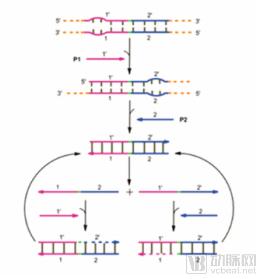
The SEA technology system is remarkably simple, requiring only a pair of standard primers and one type of polymerase. Its greatest advantage lies in its ability to achieve simultaneous one-step detection of DNA and RNA, representing an international first. In contrast, traditional RNA amplification detection involves two separate steps: reverse transcription and amplification. The one-step detection method significantly shortens reaction time, reduces experimental costs, and facilitates the monitoring of treatment efficacy.
Another advantage of SEA technology is its ability to achieve isothermal amplification without relying on complex thermal cycling instruments. Nucleic acid amplification can be performed in a simple constant-temperature environment, such as a water bath or metal bath, thereby challenging the conventional belief that nucleic acid amplification must depend on sophisticated and complex instrumentation.
The third advantage of SEA technology is rapid result interpretation. Amplification results can be read either by fluorescence detection or with the naked eye, allowing for easy and straightforward interpretation. This feature also ensures that SEA technology can perform result reading in relatively simple laboratory settings.
SEA technology is specifically developed to meet the demand for rapid nucleic acid testing. It integrates three innovative advancements: RNA/DNA targeting, isothermal amplification, and rapid detection. Characterized by simplicity, speed, cost-effectiveness, high specificity, high sensitivity, and strong scalability, SEA technology is particularly well-suited for integration with microfluidics. It holds broad application prospects in fields such as healthcare, food safety, inspection and quarantine, environmental monitoring, and animal disease control.
Ace #2: A Professional Team
Naidi Bio’s team possesses extensive experience in the field of nucleic acid testing. Team members hail from prestigious Chinese universities and research institutes, as well as international institutions such as the University of Texas at El Paso in the United States and the University of Hohenheim in Germany. The majority hold master’s or doctoral degrees.
A team of ten like-minded, optimistic individuals has come together for a shared original aspiration. “On the entrepreneurial journey, no single person can achieve perfection, but ten people united can create miracles.”

Ace #3: Customer Recognition
After more than a year of market promotion, Naide Biotechnology has achieved modest success in applying SEA technology to food safety, animal disease control and prevention, and medical POCT, earning widespread recognition from customers.
More than 20 rapid test kits for the detection of pathogenic microorganisms and foodborne hazards have been launched, serving over 30 clients. These kits have demonstrated significant advantages in comparative testing against well-known international brands, earning a strong reputation for their simplicity, accuracy, and cost-effectiveness.
Thanks to its robust technology, excellent team, and customer recognition, Naide Biology has successfully secured financing.
Milestone Ventures, an investor in this funding round, stated that Naide Biotechnology’s technological advantages alone are sufficient to position it as a leader in the POCT field. Amid the continuous rise of domestically produced reagents, the substitution of imports with domestic alternatives is set to create a significant impact in the POCT sector. The promotion of SEA technology will bring both substantial opportunities and challenges. Milestone Ventures also committed to providing Naide Biotechnology with first-hand insights on the latest market trends and marketing strategies to accelerate its growth, asserting that “one day, you will come to know Qingdao through SEA.”
However, Professor Shi Chao stated that securing angel-round financing is merely the first step in Naide Biotech’s rise. The company will leverage this support to accelerate product R&D and uphold integrity in its operations, staying true to its original mission while meeting the expectations of Milestone Venture Capital.
Looking ahead, Naide Biotechnology will continue to strengthen its efforts in animal disease control and medical POCT, gradually expanding its product portfolio. The company aims not only to provide simple and rapid nucleic acid testing solutions to society and strive to become a leading player in China’s POCT sector, but also to offer customized products and services tailored to customer needs. In the long term, it plans to build a “SEA+ Microfluidics” ecosystem, extending the benefits of SEA technology to the general public, gradually enabling at-home self-testing for diseases, and safeguarding the health of the entire population.