

Akon Health Files IPO Prospectus: Building a Disease-Centric Prescription Drug Supply Chain to Close the Loop on Integrated Medical, Disease, and Pharmaceutical Services
VCBeat (WeChat ID: vcbeat) has learned that the Westlake Conference, an annual health industry summit hosted by Sinohealth Information, opened on August 12 in Boao, Hainan. Held concurrently, the 2018 New Health Horizon Health Industry Capital Summit, themed “Investment Value Amid Industrial Leapfrogging,” brought together 250 industry leaders from renowned listed companies, unicorn enterprises, top-tier investment firms, major securities companies, investment banks, and high-quality projects from both China and abroad.
During the event, Aikang Health, as one of the first innovative demonstration enterprises in integrated prescription drug supply chain services within the industry, participated in the roadshow at the Capital Summit. It was also the only novel pharmaceutical distribution enterprise project among the 56 high-quality projects selected for this Capital Summit.
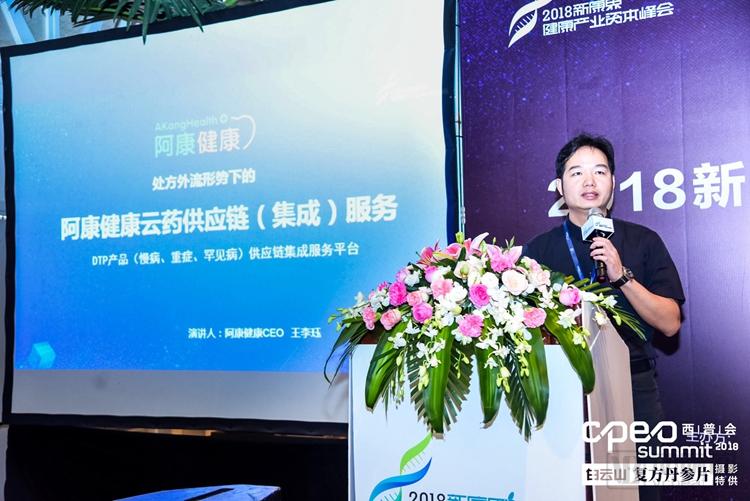
Wang Lijue, Chairman of Akang Group
A-Kang Health has built a solid foundation in prescription drug operations spanning over 13 years. Since 2014, it has been exploring opportunities arising from the outflow of prescription drugs, undergoing nearly five years of development that included interpreting national policies, innovating business models, and implementing diversified corporate restructuring. Guided by its operational philosophy—“Benevolence of physicians, compassion of pharmacists, ensuring no one struggles to find needed medications”—the company focuses its market efforts on the “last mile” that maximizes public benefit: grassroots urban and rural communities.
Meanwhile, to support the implementation of national healthcare reforms, we have consistently remained at the forefront of industry innovation and development. Leveraging innovative internet technologies, we focus on providing integrated supply chain services centered around chronic diseases, critical illnesses, and rare diseases. We have pioneered innovative leadership models, including the out-of-hospital DTP+CDC development pathway, category planning structured by medical specialties and disease types, and an integrated service model transitioning from product distribution to disease-specific solutions.
As of July 2018, leveraging its advantages in prescription drug supply chain resources, Akang Health has established solutions for 17 medical specialties and over 600 disease types. By developing disease-specific solutions based on clinical treatment pathways and providing integrated product supply chain services centered on these conditions, the company has achieved pharmaceutical care management that integrates healthcare, disease-specific protocols, and medications.
Among them, the Cloud Drug Library covers the actual inventory of 12,000 items from the medication catalogs of all hospitals in China, with a sell-through rate of 92%; its product portfolio includes offerings from more than 2,500 pharmaceutical manufacturers domestically and internationally, with direct partnerships currently established with over 800 industrial enterprises and more than 300 regional commercial distributors; it serves 180,000 B-end clients and has accumulated a user base of over 1 million C-end patients with chronic diseases.
Building a Disease-Centered Service System to Create China’s ESI
At this Capital Summit, Wang Lijue, Chairman of Akang Group, once again set aligning with international standards as the development goal, proposing that the evolution of China’s pharmaceutical landscape will center on “disease management,” while the core of prescription outflow will lie in rational drug use and PBM-driven cost containment.
Wang Lijue Extends the Analysis to Cover the Following Three Key Points:
I. Service Scenario Requirements for Pharmacy Terminals: Transitioning from a single point of drug sales to a diversified health service center. A detailed examination of existing “Internet + Pharmacy” projects in the market reveals successful, replicable models in areas such as rapid order fulfillment, home delivery of medications, rehabilitation guidance, and remote consultations. In the future, these fragmented initiatives will be driven by service demands to evolve into one-stop solutions offering convenient and cost-effective procurement, while integrating insurance-based financial payment scenarios.
II. The Endogenous Demand of Pharmaceutical Distribution Enterprises: It Is Not Drugs That Are Being Managed, But Disease Categories. As a pivotal endogenous link connecting upstream and downstream sectors, these enterprises must undergo rapid transformation. Driven by favorable national policies, the circulation of prescription drugs and the R&D of generic medicines are operating in an orderly manner. These enterprises will no longer serve merely as drug suppliers to generate operational profits; instead, they must establish a disease-centric service system to solidify their foundation.
III. Extended Consumer Demands: From Medication Needs to Pharmaceutical Care Services. The national liberalization of physicians’ multi-site practice, the rise of internet healthcare platforms, and the front-loading of information on chronic disease management and rehabilitation services have all facilitated the out-of-hospital distribution of prescription drugs. Consequently, consumers are increasingly favoring corresponding drug supply assurance services, such as the provision of more rational and safe medication regimens. Awareness of cost control for commonly used medications in chronic disease management is also gradually increasing. Therefore, the extended demand for pharmaceutical care services has deepened in tandem with the downward penetration of healthcare reform policies.
In light of this, Akang Health has proposed a strategic plan for an “integrated service model transitioning from product distribution to disease-specific solutions,” actively aligning with international standards to build China’s future ESI. From 2018 to 2022, Akang Group will leverage supply chain services to drive the outflow of prescriptions from hospitals and expand into lower-tier markets—centering on integrated supply chain services for chronic, critical, and rare diseases—to establish itself as a leading enterprise in the pharmaceutical distribution sector under the new landscape.
2023–2027: Build a chronic and critical disease service system (PBM) centered on disease types—establish comprehensive disease-specific data, with patient rehabilitation as the foundation, to help medical insurance and commercial insurers achieve rational drug use and cost control, becoming a global leader in pharmaceutical distribution and pharmaceutical services;
2028–2032: Achieve precision healthcare service management and disease management, becoming China’s ESI—by fully integrating the entire chain of healthcare, disease categories, pharmaceuticals, and insurance, to become the world’s largest healthcare service and disease health management company.
In the future, Aikang Group will take this as its mission and adhere to its corporate objective: “Make it easy to find any medication anywhere, ensuring that accessing medicines globally is no longer a challenge.” By collaborating with numerous pharmaceutical manufacturers and leveraging over 20,000 SKUs in its Cloud Pharmacy Inventory, the company will integrate terminal development across the pharmacy–healthcare–commercial ecosystem value chain. It aims to incubate pharmaceutical care service institutions centered on disease-specific management, advance the rational use of medicines in China, and establish a closed-loop system integrating healthcare, disease management, pharmaceuticals, and insurance, ultimately becoming China’s equivalent of ESI (Express Scripts Inc.).
Image provided by the Organizing Committee of the West China Pharmacy Conference