

"Chinese-Style" Breast Cancer Strikes a Decade Earlier—Can AI Be the Solution?
Liu Qiang, a breast specialist at Sun Yat-sen Memorial Hospital of Sun Yat-sen University, remains deeply pained by the case of a mother of two. Because this mother was “very strong,” she repeatedly expressed to him her wish that “her condition would hold out just long enough for her newborn child to start speaking, so she could hear the child call her ‘Mom’ once.” That single word “Mom” ultimately never came.
What took her life was breast cancer, the leading health killer currently faced by Chinese women.
“It’s so pitiful,” said Liu Qiang. “She developed breast cancer during pregnancy, and pregnancy-associated breast cancer is generally more aggressive. The cancer cells had already metastasized to the brain by the time the baby was born, and the average survival time for patients with brain metastases is only one year.”
In fact, breast cancer research is at the forefront of oncology worldwide. In the United States, for example, driven by substantial R&D investment and heightened attention, the five-year survival rate for breast cancer patients has reached 90%, with two-thirds of patients achieving cure. In recent years, the incidence of breast cancer in the U.S. has been declining year by year.
Turning its focus, this “killer” has shifted its ravaging battlefield to rapidly growing countries such as China. Dr. Lü Weiming, Director of the Department of Thyroid and Breast Surgery at the First Affiliated Hospital of Sun Yat-sen University, has observed that cancer incidence in China is on the rise, with breast cancer showing the most rapid increase in both absolute numbers and proportion, making it the leading killer among female patients.
“Chinese-Style” Breast Cancer Peak Incidence Occurs a Decade Earlier
In Western countries, the age group with a high incidence of breast cancer is 55-65 years old. In China, this peak occurs a full decade earlier, with the highest incidence rate among women aged 45-55. In addition to genetic factors such as family history, rapid socioeconomic development, the resulting high-pressure lifestyle, and poor dietary habits are all closely associated with the incidence of breast cancer.
“The work-related stress is overwhelming.” On the day of the reporter’s interview, a patient whose genetic testing results revealed cancer-associated gene mutations visited Liu Qiang’s outpatient clinic. Recalling her experience, she noted that during her years as a senior executive, she slept only a few hours each night. At the time, she paid little attention to this habit, but it inadvertently laid the groundwork for cancer development and genetic mutations. “Nowadays, women face substantial work pressure and a fast-paced lifestyle, along with irregular eating patterns. These unhealthy lifestyle factors can all influence the likelihood of developing breast cancer,” stated Liu Qiang.
What is alarming is that most people lack sufficient awareness; they not only fail to recognize the onset of risk but even inadvertently facilitate the spread of cancer.
Another pregnant breast cancer patient treated by Liu Qiang did not discover that her cancer had metastasized to the brain until she developed headaches. Prior to this, she had mistaken her chest swelling and pain for “milk stasis” associated with lactation and even sought relief through massage therapy, which inadvertently facilitated the systemic spread of cancer cells.
There are also patients who, initially unconscious, later regain consciousness only to become determined to die, forcibly cutting off their own chances of survival. One patient told Liu Qiang, “At first, I thought it might be benign, but later I realized something was wrong. I knew it was serious, so I just gave up. Since death is inevitable anyway, I decided to just let it happen.”
If urban women have at least a basic awareness of breast cancer, the greater blind spot lies in the vast rural areas. Liu Qiang has found that patients presenting with large tumors are often from rural backgrounds, reflecting a lack of awareness and delayed medical consultation.
If only it had been detected earlier.
For specialist breast surgeons, the optimal approach to preventing and treating breast cancer can be summarized in one sentence: early detection and early treatment, with intervention initiated before disease progression. The five-year survival rate for early-stage breast cancer exceeds 92%, whereas that for advanced-stage breast cancer has dropped to below 50%.
Early screening methods are neither mysterious nor have high barriers to entry. According to Director Lv Weiming, women over the age of 35 should undergo a physical examination by a physician plus an ultrasound every six months or annually. For those aged 40–55, mammography is recommended every one to two years. For older individuals, biennial mammography is sufficient. In terms of screening costs, tertiary Grade A hospitals charge RMB 135 for an ultrasound and RMB 269 for bilateral mammography. An annual expenditure of just over RMB 100 can significantly improve the likelihood of early diagnosis and treatment of breast cancer.
Yet this seemingly straightforward shortcut for breast cancer prevention and treatment has not gained widespread adoption. Liu Qiang, Lv Weiming, and their colleagues continue to face anxiety as they deal with severe cases referred from across China on a daily basis.
“Luck” Without “Awareness”
Awareness or habit is the first hurdle. In the United States, one in eight women will develop breast cancer in their lifetime, so American women place great importance on breast cancer and have a strong awareness of the need for regular annual check-ups. In China, although the number of breast cancer patients has been gradually increasing in recent years, the general public still lacks such awareness. Additionally, Liu Qiang believes that Chinese women are more prone to taking chances; due to lack of understanding combined with this wishful thinking, they tend to delay seeking medical attention repeatedly, making the disease difficult to treat after it has persisted for a long time.
Even with sufficient awareness, the uneven distribution of medical resources will become the second immediate challenge.
Primary healthcare capabilities lag far behind those in first-tier cities such as Beijing, Shanghai, and Guangzhou. Professor Li Jie from the Department of Thyroid and Breast Surgery at the First Affiliated Hospital of Sun Yat-sen University stated, “In major hospitals like ours, as well as those in Beijing and Shanghai, the survival rates for early-stage, curable breast cancer are basically consistent with those in Europe and the United States, with a five-year overall survival rate reaching approximately 90%. The most significant disparity lies in small and medium-sized cities. On one hand, patients in these areas have insufficient awareness of breast cancer; on the other hand, and more importantly, high-quality medical resources in China are unevenly distributed, leading to inconsistent levels of diagnosis and treatment.”
Even among tertiary Grade A hospitals in first-tier cities, the extent of experience in patient care can be a key differentiator in medical quality. Liu Qiang noted that a patient who had previously visited a tertiary Grade A hospital received an ultrasound report classified as BI-RADS Category 3, suggesting a high likelihood of benignity and indicating that follow-up observation would suffice. However, upon physical examination, he found the mass to have irregular features and opted for further imaging re-evaluation, which revealed a BI-RADS Category 4C classification, indicating a malignancy risk exceeding 50%. If such discrepancies can occur even in tertiary Grade A hospitals, the situation in primary care institutions is unlikely to be optimistic.
Human Resource Limitations and AI Breakthroughs
Limitations in human expertise and disparities in medical capabilities across regions and hospitals prompted Lu Weiming and Li Jie of the First Affiliated Hospital of Sun Yat-sen University to seek solutions leveraging artificial intelligence to assist in breast cancer screening.
One of the starting points is the difficulty associated with mammography screening. Both domestically and internationally, mammography remains the preferred modality for breast cancer screening in high-risk individuals aged 45 and older. However, Li Jie noted, “There are many challenges with mammography screening in China: Chinese women tend to have smaller and denser breasts, which hinders diagnostic accuracy; there is a shortage of sufficiently qualified radiologists to interpret imaging studies; furthermore, visual interpretation by the human eye has inherent precision limitations, being able to detect only image differences within a certain range and resolution.”
This is precisely where artificial intelligence holds an advantage in medicine. For instance, in mammography-based breast cancer screening, computer vision has a natural advantage in identifying lesions that might be overlooked by the naked eye. The AI medical imaging collaboration project with Tencent Miying, led by Lü Weiming and Li Jie, released an AI system for breast tumor screening this July. It achieved significant results in core metrics for lesion detection: the sensitivity for detecting breast calcifications and malignant masses reached 99% and 90.2%, respectively, while the sensitivity and specificity for differentiating between benign and malignant breast tumors reached 87% and 96%. Although further clinical validation is still required, these data have already gained recognition from senior clinicians such as Li Jie.
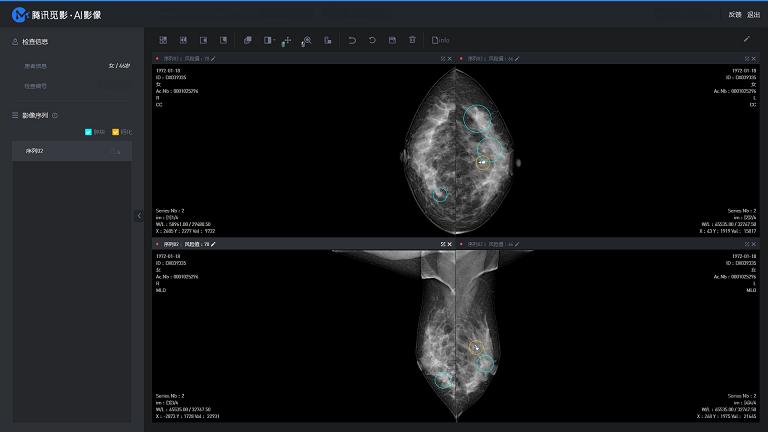
Figure caption: AI identifies lesions and differentiates between benign and malignant tumors
“Human operations are subject to the influence of time and experience, making errors in image interpretation inevitable.” At another academic forum held this June, Dr. Yu Xiangyang from Sun Yat-sen University Cancer Center, who is also researching AI applications in medicine, offered this perspective: “Approximately 10% of routine imaging reports contain errors, with the vast majority of diagnostic mistakes occurring during the image interpretation phase.” The application of AI technology can address the instability inherent in human visual assessment. Moreover, this AI assistant is “tireless” and capable of learning at a high speed.
Confronting the “Long-Standing Challenges”
Another possibility brought by artificial intelligence is to alleviate the shortage of high-quality doctors, thereby partially addressing the long-standing problem of uneven distribution of medical resources.
AI doctors, trained on extensive case data and validated by renowned specialists from top-tier (Grade 3A) hospitals, may provide greater guidance to primary care physicians with relatively limited experience. Liu Qiang pays particular attention to this aspect. During his clinical practice, he has observed that many patients suffer from suboptimal disease control due to non-standardized initial treatments and the lack of professional therapeutic plans provided by primary care physicians. “With the aid of artificial intelligence, even if primary care physicians cannot manage critically ill patients, they can deliver standardized and compliant care for common cases, which is still a positive development.”
In the view of Yan Kezhou, an AI scientist at Tencent Miying, a key factor determining the usability of AI products for mammography screening is the number of difficult and complex cases the AI “understands”—in other words, it must have a sufficiently extensive “case reading volume.” If AI is truly to assist primary-care physicians, it must possess more experience and master more standardized and professional management approaches than they do. “To enable AI to outperform physicians, the most critical step is to expose it to difficult and complex cases that ordinary doctors or individuals could never review in their entire careers.” After identifying such cases, experts from tertiary hospitals and pathologists cross-verify the diagnoses, which are then fed into the AI system to allow for step-by-step iterative improvement.
This meticulously cultivated AI physician has grown rapidly. Through pilot deployments in over a dozen hospitals, data accumulation, and feedback-driven learning, the AI system reduced the false positive rate (FP value) for mass detection to 20% of its original level within just six months. It is foreseeable that such “exponential” growth will continue, broadening the AI physician’s capabilities and making it an excellent assistant in the near future.
A Fresh Start
At the First Affiliated Hospital of Sun Yat-sen University, Ms. Guo, a breast cancer patient, came for her regular follow-up visit with Dr. Lv Weiming, Director of the department. It has been eight years since she was diagnosed with breast cancer in 2010. Due to early detection, she underwent breast-conserving surgery and now only requires periodic check-ups and medication, with no longer any life-threatening risk.
But this will be a long-term battle, for both patients like Ms. Guo and breast specialists such as Dr. Li Jie, Dr. Lv Weiming, and Dr. Liu Qiang.
They have all expressed concern, in unison, about the rising incidence of breast cancer in China. Patients’ lack of awareness regarding breast cancer has led to delays in treatment and intervention, exacerbated physical and psychological suffering, and even despair from diagnosis to death—a situation that is deeply distressing.
Every life saved counts. For professionals like Lü Weiming and Li Jie, who are actively embracing AI and researching its application in early breast cancer screening, the goal is to leverage machines to compensate for human limitations, thereby achieving more accurate detection and helping more patients.
Ultimately, the fundamental solution to tackling breast cancer in China lies in enhancing women’s own awareness of regular screening.
“We are genuinely committed to helping patients, as we have seen many cases referred from primary care hospitals where tumors measured over 20 centimeters in diameter—about the size of a basketball. Therefore, we strongly advocate for early screening and timely treatment. Artificial intelligence can play a significant role in early screening, helping to address the uneven distribution of high-quality medical resources and the challenge of extending these resources to primary care settings, thereby enabling more patients to benefit from expert medical care,” said Li Jie.