

GSK's Digital Innovation Strategy: Partnering with Leading Tech Firms to Drive Pharmaceutical Breakthroughs
Technology has brought boundless wealth to the pharmaceutical industry, fostering its remarkable prosperity.
Digital technologies, represented by artificial intelligence, machine learning, big data, and mobile health, are reshaping the pharmaceutical industry and bringing a new look to the sector. VCBeat has recently launched a special feature on “Digital Transformation in the Pharmaceutical Industry,” providing a comprehensive analysis of the technology-driven industrial changes.Click here for the special feature。
This issue’s case study on pharmaceutical company transformation features GSK. Headquartered in the UK, this multinational pharmaceutical giant carries the aristocratic demeanor of a former empire and advances its innovation strategy at a steady, unhurried pace. In currently trending areas such as AI-driven new drug development, big data-enabled clinical research, and digital marketing, GSK is pursuing innovation in an orderly and systematic manner.
The story of GSK can be broadly summarized as “one company, two pharmacies, three hundred years of history.”
GSK, short for GlaxoSmithKline plc, was formed in 2000 through the merger of SmithKline Beecham plc and GlaxoWellcome plc. Tracing back further, both companies have long-standing histories.
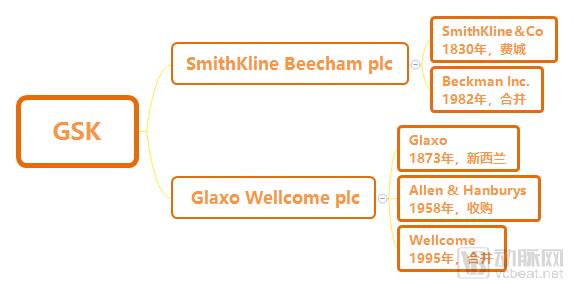
GSK History
John K. Smith opened his first pharmacy in Philadelphia in 1830, which later evolved into SmithKline & Co. and gradually expanded globally, engaging in the development and sales of vaccines and pharmaceuticals. In 1982, SmithKline & French merged with Beckman Inc. and was renamed SmithKline Beckman.
On the other side, Joseph Edward Nathan, a London-born “New Zealand drifter,” founded a trading company named after himself in Wellington in 1873. Its flagship product was a milk tablet called Glaxo, marketed with the slogan “Glaxo builds bonier babies.” The tablets proved immensely popular, and Nathan later renamed the company Glaxo.
Glaxo continued to thrive and, in 1958, acquired Allen & Hanburys, a pharmaceutical company that had evolved from a London pharmacy founded in 1715. This acquisition extended Glaxo’s historical lineage by more than a century. In 1995, Glaxo merged with Wellcome to form Glaxo Wellcome plc.
Coincidentally, the histories of GSK’s two predecessor companies both trace back to the pharmacy business—having been founded in 1717 and 1830, respectively. This is closely linked to the healthcare landscape of the time: during the 18th and 19th centuries, pharmacists played a pivotal role in the medical system, serving as both “physicians” and drug suppliers. Naturally, the products they offered were relatively rudimentary, ranging from vitamins to syrups.
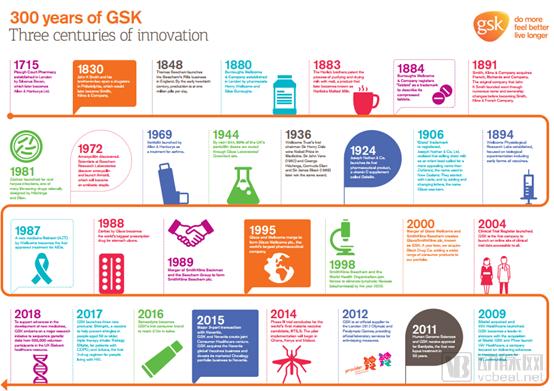
GSK’s Development History. Image source: GSK official website
GSK was founded on a very strong foundation, with Glaxo Wellcome being the third-largest pharmaceutical company globally at the time (after Novartis and Merck), holding a 4% share of the global market. The 2000 annual report showed that GSK’s revenue for that year was £18.079 billion.
Since its establishment, GSK has completed dozens of acquisitions, with targets including Block Drug, CNS Inc., Stiefel Laboratories (the world’s largest independent dermatological pharmaceutical company), and GlycoVaxyn.
Currently, GSK’s pharmaceutical products focus on major disease areas such as asthma, cancer, infections, diabetes, and mental health. Meanwhile, it also maintains a consumer healthcare business covering oral care, beverages, nutritional supplements, and skincare products, with well-known brands like Sensodyne and Polident.
In 2017, GSK reported annual revenue of £30.2 billion, with new product revenue reaching £6.7 billion. Key blockbuster products included Advair (for the treatment of asthma and chronic obstructive pulmonary disease, $4.035 billion), Triumeq (HIV/AIDS, $3.172 billion), and Tivicay (HIV/AIDS, $1.810 billion).
Historically, Wellcome, the predecessor of GSK, established a representative office in China in 1908 but did not deeply penetrate the Chinese market. In 1987, SmithKline Beckman jointly invested with Tianjin Zhongxin Pharmaceutical and Tianjin Pharmaceutical Group to establish Sino-American Tianjin Smith Kline & French Laboratories, one of the earliest joint-venture pharmaceutical manufacturers in China. In 2015, through a transaction with Novartis, GSK acquired Zhejiang Tiantian Biopharmaceutical, which now serves as GSK’s vaccine production platform in China.
A strong commitment to R&D investment has been the key to GSK and its predecessors maintaining long-term competitiveness. In 1880, Allen & Hanburys established its first laboratory in London; in 1957, scientists at Beecham Research Laboratories advanced the understanding of the penicillin molecule and discovered a new method for its production; meanwhile, scientists at Wellcome conducted decades of research into leukemia, gout, viral infections, and organ transplantation.
Five GSK scientists have won the Nobel Prize in its history, earning GSK the reputation as a "Nobel Prize cradle." All of these laureates originated from Wellcome.
In 1936, Henry Dale of the Wellcome Foundation was awarded the Nobel Prize in Physiology or Medicine for his research on the chemical transmission of nerve impulses;
In 1982, Sir John Vane of the Wellcome Research Laboratories, along with two other scientists, was awarded the Nobel Prize in Physiology or Medicine for their discoveries concerning prostaglandins and related biologically active substances;
In 1988, Dr. Gertrude Elion and Dr. George Hitchings of Wellcome, together with Sir James Black, who had served at the Wellcome Foundation and Smith Kline & French Laboratories, were jointly awarded the Nobel Prize in Physiology or Medicine for their discoveries of important principles for drug treatment.
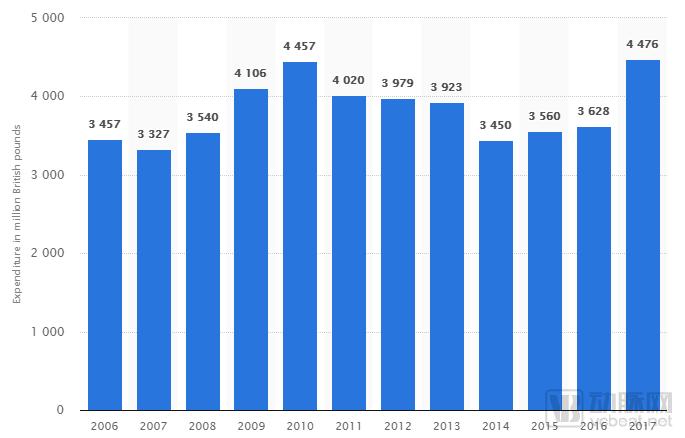
Since the establishment of GSK, the company has maintained consistently high R&D investment, with the R&D-to-sales ratio remaining at approximately 15%.
GSK R&D Expenditure, 2006–2017 (Million GBP)
Embracing digital innovation has also become a key focus for GSK in recent years. In the 2017 annual report, Karenann Terrell, Chief Digital and Technology Officer of GSK (a position first established in July 2017; she previously served as Chief Information Officer at Walmart), stated that digital technology is impacting every aspect of GSK’s business. The company aims to leverage data-driven, information-based technological advancements to accelerate drug discovery and development, and to drive business growth.
Collaboration is key to GSK’s innovation. In 2017, GSK partnered with the UK-based machine learning company Exscientia and the US-based AI-driven drug discovery company Insilico Medicine, and also joined the ATOM Consortium, aiming to accelerate drug development and cancer treatment.
In addition, GSK has pursued digital innovation in internal management, market strategy, e-commerce, patient services, and medical education. Let’s take a closer look…
GSK’s Digital Innovation Across All Business Segments
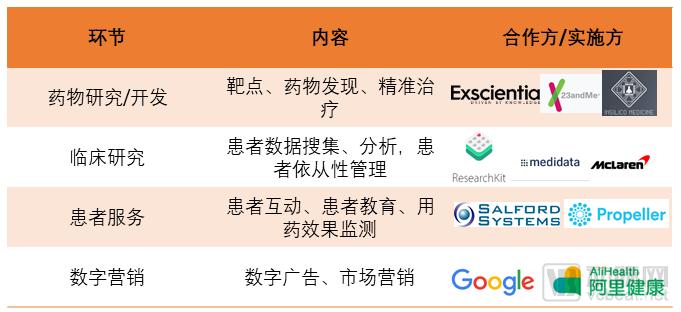
In March 2017, GSK partnered with Insilico Medicine, one of the most prominent companies in the field of AI-driven drug discovery, to leverage its AI simulation technologies to support GSK’s vaccine development. By August, the collaboration was expanded, with Insilico Medicine continuing to provide GSK with technical services in target identification and drug discovery.
In July 2017, GSK and Exscientia entered into a strategic collaboration in drug discovery. Under this agreement, Exscientia leveraged its AI-driven drug discovery platform to develop innovative small-molecule drugs for ten disease targets identified by GSK, aiming to advance clinical candidate compounds for these targets. Upon achievement of all predefined milestones, Exscientia would receive a total of £33 million (approximately $42.7 million) from GSK.
Also in July, GSK and the genetic testing company 23andMe announced a partnership to jointly advance drug research and development. Both parties aim to identify new drug targets to facilitate disease research and the development of novel therapies. The collaboration encompasses target selection for new drugs, identification and selection of patient subgroups, and patient recruitment.
Hal Barron, GSK’s Chief Scientific Officer and President of Research and Development, stated that the convergence of life sciences and technology will drive greater success in GSK’s drug development. He noted that leveraging 23andMe’s human genome database and machine learning technologies will yield more effective drug targets, accelerate research speed, and improve success rates. Machine learning will enable the fields of science and medicine to evolve from the era of “Big Data” to the era of “Understanding Data.”
Hal Barron was appointed as GSK’s new Chief Scientific Officer in November 2017. Having previously worked at Calico, Genentech, and Roche, he helped establish a research organization that leverages cutting-edge technologies in drug discovery and development. Patrick Vallance, GSK’s former Chief Scientific Officer, stepped down in early 2018 to become the UK Government’s Chief Scientific Adviser.
GSK’s innovative efforts in drug research and development were largely spearheaded by Patrick Vallance. Born in 1960, Vallance specializes in nitric oxide and endothelial cell physiology, and is a Fellow of the Academy of Medical Sciences (FMedSci) and a Fellow of the Royal Society (FRS). Commentators have noted that, as he approached the end of his tenure, Vallance took an active stance on adopting new technologies, aiming to promote their application in pharmaceutical research. His successor, Hal Barron, has to some extent continued this strategic approach.
GSK is one of the early adopters of mobile health (mHealth) tools in clinical research, leveraging smartphones and wearable devices to collect patient data and streamline the data collection process.
GSK utilizes Apple’s ResearchKit—a development framework provided by Apple to medical research institutions, physicians, and other stakeholders—to enhance the collection of patient data through mobile applications. The company has developed several apps targeting patients with rheumatoid arthritis and respiratory diseases, leveraging these applications to gather patient data.
Prior to this, Apple and Medidata, a medical data company, had collaborated for many years to optimize clinical data collection through mobile health devices and cloud-based algorithms, or to provide services such as patient reminders and monitoring, thereby ensuring medication adherence and compliance with clinical trial protocols. GSK can obtain patient data in real time via mobile health devices and correct patient behaviors. Moreover, it can uncover previously overlooked opportunities in clinical research from data that were inaccessible in the past.
Interestingly, GSK has also entered into a comprehensive partnership with the McLaren Group. Those familiar with Formula 1 racing are likely well-acquainted with McLaren, as the McLaren team is a formidable competitor in F1, having secured multiple Constructors’ and Drivers’ Championships. On the McLaren website, we found an article published in 2015 featuring a speech by Geoff McGrath, Vice President of McLaren Applied Technologies, at WIRED Health. He noted that the collaboration between McLaren and GSK began in 2011, with McLaren providing data management, predictive analytics, and biomimetic design simulation services to GSK.
In terms of clinical research directions, McLaren will leverage its specialized expertise in managing the vast amounts of data generated during racing operations to provide biotelemetry services to GSK, enabling real-time collection of patient data. This facilitates continuous assessment, thereby yielding a more comprehensive record than single-point assessments, while also eliminating the inconvenience for patients of having to adjust their schedules to accommodate assessments and outpatient visits.
Meanwhile, McLaren provided recommendations for GSK’s production management. By studying the dual-speed toothpaste production lines used for well-known brands such as Sensodyne and AquaFresh, McLaren implemented new methods that reduced the changeover time from producing one product to another on the same line from 39 minutes to 15 minutes. This improvement enables the £15 million production line to produce an additional 6.7 million tubes of toothpaste annually. GSK will roll out this best practice across its global manufacturing facilities.
With the development of the internet and mobile internet, patients have begun to participate more proactively in medical services and pharmacotherapy. Most patients acquire knowledge about diseases and medications through channels such as websites and mobile applications, and offer their own suggestions regarding diagnosis and treatment. In particular, some patients with chronic diseases, having managed specific conditions over extended periods, have become “experts” in these fields.
Pharmaceutical companies have clearly taken note of this trend and have begun to engage with patients through digital channels to deliver a better healthcare experience. GSK is no exception; in recent years, the company has progressively implemented digital health services through independent research and development, partnerships, and other approaches.
In 2013, GSK and the Community Care of North Carolina (CCNC) launched a novel digital approach that enables healthcare providers and payers to analyze patients’ medication regimens in real time with the click of a button, thereby facilitating optimized pharmacotherapy. By leveraging data analytics tools to examine patients’ prescription fill histories and hospital admission and discharge records, GSK predicts the risk of adverse outcomes and proactively recommends interventions most likely to enhance patient engagement and ultimately improve clinical outcomes.
Two other examples include GSK’s use of electronic health records from Salford to gain a deeper understanding of patient experiences in real-world settings, particularly through a large-scale project focused on patients with chronic obstructive pulmonary disease (COPD). Additionally, GSK partnered with Propeller Health to develop and manufacture custom sensors for the Ellipta inhaler, which delivers various medications for asthma and COPD. These sensors enable GSK to remotely monitor inhaler usage, providing insights into how patients actually use the medication and how this relates to clinical efficacy.
GSK has increased its investment in digital marketing, forging partnerships with Google and Alibaba. The collaboration with Google involves leveraging its digital content advertising platform to deliver targeted advertisements to users. Similarly, the partnership with Alibaba is supported by the Alimama advertising platform.
GSK has also partnered with Alibaba Health to launch adult disease prevention services, providing users with online disease education and consultation, as well as online appointment booking, thereby creating a seamless online-to-offline experience for convenient disease prevention and vaccination consultations.
Of course, the impact of digital marketing has also been highly significant. In its annual report, GSK stated that its engagement rate with end users increased by 50%, reaching 15%.
Summary
GSK has not extensively deployed digital technologies or tools across its operations; however, its partnerships are predominantly with leading companies in their respective fields, such as Insilico Medicine and Exscientia in the AI sector, and Google and Alibaba in digital marketing. This approach lends GSK’s digital innovation a characteristic of “quality over quantity.” Furthermore, the impact of these digital innovations is evident; for instance, the collaboration with McLaren directly boosted production output.
GSK’s “DNA” has determined that it will be a company driven by research and development as well as innovation. Amid the wave of digital innovation, GSK continues to lead the way, laying the foundation for sustainable growth and achieving its mission to help people “do more, feel better, live longer.”