

Can Roche Become the World's No.1 Pharma Company Through Digital Innovation?
Technology has brought boundless wealth to the pharmaceutical industry, fostering its unprecedented prosperity.
Digital technologies, represented by artificial intelligence, machine learning, big data, and mobile health, are reshaping the pharmaceutical industry and giving it a new look. VCBeat has recently launched a special feature on “Digital Transformation in the Pharmaceutical Industry,” providing a comprehensive analysis of the technology-driven industrial changes.Click here for the special feature。
Globally, there are many large pharmaceutical companies, but few players have managed to break through the status quo like Roche. In 2014, Roche rose from fifth place in 2013 to third place in global pharmaceutical revenue rankings, and since then, it has consistently ranked among the top three alongside Pfizer and Novartis for four consecutive years. As the world’s largest healthcare company, Roche’s fleet is primarily driven by two engines: pharmaceuticals and diagnostics.
In the past, two key drivers propelled pharmaceutical companies forward. However, in a digital future where an increasing number of internet companies serve as platforms centered on meeting consumer needs, pharmaceutical enterprises must build their own ecological networks through digital transformation. Michele Pedrocchi, Head of Global Strategy and Business Development at Roche Diagnostics, candidly stated, “We have much to learn, but we are actively engaging in this field and rapidly accelerating our efforts. Ultimately, personalized medicine in the digital era will lead to better healthcare decision-making. We will increasingly conduct predictive analytics and deliver preventive treatments. In the past, our relationships with partners were one-to-one and unidirectional; now, we must bring together multiple partners within an ecosystem that balances standardization and flexibility, advancing toward an era of precision and personalized medicine.”
Winds rise from the tips of duckweed: Roche’s path from a single towering tree to a thriving forest reveals its digital tendrils. VCBeat (WeChat ID: vcbeat) analyzes Roche’s recent moves to decode the logic behind its digital innovation.
Roche’s 2017 revenue amounted to $38.791 billion, with its pharmaceutical division achieving a 5% increase in income. In its 2017 financial report, Roche attributed this robust growth to the launch of several new drugs. Roche’s development trajectory demonstrates that, as a relatively younger pharmaceutical company, it has successfully outperformed industry giants such as Schering-Plough, Sanofi, and Johnson & Johnson, thereby reshaping the competitive landscape of the pharmaceutical sector. Over the past two decades, VCBeat has identified three key drivers behind Roche’s growth: innovation, acquisitions, and forward-looking R&D strategy.
I. R&D
Roche can be described as the company most willing to invest heavily in R&D, a strong tradition established even before its revenue ranked among the top three pharmaceutical companies globally. Data show that Roche has consistently led in R&D spending while maintaining a steady growth rate. Three members of Roche’s R&D team have been awarded Nobel Prizes. Although high R&D investment has proven beneficial—allowing later generations to reap the rewards—for the pharmaceutical industry, where new drug development requires enormous capital, such efforts often entail high risks and low returns, making them thankless endeavors. Nevertheless, Roche has achieved both high investment and high returns. Notably, Roche successfully navigated patent cliffs in the 1970s and in 2000 by developing new product lines. This year, Roche successfully developed drugs for autism and Alzheimer’s disease. Its oral novel drug, balovaptan, received FDA approval as a breakthrough therapy for autism. Additionally, this year Roche launched two large-scale Phase III clinical trials for Alzheimer’s disease treatments. In contrast, Pfizer announced the discontinuation of its development programs for Alzheimer’s and Parkinson’s diseases during the same period.
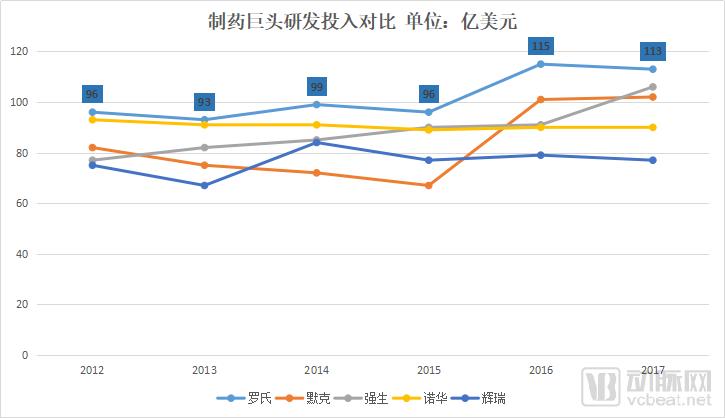
Source: Bloomberg; Chart by VCBeat
II. Mergers and Acquisitions
Mergers and acquisitions (M&A) are arguably the most effective strategy in the pharmaceutical industry, enabling companies to acquire exactly what they need. Roche has repeatedly leveraged its leadership’s keen insight to acquire promising companies at low valuations, helping the company emerge from downturns and solidify its market position. The most iconic example is its acquisition of Genentech. In 1986, Roche acquired nearly 60% of the biotechnology company Genentech for $1.537 billion, a relatively low price at the time. Thanks to Genentech’s remarkable turnaround, its biopharmaceutical products—initially viewed with skepticism—generated substantial revenue for Roche in the 1990s.
Of course, this strategy remains effective in digital innovation. Roche continues to integrate data tools from various sources through acquisitions, building a comprehensive healthcare ecosystem that offers new options for healthcare professionals and incorporates previously isolated doctors, laboratories, regulatory agencies, and researchers into a collaborative network.
III. Anticipating the Future Direction of Next-Generation Drug Development
Roche’s greatest success lies in its forward-looking business layout and its consistent ability to align with the next generation of drug development trends. After World War II, Roche built its foundation on sedative-hypnotic drugs. However, in 1965, then-CEO Adolf Jann gradually led the company to divest from its two major sedative-hypnotic products, strengthen diversification efforts, and expand its operations across the entire healthcare sector. As early as the 1960s, Roche had already begun strategically positioning itself in the research and development of biologics and diagnostics. Subsequently, Roche’s three blockbuster monoclonal antibodies ranked among the top three globally in oncology drug sales, underscoring Roche’s dominance in capturing half of the monoclonal antibody market.
In the future, Roche’s core business will remain drug discovery and development. However, as Gregg Talbert, Global Head of Digital and Personalized Healthcare Partnerships at Roche, stated, “We have recognized that future drug discovery and development must be underpinned by strong partnerships to leverage innovations beyond our own domain.”
Roche’s corporate philosophy, as stated on its official website, is “Doing now what patients need next.” The medical future that Roche is betting on lies in precision medicine and personalized healthcare. Roche pursues digital innovation through data for three reasons:
First, precision medicine is an inevitable trend driven by various stakeholders.
Second, to alleviate the current challenges in new drug development.
Third, leverage the existing advantages in diagnostic services.
Precision medicine and personalized medicine are regarded as the blueprint for the future of healthcare. Precision medicine is a novel medical concept and healthcare model that has evolved from individualized medicine, driven by rapid advancements in genomic sequencing technologies and the interdisciplinary application of bioinformatics and big data science. At its core, precision medicine is fundamentally patient-data-driven, in contrast to traditional healthcare models, which are physician-driven.
The significant advancement of precision medicine has been primarily driven by policy support. In 2016, then-U.S. President Barack Obama allocated $215 million to launch the Precision Medicine Initiative, a collaborative effort involving the National Institutes of Health (NIH), the Food and Drug Administration (FDA), and the Office of the National Coordinator for Health Information Technology (ONC). Furthermore, the United States introduced complementary measures to facilitate this progress. At the end of 2016, the U.S. Congress enacted the 21st Century Cures Act, which proposed using “Real World Evidence” (RWE) as an alternative to traditional clinical trials for approving expanded indications, thereby accelerating the market entry of drugs and medical devices. This regulatory shift has further encouraged pharmaceutical companies to increase their investment in real-world research.
In the oncology sector, where Roche currently holds a dominant position, the trends toward personalized and precision cancer therapy are gaining significant momentum. Oncology treatments now account for approximately 60% of Roche’s total revenue. Cancer care extends beyond mere symptom management; with advances in medicine, the ability to profile the genetic makeup of a patient’s tumor in a relatively rapid and cost-effective manner has become a key direction in cancer treatment.
In the United States, approximately 1.6 million people were diagnosed with cancer in 2016. However, no two individuals share identical pathological mechanisms. Since 1991, the cancer mortality rate has declined by approximately 20%, and the five-year relative survival rate has risen to 68%. A pivotal advancement in treatment strategies has been the recognition that tumors are driven by individual genetic factors. Each person’s cancer possesses a unique genetic profile.
Future oncology drug development should also evolve toward precision medication tailored to different populations, or even to each individual. To identify large-scale population groups or similar disease categories, vast amounts of structured data have become essential.
Of course, Roche’s $1.9 billion acquisition of Flatiron, an oncology data company, was not intended merely as an insurance policy for the future of healthcare. Rather, it aims to alleviate the current predicament in new drug development. Mastering medical data can be said to build the infrastructure for new drug research and development.
Roche’s major drugs—Rituxan, Herceptin, and Avastin—had their U.S. patents expire in 2018, 2019, and 2020, respectively. In 2017, due to competition from generic drugs, Roche’s revenue in its traditional stronghold of Europe declined by 2%. Moreover, a number of Roche’s best-selling medications are approaching patent expiration in the near future. For instance, the impending expiry of Herceptin’s patent is set to trigger a redistribution of a $6 billion market. According to Roche’s 2017 financial report, the company had as many as 31 oncology compounds in Phase III clinical trials. Despite Roche’s urgency in new drug development, each new drug still requires an average of ten years to successfully reach the market unless the current clinical trial model is reformed.
Therefore, to ensure the growth of key businesses, Roche urgently needs to leverage real-world data and analytics to accelerate clinical trials. Oncology big-data companies like Flatiron can rapidly match patients for clinical trials, thereby accelerating the market launch of new drugs while reducing costs.
Michele Pedrocchi, Head of Global Strategy and Business Development at Roche Diagnostics, once stated: “In the future, we will leverage data on various patient characteristics to determine optimal treatment combinations, thereby improving patients’ overall health outcomes.”
Although there are still many uncertainties surrounding digital innovation in the pharmaceutical industry, Roche’s choice to enter through precision medicine is more importantly aligned with the strengths of its diagnostics business. In 2017, Roche’s global diagnostics division achieved a 5% year-on-year growth in sales revenue, reaching CHF 12.1 billion (approximately USD 12.9 billion).
In the era of precision medicine, diagnostic services hold greater promise than pharmaceutical businesses. First, diagnostic services can help reduce medical costs under health insurance cost-containment measures, thereby promoting the growth of low-cost business models in healthcare. According to statistics from Roche Diagnostics, in vitro diagnostics (IVD) influence 60% of clinical treatment decisions, yet account for only 2% of total clinical treatment costs. This trend is further driven by the rising prevalence of chronic diseases among the aging population. In future healthcare, facilitated by the development of the Internet of Things (IoT), sensors, and mobile devices, medical practices will integrate prevention, screening, diagnosis, prognosis, treatment, and monitoring into a unified system. Prevention and prognosis are currently neglected aspects of the existing healthcare system, yet they are precisely the areas that can significantly improve health outcomes and reduce medical costs. Diagnostics play a crucial role in early screening and continuous health monitoring. Furthermore, the advancements in molecular diagnostics and genetic testing underscore the developmental trajectory of diagnostic services within precision medicine.
At the current stage, new drug development can be described as the Achilles’ heel of pharmaceutical companies. Taking Roche as an example, the revenue of its main divisions increased by 5% last year, reaching CHF 41 million. In its annual report, Roche attributed this growth to Ocrevus, a newly developed drug for the treatment of multiple sclerosis (MS), and Tecentriq, the first PD-L1 inhibitor approved by the FDA for targeted therapy in bladder cancer.
Without new drug launches, pharmaceutical companies will face an uphill battle, caught between the fierce threat of the patent cliff and the substantial costs of numerous clinical trials.
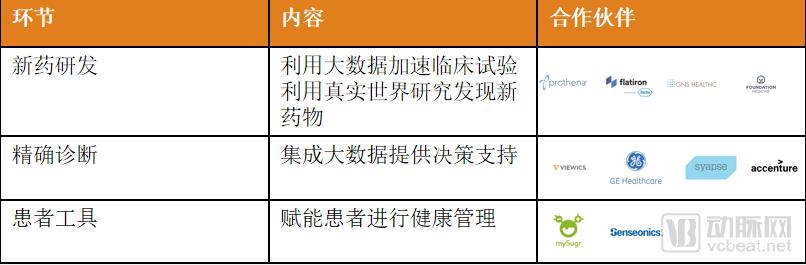
Developing new drugs typically takes more than 10 years on average. Pharmaceutical companies are facing not only the challenge of patent expirations and a gap between old and new drug launches, but also the increasing difficulty of drug discovery, with fewer compounds available for developing new medications. Pfizer revealed in last year’s annual report that it had terminated 13 projects. In reviewing Roche’s strategic moves, VCBeat noted that AI rarely appears among Roche’s partners; instead, Roche places greater emphasis on data. In clinical trials for new drugs, Roche is transforming trial processes through digitalization to improve efficiency and accelerate drug development.
Prothena
In June 2017, Roche announced a collaboration with Prothena to develop a patient monitoring application for use in Phase II clinical trials. In the context of its clinical development of a therapeutic agent for Parkinson’s disease, Roche updated traditional scale-based assessment methods by designing an app equipped with a comprehensive assessment suite capable of continuously and remotely monitoring and capturing symptoms in patients with Parkinson’s disease. With this smartphone-based tool, clinical investigators no longer need to rely solely on periodic interviews to obtain patient status updates, and can acquire more sensitive and comprehensive data in a shorter timeframe compared with one-time assessments. The ultimate goal is to rapidly and reliably collect large volumes of data to monitor individual treatment responses, thereby enabling personalized therapy. This approach can enhance patient adherence in clinical trials while yielding more precise insights into drug efficacy.
Patient compliance in clinical trials is crucial for accelerating new drug development. According to a Cognizant report on enrollment forecasting, approximately 80% of clinical trials fail to recruit suitable patients within the designated timeframe, and about one-third of Phase III clinical studies are terminated due to difficulties in patient recruitment. In 2017, Roche conducted clinical trials involving more than 295,000 patients. Roche aims to simplify clinical trials to enhance engagement among both patients and clinical investigators, while minimizing their inconvenience and the time and effort required. Digital technologies enable decentralized clinical trials by shifting trial activities from centralized sites to patients’ homes. This continuous stream of data feedback allows researchers to better identify potential drug combinations.
Flatiron Health
Roche acquired Flatiron Health for $1.9 billion, making it the largest acquisition in the field of artificial intelligence. What attracted Roche was the vast amount of real-world data integrated by Flatiron Health. The company has already collected information on more than 30% of cancer patients in the United States, far surpassing other competitors in this field. Roche can utilize Flatiron Health's data to match patients for clinical trials. Matching patients for cancer therapies is extremely challenging because cancers continuously evolve, and the lengthy development time for new drugs creates a significant time gap, directly resulting in very small target patient populations for each clinical trial.
Although AI is touted for its rapid matching capabilities, it remains ineffective without accessible data. Building a robust data ecosystem requires extensive coordination, standardization, and analysis, all of which hinge on collaboration between healthcare companies and technology partners.
Roche’s CEO stated regarding the acquisition of Flatiron Health: “Flatiron Health’s data analytics platform is not only valuable to Roche, but also represents a breakthrough for oncology research and development across the entire industry.”
GNS Healthcare
GNS collects data including electronic health records, medical device data, genomics information, healthcare consumption behaviors, and adverse drug reactions. These data are leveraged to match patients with the most suitable personalized health interventions and medications. This, in turn, helps healthcare institutions improve outcomes and reduce costs in areas such as preterm birth, medication adherence, metabolic syndrome, diabetes, and specialized oncology care.
Roche’s subsidiary, Genentech, has entered into an agreement with GNS to leverage GNS’s AI platform for analyzing the efficacy of existing therapies in oncology. Roche is currently conducting pilots using GNS’s technology framework to analyze vast amounts of proprietary data, such as electronic health records and next-generation sequencing data. The goal is to uncover hidden drivers of cancer progression and drug response in some of the most challenging cancers. This collaboration aims to derive unique insights from the growing volume of genomic and real-world data, which will help develop personalized next-generation cancer treatments.
Foundation Medicine
In June this year, Roche acquired Foundation Medicine for $2.4 billion. Headquartered in Cambridge, Massachusetts, FMI is a molecular information company specializing in cancer care. The company provides Comprehensive Genomic Profiling (CGP) analysis services to identify genetic mutations in patients’ cancers, thereby supporting targeted therapy, immunotherapy, and clinical trials. Following the acquisition, Roche and Foundation Medicine will jointly leverage their expertise in genomics and molecular information to strengthen the development of personalized medicines and enhance care for cancer patients. Secondly, this acquisition aims to promote the widespread availability of Foundation Medicine’s high-quality CGP testing and innovative data services, realizing Roche’s vision for personalized healthcare.
Roche believes that data on patients and drugs is flowing in from many sources—in vitro diagnostics, lifestyle sensors, laboratories, electronic records, clinical trial data, genomic data, doctors, and patients themselves. In short, these data have the potential to drive better decision-making and find the most effective treatments for patients. It can also be seen that if pharmaceutical companies continue to focus solely on the final stage of drug manufacturing, they will be left far behind. Without access to upstream patient data, they will be unable to develop new drugs in an increasingly challenging R&D environment. The winners will be those who can master the entire data closed loop.
Viewics
In November 2017, Roche acquired Viewics, a U.S.-based big data company specializing in laboratory analytics. Viewics focuses on business analytics for laboratories, aggregating and extracting data from various sources to enable faster, data-driven decision-making in laboratory operations. “The Viewics platform provides laboratories with a range of powerful tools and analytics that help improve efficiency,” said Christian Hebich, Head of Solution Integration and Services at Roche Diagnostics. “This enhances our product portfolio, transitioning from standalone systems to integrated ones, thereby delivering holistic solutions for healthcare developers, providers, and patients.”
GE healthCare
In January 2018, Roche announced a collaboration with GE Healthcare to develop an integrated diagnostics platform aimed at improving the treatment of cancer and critical care conditions.
The two parties will jointly develop software to facilitate faster and more accurate early-stage decision-making. Roche’s primary role in this collaboration is to leverage its existing biomarker data, histopathology data, genomics data, and in vitro data from sequencing panels, applying advanced analytics to the in vivo data generated by GE Healthcare’s imaging and monitoring devices.
Syapse
Syapse provides a basis for decision-making in precision medicine, with a focus on cancer treatment. Headquartered in San Francisco, Syapse offers a data-sharing network that aggregates data from physician hubs across multiple healthcare systems. The platform integrates anonymized electronic health records, laboratory reports, and DNA sequencing data.
Syapse and Roche will jointly develop new software and analytics solutions to provide healthcare providers with the tools and insights they need to implement precision medicine at scale. By combining Syapse’s software with Roche’s oncology expertise, this collaboration will make precision medicine a reality for cancer patients and their healthcare providers. Syapse also offers solutions that match patients to clinical trials by leveraging large volumes of patient data.
Accenture
In December last year, Accenture announced a collaboration with Roche to leverage digital solutions to improve survival outcomes for cancer patients. By enhancing data integration services, the partnership aims to advance precision oncology treatments and medical decision-making. The dataset capabilities provided by Accenture will enable Roche to integrate patient data between hospitals and the Navify Tumor Board solution, thereby supporting clinicians in making the best possible treatment decisions for their patients.
Accenture will provide digital data integration services for Roche’s NAVIFY Tumor Board solution. The Navify Tumor Board solution is a clinical workflow and decision support software launched by Roche, designed to optimize decision-making for cancer patients in clinics, tumor boards, or multidisciplinary team meetings. By aggregating relevant patient data from disparate IT systems into a single software solution, the NAVIFY Tumor Board solution simplifies and standardizes tumor board workflows in clinical settings, thereby facilitating effective team collaboration, reducing errors, and allowing care teams more time to evaluate individual patient cases.
Personalized medicine is consumer-centric. According to Accenture’s 2016 survey on patient support services, “Pharmaceutical Companies’ Growing Opportunities in Patient Services,” 95% of pharmaceutical companies were projected to invest in patient engagement technologies by 2018. Patient services will become the standard for gaining user support, rather than a niche add-on.
mySugr
In October 2017, Roche acquired the Austrian diabetes management platform mySugr. The mySugr platform comprises applications and services, including diabetes coaching, treatment management, unlimited test strips, automated data tracking, and integration with other medical devices, serving as the core of Roche’s new patient-centered digital health care service for diabetes.
Frank Westermann, CEO and Co-Founder of mySugr, stated: “We founded mySugr to address our daily challenges and simplify diabetes management through smartphones. To date, the mySugr team has helped over one million users manage their lives. Leveraging Roche’s diabetes expertise and global network, mySugr is poised for further scaling.”
Senseonics&TypeZero
Roche to Collaborate with Senseonics and TypeZero on Implantable Glucose Monitoring DevicesSenseonics’ implantable continuous glucose monitoring (CGM) system, Eversense, received FDA approval in June and will be launched in the United States. The promise of automated insulin delivery systems lies in their ability to automatically and sustainably maintain tight glycemic control while avoiding hypoglycemia. Tim Goodnow, President and CEO of Senseonics, stated in a press release, “Through this partnership, we are one step closer to bringing this promise to market and significantly alleviating the daily challenges faced by people with diabetes.” Eversense has previously been marketed in Europe, where Roche and Senseonics have established a successful distribution partnership. However, in the United States, Senseonics will handle its own distribution.
Proprietary App
Roche has quietly launched the Accu-Chek Connect app, a diabetes management application. The app offers diabetic patients various reporting options to help them identify trends and patterns in blood glucose levels, and allows them to share data with caregivers or healthcare teams via linked online accounts, email, or text messages. It receives data from the Accu-Chek Aviva Connect Bluetooth meter. As of June 27, the app is available on iOS and Android devices in the United States. Use of the app requires activation and configuration by a professional healthcare provider. Within its FDA-cleared indications, the app is designated for prescription use only. In addition to tracking insulin injections, the app enables users to log meal details, including portion size, calories, and carbohydrate content. Users can choose to share their food intake information with their healthcare team through their connected account.
Beyond digital innovation, Roche has demonstrated significant potential in its quest to become the leading pharmaceutical company. In China, Roche’s second-largest market, four of its flagship products successfully completed national drug price negotiations, new oncology drugs received accelerated approval for market launch, and the Roche Innovation Center, with an investment of RMB 863 million, is currently under construction at its Shanghai campus. Dr. Severin Schwan, Global CEO of Roche, has stated that the Chinese market could surpass the United States to become Roche’s largest market, serving as the next Genentech for the company.
Roche’s other innovations include providing a patient platform to conduct patient education and carry out activities such as clinical trial patient recruitment.
Advancing cancer treatment in emerging markets and countries, including collaborating with public health departments in the Middle East to strengthen healthcare systems and improve breast cancer survival rates.
What is past is prologue. With the advent of the digital age, the landscape among pharmaceutical companies is being rewritten. Roche has been in development for 120 years. Looking at Roche’s growth, innovation is indeed in its DNA. More importantly, Roche has consistently targeted unmet needs and established its market position through breakthrough innovations. The path to the future is not necessarily the one most traveled. What makes Roche most worthy of emulation is its ability to swiftly grasp the direction of industry development and respond with timely and decisive actions. In innovation, it is not only essential to cultivate the ability to identify industrial trends but also to forge the power to lead and drive change.
The second major characteristic of Roche’s innovation strategy is its focus on securing core critical points while streamlining value chain processes. Roche’s innovation layout is tightly interlinked, avoiding a fragmented approach. It addresses fundamental data issues and overcomes barriers through mergers and acquisitions. While Roche is willing to invest heavily, its most commendable practice lies in allocating resources with precision and maximum impact. Repeatedly adopting unconventional yet strategic moves, Roche has consistently achieved its objectives with remarkable success.