

Digital Innovation Powers AstraZeneca's Resurgence: A Century-Old Pharma Giant Reborn
Technology has brought boundless wealth to the pharmaceutical industry, fostering its unprecedented prosperity. Digital technologies, represented by artificial intelligence, machine learning, big data, and internet healthcare, are reshaping the pharmaceutical sector and giving it a new look. VCBeat has recently launched a special feature on “Digital Transformation in the Pharmaceutical Industry,” providing a comprehensive analysis of the industry-wide changes driven by technology.Click here for the special feature.
In the past few years, AstraZeneca has undergone a dramatic transformation, shifting from being risk-averse, isolated, andDevelopmentDigitalization has played a pivotal role in driving and enabling the transformation of a once slow-moving company into one that now proudly embraces a fast-paced culture, innovation, and entrepreneurial values.
In response, AstraZeneca CEO Pascal Soriot stated with great pride: “I am excited about AstraZeneca’s prospects as an innovation leader driven by science, as I believe the company will create long-term value for both patients and shareholders.”
The Spotlight on Digital Innovation in Major Pharma: AstraZeneca. Formed in 1999 through the merger of Sweden’s Astra and the UK’s Zeneca (both century-old enterprises), this pharmaceutical giant has experienced a turbulent journey in the industry, having once ranked among the top three global pharmaceutical companies and at another point nearly becoming an acquisition target.
Regardless of the circumstances, AstraZeneca has maintained a high level of R&D investment and actively promoted management and business innovation, with digital innovation being a key focus. As Pascal Soriot stated, AstraZeneca has consistently stood among the world’s leading pharmaceutical companies as an innovator driven by scientific leadership.
Since 2006, AstraZeneca’s performance has surged, with sales revenue reaching $33.591 billion in 2011, ranking seventh among global pharmaceutical companies. However, following its peak, the company’s performance began to decline due to the expiration of patents on multiple drugs—the “patent cliff.”
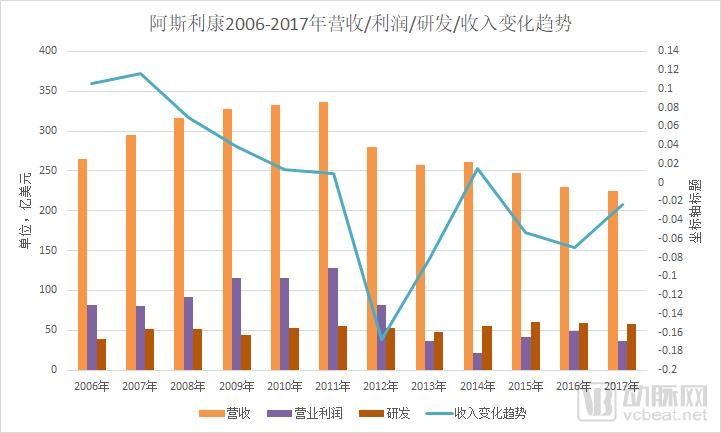
Source: AstraZeneca Annual Report; Chart by VCBeat
Over the past decade, AstraZeneca’s development has roughly undergone two phases: a period of gradual growth from 2006 to 2011, and a phase from 2012 to 2017 marked by setbacks in performance growth and a gradual decline.
Pascal Soriot assumed the role of CEO at AstraZeneca in October 2012, effectively taking the helm during a period of crisis. The French executive, born in 1959, who began his career as a veterinarian and holds an MBA from HEC Paris, leveraged his experience from Aventis and Genentech to drive sweeping reforms at AstraZeneca. He laid off thousands of employees, invested £330 million in building a new R&D center, and revived several previously abandoned projects, including the blockbuster drug Olaparib.
Since 2012, although AstraZeneca’s performance continued to decline, it was evident that the downward trend had gradually been reversed. Especially in 2014,Pascal SoriotLeading AstraZeneca to successfully fend off Pfizer’s $100 billion acquisition bid is widely regarded as his crowning achievement at the company.
Therefore, when rumors emerged in July 2017 that Pascal Soriot would be jumping ship to the Israeli pharmaceutical company Teva with a salary double his current one at AstraZeneca, few in the industry believed them. For the 59-year-old Soriot, AstraZeneca was likely to be his final career stop.
July 26, 2018,Pascal SoriotLed the team in preparing the report on AstraZeneca’s Q2 and first-half financial results: AstraZeneca reported H1 revenue of $10.333 billion, a 5% year-over-year increase; core products in oncology, cardiovascular, renal, and metabolism demonstrated strong performance, with Q2 sales up 19% year-over-year and H1 sales up 14% year-over-year.
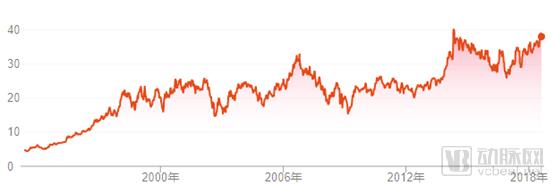
Boosted by Strong Q2 Earnings, AstraZeneca’s Stock Price Rebounds to Highs, with Market Cap Approaching $100 Billion
As the ancient Chinese saying goes, “When you reach an impasse, change; through change, you find a way forward; and by finding a way forward, you ensure longevity.” AstraZeneca, with its century-long history, undoubtedly understands this principle: innovation is the sole driver sustaining corporate development. This is especially true when performance falters; only through bold transformation, coupled with revenue expansion and cost reduction, can new growth engines be identified. This is one of the key reasons why AstraZeneca places significant emphasis on innovation, particularly digital innovation.
In March this year, Pascal Soriot stated at the 250th anniversary celebration of Homerton College, University of Cambridge, that the healthcare industry is undergoing a transformation driven by data, computing power, and intelligent technologies such as AI. Big data and related technologies may represent significant opportunities, with life sciences being a key sector in which (AstraZeneca) should capitalize on this boom.
So, what initiatives has AstraZeneca undertaken in digital innovation—represented by AI and big data—and what results have been achieved? VCBeat has compiled an overview.
AstraZeneca’s Digital Innovation Across All Business Segments
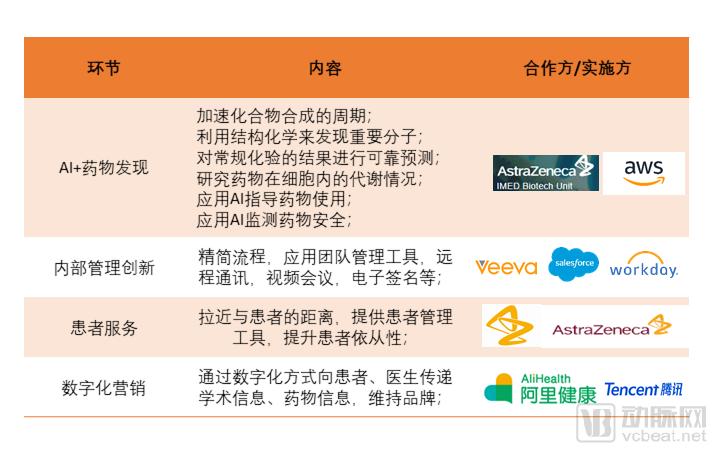
Previously, VCBeat published a report from AstraZeneca’s iLAB titled “Artificial Intelligence and Machine Learning Are Disrupting Drug Discovery and Development,” which provided a detailed overview of AstraZeneca’s efforts in applying AI.
In summary, it includes the following aspects:
1. Accelerate the cycle of compound synthesis;
2. Leveraging structural chemistry to discover important molecules;
3. Reliable prediction of routine laboratory test results;
4. Investigate the intracellular metabolism of the investigational drug;
5. Application of AI to Guide Medication Use;
6. Apply AI to monitor drug safety;
In 2017, AstraZeneca held a DMTA “Hackweek” (DMTA stands for Design–Make–Test–Analyze, the workflow for early-stage drug discovery). Scientists from various research sites collaborated with internal experts at AstraZeneca to build the first “DMTA machine” model by leveraging their scientific knowledge and technical expertise. Working continuously for five days in the innovation lab in Gothenburg, they fundamentally transformed the approach to drug discovery. Embracing the “hacker” spirit, the team overcame numerous challenges by integrating hardware and software accumulated over more than two decades, ultimately creating a robotic platform capable of completing the entire DMTA cycle of a research project within two hours.
Establishing the three-dimensional chemical structures of potential new drugs is critical to drug development, as the size and shape of a molecule are paramount. These attributes influence many different properties, including interactions with biological systems and the manner in which molecules aggregate to form the active pharmaceutical ingredient. AstraZeneca is leveraging quantum computing to design the chemical structures of drugs for analysis.
In its research, AstraZeneca is also leveraging AI to enhance the efficiency of existing processes and transform data into knowledge. The company is using AI to reliably predict the outcomes of routine assays, such as human plasma protein binding (hPPB) tests, thereby enabling scientists to devote more time to issues that will provide AstraZeneca with a greater competitive advantage.
AstraZeneca is employing mass spectrometry imaging (MSI) to spatially map the cellular localization of molecules in biological samples and tissue sections, such as those used for pathological assessment. These comprehensive spatial data effectively link the tissue microenvironment with drug localization, efficacy, and safety. However, existing data mining methods impose high demands on computational systems, limiting AstraZeneca to analyzing small, individual datasets. To address this challenge, they developed new computational algorithms capable of accurately and efficiently segmenting large volumes of MSI data, thereby enhancing learning capabilities across multiple endpoints. Research on this work was published by AstraZeneca in Analytical Chemistry.
AstraZeneca has developed a new deep learning algorithm that leverages digital pathology to automate tissue biomarker analysis. The company aims to transform the automated analysis of digital pathology images into a high-throughput process and integrate AI algorithms into the development of diagnostic tests. Its goal is to use AI to influence patient treatment by directing targeted therapies to those patients who need them most.
AstraZeneca has also collaborated with multiple universities and research institutions to develop an innovative AI-driven drug alert system called “Watcher,” which incorporates the REACT 4 toolkit. This system organizes and visualizes safety, efficacy, and biomarker data from Phase I and Phase II clinical trials and is currently being utilized in more than 140 of AstraZeneca’s studies. REACT 4 can generate clinical interpretations on demand, and depending on the system in use, Watcher’s continuous monitoring can detect signals and provide timely notifications when such signals are identified.
In summary, from drug design to clinical trials, artificial intelligence (AI) has brought breakthrough advancements to every stage of drug development. With the assistance of deep learning, machines have begun to mimic the activity of neurons in the human brain, creating an artificial “nervous system.” AstraZeneca has employed AI methods in numerous pharmaceutical R&D trials to reduce costs and accelerate data availability.
In addition to its in-house efforts, AstraZeneca has partnered with Berg, a company headquartered in Boston, USA, to leverage AI for drug development. By testing more than 1,000 cancer and healthy human cell samples, the company identifies previously unknown cancer mechanisms, thereby pinpointing potential therapeutic approaches. The collaboration between the two parties focuses primarily on Parkinson’s disease and other neurological disorders.
As a large enterprise operating in more than 100 countries worldwide and employing over 60,000 people, internal management is also a key priority for AstraZeneca. During AstraZeneca’s transformation, IT innovations in internal management deserve particular attention. By adopting a systematic approach and selecting top-tier service providers, AstraZeneca reduced its IT costs from $2 billion in 2013 to less than $900 million in 2017.
Dave Smoley assumed the role of Chief Information Officer (CIO) at AstraZeneca in April 2013, reporting directly to CEO Pascal Soriot. Under his leadership, AstraZeneca streamlined its IT requirements and achieved significant reductions in IT costs. He and his team primarily focused on the following areas:
Serving Business Innovation
l Simplify processes and improve work efficiency by leveraging Veeva, Salesforce.com, Concur, and Workday;
l Expand reach and enhance engagement with healthcare practitioners by implementing multi-channel relationship marketing (MCRM);
l Provides an innovative approach to engaging and collaborating with patients through a newly created patient experience platform, enabling nurse educators to significantly increase patient interactions, ultimately leading to higher trial enrollment;
l Enhance patient engagement by developing mobile applications and smart devices;
l Support cutting-edge science and technology through the development of scientific computing platforms;
l Streamlined the deployment of a patient side-effect monitoring program for U.S. oncology operations, saving $10 million over three years while accelerating release readiness;
- Develop a patient support system to enhance patient engagement, provide reminders and encouragement, while gathering insights on the portfolio of asthma and COPD (chronic obstructive pulmonary disease) medications.
Serving Business Model Innovation
l In 2015, partnerships with Workday and Concur laid the foundation for simplified processes and significant time savings for over 66,000 colleagues;
l Delivered a more robust human resources function and improved efficiency through advanced computing, recruitment, a new service center hotline, weekday document management, piloting the Saba Cloud Code of Conduct, and implementing a learning platform strategy that yielded tangible results;
l Launched a new software store offering a streamlined user “retail” experience, saving 488 hours per month through simplified release processes and enabling end users to save 1,300 hours per month, thereby increasing scheduling revenue;
l Initiated financial transformation, driving the simplification and performance optimization of the entire finance department;
l The use of virtual reality enables AstraZeneca to streamline operational training processes, accelerate drug delivery, and ensure the implementation of its business strategy.
Technological Innovation
l Explored deep learning methods using experimental data on legacy compounds to predict new therapeutic applications;
l Tried a cloud-based, automated machine learning platform across multiple areas of our business, including accurately predicting exacerbations of chronic obstructive pulmonary disease (COPD) from patients' clinical trial data, early detection of machinery failures in operations, forecasting future employee attrition in human resources, and preprocessing repetitive wording in commercial advertisements;
l Collaborated with the oncology department to leverage AWS’s capability to analyze over 20,000 exomes in record time, uncovering new insights for drug discovery;
l Implemented a Hadoop-based data pool, enabling data analysis and integration at an unprecedented scale;
l Virtual reality is now being used to train new employees under sterile working conditions and to enable scientists in R&D to observe and design chemical compounds in a 3D environment;
l Reduced costs and time in remote engineering through the use of augmented reality-assisted technology;
l Scientists have begun using 3D printing to replace broken laboratory components, saving time and precious samples.
Dave Smoley stated that AstraZeneca has undergone a transformative shift over the past few years, evolving from a risk-averse, siloed, and slow-moving organization into one that now proudly embraces fast-paced innovation and entrepreneurial values, with IT playing a pivotal role in driving and enabling this transformation.
Dave Smoley stated that AstraZeneca’s IT department will focus on three key initiatives in the future: delivering world-class IT services through operational excellence, digitizing all of AstraZeneca’s business units, and identifying new opportunities for future growth.
AstraZeneca entered the Chinese market in 1993, with its headquarters in Shanghai. It currently has production and operational bases in Shanghai, Taizhou, Wuxi, and other locations, employing more than 10,000 people.
AstraZeneca’s Taizhou Supply Base, located in China Medical City in Taizhou, represents the company’s largest single investment to date, with a total investment of USD 300 million. The facility covers a total area of approximately 100,000 square meters, with a building area of 51,000 square meters. Groundbreaking took place in January 2012, and commercial production officially commenced in September 2014.
As a global strategic supply hub, AstraZeneca’s Wuxi Supply Site was commissioned in April 2001, with cumulative investments reaching $340 million and a workforce of 654 employees.
AstraZeneca’s China Logistics Center in Wuxi commenced commercial operations in June 2016, with an investment of USD 58 million. The facility features a fully automated high-bay warehouse, with Phase I offering a storage capacity of 30,000 pallets for the storage and distribution of pharmaceutical products sourced from AstraZeneca’s China operations and global supply bases.
In terms of R&D, AstraZeneca has established an Innovative Medicines Team for Emerging Asian Markets in Shanghai, dedicated to the development and proof-of-concept studies of innovative drug candidates, elucidating the underlying scientific mechanisms of the most prevalent diseases in China and Asia, and addressing the unique healthcare needs of Asian patients. Additionally, a small-molecule innovative drug R&D and manufacturing base has been established in Wuxi for the development and production of novel small-molecule therapeutics.
In 2017, AstraZeneca’s sales in China approached USD 3 billion, ranking among the top foreign pharmaceutical companies and demonstrating rapid growth.
AstraZeneca China pioneered its “3D” innovation strategy in 2015. The “3D” refers to Diagnostics, Device, and Digital. Through this 3D innovation concept, AstraZeneca aims to connect the previously isolated segments of disease diagnosis and treatment into an integrated continuum, creating end-to-end, whole-disease-course solutions for patients and meeting their needs at every stage of the diagnostic and therapeutic journey.
AstraZeneca’s digital innovations are highly aligned with the digital transformation of the pharmaceutical industry. Pharmaceutical giants, represented by AstraZeneca, are leveraging technologies and platforms such as artificial intelligence, machine learning, big data, and electronic data capture to accelerate drug R&D efficiency, expedite clinical trial processes, strengthen relationships with physicians and patients, and comprehensively revolutionize pharmaceutical business workflows.
In the field of new drug development, Exscientia alone has secured collaborations with Sanofi and GSK worth over $300 million. In terms of capital inflow, according to statistics from VCBeat, 14 “AI + New Drug” companies had raised a total of $276.82 million by June 2017; by July 2018, newly injected funds exceeded $600 million. Pharmaceutical giants such as Roche, Merck & Co., Takeda, and Johnson & Johnson also hold high expectations for the application of AI in drug discovery.
In digital marketing, over the past five to six years, more than 1,000 pharmaceutical companies have created tens of thousands of WeChat accounts and mobile apps targeting different medical specialties, diseases, and specific physicians, investing billions of resources.
In the life sciences sector, companies are grappling with mounting pricing pressures, the imminent “patent cliff,” and heightened regulatory scrutiny, all of which are driving increasing complexity in business models. Consequently, pharmaceutical companies are moving away from traditional face-to-face interactions driven by sales representatives, gradually adopting a model in which multiple teams deliver compliant information and content to multi-layered customers—including hospitals, healthcare networks, physicians, pharmacies, and other key decision-makers—through diverse channels.
Summing up all these phenomena, it is evident that the pharmaceutical industry is ushering in a “wave” of digital transformation. Why digital transformation, and why now? We believe there are three reasons:
First, since the advent of the internet, IT technology has become increasingly mature. Big data, artificial intelligence, and the Internet of Things have moved from theoretical stages to practical applications. Innovative companies providing technologies and “solutions” are growing rapidly, and the pharmaceutical industry offers highly favorable application scenarios.
Second, under the influence of the patent cliff, stricter regulations, a plateau in innovative drug output, and constrained drug prices, the pharmaceutical industry requires new technologies to drive reform, with digital transformation undoubtedly being a highly promising direction;
Third, “pioneers” such as Pfizer, Novartis, Roche, Johnson & Johnson, and AstraZeneca have already implemented digital technologies and achieved tangible results in drug R&D, clinical research, patient services, and marketing; it is only a matter of time before these experiences are replicated.
Based on this assessment, we believe the pharmaceutical industry is ushering in a wave of digitalization. Early adopters may gain first-mover advantages, while those indifferent to or resistant to technology will face accelerated obsolescence.
Returning to AstraZeneca’s digital innovation, we believe there are several key takeaways: First, the entire company—from the CEO and CIO to ordinary employees—is actively embracing innovation. Second, a dedicated department oversees digital innovation, enabling systematic resource integration and organizational restructuring. Finally, the company has strategically selected high-quality external service providers, comprehensively meeting its innovation needs through collaborations and service procurement.
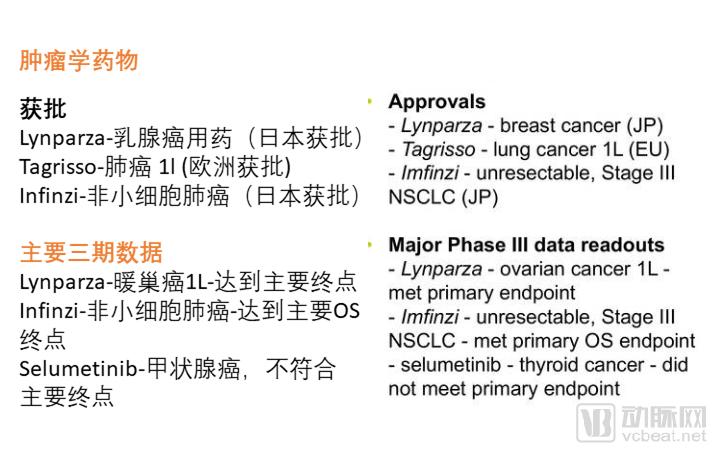
Of course, beyond digital innovation, AstraZeneca’s most impressive performance in its “return to glory” lies in its drug pipeline. In its Q2 financial report, AstraZeneca unveiled its R&D pipeline with the greatest growth potential.
AstraZeneca’s Oncology Drug Pipeline
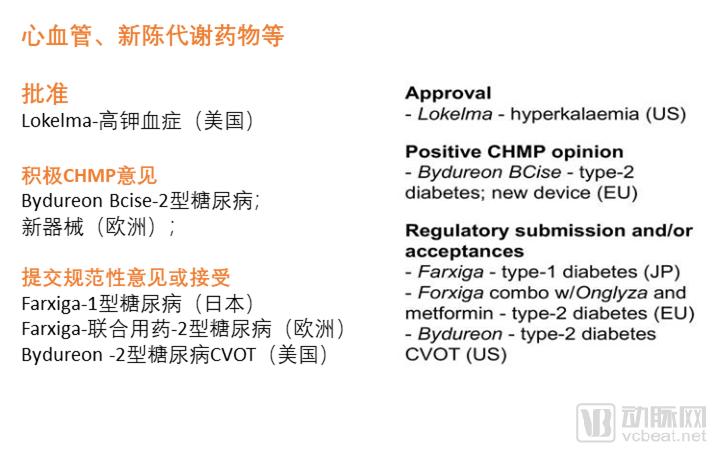
AstraZeneca’s Cardiovascular and Metabolic Drug Pipeline
In his book *Who Says Elephants Can’t Dance?*, legendary CEO Lou Gerstner recounts how he revitalized IBM, which was then “halfway to the grave,” through bold and sweeping reforms. A similar scenario may have applied to AstraZeneca five years ago. It was precisely the immense pressure of the “patent cliff” that compelled AstraZeneca to pursue determined internal innovation and fight with its back against the wall. Digital innovation has accompanied AstraZeneca’s resurgence and will continue to support the company as it moves further ahead.
[References]
https://seekingalpha.com/article/4190388-astrazeneca-group-plc-2018-q2-results-earnings-call-slides
https://www.astrazeneca.com/content/dam/az/PDF/2018/Pages%2046-49.pdf