

AK Health and WeiWenZhen Forge Strategic Partnership to Advance Out-of-Hospital Chronic Disease Rehabilitation Infrastructure
VCBeat (WeChat ID: vcbeat) has learned that on August 22, Sichuan Junyi Fudun Technology Co., Ltd. (hereinafter referred to as “Wei Wenzhen”) and Guangdong Akang Health Technology Group Co., Ltd. (hereinafter referred to as “Yun Yaoku”) signed the “Framework Agreement for Comprehensive Strategic Cooperation.”
By joining forces, the two parties will fully leverage their respective strengths in supply chain development, internet-based diagnosis and treatment, cloud-enabled services, and promoting the balanced development of the “medical + pharmaceutical” sectors. This collaboration will accelerate the establishment of the initial phase of out-of-hospital chronic disease rehabilitation programs at retail pharmacies, serving as a significant driving force in the fields of chronic diseases, critical illnesses, and rare diseases.
We hope to enhance, to some extent, the scientific understanding of the model where “initial diagnosis of chronic diseases occurs within hospitals, while follow-up visits and rehabilitation take place outside hospitals.” We also call on more enterprises to join the effort in building chronic disease rehabilitation systems. By leveraging internet technologies, we aim to establish an integrated “medical care + pharmaceuticals + insurance” ecosystem, shifting the focus from end-stage treatment to source-level prevention through the collaboration of multiple stakeholders. Ultimately, this will help the 360 million chronic disease patients in China gradually recover and raise awareness of disease prevention.
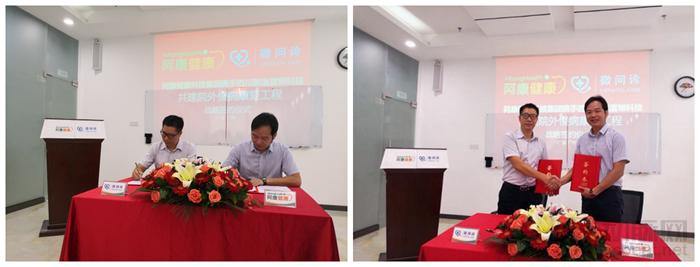
Strategic Cooperation Signing Ceremony: Left: Zhou Congjun, Co-founder of Sichuan Junyi Fudun Technology; Right: Wang Lijue, Chairman of Akang Health Group
As China’s industrialization, urbanization, and population aging accelerate, the impact of residents’ lifestyles, ecological environment, and food safety on health has become increasingly evident. The incidence, prevalence, and mortality of chronic diseases continue to rise, imposing a growing disease burden on the population.
In October 2016, the State Council issued the Outline of the “Healthy China 2030” Plan, followed by the Medium- and Long-Term Plan for the Prevention and Control of Chronic Diseases in China (2017–2025) in January 2017. Both documents explicitly set forth regulatory frameworks and developmental guidelines for the entire continuum of chronic disease management, from diagnosis and treatment to rehabilitation. They emphasize the coordination of all social resources, the integration of health considerations into all policies, and the establishment of a system centered on self-prevention, collaboration between medical care and public health, and co-construction and shared benefits. These initiatives aim to shift the focus from disease treatment to health management, with the goal of significantly improving the environment for chronic disease prevention and control by 2020, reducing the mortality rate from chronic diseases among individuals aged 30–70 by 10% compared to 2015 levels, and achieving whole-population, full-lifecycle health management by 2025.
In reality, although national health policies are being continuously deepened and implemented, significant challenges remain, including accelerating population aging, slow development of medical service infrastructure, shortages of professional talent, inadequate medical resources and pharmaceutical supplies at the primary care level, and incomplete accumulation of health data. In the internet era characterized by continuous policy innovation and technological advancement, and against the backdrop of a large base of individuals at risk for chronic diseases and an aging online user demographic, achieving the digital transformation of the chronic disease management industry through industrial internet solutions and constructing truly patient-centered out-of-hospital service scenarios represent key areas of exploration in the strategic partnership between Wei Wenzhen and Cloud Pharmacy Warehouse.
At the signing ceremony, both parties reached a high level of consensus to integrate their resources with chronic disease rehabilitation as the core framework, implementing the construction project in three phases:
I. FromIn-Hospital to Out-of-Hospital Coordination: Initial consultations are conducted on-site, while follow-up services are provided via Internet-plus healthcare platforms. Physician services further deepen the traditional “diagnosis, treatment, rehabilitation, and follow-up” workflow by integrating prevention, health maintenance, medical care, rehabilitation, and health education. Building on existing foundations, common disease indicators and clinical medication pathway data are systematically organized and categorized to establish standardized health benchmarks, thereby delivering comprehensive, precise health management and chronic disease rehabilitation services.
II.Scenario-Based Pharmacist Services: The first point of contact for out-of-hospital chronic disease rehabilitation will be the pharmacy. Chronic disease management requires patient adherence; therefore, it is essential to first establish pharmacist-led service scenarios. This can be achieved by providing pharmacists with specialized training, developing standardized chronic disease management protocols, enhancing service quality, and strengthening the pharmacist’s managerial role, thereby encouraging patients to proactively adhere to their treatment plans. By redefining the relationships among patients, medications, and services, an ecosystem centered on shifting from medication management to disease-specific management should be established, thus comprehensively advancing chronic disease rehabilitation services within grassroots chain pharmacies.
III.Promoting Pharmaceutical Care Services, Develop a Rational Drug Use System: By fostering collaboration between hospitals and external entities and promoting interaction from physicians to pharmacists, drive the circulation of the existing pharmaceutical market with a patient-centric approach. Establish digital analytical models for service lines extending from hospitals to pharmacies. Based on clinical medication pathways centered on disease management, integrate third-party insurance as an intermediary. Within a multi-stakeholder regulatory environment for medication use, explore a PBM (Pharmacy Benefit Management) model with Chinese characteristics by launching chronic disease insurance, thereby providing customers with truly necessary medical insurance, reducing their financial burden, lowering healthcare costs, and achieving rational drug use.
Wang Lijue, Chairman of Akang Health Group, stated that the future of chronic disease management in China requires the establishment of a closed-loop system by integrating follow-up rational medication services within a big data monitoring environment. Guided by a patient-centric philosophy, every location accessed by patients becomes a service point, and their urgent needs define the focus of care. Moving forward, both parties will continue to advance chronic disease management amidst the rapid segmentation of the healthcare market. By leveraging over 20,000 partnered terminal stores, they aim to serve nearly 150 million individuals with chronic conditions in surrounding areas, thereby constructing an out-of-hospital retail-based chronic disease management framework. This initiative ensures that the general public can receive reliable medical care conveniently at their doorstep. Furthermore, the foundation for chronic disease services will be strengthened through the continuous integration and sharing of industry resources; health data analysis models will be developed using innovative internet technologies; and the service capabilities of physicians and pharmacists will be enhanced through ongoing professional education and skills training.
“Cloud Pharmacy” is a supply chain shared operations brand under Guangzhou Zhenkang Pharmaceutical Co., Ltd., a subsidiary of Guangdong Akang Health Technology Group Co., Ltd. The parent company, Guangdong Akang Health Technology Group Co., Ltd., is a comprehensive group focused on the distribution of prescription drugs for chronic diseases, chronic disease management, hospital prescription circulation, e-commerce operations, and growth in out-of-hospital prescription volume.
Leveraging internet technology innovation and building upon years of clinical resources and supply chain advantages, the company is dedicated to providing professional pharmaceutical care and Chronic Disease Care (CDC) services to patients with chronic conditions outside hospital settings. It offers supply chain services for chronic disease prescription drugs to terminal pharmacies, pharmacy chains, clinics, and primary healthcare institutions. Additionally, it supports the pharmaceutical industry by expanding off-hospital prescription drug channels, driving product growth, and managing patient data. The company focuses on chronic diseases, critical illnesses, and rare diseases, operating a portfolio of over 12,000 prescription drugs for chronic conditions and establishing direct collaborations with more than 1,000 domestic and international manufacturers. It holds exclusive off-hospital distribution rights for over 200 products, with its product mix covering treatments for more than 1,000 types of chronic, critical, and rare diseases.
“Wei Wenzhen” is Sichuan Junyi Fudun Technology Co., Ltd.’s O2O telemedicine service platform, the first in China to adopt audio-video consultations and deliver services through pharmacies. The company is a high-tech enterprise specializing in “Internet + Healthcare,” providing remote pharmaceutical and medical services as well as electronic prescription circulation.
To address the current issues faced by the general public in purchasing medications, seeking medical care, pharmacy operations, and government regulation, we propose the principle of “Consult Before You Buy.” Leveraging internet and telemedicine technologies, we have progressively developed and launched an O2O integrated healthcare service platform available on both PC and mobile devices. This platform, comprising “Good Pharmacist,” “Micro-Consultation,” “Fudun Cloud Hospital,” and “FT-Health,” integrates remote pharmaceutical services, basic medical care, and health management. It aims to provide a gradual solution to social challenges such as ensuring rational and safe medication use, as well as alleviating the difficulties and high costs associated with accessing medical care.
To date, the company has established more than 30 service centers across China, covering over 140 cities in more than 30 provinces. It has gained significant recognition in the field of telemedicine and ranks first in market share for “Internet + Healthcare” services among retail pharmacies. Its daily volume of remote consultations exceeds 100,000 cases. In 2018, it was listed among Chengdu’s Top 100 New Economy Enterprises.