

Bionano Genomics Raises $20.58 Million in Nasdaq IPO to Advance Optical Genome Mapping Platform
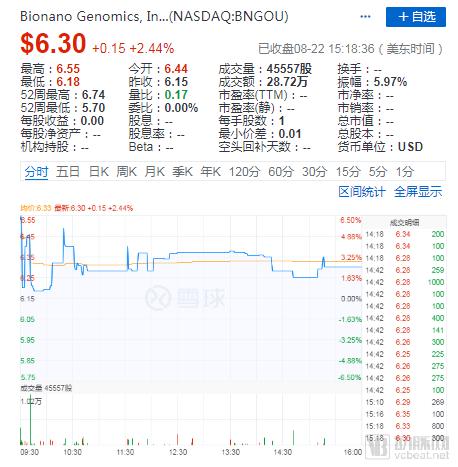
Image from Xueqiu
On the evening of August 22, 2018, VCBeat learned that Bionano Genomics had officially listed on the NASDAQ in the United States. Its initial public offering was priced at $6.125 per share, with 3.36 million shares issued, raising a total of approximately $20.58 million.
It is reported that Bionano Genomics, with the stock ticker symbol BNGOU, officially began trading last night. As per convention, the offering is expected to close on August 23, New York time. Previously, the company had aimed to raise $38 million. However, last week, it reduced the size of its initial public offering to 2.45 million shares, with an anticipated price range of $6–$7 per share.
Bionano, founded in 2003 and headquartered in California, is a life sciences company specializing in genomic analysis and scientific instruments.
The company’s proprietary nanopore-based single-molecule DNA genome assembly technology enables the detection of structural variants in genomes, allowing researchers and clinicians to accelerate the discovery of novel diagnostic and therapeutic targets and streamline the study of chromosomal alterations. Building on this technology, the company has developed Saphyr, an ultra-sensitive and ultra-specific structural variant detection platform that includes an integrated system comprising the instrument, chip consumables, reagent kits, and a comprehensive suite of data analysis tools.
In simple terms, single-molecule imaging technology generates a genomic map of long single-molecule fragments. So, what are the differences and connections between this and Next-Generation Sequencing (NGS) technology? To quote Dr. Han Cao, its founder: “The map represents planar information, viewed from top to bottom like looking at a geographic map; sequencing, in contrast, yields linear information, assembled segment by segment in a linear fashion from below.”
In its previous prospectus, Bionano disclosed that it intended to use the proceeds from its offerings to expand commercial operations, continuously improve and iterate its technology, and develop additional reagents. After commercializing its second-generation single-molecule genomic analysis platform, Irys, in 2014, Bionano launched the third-generation high-throughput single-molecule genomic analysis platform, Saphyr, in 2017. The platform systems are now deployed across all five continents. The third-generation Saphyr chip can complete high-depth (640 Gb–890 Gb) de novo whole-genome map assembly and large structural variant detection for two individuals within a single day.
Bionano founder Han Cao is a Chinese scientist who graduated from the University of Science and Technology of China. After a brief stint at the State Key Laboratory of Plant Genetic and Protein Engineering near Weiming Lake at Peking University, Cao traveled to the University of Delaware to pursue his Ph.D., and joined the University of Pennsylvania Medical Center in 1998.
Although headquartered in the United States, Bionano has maintained close engagement with China’s NGS industry. Han Cao founded Bionano with the original intention of leveraging single-molecule long-range mapping technology to address the “pain points” of NGS.
The principle of next-generation sequencing (NGS) involves fragmenting the genome and interpreting it piece by piece. Its advantages include speed and cost-effectiveness; however, the process of reassembling these fragments is notoriously challenging. Assembly would be relatively straightforward if the fragments were non-repetitive, but the absence of repetitive sequences in genomic fragments is virtually impossible.
What sets Saphyr apart is its ability to leverage nanofluidic silicon chips for long-range, linear analysis of whole genomes at the single-molecule level, providing customers with solutions to challenges that are difficult or impossible to address comprehensively using next-generation sequencing (NGS).
In 2014, the company secured $53 million in Series C financing, co-led by Legend Capital and Novartis Venture Fund. Beyond capital investment, Bionano has maintained close collaborations with enterprises. In 2016, Berry Genomics entered into an agreement with Bionano to jointly develop next-generation clinical products for chromosomal structural variation analysis based on the Irys® platform (Bionano’s second-generation technology), with Berry Genomics responsible for submitting product registration applications to the China Food and Drug Administration (CFDA). Additionally, the company has established cooperative relationships with numerous domestic gene sequencing firms, such as FutureOmics and GeneCloud Health.
The prospectus also disclosed their direct commercialization efforts in China, assisting existing and future partners in conducting product development beyond scientific research, and seeking approval from relevant authorities. Specific areas may include instruments, reagents and consumables, and laboratories, among others.