

Helix Files IPO Prospectus: The 'App Store for DNA' Bets on One-Time Sequencing, Infinite Insights
Unicorn Companies: A term generally used in the investment community to refer to companies with a valuation exceeding $1 billion and a relatively short founding history.
During the growth of startups, two extreme phenomena often emerge: some companies struggle for years only to secure meager funding, while others, like magnetic money-attractors surrounded by investors as if they were the center of attention, rapidly close multiple rounds of large-scale financing within just a few years, soaring to become industry unicorns.
What kinds of companies can become unicorns? What characteristics do they possess, and where lie their competitive advantages that set them apart from the crowd?
VCBeat has recently launched a special feature titled “Super Unicorns,” compiling a list of companies that achieved unicorn status within three years of their founding, based on the VCBeat knowledge base. Six companies were rigorously selected for in-depth case studies. If you are active in this industry, you are welcome to engage with the authors at any time; for media coverage inquiries, please contact VCBeat directly.
Helix, established in 2015, is a subsidiary of the sequencing giant Illumina. Although Illumina’s business presence permeates every corner of the sequencing industry, it has primarily conducted its operations through internal divisions. For instance, the non-invasive prenatal screening (NIPS) business is managed by the corporate entity itself (following the acquisition of Verinata Health), while the early cancer screening business was strategically placed under its subsidiary, Grail. Helix stands out as one of the few subsidiaries of the company, bearing nearly all of the parent company’s expectations for the consumer genomics market.
At its inception, Helix secured $100 million in financing, a feat that drew the envy of many startups. Although it did not attract capital as aggressively as its sibling companies during subsequent development, Helix’s Series B funding round still reached $200 million. Furthermore, unlike GRAIL, Helix does not need to conduct large-scale clinical trials, and thus its urgency for capital is less pronounced.
Undeniably, Helix has remained in the industry spotlight since its inception, partly benefiting from its association with Illumina. However, unlike the business models of companies such as 23andMe, Helix aims to truly digitize life, enabling users to achieve more precise self-management. To this end, it introduced the concept of a “Genetic App Store,” integrating genetic data with everyday life and carving out its own unique business model.
Helix’s current CEO is Robin Thurston, who graduated from the University of Colorado Denver, a public research university in the United States.
Thurston is an avid sports enthusiast who has consistently maintained a routine of cycling and running since 1981. In his early career, Thurston founded MapMyFitness, a fitness management company. The company was acquired in 2013 by Under Armour, a renowned American premium performance athletic brand, leading to Thurston joining Under Armour as its Chief Digital Officer.
In 2017, Thurston joined Helix as CEO, transitioning from the sports and health sector to biotechnology.
Scott Burke is the company's co-founder and CTO. Burke graduated from Harvey Mudd College and has nine years of work experience at Yahoo, where he successively served as Vice President and Senior Vice President of the Big Data Platform.
Burke joined Helix in August 2015. His experience in building teams at both startups and large corporations has enabled him to accumulate business expertise in the fields of online healthcare, data analytics, and consumer sectors.
CMO Deena Bahri graduated from Swarthmore College, one of the top liberal arts colleges in the United States, and subsequently earned an MBA from Harvard Business School. As a seasoned marketing executive, she has held marketing leadership roles at multiple companies, including TheLadders.com, Gilt Groupe, Birchbox, and Juicero. Bahri officially joined Helix in September 2017.
In addition, Helix has assembled a team of scientific advisors specializing in law, medicine, and disease research, with members hailing from top-tier research institutions and universities such as Harvard Medical School, the Mayo Clinic, the University of Michigan, and Duke University.
Unlike the one-product, one-test model adopted by other companies, Helix chooses to offer consumers a low-cost whole-genome sequencing test first, and then gradually sell individual reports.
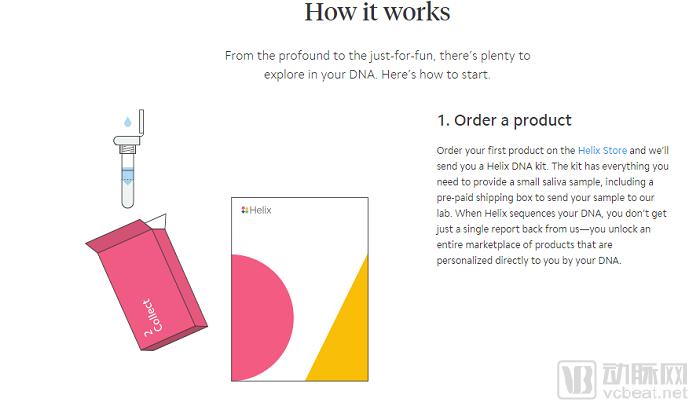
Users can undergo whole-genome sequencing for just $80. After placing an order, they receive a Helix DNA kit shipped by Helix. Similar to other comparable products, the kit includes a small saliva collection device and a shipping container. Once the sample is collected, users mail it back to Helix’s laboratory for sequencing. Because Helix employs next-generation sequencing (NGS) technology, it generates 100 times more data than similar sequencing products currently available on the market.
What is even more surprising is that after the sequencing is completed, users do not receive any reports from Helix. Instead, they must pay for the specific items they wish to explore based on their needs or interests in order to receive the corresponding reports. This is akin to providing users with an App Store for genetic testing, where they can choose to download the paid “apps” they need.
In this process, sequencing is not the end but the beginning of a journey into genomic exploration.
Of course, as long as users undergo testing using Helix’s kit, Helix is obligated to manage and store their data. They employ the same security technologies used by online banks to store and protect users’ DNA data, and ensure the security of this information through rigorous security protocols.
Moreover, even the “developers” who provide “software” on the platform do not have access to users’ complete data. Helix shares only a small subset of data with these “developers” after users have purchased the corresponding items, enabling them to generate test reports. Upon completion of the analysis, users are notified of these reports via email.
However, for the “developers” behind the scenes, leveraging Helix’s platform ecosystem and Illumina’s brand backing provides them with a more favorable marketing environment, making customer acquisition significantly easier than going it alone. Furthermore, Helix handles the entire process from sample submission to data generation, leaving these companies to focus solely on final data interpretation. By eliminating the need to purchase equipment or build laboratories, they avoid hardware expenditures in the upstream and midstream segments, enabling an asset-light operational model particularly advantageous for startups.
Furthermore, this model also prevents users from undergoing redundant testing when screening for different conditions. Once tested, users are effectively locked into the Helix platform, where they are likely to purchase most of their subsequent reports.
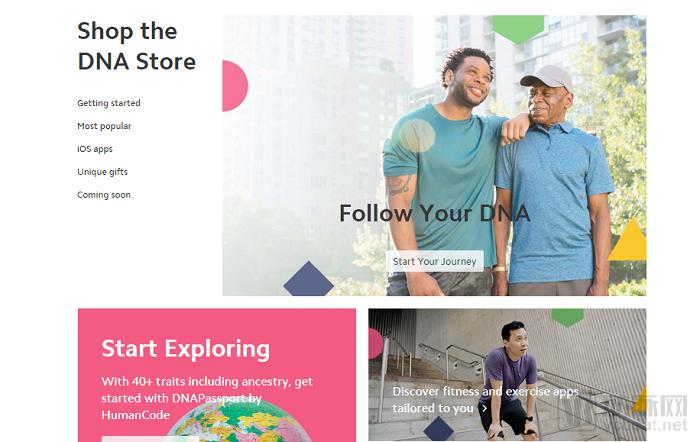
Currently, Helix categorizes the products on its platform into four major categories: Ancestry, Health, Personal Management, and Entertainment.
Compared with Ancestry and 23andMe, Helix’s ancestry products are slightly more affordable. Several ancestry-related products from Insitome (including ethnicity, as well as migration and diet) are all priced at $69.99.
Health products focus on medical-related testing, providing insights to physicians through genetic analysis and health screenings under rigorous scientific and clinical validation.
Products in this category currently focus primarily on genetic disorders and chronic diseases, such as Alzheimer’s disease, diabetes, and familial hypercholesterolemia. Compared with other major categories, Healthy’s offerings are significantly more clinical in nature. Furthermore, the company has launched a one-on-one consultation service, allowing users to receive guidance from clinically experienced physicians on how to better utilize their genetic data for just $75.
This sets it apart from many companies in China, most of which ultimately provide dry, tedious test reports. However, users have no one to consult on how to apply these reports in their daily lives. Lacking genetics knowledge and with companies failing to offer open communication channels, a barrier to dialogue emerges between the two parties, making it difficult for users to enjoy a satisfactory product experience.
The emergence of genetic counseling has addressed this issue. However, in China, a formal workforce structure for genetic counselors has yet to be established, making this model currently impractical for the Chinese market. Nevertheless, the concept of upstream and downstream integration is worth learning from.
Moreover, these products typically focus on a single disease condition, offering only superficial insights. For instance, patients with diabetes spend merely two hours per year consulting with their physicians, leaving the remaining 8,758 hours for self-management. These tests can help users gain a better understanding of their own health, thereby facilitating more effective participation in self-management. In this regard, the author favors small yet elegant solutions.
Personalized management products are more closely related to metabolic health, utilizing genomics to identify the most suitable metabolic profiles and lifestyle interventions. Currently, these products are primarily associated with sports and wellness, aligning with the consumption demands of target users such as urban white-collar professionals.
Among them, four products are from DNAFit, a European startup specializing in sports and wellness genetics. Its offerings include tests for fat burning, muscle building, and dietary plans. This differs from many Chinese companies, whose products tend to be more generic—either bundled into high-priced packages or vaguely centered around a few metabolomics markers.
Additionally, Azumio integrates mobile fitness with genomics by linking single-item testing products to downstream applications and providing online fitness recommendations. At under $140, its price is significantly lower than that of personal trainers at gyms.
Compared to entertainment-oriented genetic testing in China, Americans exhibit far greater creativity. A company named Dot One is attempting to merge fashion, daily life, and genetics by offering DNA-customized clothing, socks, bags, blankets, scarves, and artwork. However, with prices ranging from $90 to $240, the key question remains: how many consumers are willing to pay?
Moreover, consumer-facing products are often prone to criticism. Soccer Genomics’ product, which offers personalized training plans based on DNA test results, drew widespread online backlash due to its ill-conceived marketing advertisements. This also poses a challenge for Helix: how should it manage and oversee such products?
“Critics of personal genomic testing remain, and we welcome their voices; scrutiny and debate will help the industry operate more effectively. However, large-scale sequencing of exomes and genomes is inevitable. From ancestry analysis to aiding in the diagnosis of familial hypercholesterolemia, genetic information can help people lead healthier and happier lives,” Thurston mentioned in an interview.
Unlike the hands-off approach adopted by the Google Play Store, Apple Inc. strictly vets every app submitted to its platform through a rigorous review process. Helix has replicated this model. The company maintains an internal team of 14 members responsible for vetting each product, including scrutinizing the underlying scientific principles, with the aim of filtering out pseudoscientific tests.
“We hope such procedures can earn consumers’ trust; products on the Helix platform are reliable,” said Thurston.
Titanovo is one of the products listed on Helix, specializing in DNA-based dietary plans. Its CEO, Savsunenko, shared insights into Helix’s review process. Savsunenko revealed that the company initially submitted 200 scientific studies to support its product, but 60%–70% of them failed to meet Helix’s standards. “I was certainly disappointed; they kept pointing out flaws here and there. But ultimately, it cannot be denied that our product has been upgraded.”
It is understood that Titanovo has discontinued its early product, DNA Lifestyle Coach, and is currently focusing on its Helix-based product, DNA Diet Coach.
However, Helix also offers some controversial products, such as its wine preference test. The developer behind this product is Vinome.
Skeptics argue that while DNA can predict what flavors a person is capable of tasting, it cannot truly determine whether that person will enjoy them. However, Thurston contends that Vinome has provided a solid scientific foundation: their taste algorithm is based not only on DNA test results but also on extensive questionnaire data, making the approach feasible.
“My view is that the value of genetic data is to provide you with a baseline,” said Julia Cheek, CEO of EverlyWell. EverlyWell is also a consumer-focused nutrition genetics company, primarily offering testing services for protein and fat content in blood and breast milk. The company currently provides food sensitivity, metabolism, and breast milk testing services through the Helix platform, while also conducting DNA research.
Of course, in addition to directly serving individual consumers, Helix is also pursuing larger contracts, namely community services.
Thurston cited the company’s partnership with the Healthy Nevada Project, announced in early January, as an example. Launched in 2018, this initiative has provided Exome+™ sequencing to tens of thousands of Nevada residents, opening up new avenues for community health. The “Exome+” service can be understood as exome sequencing based on next-generation sequencing (NGS) combined with Helix’s customized targeted capture sequencing. By connecting users with clinical-grade genetic information, it has created unprecedented opportunities. “We believe this will usher in a new era of personalized medicine, enabling people to live healthier, happier, and longer lives,” Thurston stated.
In the future, studies involving large-scale populations will be crucial for deciphering the relationship between health and genetics. A comprehensive understanding of multi-modal data can help identify new risk factors within populations, thereby further improving people’s health outcomes and uncovering novel biomarkers that may lead to new therapies. This will facilitate the right interventions in the right populations at the right time, enabling the prevention, mitigation, and treatment of diseases.
As more organizations recognize the vast potential of genetic testing, Helix’s opportunities to impact community health and population genetics will continue to grow. For example, the National Institutes of Health’s All of Us program aims to sequence one million volunteers, and the UK Biobank has released genetic data from its cohort of 500,000 participants. Geisinger, a partner of Helix, announced in 2017 that its MyCode Community Health Initiative—which enabled ordinary Americans to undergo genomic testing in primary care settings for the first time—had enrolled more than 166,000 individuals.
Robin Thurston stated, “We believe we are reshaping the world of health and medicine, one in which access to valuable DNA information is as commonplace as checking blood pressure; in turn, researchers will be able to identify more actionable associations between our DNA and phenotypic traits.”
First, with a person-centered approach, users can actively participate in their own health management, no longer serving as static “samples.” Second, sequencing the genomes of hundreds of millions of healthy individuals and integrating their genetic data with other datasets (such as electronic medical records [EMR] and behavioral data) will enable deeper exploration of health baselines, disease progression, and prevention. Finally, from both cost and efficiency perspectives, genomics can transition into an “on-demand” model.
In 2018, Helix will prioritize the promotion of health-category tests.
The most distinctive feature that sets Helix apart from other consumer genomics companies is that it does not offer any products directly, yet it enables the provision of virtually any product to consumers. Meanwhile, its relationship with other companies is not purely competitive; there is potential for collaboration with both corporations and institutions.
By providing testing services, they have gained access to user data, which enables them to attract more developers and firmly retain consumers. Additionally, other startups can save on costs associated with laboratories and testing, granting them greater flexibility to focus on refining their products.
Of course, there have been similar products in China, such as Yimai Gene launched by Jiyun Huikang. Currently, several gene companies with blockchain concepts are also aiming to establish a similar environment on the blockchain. However, due to domestic consumer spending power and the immaturity of blockchain applications, the development of these projects has been relatively slow.
Beyond the aforementioned features, Helix actually has a hidden function—helping entrepreneurs find inspiration. It acts like a marketplace, bringing together a wide variety of products. In this way, startups have plenty of references to draw from.
If Helix can eventually display user ratings, product download counts, and even product reviews, similar to the App Store, consumers’ perceptions and evaluations of products will become clear at a glance.