

GenePoint Secures Tens of Millions in RMB in New Round Led by Zhongwei Fund
On August 24, 2018, BaseBiotech (Shanghai) Co., Ltd. (“BaseBiotech”) announced that it had recently completed a new round of financing. This round raised tens of millions of RMB, with Zhongwei Fund as the sole investor. One year prior, BaseBiotech had secured its Series A financing from Bangming Capital.
Basepoint Bio, established in 2015, is a technology-driven biotechnology company. The company focuses on innovative development, technological application, and process management in the field of cryogenic biological samples, striving to promote the integration of intelligent, automated, and Internet of Things (IoT) technologies within the cryogenic supply chain.
Basepoint Bio’s core products are its independently developed, next-generation automated cell biospecimen storage systems based on cryogenic automation and biocryopreservation technologies, as well as integrated solutions for alternative energy equipment.
In simple terms, the storage of biological samples can be likened to book storage in a library. When the volume of books and the frequency of borrowing are low, manual management is sufficient. However, as the inventory and turnover of books increase, relying solely on manual labor becomes increasingly inadequate.
Mr. Chen Zhehua, the founder, told VCBeat: “Previously, sample storage in the laboratory relied primarily on manual management. With the adoption of an automated management system, all sample information is verified during both inbound and outbound processes. This not only significantly reduces labor costs but, more importantly, enhances the consistency of sample quality and ensures the traceability of sample information and data. For large-scale biobanks, the improvements in access efficiency and the reduction in labor costs achieved through automation are quite substantial.”
Accurate storage of samples requires not only a comprehensive labeling system, retrieval system, and inventory records to ensure precise handling during every access; most importantly, the entire process must be conducted below the glass transition temperature (Tg, below which intracellular microscopic activities effectively cease) to prevent irreversible damage to the samples caused by repeated freeze-thaw cycles.
To address the issue of viability loss in biological samples during handling, Basepair Bio initiated the research and development of an automated ultra-low temperature system in early 2016. This represents the optimal solution for quality control in biological sample storage, featuring a workstation that can be directly placed in a liquid nitrogen environment below -190°C—a technological first worldwide.
“Samples were handled and organized on a cryogenic workbench maintained below -150°C, minimizing temperature fluctuations and ensuring quality integrity,” he continued.
Through the joint efforts of China’s leading teams in ultra-low temperature technology and automation, BasePoint Bio launched the Hatch™ system last November—the world’s first automated biospecimen access system capable of operating at temperatures well below the glass transition temperature. By integrating cutting-edge AGV (Automated Guided Vehicle) intelligent robotics technology, the system effectively meets the stringent requirements for biospecimen safety and long-term integrity in the era of precision medicine.
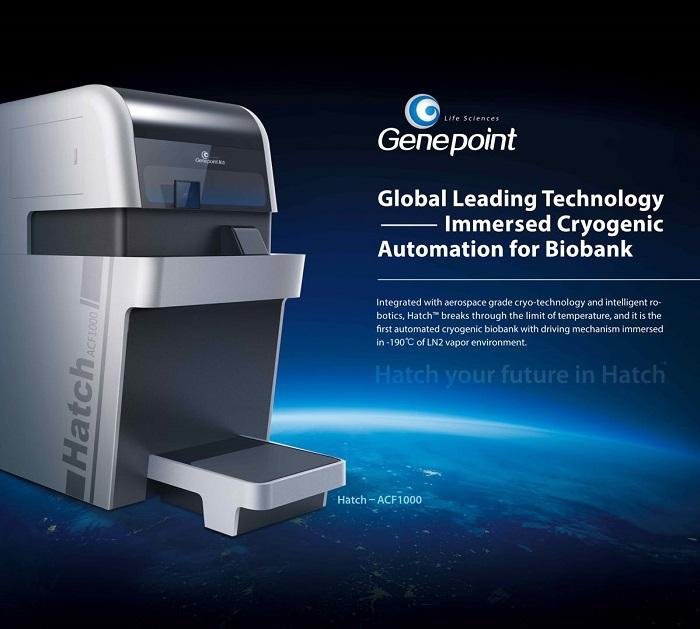
Hatch™ Automated Biospecimen Access System
The introduction of the Hatch™ system will facilitate the provision of full-lifecycle storage status data for samples to researchers, thereby strongly supporting the evidentiary basis of life sciences research and enhancing the credibility and reproducibility of scientific findings.
“Our core technology is the entire new structure that operates safely and stably at cryogenic temperatures. This is an interdisciplinary collaboration with a relatively high technical threshold; currently, our technology is globally leading in this field,” stated Mr. Chen Zhehua.
Currently, Jidian Biotech’s user base primarily falls into two major categories: the first comprises large public institutions (including national-level research platforms and hospitals); the second consists of commercial clients engaged in the R&D, manufacturing, and storage of cell therapy technologies. “These application scenarios share two characteristics: one is a large volume of stored samples, and the other is the high quality requirements for sample processing,” he stated.
To serve these two types of clients, Base Biologics has developed large-capacity automated storage systems to meet the storage and management needs of large-scale biobanks. For smaller laboratories at universities and research institutes, Base Biologics has also introduced compact, scaled-down equipment. These solutions will provide significant support to scientific research customers.
Regardless of the size of the biobank, the quality requirements for samples remain consistent: minimal temperature fluctuation, minimal human intervention during handling, and sample conditions that closely approximate their ex vivo state.
From the outset of its product launch, BasePoint Bio initiated globalized and branded operations. By leveraging channels established through continuous academic conferences and marketing campaigns held both domestically and internationally, the company has effectively delivered product information to customers. Last year, it secured an order from the Singapore Academy of Sciences for its first ultra-low temperature automated equipment, even while the device was still in the blueprint stage. This year, it has further won orders from multiple strategic clients, achieving robust revenue growth.
Following this round of financing, the company will further invest in the research and development and production of new automated storage equipment. Meanwhile, with the rise and growing prominence of CAR-T technology, a consensus is emerging within the industry that this technology may reshape the entire biopharmaceutical landscape. As an equipment manufacturer, he believes the company is well-positioned to enter the field of CAR-T cell processing.
“The commercialization of CAR-T therapy has created vast opportunities across the upstream and downstream sectors of the cell therapy industry, while also presenting unprecedented challenges and opportunities for upstream equipment manufacturers,” he stated. “We have observed that, driven by the need to comply with Good Manufacturing Practice (GMP) requirements, multiple stages of the CAR-T manufacturing process are shifting toward more automated, closed, and traceable technologies and equipment. However, all such products are currently monopolized by foreign companies, making it difficult to offset the high equipment costs through reductions in labor expenses.”
“We believe that the true transformation of the industry will inevitably be triggered by a cost tipping point. With substantial accumulation in automation technology, we are confident that in the near future we can provide customers with more comprehensive, high-quality, and cost-controllable equipment and technologies, helping the industry strive to reach this critical threshold,” he added.
It has been revealed that Basepoint Bio currently offers intelligent solutions for the cryogenic storage and retrieval stage of cell therapy manufacturing processes.
“This represents an excellent entry point into the industry. On one hand, our technology and products in this area are already highly mature; on the other hand, regardless of how technical pathways evolve in the future, the fundamental requirement that cells must be stored at ultra-low temperatures to ensure long-term viability will remain unchanged,” stated Mr. Chen Zhehua. “This gives us a significant advantage. No matter how many competitors enter the field, our starting position will be exceptionally high due to our accumulated technological expertise and customer base in the realm of ultra-low temperature automation.”