

10 Innovative U.S. Companies Transforming Healthcare Payment Platforms
Healthcare is one of the most important industries in the United States, with healthcare expenditures accounting for approximately 18% of GDP, significantly higher than those of other developed nations. Research indicates that patient out-of-pocket payments constitute 35% of U.S. healthcare providers’ revenue, second only to Medicare and Medicaid. However, complex medical billing and the rising proportion of out-of-pocket costs have become barriers to healthcare payment, creating opportunities for innovation.
VCBeat (WeChat ID: vcbeat) has compiled a list of 10 innovative U.S. companies, analyzing revenue cycle management (RCM) issues hidden behind medical bills and the development trends of the payment market through the healthcare payment platforms they have built.
When discussing medical billing and payments, one must mention the concept of Revenue Cycle Management (RCM). The Healthcare Business Management Association (HBMA) definesRCM is defined as "the process of managing reimbursement, payments, and revenue generation."Revenue cycle management begins when a patient seeks medical services from a provider and ends when all reimbursements and payments are completed. Healthcare organizations must follow these basic steps:
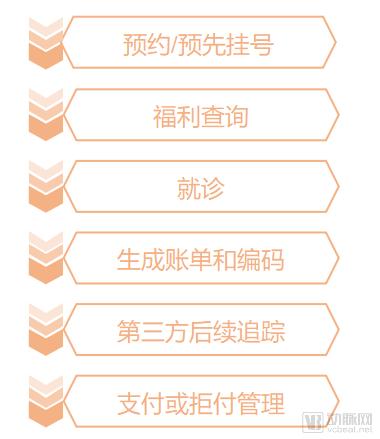
To some extent,RCM is the economic lifeline of healthcare organizations.. Currently, the entire U.S. healthcare revenue cycle management market is valued at approximately $50 billion and is projected to grow to $90 billion over the next four years, with medical billing serving as the core of revenue cycle management.
However, a survey by the Healthcare Financial Management Association (HFMA) reveals that healthcare organizations face numerous challenges hindering their optimization of Revenue Cycle Management (RCM). First, due to the excessive complexity of billing, processing times can extend over several months. During this period, bills often bounce back and forth between payers and providers before issues are resolved, while most patients are unable to pay medical costs upfront. Second, a lack of information makes it difficult for healthcare providers to address reimbursement-related issues. Finally, due to inadequate systems, healthcare institutions struggle to determine which procedures require prior authorization from patients’ health plans.
Therefore, the ultimate goal of Revenue Cycle Management (RCM) is to establish a process that enables healthcare institutions to collect service fees in the shortest possible time. Furthermore, as hospitals and smaller healthcare facilities gradually transition to value-based care models, they need to develop policies and programs to address financial challenges, thereby providing comprehensive revenue cycle management solutions.
Payment Platforms Based on Big Data Analytics and Information Technology Are an Effective Solution for RCM. As the healthcare environment continues to improve, healthcare providers must ensure the smooth operation of their entire workflow if they wish to sustain patient services and generate revenue. By building a platform centered on medical billing, healthcare institutions can alleviate concerns about revenue and focus more on delivering high-quality care to patients.
Given that most payments are tied to value-based care models, healthcare organizations need to balance the relationship among quality of care, patient satisfaction, and medical costs—a task that big data analytics can facilitate. In addition to managing large volumes of healthcare information, data analytics can also help predict reimbursement outcomes.
Information technology solutions have helped providers address common challenges in revenue cycle management (RCM), such as ICD-10 coding, communication between payers and providers, and medical billing processes. These solutions are equally applicable to both value-based reimbursement and traditional fee-for-service payment models, benefiting healthcare organizations that have not yet transitioned to the latest payment frameworks. By leveraging these solutions, organizations can track reimbursements and payment workflows, resolve claim denials, and secure stable, sustained revenue streams.
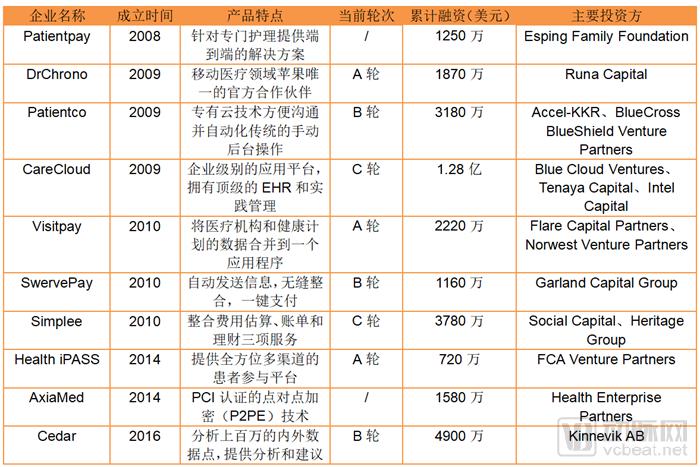
(Data source: Crunchbase, compiled by VCBeat)
Overall, to ensure that healthcare providers can track every step throughout the entire cycle, address emerging issues, and achieve effective billing payments and sustained, stable revenue, medical payment platforms generally include the following basicFunctions and Services:
1.Personal Information. The payment platform integrates with other systems, providing patients with a clear overview of their personal information, including billing details, electronic health records (EHRs), and electronic medical records (EMRs). This facilitates better management, tracking, and payment of medical expenses for patients.
2.Payment Management. The payment platform offers secure and diverse payment options while automating backend processing workflows.
3.Reimbursement Management. By leveraging technology to optimize the entire revenue cycle management process, healthcare institutions can simultaneously reduce the incidence of claim denials or rejections. Additionally, they can utilize cutting-edge tools to train their staff on how to effectively handle denied or rejected claims.
4.Analysis and Communication. Healthcare providers analyze data to offer personalized recommendations and timely communication, helping patients resolve issues encountered during the payment process.
5.Customer Relationship Management. Healthcare institutions can use this system to manage patient engagement, review patients' prior billing records, monitor their financial behaviors, track key metrics in a timely manner, and optimize all interactions with patients.
It can be seen that currentlyCareCloudAs a leader in financing, although it has been established for only ten years, CareCloud has developed into a major supplier in the global medical RCM market. CareCloud mainly serves clinics, large medical institutions, enterprises, healthcare startups, and specialized agencies. Its solutions include revenue cycle management, practice management, electronic health records, patient experience, mobile apps, billing management, specialty care services, and healthcare analytics. Due to its high-quality, multi-faceted services, CareCloud's products were ranked first by Black Book in 2017 for practice management software and cloud-based electronic health record (EHR) SaaS platforms. Currently, CareCloud serves over 4.5 million patients and manages accounts receivable exceeding $2 billion.
Besides CareCloud, Simplee and Patientco were also strong early competitors.SimpleeThe launched financial software payment platform primarily consists of three core products: Simplee Estimate enables healthcare providers to build trust with patients from the outset; Simplee Wallet facilitates intelligent and coordinated communication, helping users understand their outstanding balances and the reasons behind them; and Simplee Finance offers more user-friendly financial options, thereby reducing the economic burden on both patients and healthcare providers. Simplee serves over 900 U.S. hospitals and physician organizations, covering approximately 5 million patients, with annual bill payments exceeding $1 billion.
PatientcoThe newly launched SmartFinance™ patient self-service financial management platform integrates diverse financial products with Patientco’s multi-channel consumer communication and payment tools. Healthcare organizations can leverage SmartFinance™ to customize financial solutions tailored to different patient needs, thereby accelerating the patient payment process and improving collection rates. Currently, the platform serves 10 million patients and over 2,000 healthcare institutions across the United States, covering $1 billion in medical expenses.
The Most Recently EstablishedCedarPoised to emerge as a new competitor in the mobile health sector, its product portfolio includes a financial management platform for patients and a customer relationship management (CRM) system for healthcare institutions. On behalf of its clients, which include Crystal Run Healthcare—one of the fastest-growing multi-specialty group practice platforms in the United States—Cedar connects with nearly 100,000 patients nationwide, helping them process tens of thousands of medical bill payments each month. Through this platform, these healthcare institutions have achieved a 35% increase in collection rates, a 50% reduction in days sales outstanding (DSO), a 95% customer satisfaction rate, and a 60% increase in the number of self-service payments.
According to the report by Future Market Insights,The global market size for medical revenue cycle management software is projected to reach $43.3 billion by the end of 2022, with a compound annual growth rate (CAGR) of 6.9%.。
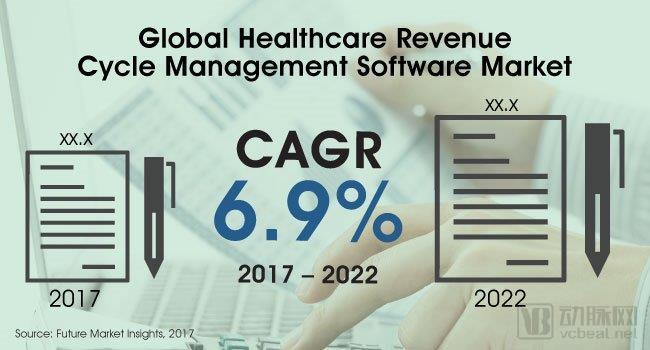
As patients’ cumulative medical expenditures continue to rise, coupled with improved collection rates and settlement efficiency, the resulting profits are substantial. The report projects that the market will exhibit positive growth in the coming years. Meanwhile, RCM softwareMarket DriversThe following points are noted:
1. Medical CodesIt serves to standardize clinical pathways and pricing, streamline reimbursement processes, and forms the basis for payer reimbursement. Meanwhile, Revenue Cycle Management (RCM) systems reduce errors by healthcare providers in this area, enabling administrators to improve efficiency and devote more energy to the rational allocation of medical resources. For instance, in the United States, the medical coding process is unpredictable and tedious; relevant RCM solutions can optimize this workflow.
2. Reduced reimbursement for medical services by government and private entities, coupled with rising claim denial rates, will drive a significant number ofSocial InsuranceSuppliers seek RCM solutions.
3. Government's Role in the Healthcare SectorControl PoliciesContinuous changes have led to rising operating costs and declining revenues for healthcare institutions.
4. Relevant regulatory authorities will continue to monitor illegal installment payments for health insurance, which will further reduce its revenue. To maintain a lowOperating Costs, healthcare providers outsource revenue cycle management (RCM) operations to external specialized firms to improve their RCM systems.
5. RCM software can enhance accounts receivable managementFollow-up Management, with gains in this area expected to account for more than one-quarter of global healthcare revenue.
6. Manual reimbursement management can adversely impact the RCM of healthcare institutionsAdministrative and Regulatorythe burden on.
From a technical perspective, cloud deployment will reduce healthcare costs, enhance the flexibility of Revenue Cycle Management (RCM) systems, and ensure interoperability among multiple users by improving resource accessibility, eliminating scalability constraints, increasing infrastructure reliability, and strengthening organizational operational frameworks. In 2017, cloud-based healthcare RCM software generated nearly $27 billion in revenue. Given the complex structure of RCM, cloud deployment is also expected to drive cost savings by aligning actual usage with resource expenditures.
On the user side, hospitals are the largest end-users of RCM software, followed by clinics and laboratories. In 2017, laboratories accounted for nearly one-fifth of global healthcare revenue, while the use of RCM systems in clinics was projected to generate nearly $6.5 billion in revenue.
Major partners in the global healthcare payment software sector, such as Cerner, McKesson, Quest Diagnostics, Athenahealth, Epic Systems Corporation, EMC, Greenway Health LLC, and Allscripts Healthcare Solutions, will focus on eliminating the shortcomings of traditional models and enhancing security measures to protect critical data managed by their products. Furthermore, “new entrants” may face barriers when entering this highly competitive market.
Due to differences in healthcare systems and policies, the U.S.-style medical billing and payment platform model is still in its early stages in China, with the mobile healthcare payment market dominated by the government and large enterprises.
March 2017,National Platform for Cross-Regional Medical Expense SettlementOfficially launched and operational, the system features an Inter-provincial Medical Treatment Settlement System that serves as the data exchange hub for cross-province medical care, facilitating data interchange among various regions. The Statistical Analysis System functions as the fund clearing center for cross-province medical treatment, handling reconciliation, settlement, and monitoring of medical expenses incurred outside the insured’s home region. The Query Service Center and Collaborative Management System act as the data resource center for cross-province medical care, storing information on patient registration for out-of-area medical treatment, basic catalogs, contracted designated healthcare institutions, and records of medical visits and settlement payments, while also conducting data analysis and applications.
In addition, both Alipay and WeChat have launched healthcare services on their respective platforms, including appointment scheduling, online consultations, electronic social security cards, electronic health records, bill inquiries, access to laboratory test reports, and social security inquiries and payments.
AlipayThe “Future Hospital” initiative is divided into three phases: Phase I assists hospitals in establishing mobile medical services and building an intelligent healthcare platform to enable basic functions such as appointment scheduling, consultations, and payment processing. Phase II incorporates electronic prescriptions, mobile payments for national health insurance, and direct billing with commercial insurance providers. Phase III focuses on constructing a health management platform powered by big data and cloud computing capabilities.
Currently, Alipay’s healthcare initiative has entered its second phase. Specifically, across various pilot programs, users can bind their electronic social security cards to Alipay and complete payments for both medical insurance-covered and out-of-pocket expenses via their mobile phones during medical visits. The family-sharing feature for medical insurance accounts allows users to transfer their medical insurance balance to family members and relatives for use. Additionally, the medical insurance spending alert function pushes every medical insurance transaction record to users through Alipay’s billing statements. Recently, Alipay has launched free medical coverage for all users, with a maximum benefit amount of up to RMB 20,000.
AndWeChatThe launched “Smart Healthcare” solution has covered 362 cities across 33 provincial-level administrative regions in China. It mainly includes functions such as appointment registration, social security inquiry and payment, physical examination services, outpatient payment, and vaccination services. Compared with Alipay, WeChat focuses more on cross-provincial medical treatment and payments under the New Rural Cooperative Medical Scheme.
Currently, the Chinese government has adopted a universal health insurance system comprising basic medical insurance for urban employees, basic medical insurance for urban residents, and the New Rural Cooperative Medical Scheme (NRCMS). This system is primarily social security-based and operates on a pay-as-you-go model. In contrast, the U.S. government-led social health insurance programs focus on covering the elderly (Medicare) and vulnerable populations (Medicaid), while health insurance for the working population is provided by commercial insurers. The entire U.S. healthcare system involves four key stakeholders: the government, healthcare providers, insurers, and patients. Furthermore, China’s healthcare delivery model follows a market-oriented approach where patients can register and consult doctors on a walk-in basis, whereas the U.S. employs an appointment-based, managed care system, with the vast majority of Americans having a designated primary care physician.
Differences in health insurance systems and care delivery models have led to distinct challenges and approaches in managing medical bills in China and the United States. Compared with China, U.S. medical billing is more complex due to the involvement of multiple stakeholders, resulting in longer processing times. The emergence of healthcare payment platforms has thus met market demand by addressing issues across the entire revenue cycle. Although the demand gap in this area is smaller in China, the introduction of services such as cross-regional settlement for medical care and online health insurance payments demonstrates the rapid development of mobile healthcare in the country. Various stakeholders are continuously exploring and innovating to build a more robust healthcare system and enhance patient experience.
References:
1. https://www.adec-innovations.com/about-us/faqs/what-is-revenue-cycle-management-rcm/
2. https://hitconsultant.net/2018/01/19/healthcare-revenue-cycle-management-software-market/