

Johnson & Johnson Digital Innovation: Transforming Back-Office Functions into Engines of Digital Innovation
Johnson & Johnson CEO Alex Gorsky: “Our immediate priority is to accelerate growth globally through innovation and enhanced operational execution. Internally, we have established rigorous management processes to better focus our efforts. We are launching new business models and customer experiences to address healthcare consolidation and the development of alternative care resources. We also recognize the growing impact of technology and data on the products and services we deliver, and we are improving outcomes in a cost-effective manner.”
Across the global commercial landscape, the wave of digitalization has become unstoppable. The healthcare industry, long characterized by formidable barriers, is also undergoing reconstruction.
McKinsey has developed a benchmark to assess the digital maturity of companies across various industries. Digital leaders tend to score in the range of 70 to 80, while the best-performing industries, such as retail, travel, and hospitality, have average net scores between 40 and 50. The global average digital maturity score for all enterprises studied by McKinsey is 33, with the pharmaceutical industry averaging 27. Why does an industry that claims to be driven by innovation and genetics lag behind in substance? The reason is simple: as McKinsey’s report points out, only 10% of companies state that they have a clear understanding and strategic response to how digitalization impacts their business.
Yet it is those top 10% of companies that determine the direction of the tide. Johnson & Johnson is one of them.
In 1886, American pharmacist Robert Wood Johnson joined forces with his two brothers to begin producing surgical dressings in a former wallpaper factory, with the company employing just 14 people. Today, Johnson & Johnson operates more than 200 companies worldwide and has 134,000 employees.
Johnson & Johnson did not enter the medical field by following the path of producing over-the-counter drugs; rather, it emerged alongside Dr. Lister’s germ theory, with the company initially manufacturing sterile gauze and antiseptic bandages.
In the late 19th century, Johnson & vigorously expanded its consumer healthcare business. For instance, its baby powder once accounted for more than 40% of the company’s revenue. Other products included dental floss and mouthwash. In 1920, the company invented Band-Aid adhesive bandages. Band-Aid not only became synonymous with adhesive bandages but also emerged as Johnson &’s best-selling product.
Johnson & Johnson truly made significant strides into the prescription drug market in the mid-20th century, when it was still a small pharmaceutical company that consecutively acquired several firms specializing in pharmaceuticals. In 1959, Johnson & Johnson acquired Switzerland’s Cilag Chemie and McNeil Laboratories, a U.S.-based company producing the children’s prescription medication Tylenol. In 1961, Johnson & Johnson further acquired Belgium’s Janssen Pharmaceutica. These two acquisitions enabled Johnson & Johnson to consolidate its capabilities in prescription drug research and development.
Having established a solid foundation in prescription drugs, Johnson & Johnson began to venture into the medical device sector. In 1986, it acquired LifeScan’s blood glucose monitoring product line; in 1996, it merged with Cordis and its cardiac and arterial stent products; and in 1999, it acquired the biotechnology company Centocor.
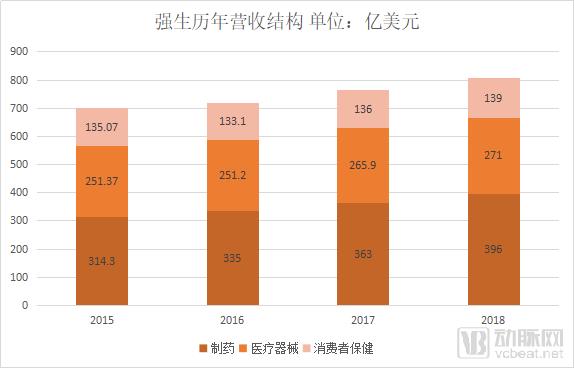
Note: The fiscal year does not coincide with the calendar year.
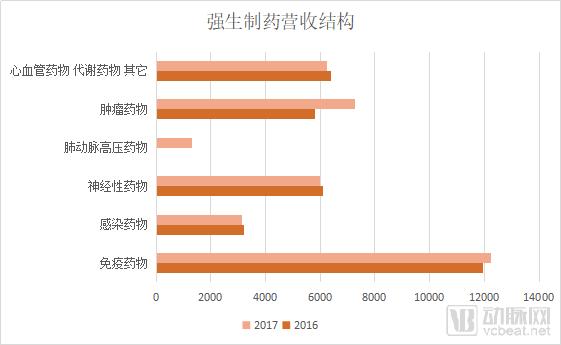
Unit: million USD
After more than 120 years of development, Johnson & Johnson has formed a business structure driven by three core segments: pharmaceuticals, medical devices, and consumer health. Historical revenue data clearly show that the pharmaceutical segment has consistently been Johnson & Johnson’s largest contributor. Although the company operates on a “three-pillar” model, its structure is not entirely stable, with the diagnostics business being particularly vulnerable. In the second quarter of 2018, sales in the pharmaceutical segment reached $10.4 billion, representing a year-over-year increase of 17.6%. In contrast, the medical devices segment grew by only 2% during the same period. Over the long term, the pharmaceutical segment accounted for 47.4% of Johnson & Johnson’s total revenue in 2017. Over the past five years, the pharmaceutical business has grown at an average annual rate exceeding 7%, while the other two major segments—medical devices and consumer health—have shown relatively sluggish performance.
Johnson & Johnson itself has placed greater confidence in its pharmaceutical division. In March of this year, the company sold its blood glucose monitoring subsidiary, LifeScan, for $2.1 billion. By divesting non-core assets such as these glucose meters, Johnson & Johnson aims to exit highly competitive, low-margin segments and refocus on its core businesses. Concurrently with the sale of its medical device operations, Johnson & Johnson spent $30 billion to acquire Actelion, a pharmaceutical company specializing in rare diseases. The acquisition of Actelion marks the largest transaction in Johnson & Johnson’s history. The company views rare-disease therapeutics as another key growth engine, establishing it as its sixth major therapeutic area, thereby creating a differentiated and leading drug portfolio.
However, Johnson & Johnson’s strategic shift to focus on pharmaceuticals does not guarantee an unchallenged dominance. Among the top 10 global pharmaceutical companies, each possesses its own competitive advantages and is aggressively vying for market share. Moreover, the pharmaceutical business itself is facing an increasing array of challenges.
First, in terms of policy and regulation, pharmaceutical companies’ sales are influenced by government healthcare programs and private insurance plans. Meanwhile, rising medical costs are exerting increasing fiscal pressure. Global healthcare expenditure is projected to reach $8.7 trillion in 2020, placing substantial strain on healthcare systems. In response, public sectors and healthcare payers are driving down the prices of medical services.
Moreover, healthcare system reforms have led to payers beginning to integrate the value chain and provide services traditionally delivered by healthcare providers. Following this integration, payers will wield greater bargaining power over pharmaceutical companies, exerting increased pricing pressure on them. On the other hand, the public sector, as a payer, will create more obstacles for large pharmaceutical companies through its influence on regulatory policies. For example, in China, multinational pharmaceutical companies must accept price cuts of up to 50% if they wish to include their anticancer drugs in the national medical insurance scheme and expand drug accessibility.
Johnson & Johnson has explicitly stated that current U.S. public policies are unfavorable to intellectual property and patent protection. In Japan, Europe, and the United States, governments are extensively involved in healthcare financing. In emerging markets such as China, the issuance of the “Opinions on Reforming and Improving Policies for the Supply, Guarantee, and Use of Generic Drugs” by the General Office of the State Council’s Office for Healthcare System Reform has posed severe challenges to the market position of originator drugs in China.
Beyond policy, the competitive pressure from generics triggered by the patent cliff represents an existential burden that pharmaceutical companies can scarcely bear. Take Johnson & Johnson’s REMICADE® (infliximab) as an example. Infliximab is indicated for the treatment of rheumatoid arthritis, Crohn’s disease, and psoriasis, and accounts for 8.3% of Johnson & Johnson’s revenue. However, this drug is facing competition from biosimilars, with its market share in Europe having declined by 50%. Another key product for Johnson & Johnson, Zytiga, used to treat prostate cancer, also faced patent expiration in 2018. Zytiga generated $2.505 billion in sales last year, representing 34% of Johnson & Johnson’s oncology drug sales.
Of course, the R&D capabilities of multinational pharmaceutical companies should not be underestimated, as they are capable of developing new drugs. However, nearly every pharmaceutical company aims to make breakthroughs in addressing major unresolved diseases. Drugs in the fields of oncology and immunology are particularly closely watched by all industry players. Taking prostate cancer drugs as an example, Johnson & Johnson has made significant investments in this area, but other companies, including Pfizer and Roche, have also committed substantial resources.
Developing new drugs requires substantial investment, and clinical trial failures can deal a severe blow to pharmaceutical companies. Last year, the U.S. Food and Drug Administration (FDA) refused to approve Johnson & Johnson’s Biologics License Application (BLA) for sirukumab, an IL-6 anti-inflammatory agent, which sought approval for the treatment of moderate-to-severe rheumatoid arthritis (RA). The failure of this project remained an indelible setback for Johnson & Johnson in 2017, despite the company’s blockbuster drugs such as Imbruvica and Darzalex.
Can a “blockbuster” new drug become the lifeline for big pharmaceutical companies, while digital innovation is often seen merely as an added bonus to accelerate R&D? However, the prescription for solving pharmaceutical companies’ challenges does not lie in drugs. A report from Accenture points out that among the top 10 best-selling drugs, these medications are effective in only 4%–25% of patients who take them. If we want to improve health outcomes, the solution should not rely on “blockbuster” drugs, but rather on how to provide more support to patients.
Therefore, the prescription for pharmaceutical companies is not a drug, but rather how to transform service delivery. Services are health-related management tools provided to patients, providers, or caregivers, enabling patients to achieve better health outcomes. These services encompass a rapidly expanding array of interventions, such as digital tools and applications, care support, remote monitoring, counseling, and referrals.
As the entire healthcare system shifts toward personalized, value-based models, value-based care means that pharmaceutical companies must transition from a product-quality-centric approach to one that is consumer-centric, highly transparent, readily accessible, and quality-assured. Adopting a service-oriented strategy could save pharmaceutical companies $50 billion, enabling these funds to generate greater value.
It is evident that those who choose to remain on the sidelines at this juncture will fall behind. After all, even internet technology giants such as Apple and Google are consolidating the entire market.
President of Johnson & Johnson ConsumerJorge Mesquita stated, “At the heart of these rapid changes lies a new consumer-centric model that completely upends the cost structures and value propositions of products as we have known them. While innovation previously faced certain barriers in the industrial sector, it can now be accessed through networks of external partnerships. Furthermore, financial strength is no longer as critical for companies like Johnson & Johnson as it once was, since new startup entrants can relatively easily secure funding through venture capital.”
Johnson & Johnson, which has frequently faced consumer skepticism in its medical device and consumer health businesses, has recognized the current landscape and is advancing toward a value-based healthcare system. The company believes that the next step in expanding its pharmaceutical business lies in ensuring the launch of new products while enhancing the accessibility and market penetration of existing ones.
As Johnson & Johnson’s Chief Information Officer and Vice President stated, “Our business strategy is not implemented based on what we believe we can do, but rather on how to support our objectives and shape our processes over the next three to five years.”
VCBeat has previously reviewed the digital innovation pathways undertaken by several major pharmaceutical companies in their transformation efforts. Although digital innovation spans the entire value chain—from drug discovery and clinical trials to drug sales, supply chain management, and investment incubation—past analyses have revealed that large pharmaceutical companies each place distinct emphasis on different aspects of digital innovation. For Johnson & Johnson, the most prominent highlight of its digital transformation has been the digitalization of internal management.
Stuart M. McGuigan, Vice President and Chief Information Officer of Johnson & Johnson, pointed out: “The goal of IT initiatives is to transform internal management systems from back-office functions into true engines of innovation.” In the pharmaceutical industry, digitalization was previously limited to manufacturing, design, analytics, and regulatory submission processes. Now, digital transformation solutions can change the game for pharmaceutical companies across all fronts by implementing well-positioned digital strategies.
In an interview, Stuart M. McGuigan discussed the reasons behind Johnson & Johnson’s internal digital transformation. He pointed out, “Although most of J&J’s current consumer health and life sciences operations are still conducted offline, there is no doubt that e-commerce represents the future direction. Moreover, the entire healthcare system is evolving toward precision medicine. Large volumes of data and analytics are driving personalized healthcare. With advanced tools such as machine learning, we can directly determine which personalized medical approaches can improve quality of life and reduce subsequent healthcare costs, prevent disease recurrence in specific populations, and lower hospital readmission rates. These technologies are highly exciting and will continue to have substantial application scenarios even decades from now.”
In digital innovation, internal process innovation is often an overlooked aspect. However, internal digitalization is crucial for leveraging existing data to reconstruct workflows and generate greater value. It also plays a vital role in driving the overall digital transformation process. True digital innovation should encompass everything from core internal operations to the supply chain. If pharmaceutical companies aim to implement user-centric processes on the front end, they must also digitize their back-end business processes. Moreover, the cost of maintaining legacy systems may even exceed that of building new digital systems.
Johnson & Johnson operates more than 200 independently managed companies across over 60 regions worldwide. The digitalization of its internal processes first addresses cross-departmental and cross-organizational information access, migrates content to a hybrid cloud, and unlocks the value of critical information from legacy systems. Johnson & Johnson also leverages analytics to build comprehensive customer profiles, enabling demand forecasting and pricing simulations.
Johnson & Johnson invests over $2 billion annually in technology, and the efforts are already beginning to yield results. Miao Song, Vice President and Chief Information Officer at Johnson & Johnson, stated: “In our transition to the cloud, Johnson & Johnson has partnered with Amazon and Microsoft to create an integrated, scalable, and secure GxP-compliant cloud IT platform. Our hybrid cloud now stores 2.8 times the volume of data that Google processes daily. Currently, 90% of Johnson & Johnson’s business operations are hosted on the cloud.”
AI-Driven Drug Discovery
Janssen Pharmaceuticals, a subsidiary of Johnson & Johnson, is leveraging artificial intelligence to redefine drug discovery. Scientists at Janssen reported in *Cell Chemical Biology* that their team has developed a novel approach employing artificial intelligence to accelerate the drug development process, utilizing machine learning to perform tasks that typically require human cognition and intellectual effort.
In traditional drug discovery experiments, cells representing specific diseases are typically exposed to various compounds and photographed. Microscopic snapshots are then taken of each subsequent drug response. A single experiment can generate 500,000 snapshots. AI can classify and organize these images, facilitating the identification of compounds that elicit specific responses in the relevant disease models.
Janssen scientist Hugo and his team discovered that this new AI-powered approach can boost drug development efficiency by up to 250-fold compared with traditional methods. He stated, “In the pharmaceutical field, many medical needs remain urgently unmet. Our algorithms can help organize relevant information more effectively and accelerate the identification of superior treatments, ultimately benefiting patients.”
Digital Innovation in Supply Chain
Remo Colarusso, Vice President of Johnson & Johnson Pharmaceuticals, stated, “We are working to optimize our supply chain so that we not only meet patients’ needs today but also anticipate and understand their demands, transforming ourselves to adapt to them. The healthcare industry is rapidly leveraging digital technologies to help change the course of human health: today, 57% of patients use connected devices to share critical data with their physicians, such as blood glucose readings or blood pressure measurements. Meanwhile, healthcare providers are delivering medical services in equally innovative ways, such as transmitting test results and enabling online appointment scheduling.”
Digital innovation in the supply chain can enable business decision-making processes to be driven by internal data and analytics. Although pharmaceutical companies possess vast amounts of data, these data remain siloed, making it difficult to extract valuable insights. Advanced technologies such as big data, agile analytics, and artificial intelligence can help pharmaceutical enterprises gain deeper understanding of market dynamics and consumer behavior intelligence, thereby bridging the gap that is key to driving strategic business decision-making.
For example, YuMi, a collaborative robot in Johnson & Johnson’s supply chain team, can perform certain repetitive assembly tasks to help boost productivity and deliver products to consumers more quickly. This robot has been working at Johnson & Johnson in France since 2015. It is so precise that it can even thread a needle, ensuring a high level of precision in its supply chain operations.
Innovation in the supply chain enables Johnson & Johnson to rapidly identify issues within its production processes and even predict them before they occur. Prior to digitalization, there was insufficient data to support such analytics, nor was there the capability for real-time data processing.
Delivering Services to Patients, Not Just Medications
Pharmaceutical companies are seeking to establish more direct connections with patients and engage in their health management, leading major pharmaceutical firms to launch their own health management apps. In Johnson & Johnson’s vision for future healthcare solutions, the company aims to improve health outcomes through early intervention by integrating consumer and medical approaches. It advocates for sustainable changes in health behaviors, engaging in health management during the pre-diagnosis phase for consumers, and leveraging data across the entire care continuum to generate value.
Johnson & Johnson’s future healthcare strategy should involve pre-consultation assessment of factors influencing individual health behaviors, leveraging data-driven recommendations to guide consumers toward corresponding health-improving actions. It should apply real-world experience and evidence to enhance efficiency and measure the magnitude of impact. Finally, it should utilize data analytics to gain deeper consumer insights and continuously refine processes through learning. In the realm of digital health, Johnson & Johnson has launched multiple mobile applications.
One-touch Reveal
OneTouch Reveal is another mobile application designed to help patients with diabetes easily monitor and manage their blood glucose levels. The app connects with J&J’s OneTouch blood glucose meters, enabling users to track their blood glucose levels, visualize trends, and share data with their physicians.
7minute workout APP
This app is essentially a Johnson & Johnson version of a simplified KEEP. It can sync with the iPhone Health app, recommending different workout types and intensities based on overall fitness levels to help maintain exercise consistency. Moreover, this Johnson & Johnson app is particularly suitable for beginners, offering 12 different 30-second exercise routines. The app also features built-in coach-led video tutorials.
Rest Devices
Boston-based Rest Devices has announced a partnership with Johnson & Johnson to develop an intelligent, personalized sleep guidance system for infants (and their parents, who hover over the crib with smartphones). The system includes a wearable baby monitor called Mimo and a companion app called Nod.
Investment & Incubator
As mentioned at the beginning of the article, innovative companies can secure substantial funding through venture capital, empowering them to compete head-on with traditional enterprises. Of course, acquiring these innovative startups early on can serve as a win-win solution. In 2017, Johnson & Johnson made 21 investments through its subsidiary, Johnson & Johnson Innovation.
Johnson & Johnson Innovation has expanded its search for innovative healthcare solutions through 22 QuickFire Challenges launched since 2014, attracting more than 1,500 applicants from around the world. These challenges span a broad range of areas, from artificial intelligence and infant care to medication safety. Johnson & Johnson will continue to broaden the scope of the competition, with three new QuickFire Challenges in digital beauty, the future of lab coats, and other fields set to launch in 2018.
In June this year, Johnson & Johnson Innovation announced the launch of the QuickFire Lung Cancer Challenge in Shanghai. In China, Johnson & Johnson has also partnered with the Pudong New Area Government to establish the Shanghai JLABS incubator.
Dr. Robert G. Urban, Global Head of Johnson & Johnson Innovation LLC, stated, “At Johnson & Johnson Innovation, we adopt a collaborative approach, tailoring each deal to the specific needs of the company and its technology, so that we can accelerate the best scientific and technological advancements to address today’s healthcare challenges. We have achieved remarkable results in external innovation, having established more than 60 significant new strategic partnerships in 2017.”
Summary
Across all industries, consumers never pay for a company’s historical heritage. Johnson & Johnson has faced lawsuits abroad over its baby powder, body wash, and vaginal mesh medical devices. The company has consistently sought to participate in emerging healthcare reforms. J&J Innovation maintains its characteristic approach to localization, conducting innovative trials tailored to the distinct environments of different regions.
Meanwhile, the most promising strategy for Johnson & Johnson Innovation remains projects that closely integrate its Consumer Health, Pharmaceutical, and MedTech businesses. This approach offers an integrated solution for disease prevention, intervention, and treatment. For instance, Johnson & Johnson has launched initiatives leveraging artificial intelligence to detect early signs of Alzheimer’s disease and using speech recognition technology for online monitoring of brain health in the elderly. Both J&J’s digital transformation and supply chain transformation encompass all three business lines simultaneously.
In the pharmaceutical sector, Johnson & Johnson aims to launch disruptive products that transform currently incurable diseases into conditions that can be controlled and managed. Looking to the future, the company is committed to continuous innovation and breakthroughs to identify new avenues for growth in the next phase.