

Billions in Two Years: Internet-Enabled Primary Care Diagnostics Emerges as a Hot Investment Sector
In the past two years, there has been a growing number of projects in the “Internet + grassroots medical laboratory testing” sector. This trend is driven not only by national healthcare reform policies that favor primary care but also by increasing investor interest and willingness to commit capital, standing alongside founders as they await the day when the market fully matures.
To gain a clear understanding of the challenges faced by enterprises in this sector, investor preferences, and future development trends, VCBeat (WeChat Official Account: vcbeat) has launched a special report titled “Internet + Primary Care Medical Laboratory Testing.” This initiative aims to provide an in-depth reflection on the current state of development in this field. We also welcome active participation from companies in this sector to share their stories, and invite experts or physicians with research experience in this area to offer insights and guide the industry’s future direction.
Since VCBeat began focusing on primary healthcare, it has observed that laboratory testing remains a relatively weak link in primary care institutions. Although large third-party medical laboratory companies in China currently assist these institutions with sample transportation, their coverage is far from comprehensive across the vast Chinese market. Village clinics located in remote mountainous areas, in particular, are the primary care facilities where laboratory testing challenges urgently need to be addressed.
Due to the wide and scattered distribution of these village clinics, coupled with their low daily testing volumes, the high costs associated with specimen transportation (round-trip logistics) make them unattractive to most third-party medical laboratories. Consequently, these providers are only willing to serve primary healthcare institutions in urban areas with convenient transportation access.
This represents both a critical pain point in primary healthcare and the direction of healthcare reform. A number of forward-thinking entrepreneurs are willing to devote their time and energy to improving medical laboratory testing in primary care settings, such as Shenzhen KuaiYiJian, Hangzhou Yunhu Technology, and Fuzhou Yibohui.
The advent of “Internet+” has seemingly transformed this traditionally high-cost industry into one with strong operational feasibility. However, initial investments are still required, such as R&D costs, offline promotion expenses, and logistics costs. Compared with the traditional medical laboratory testing industry, the assistance of internet-enabled tools allows primary healthcare institutions to send out test samples quickly and receive test reports promptly. The entire process is fully controllable, enabling patients to access diagnosis and treatment services close to home.
Unfortunately, it was very difficult for such companies to secure financing at that time. Investors were also hesitant about these new projects, unsure whether they should bet on this sector.
Two years have passed, and investment firms have grown increasingly enthusiastic about such projects, with some even hoping to identify the next “KuaiYiJian.” This July, KuaiYiJian secured the largest financing round in the industry—a RMB 100 million Series B round—led by Nokia Growth Partners (NGP), co-led by SoftBank China, and participated by Chende Capital.
Although the funding amount is not high compared to other medical sectors, it is no small feat for a new field to see investment from zero grow to hundreds of millions of yuan within two years. So, what are the reasons behind this change? How do investors view the “Internet + Primary Care Medical Testing” market? What are the future development trends? To address these questions, VCBeat conducted interviews withThe investors behind these projects, such as Deng Yuanjun, Managing Partner of Nokia Growth Partners, and Wu Kai, Partner of SoftBank China Capital, Wu Jialu, Partner at Chende Capital; Tian Min, Partner at Yuanjing Capital; and Saren Tuoya, Investment and Incubation Manager at Beike Society, to gain their insights on this field.
Based on public data, VCBeat has compiled a list of companies in the “Internet + Primary Care Medical Testing” sector that have secured financing over the past two years, as detailed below:
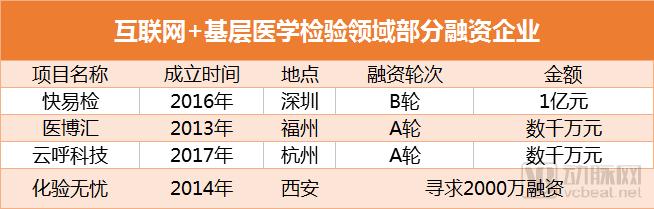
As can be seen from the list, the fastest-growing project is KuaiYiJian, which secured the largest financing round in the industry just two years after its establishment. Facts have proven that Wang Zheng, the founder of KuaiYiJian, had the right strategy. HeMarch 2015After resigning from SF Express to start a business, I attempted to enter the primary healthcare market from a logistics perspective. By leveraging comprehensive logistics and information technology, we provide high-quality medical specimen delivery and related services, helping primary care physicians enhance their technical skills, promote their brand, attract patients, improve efficiency, reduce costs, and increase revenue. After several years of development,The KuaiYiJian team has grown to nearly 1,000 members, with frontline business personnel accounting for 80% of the entire company, and business volume increasing tenfold.
Wu Kai stated,Village doctors are a particularly critical link in the entire value chain.Unlike the distant doctor-patient relationships in urban areas, village doctors are an integral part of the community, having lived alongside villagers for generations.There is a stable relationship between villagers and village doctors.solid relationship chains. When village doctors on the KuaiYiJian platform are willing to recommend KuaiYiJian’s medical services to patients, the final barrier in the primary healthcare market is breached.
Deng Yuanjun believes that KuaiYiJian has resolved the bottleneck issues in laboratory testing for most rural clinics, bringing high-quality medical resources down to the grassroots level of healthcare.By analogy,This aligns with his original intention at the time to focus on low-end smartphones. Therefore, “our investment priorities are entrepreneurial opportunities in non-tier-one regions, such as fifth-tier cities, rural areas, and townships.”
Yibohui is an institution dedicated to leveraging internet technology to empower primary healthcare services. By adopting an open-platform model, it penetrates the market of 927,000 primary care institutions, connecting patients with medical resources such as hospitals, physicians, and third-party laboratories. It bridges the service gap between hospitals and clinics, as well as between doctors and patients, providing one-stop medical services for the primary care sector.
For primary healthcare institutions,MedHubDeveloped two major internet platform systems—“Clinic Connect” and “Medical Diagnosis Connect”—to empower them.
“Clinic Connect” integrates and decentralizes resources that have long been in urgent demand by primary healthcare institutions, delivering them directly to these frontline facilities. The platform currently features four open functional modules: (1) an in vitro diagnostics module for blood testing, genetic testing, and point-of-care testing; (2) a referral and consultation module supporting appointment-based referrals and online consultations; (3) a real-time monitoring module leveraging smart wearables, family doctor services, and chronic disease management; and (4) a pharmaceutical and medical device procurement module offering home delivery of medications and an online marketplace for drugs and medical equipment. Together, these components create a truly one-stop internet-based service platform for primary healthcare.
“Yi Zhen Tong” is a cloud-based SaaS management platform designed for small and medium-sized primary healthcare institutions. Beyond routine operational management, “Yi Zhen Tong” is committed to becoming an intelligent diagnostic platform for primary care facilities, addressing the lack of clinical experience among primary care physicians by providing optimal diagnostic and treatment pathways for common and frequently occurring diseases. A representative from Yi Bo Hui stated that over 20,000 clinics across China currently use Yi Bo Hui’s “Zhen Suo Tong” and “Yi Zhen Tong” systems. These two platforms have covered 17 provinces and municipalities, including Beijing, Fujian, Jiangxi, Hunan, Hubei, Shaanxi, Henan, Hebei, Anhui, and Shandong, with more than 20,000 registered physicians and over 600,000 patients served.
Yunhu Technology secured tens of millions in financing just six months after its establishment, marking the fastest fundraising pace. At the time of the announcement, Chen Xiaobing, founder of Yunhu Technology, stated that the funds from this round would be primarily used to build out its business framework, refine its product lineup, and further expand sales channels.
Tian Min believes that Yunhu Technology connects medical laboratories with primary healthcare institutions through its professional service capabilities, systematically reducing the costs for medical laboratories to extend their services to the grassroots level and further stimulating vitality in the medical testing market. Meanwhile, the Yunhu team comprises professionals from leading enterprises in the clinical laboratory and genetic testing industries, possessing a deep understanding of the pain points in primary healthcare. As national policies liberalize access to grassroots clinics, Yunhu is well-positioned to leverage its years of market expertise to support tiered diagnosis and treatment, empowering grassroots clinics to enhance their laboratory testing capabilities and diversify their product offerings.
When discussing the reasons for the investment, Tian Min candidly shared the following motivations for investing in Yunhu Technology:
First, driven by national policies, the demand for primary-level laboratory testing has increased.From the perspectives of policy orientation and market development, the growth trajectory of various small clinics in China has been highly favorable over the past two years, with a rapid expansion in the number of both specialty and general practice clinics. Meanwhile, policies are encouraging private sector participation in the establishment and development of clinics to address the shortcomings of China’s public healthcare system.
Second, primary care clinics have limited laboratory testing capabilities.With the rapid expansion of these clinics, a lack of laboratory testing capacity has become a common challenge across all types of clinics. Due to limited investment capital, most clinics cannot afford large-scale investments in in-house laboratories; therefore, to meet diagnostic and treatment needs, they must rely on third-party companies to supplement their testing services.
From a market-wide perspective, the number of patients visiting primary care clinics will surge in the future as China continues to expand its primary care clinic infrastructure and advance its tiered diagnosis and treatment system. With the continuous development of laboratory medicine, characterized by ongoing updates to testing methods and techniques and steady improvements in testing capabilities, primary hospitals and clinics often lack comprehensive diagnostic capacities. This gap underscores the necessity for third-party clinical laboratory providers.
Second, the existing third-party clinical laboratories suffer from logistical redundancies and waste, creating an opportunity for the development of Yunhu Technology.The third-party medical testing sector in China is relatively well-developed. Companies such as KingMed Diagnostics and Dian Diagnostics originated as third-party laboratories and are now gradually expanding into other testing areas, such as genetic testing. As healthcare demand continues to grow, third-party testing institutions enjoy strong market prospects, and these two companies have also performed well in the capital markets. These large corporations have attempted to provide services to primary care clinics, but they have encountered significant challenges due to conflicts with their existing customer base, namely tertiary Grade A hospitals. Therefore, there will undoubtedly be a need for primary-care-focused testing services to meet this demand in the future.
Furthermore, the annual reports of these major companies reveal that logistics account for a significant proportion of their total costs. Since medical testing logistics involve the transportation of specialized medical supplies, each of these large corporations maintains its own team of over a thousand personnel to provide sample collection and logistics services to hospitals. However, there is substantial overlap in their logistics routes, making it relatively costly to maintain in-house logistics teams. If a third-party provider could assume a role akin to SF Express in this sector, it would reduce redundancy and waste across the industry. The true value of such a third-party provider lies in establishing a logistics network starting at the grassroots level and gradually expanding to cover the entire healthcare system—a gap that Yunhu Technology precisely fills.
Fourth, Yunhu Technology boasts a strong team lineup and robust execution capabilities.The founder previously served as the Head of Logistics at Adicon, one of China’s top three third-party medical testing institutions. He possesses in-depth expertise in medical logistics and team operations. Moreover, his team members also hail from Adicon, including the architect of its entire IT infrastructure and the core ground promotion team, ensuring a highly complete organizational structure. The co-founder brings expertise in genetics, which will be a crucial component in enhancing the company’s product diversity and service comprehensiveness, given that novel testing methodologies are poised to play a significant role in its future development.
Following this investment, they have successfully contracted with over 1,000 clinics, serving as a bridging link to fill the gap in primary care laboratory testing services. By leveraging IT solutions to aggregate the testing demands of these clinics, they are well-positioned to build a robust third-party laboratory testing service platform in the future.
Yuanjun Deng heads NGP, a global venture capital firm with over $1 billion in assets under management. HeFocus on smart mobility,Internet of Things、Medical、EducationThese four major sectors. Although KuaiYiJian is NGP’s first investment project in China’s healthcare sector, it has also invested in Yuedongquan and Xiaoxun Technology within the broader health and wellness industry. The majority of users on the Yuedongquan platform are concentrated in third-, fourth-, and fifth-tier cities, where the platform helps users establish exercise habits and boasts a large user base. NGP’s investment portfolio also includes My Dagong Network, whose user base consists predominantly of rural residents who likewise hope for their family members to fall ill less often or not at all.Therefore, these initiatives can all be integrated with KuaiYiJian to provide laboratory testing products or other health services to users on these platforms.
Wu Jialu, Partner at Chende Capital, mentioned that Chende made an angel investment in KuaiYiJian as early as 2016. At that time, the investment team’s assessment was that primary healthcare services held significant potential for rapid growth. Data indicated that the number of primary healthcare institutions and practitioners in China had already reached a high level of coverage. Meanwhile, the extensive coverage of the New Rural Cooperative Medical Scheme (NRCMS) enhanced the payment capacity at the grassroots level, revealing that the market’s unmet demand lay in high-quality products and services tailored for primary healthcare institutions.
From a micro-level logical perspective, Chende focused on the replicability of the business model and the viability of the unit economics. At that time, Chende’s investment team, together with the Kuaiyijian team, conducted market research in Fujian and other regions. They observed that in mature markets, the business had essentially reached break-even, giving them reason to believe that Kuaiyijian could achieve profitability in the future by layering additional products and services. Once this rationale was clarified, Chende decided to invest.
Sa Ren Tuoya believes that the decision to invest in Yibohui at the time was primarily driven by its mature strategic planning, practical service philosophy, and the value of its open platform.
First, in terms of strategic planning, Yibohui embarked on its exploratory journey well before the state began encouraging “Internet + Healthcare,” making a highly pragmatic choice to focus on the primary care segment. Moreover, within the laboratory testing sector, Yibohui can be regarded as the pioneer that successfully integrated third-party laboratories with rural medical institutions.
Second, in terms of service philosophy, YiBoHui has been committed to enhancing the capabilities of primary healthcare institutions, rather than merely filling resource gaps. The company has heavily invested in an AI strategy for primary care diagnostics and treatment, dedicated to leveraging technology to address current challenges such as insufficient clinical experience and limited diagnostic and therapeutic capabilities at the grassroots level. Arguably, this initiative by YiBoHui has significantly accelerated the advancement of the tiered diagnosis and treatment system that the nation aims to implement.
Third, in terms of platform value, Yibohui enters the market as an open platform, integrating throughout the entire primary healthcare service chain. This platform model not only consolidates third-party laboratory testing, hospitals, experts, and logistics services, but also provides a convenient entry point for more service providers seeking to engage in primary healthcare, while empowering primary healthcare institutions with the key to unlock broader opportunities.
Fourth, regarding the investment philosophy of Beike Fund, as a leading innovation and entrepreneurship ecosystem in China’s medical and health industry, Beike Society places the utmost importance on corporate founders and their teams. Mr. Jie, the founder of Yibohui, is a serial entrepreneur with extensive experience in corporate operations. He has been continuously exploring the primary healthcare sector and possesses a profound understanding of the medical system. Furthermore, Yibohui’s business and profitability models have already been validated by its team.
As they secured capital-fueled support for their "Internet + grassroots medical testing" projects, they also accelerated their nationwide expansion across China.
It is reported that KuaiYiJian has nationwideThe number of clinics it serves has increased from 2,000 to 20,000, and its service coverage has expanded from the original provinces of Guangdong and Fujian to eight provinces, including Sichuan, Zhejiang, and Hunan. It has also established its own cold-chain logistics fleet, standardized the specimen transportation process, and is gradually building a comprehensive logistics system.
Last year, Yibohui also launched a cloud-based clinic management system called “Yizhentong” to help primary care clinics quickly integrate with the internet. The company plans to fully establish an organic ecosystem for smart healthcare at the grassroots level within two years, thereby enhancing the capacity of primary medical services.
Yunhu Technology is also actively exploring its development model. By promoting the “Internet + Healthcare” service model, it aims to build an internet-based platform that enables information sharing among the general public, medical institutions at all levels, and third-party clinical testing laboratories, thereby helping ordinary citizens enjoy equitable access to high-quality medical services. Chen Xiaobin believes that in the field of medicine, prevention is far more important than treatment. Promoting the widespread adoption of genetic testing can enable more people to understand and utilize such testing for disease prevention.
Among the primary healthcare institutions currently offering "Internet +" grassroots medical laboratory services, the majority are private clinics that adopt a hub-and-spoke strategy, focusing on establishing a strong presence in a single region before expanding outward.
Tian Min introduced that clinics partnering with Yunhu Technology are distributed across urban-rural fringe areas and within cities, primarily centered around regional urban hubs. Effective service delivery requires logistics coverage to reach a certain density. Therefore, the company currently focuses its services on Hangzhou as the core and Zhejiang Province as the key region. Within Hangzhou, Yunhu Technology serves all clinics—whether urban or suburban—as long as there is demand.
By comparison, public primary healthcare institutions have less incentive to adopt platforms like Yunhu Technology than private hospitals, as their demand for profit and revenue is not as urgent. “With the decentralization of services to the grassroots level, we believe there are significant opportunities ahead,” added Tian Min.
Meanwhile, private primary healthcare institutions make decisions more quickly than their public counterparts, as they are not burdened by extensive approval procedures. Decision-making in most private medical institutions is predominantly individual-driven, resulting in relatively shorter decision cycles.
For public primary healthcare institutions, the decision to adopt external platforms may be elevated to the regional primary care administrative authority. This administrative body effectively determines where primary health clinics in the district will procure their supplies and whether they require third-party laboratory testing services. Consequently, companies seeking to expand their customer base will focus more on engaging with government entities rather than with clinic operators.
Currently, laboratory testing services at public primary healthcare institutions have not yet been fully opened up. However, Tian Min believes this sector holds significant potential and will be a key focus for future business development by these enterprises. From the current perspective, companies seeking rapid market entry may start with private clinics, given their large numbers, before turning their attention to government procurement for primary care services at public grassroots medical institutions.
Yuanjing Capital has long focused on four key sectors: internet innovation, consumption upgrades, digital healthcare, and intelligent technology.
Regarding these four sectors, Tian Min hopes to leverage the tools and power of the internet to disrupt the traditional healthcare industry and seize opportunities, placing significant emphasis on the role of internet-based solutions.
Therefore, in healthcare investments, Tian Min provides portfolio companies with both capital and resources. She believes there is a strong interconnectivity among invested enterprises, as the core elements of the healthcare sector essentially revolve around physicians, medical institutions, and patients. Yunhu Technology integrates primary-care physicians, medical institutions, and patients onto its platform. This setup will also facilitate linkages with other insurance-related companies in its investment portfolio, creating definite synergies for the future sales of specific medical insurance products through primary-care channels.
The core strategy is that Yuanjing Capital invests in different healthcare investment firms at various stages, as the healthcare sector places particular emphasis on resource integration.
Deng Yuanjun aims to leverage the strong relationships established between KuaiYiJian and primary healthcare institutions to extend its service chain, thereby continuously delivering high-quality medical resources to these facilities. For instance, with the ongoing improvement of infrastructure in rural markets, technical challenges associated with telemedicine—such as the transmission of imaging data and diagnostic images—can be effectively resolved.
In addition to financial support, assistance will also be provided in areas such as team management and channel development. He believes that Nokia’s endorsement will help KuaiYiJian acquire local users, following the same principle as “love me, love my dog.”
Wu Jialu believes that in vitro diagnostics (IVD) is a key investment focus for Chende Capital, which has consistently sought out high-quality products and companies within this sector that address critical market pain points. Kuaiyijian has also established strong collaborative relationships with companies invested in by Chende Capital, continuously enriching its product portfolio.
Sa Ren Tuoya stated that Beike Fund has consistently focused on innovation and entrepreneurship services in the healthcare sector, with investment and incubation layouts in areas such as precision medicine, in vitro diagnostics (IVD), smart hardware, and medical data, aiming to enhance synergies among portfolio projects. Furthermore, the Beike Society ecosystem provides multi-dimensional support, including brand operations, entrepreneurship education, investment and financing matchmaking, and access to medical resources.
So, what business models will such enterprises evolve into in the future?
Regarding the KuaiYiJian platform, Wu Kai offered this assessment: Leveraging the founders’ backgrounds in SF Pharmaceutical Logistics and FedEx, it initially entered the grassroots market from the perspective of medical testing logistics. Today, it has evolved into a comprehensive platform serving primary healthcare, connecting village doctors, residents, county hospitals, third-party testing centers, diagnostic companies, and even pharmaceutical enterprises through KuaiYiJian. In the future, it has the potential to become an information distribution platform for the grassroots level.
“In the future, I hope Yibohui will evolve into the ‘Alibaba’ of the healthcare industry, providing convenient services for physicians on this platform and helping patients complete the last mile of one-stop medical care,” added Saren Tuoya. She believes that, from a demographic perspective, the primary healthcare market represents a promising direction and a substantial market opportunity; the strategy of “encircling cities from rural areas” is inevitably the trend of the future. In the years to come, primary healthcare will also require outstanding clinical decision support systems and commercial health insurance providers tailored to the primary care sector.
Tian Min also believes that enterprises in the “Internet + grassroots medical testing” sector will ultimately evolve into platforms. Taking Yunhu Technology as an example, it connects clinics and primary healthcare institutions lacking in-house testing capabilities on one end, with hundreds of third-party medical testing centers on the other.
In fact, the concentration of third-party medical testing centers in China remains relatively low. Major players such as KingMed Diagnostics, Adicon, and Dian Diagnostics collectively account for only about 10% of the market in terms of laboratory count. The sector is still dominated primarily by independent single-site testing centers or very small chains.
Smaller third-party medical testing laboratories often possess technological advantages in specific products but lack robust sales channels. In this context, Yunhu Technology serves as a platform to deliver superior products to grassroots healthcare providers and small clinics. This also represents an expansion of business product services for the Yunhu Technology platform.
On the clinic side, they enable doctors to view test reports online through their mobile products deployed at various clinics, such as smartphone apps. Given that Yunhu Technology offers robust laboratory testing modules, whereas primary care clinics often have relatively weak IT systems or even lack comprehensive laboratory modules altogether, the company provides its well-developed laboratory module to these grassroots clinics. Doctors can activate this module via their smartphones or computers to complete the entire workflow, including sample transfer, testing, and result reporting. Consequently, clinics are not required to possess strong in-house IT capabilities.
For startups, given limited resources and capital, it is not feasible to extensively explore a wide variety of business models. The immediate first step is to penetrate more clinics and expand regional coverage by validating products and services that address relatively inelastic demand. In the future, beyond its logistical role, a key function will be to introduce high-quality products from upstream third-party testing agencies into clinics. This constitutes a core capability, including determining which product combinations are adopted by specific clinics, which also falls within its scope of business. Once both the logistics network and the downstream clinic network are fully established, additional ancillary services can certainly be integrated into this ecosystem; however, we have not yet reached that stage.
When discussing future plans, she believes that as Yunhu Technology matures, its business model may evolve. The current B2B model is profitable, and demand continues to grow. “Our aspiration is for it to become China’s largest service platform provider in third-party testing, particularly in serving grassroots healthcare institutions and clinics. Additional services may emerge on this platform. As testing capabilities deepen in the future—such as in genetic diagnostics—or by leveraging product offerings and offline logistics advantages, the company may expand into consumer-facing (to-C) testing services.”
In the future, third-party medical laboratory institutions will likely continue to focus primarily on the B2B sector. Tian Min believes that a true B2C model is essentially a false premise in the healthcare industry. This is because, whether for hemodialysis centers or other facilities, patient acquisition channels are rooted in hospitals. From the patient’s perspective, trust remains heavily tilted toward large hospitals and physicians. If a major hospital or doctor recommends a specific location for hemodialysis, patients are far more likely to follow that advice; their choices are not as casual as selecting a supermarket or restaurant. Therefore, she argues that so-called B2C companies must, from a customer acquisition standpoint, maintain close ties with major hospitals and establish robust patient referral mechanisms to ensure the effective operation of these centers. In this sense, the business remains fundamentally B2B, with its core competitiveness lying in the ability to channel patient flow from major hospitals into their own facilities.
Meanwhile, the state also promotes third-party medical services, with private sector players gradually taking on these roles. The distinction lies in whether centers are established through heavy-asset investments or via asset-light technological approaches, such as the AI technologies employed in imaging centers.
It is precisely for this reason that most investment institutions are also focusing on this sector. For startups, the service model remains B2B, centered on how to effectively provide follow-up care for patients discharged from large hospitals, including rehabilitation and chronic disease management. Ultimately, the ability to retain patients may depend on the quality and capability of the services provided.