

AI Medical Imaging's Land Grab Era: Who Will Take the Lead?

Infervision
Artificial Intelligence Product Developer
It has been seven years since Watson established its commercial direction in healthcare in 2011. During this period, artificial intelligence has flourished, with countless startups following the trend and deep learning algorithms undergoing multiple iterations. However, as the hype subsided, what remained were the remnants of numerous pioneers.
Now, survivors and latecomers have gradually emerged as the leading players in the field of medical artificial intelligence. Under the deep learning paradigm, companies can all report impressive accuracy figures for their AI products. However, the new era is no longer defined solely by algorithms, nor can the quality of AI be judged merely by a single metric or the outcomes of human-machine competitions. To survive in this industry, one must gain entry into hospitals.
Now, the competition in the AI healthcare industry is focused on implementation.
Regardless of whether in developed or developing countries, the mismatch between the supply and demand of high-quality medical resources, as well as the irrational flow of patients seeking medical care, has always been a global medical challenge. In Japan, there are 52 MRI machines and 107 CT scanners per million people. Despite the large number of imaging devices, there is a severe shortage of skilled personnel. The introduction of AI will significantly alleviate this tense situation in Japan, and the quality of reports will also be more comprehensive than before.
Looking at the domestic market, China’s medical device sales reached RMB 417.6 billion in 2017, with diagnostic imaging accounting for over RMB 40 billion. The annual growth rate of medical imaging data is approximately 63%, whereas the growth in the number of physicians capable of making diagnoses lags far behind the increase in imaging volume. For instance, the annual growth rate of radiologists is only 4.1%. Meanwhile, radiologists in China are required to interpret tens of thousands, or even hundreds of thousands, of medical images per day, resulting in a severe imbalance between supply and demand. Furthermore, under the dual-review system, it is particularly challenging to avoid misdiagnoses and missed diagnoses. According to statistics, the number of patients subjected to medical imaging misdiagnoses in China reaches as high as 57 million per year.
Wang Zhenchang, Vice President of Beijing Friendship Hospital, Capital Medical University, expressed deep concern about the current situation: “Junior doctors lack diagnostic experience, resulting in an overall low quality of image interpretation; senior doctors have to work until 9 p.m. every night, seven days a week, under immense pressure.”
The application of artificial intelligence in the healthcare industry has inspired hope. Through deep learning, machines can perform tasks such as image classification, object detection, and recognition, accurately delineating even minute lesions to assist physicians in making diagnoses. “Misdiagnoses and missed diagnoses have decreased, and so have doctor-patient conflicts.” This is the direct experience reported by clinicians.
A director of radiology lamented, “Because I missed a tiny nodule in my father’s body, I am now powerless to help with his condition. If this technology had been available a few years earlier for early detection, he would not have ended up like this.”
The implementation of AI is widely anticipated.
If artificial intelligence, as an emerging technology, does not take deep root in its specific medical domain, it risks becoming merely a hype-driven concept. At the recent “AI Navigator: Infervision 100+” Global Product Application Sharing Conference, Chen Kuan, CEO of Infervision, addressed the issue of how AI development is portrayed: “The clamor for artificial intelligence is growing louder, but with greater hype comes larger bubbles. Amidst the tide, much debris inevitably drifts along. We at Infervision prefer not to define this narrative ourselves; instead, I hope to entrust the authority to evaluate artificial intelligence to physicians.”
Infervision has always placed great emphasis on physician acceptance of its products and their user experience. Over the past three years of persistent effort, Infervision has continuously advanced the clinical deployment of its artificial intelligence solutions. In a post-conference interview, VCBeat asked Chen Kuan about the frequency of communication within the Infervision team. Chen Kuan stated, “Among our more than 300 employees, 260 researchers rotate through hospitals, working alongside physicians on a daily basis. This constitutes a continuous collaborative process, so the concept of ‘frequency’ does not apply.”
Infervision’s imaging-based products have now been deployed in nearly 200 top-tier hospitals across multiple cities worldwide, with the number of contracted hospitals in China reaching three digits. According to Infervision’s statistical data, the click-through rate for its systems in hospitals exceeds 60%, indicating no issue of underutilization. This represents a milestone success, signifying not only hospital recognition of Infervision’s products but also affirming the practical feasibility of implementing artificial intelligence technology in healthcare, with Infervision taking a leading position in this field.
Infervision’s product portfolio primarily comprises four categories: InferRead CT Lung for auxiliary lung screening, InferRead CT Stroke for auxiliary stroke screening, InferRead DR Chest for auxiliary chest screening, and InferScholar Center, a medical imaging deep learning center.
The first three products target pulmonary, thoracic, and neurological conditions, respectively. The Medical Imaging Deep Learning Center connects with the research centers of academic hospitals to meet their AI research needs, enabling physicians to effortlessly conduct personalized and differentiated cutting-edge deep learning research, including interdisciplinary projects.
These products have been rigorously tested across multiple hospitals using diverse datasets, meeting the robustness, usability, and safety requirements for AI-based medical products. At the conference, Wang Zhenchang, Vice President of Beijing Friendship Hospital, Capital Medical University, stated, “Our collaboration with Infervision has spanned one year, during which we have analyzed tens of thousands of imaging cases. Looking ahead, we plan to deepen our cooperation in both data and technology. As a physician, I hope the era of artificial intelligence arrives sooner rather than later, and I am committed to contributing to its advancement.”
Chen Kuan provided a brief explanation of Infervision’s product strategy: “Our strategic philosophy is straightforward—we enter those fields that can maximally address physicians’ challenges, alleviate their workload, and enhance diagnostic quality. As malignant tumors are the leading cause of death in China, our first product line focuses on lung cancer. The second leading cause of death is cerebrovascular disease, which constitutes our second product line. Subsequent products will expand into areas such as breast, cardiac, and hepatic diseases, gradually extending Infervision’s product coverage across various medical specialties.”
Infervision has submitted all of its products for Class II and Class III medical device approvals in China, making it one of the first companies in the country to seek regulatory clearance for AI-based products. However, Infervision does not intend to pursue Class III approval for every system. For the company, deploying the right products in the appropriate clinical settings is more important than the “prestige” associated with obtaining Class III device certification.
All AI companies face the same challenge: commercialization after regulatory approval. Should they adopt a subscription model or charge per image interpretation? This is a question that AI enterprises must answer now that they have largely penetrated the market of top-tier hospitals. Underlying this issue is the attitude of hospitals toward commercialization.

For a given system, hospitals may well choose to seek out lower-priced alternatives with comparable quality only after the trial period ends or the product has been validated. There are two approaches to addressing this issue: first, maintaining sufficiently high product stickiness; and second, leveraging intellectual property law.
Currently, Infervision has been deployed in nearly 200 hospitals worldwide. Maintaining user stickiness and providing hospitals with a superior experience compared to other products have always been Infervision’s goals. A tertiary Grade A hospital often trials AI products from multiple vendors, making product comparisons highly intuitive. At the conference in Tianjin, Xu Maosheng, Vice President of Zhejiang Provincial Hospital of Traditional Chinese Medicine, stated, “Our hospital uses two AI products, including one from Infervision. While both products demonstrate comparable accuracy, Infervision’s structured reports are more detailed, and its user interface is more favored by our physicians.”
Once physicians become accustomed to having artificial intelligence assist them in drafting structured reports, the era of handwritten reports will be consigned to history. Therefore, after deploying its solutions in 200 hospitals, Infervision is striving to enhance the user experience for these institutions, thereby strengthening the stickiness of its products.
Meanwhile, transparency in the bidding process and the protection of intellectual property rights are also crucial, not only for Infervision but for all AI enterprises. At present, what AI companies need to do is strive for greater implementation in hospitals, and in this regard, Infervision has taken the lead.
China still lags far behind the United States in science and technology, with artificial intelligence (AI) being a notable exception. During an interview, Eliot Siegel, Chair of the Medical Imaging Resource Center at the Radiological Society of North America (RSNA), told VCBeat, “China’s achievements in the field of AI are nearly on par with those of the United States. This is likely the technological domain where China has the greatest potential to surpass the U.S. at the current stage.”
Infervision has made this its goal, and its products have been deployed worldwide. At the “Infervision 100+” conference, Norio Nakada, Director of the Department of Diagnostic Imaging at Jikei University School of Medicine Hospital in Japan, stated, “I am greatly surprised by the significant achievements AI has made. As early as November 2017, Infervision was invited to participate in the high-tech sector of Japan’s National Strategic Special Zones, making it the only Chinese AI company selected to date.” Salvador Pedraza Gutierrez, Director of the Girona Institute for Diagnostic Imaging in Spain, commented, “In the absence of low-dose CT-based early lung cancer screening policies in Europe, Infervision’s AI offers a rapid and effective solution for early lung cancer screening using conventional chest X-ray images.”
In the “AI + Healthcare Practice” section of the series of reports titled “Debate on the Technological Competitive Landscape among G20 Nations,” Infervision has emerged as a leading practitioner in China’s AI medical imaging sector, closely following the BAT giants.
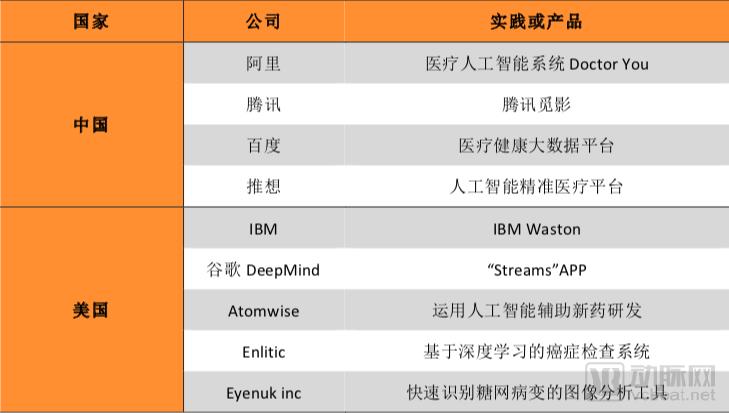
“AI + Healthcare Practices” in G20 Countries (Excerpts from China and the United States)
As the oldest medical AI enterprise in China, Infervision has witnessed the rise and fall of AI companies over the past three and a half years. A large team of researchers (currently over 260, accounting for more than 70% of the workforce) has ensured the continuous iteration of the entire company. After securing RMB 300 million in Series C funding in March, Infervision achieved deployment in 100 domestic hospitals.
The “AI Navigator, Infervision 100+” conference was not merely a summary of Infervision’s past achievements, but also a milestone signaling the tangible integration of artificial intelligence technologies into hospital settings. Looking ahead, Infervision will expand its products into broader domains, embark on a new journey in AI medical imaging, accelerate product deployment, and contribute its efforts to the healthcare sector.