

Metabonose Files IPO Prospectus: Pioneering Real-Time Gut Health Monitoring via Toilet-Mounted Nanosensor Technology
There was a saying: when you have aIdeaAt that point, a thousand people may have already had the idea, a hundred may be planning to act on it, but only those who can truly bring thisideaYet fewer than ten individuals carried it through. When the idea of assessing human health through stool analysis first emerged, Zhang Liang had already begun employing nanosensors to monitor stool, thereby generating data reflective of an individual’s health status.
Zhang Liang graduated from Zhejiang University and subsequently served as the Head of China Operations at AerNos, a U.S.-based startup specializing in nano gas sensors.He later served as a Special Advisor at Alpha Sensors, a U.S.-based startup specializing in nanoscale gas sensing. As one of the first entry-level hires at SMIC, he single-handedly established the photovoltaic applications laboratory for Dow Chemical’s Electronic Materials Division at its Shanghai R&D Center.
Since graduating in 2001, Zhang Liang has worked in the high-tech industry for 15 years. While working on a nanosensor-related project in the United States in 2014, he developed an interest in the medical and health sectors. At that time, Zhang was involved in a project that used nanoscale gas sensors to analyze volatile organic metabolites (VOMs) in human exhaled breath for the early diagnosis of lung cancer. Given that the human body produces numerous VOMs, Zhang wondered whether it would be a valuable application of nanosensors in healthcare to develop sensors capable of specifically capturing certain VOMs directly linked to human health, thereby reflecting health status and providing personalized health guidance.
We have never lacked ideas; what we have lacked is execution. After conceiving this idea, Zhang Liang closely monitored the latest applications and domestic developments in nanosensors. In 2017, Zhang Liang reached out to his university classmates Fu Chao and Song Hao, as well as his friend Cai Fei, to initiate the project, and the four of them formed the founding team. In July 2018, the company Metabonose was officially registered and established.
Having graduated many years ago, all four individuals have accumulated substantial professional experience in their respective fields. Fu Chao brings 13 years of experience in embedded development and machine learning algorithms. As the company’s Chief Technology Officer (CTO), he oversees technical development, including algorithm design for the Metabonose product. Song Hao has 15 years of experience in domestic and international markets, operations, and management. Serving as the company’s Chief Operating Officer (COO), he is responsible for operational management and related business activities. Dr. Cai Fei is the Chief Scientist of Metabonose. He earned his Ph.D. in Biochemistry from the University of Southern Mississippi and completed his postdoctoral research at the University of California, Berkeley. Currently a Senior Scientific Researcher at Genentech, a global leader in biopharmaceuticals, Dr. Cai has 15 years of scientific research experience in the field of microbiology.
Metabonose’s Concept: Monitoring Stool Gases for Real-Time Analysis of Gut Microbiota Status
Since its establishment, Metabonose has abandoned the traditional approach of analyzing human health via VOM (Volatile Organic Metabolites) using chromatography-mass spectrometry or nuclear magnetic resonance instruments. Instead, it employs gas nanosensors to detect volatile gases in human feces, enabling real-time monitoring and efficient feedback. This eliminates the need to wait several days for stool samples to be mailed back for PCR/NGS analysis; by simply installing the nanosensor into the user’s toilet seat cover, the device can automatically analyze the gas composition.
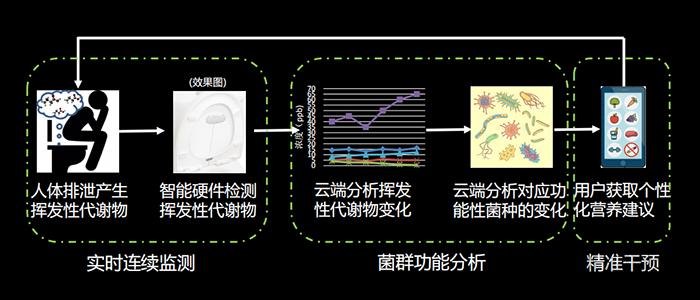
Schematic Diagram of Detection Analysis (Image Provided by the Enterprise)
After ingestion, food passes through the small intestine to the large intestine, where gut microbiota ferment these nutrients to produce various metabolites. Some of these metabolites are reabsorbed by the intestines, while others are excreted. The company conducts targeted analysis of volatile organic metabolites (VOM) in the excreta, measuring over a dozen metabolites that reflect the overall status of the human gut microbiota to determine whether it is in a state of equilibrium. If an imbalance is detected, Metabonose provides users with guided nutritional recommendations to help restore balance through dietary adjustments.
Metabonose is developing algorithms to mitigate the impact of environmental factors such as temperature and humidity onVOMimpact, thereby enhancing product performance. Currently, the detection sensitivity of the prototype can reach the parts per billion (ppb) level. The company has filed a patent application, which has passed preliminary examination and is currently under substantive review.
Less than two months old, the company has been fortunate enough to be selected from hundreds of startup projects into the third cohort of “Bayer’s G4A Shanghai,” a world-class incubator. Since joining the incubator, Metabonose has been accelerating its product’s industrial design, and new products are expected to launch soon.
Metabonose’s Products: To B or To C, or Placed Inside the Toilet Lid?
Metabonose is currently in its early stages, with its business model still under discussion. The final product may target either consumers (B2C) or businesses (B2B). Metabonose can license its technology to companies and charge fees for services. Alternatively, the company may sell instruments directly to individual users, catering to those who prioritize their health and quality of life.
Zhang Liang, founder of Metabonose, stated that the gut microbiota is associated with many diseases. For individuals who have long been in a state of suboptimal health or suffer from chronic conditions and have tried numerous approaches without resolving their health issues, the underlying cause is likely an imbalance in the gut microbiota. Therefore, improving human health can be approached by modulating the gut microbiota.
The company currently plans to cultivate a base of seed users through crowdfunding to establish a strong reputation. Meanwhile, Metabonose is also keeping pace with new media trends by inviting influencers and celebrities to promote its products, thereby leveraging fan influence. However, both of these strategies are aimed at individual consumers. The company also plans to collaborate directly with toilet manufacturers to integrate the Metabonose device into toilet seats, endowing them with novel VOM monitoring capabilities and transforming them into smart toilets that provide real-time feedback on users’ health status. Through such partnerships, Metabonose can cultivate its own core customer base by leveraging the existing sales channels of toilet manufacturers.

Corporate Development Blueprint (Image provided by the company)
The company is currently developing prototypes and algorithms, while attempting to build a health service management platform. Metabonose plans to raise an angel round of financing, with the funds allocated to establishing a laboratory and hiring professional engineers to accelerate the commercialization of Metabonose products.
Founder Zhang Liang stated, “Currently, our primary focus is on the field of gut microbiota. However, we plan to expand into other areas in the future, such as agriculture. For instance, we will analyze bacterial metabolites in plant roots and stems to determine which biofertilizers are most conducive to plant growth.”