

Takeda Asia-Pacific CIO Lu Yong: Building the First Digital Innovation Framework for Pharma—Avoiding Reckless Rush and Paralysis by Caution
Technology has brought boundless wealth to the pharmaceutical industry, fostering its remarkable prosperity.
Digital technologies, represented by artificial intelligence, machine learning, big data, and internet healthcare, are reshaping the pharmaceutical industry and bringing a new look to the sector. VCBeat has recently launched a special feature on “Digital Transformation in the Pharmaceutical Industry,” providing a comprehensive analysis of the technology-driven industrial changes.Click here for the special feature.
This episode’s guest is Mr. Lu Yong, Director of Digital and Information Technology for Takeda Pharmaceutical Company’s Asia-Pacific and Greater China regions. Mr. Lu has led Takeda Pharmaceutical’s “N3“Guided by the philosophy of New Model, New Tool, and New Service, and leveraging digital technologies, we have provided Takeda Pharmaceutical with new perspectives and pathways for business development.”

Lu Yong, Director of Digitalization and Information Technology for Asia-Pacific and Greater China at Takeda Pharmaceutical. Photo provided by the interviewee.
In an interview with VCBeat, Mr. Lu Yong discussed the wave of digital innovation and notable case studies in the global pharmaceutical industry, analyzed Takeda Pharmaceutical’s digital innovation initiatives, and provided forecasts on the future of digital transformation in the sector. He stated:
l The convergence of technological advancements and the pharmaceutical industry’s demands has given rise to a wave of digital innovation in the sector. This natural progression has been further propelled by a series of new national policies that provide both encouragement and regulatory oversight.
l The pharmaceutical industry is selective in its adoption of digital technologies and tools, with varying levels of technological maturity across different domains. In terms of return on investment, the industry prioritizes solutions with proven efficacy.
- Digital innovation is pharmaceutical companies’ “bet” on the future; new technologies will reshape the landscape of the pharmaceutical industry, with areas such as AI-driven drug discovery and development, real-world evidence studies, and integrated digital patient services holding substantial future potential.
The Wave of Digital Innovation Sweeps the Global Pharmaceutical Industry, with Takeda Pharmaceutical Deeply Engaged
The foundation of the pharmaceutical industry lies in the successful commercialization of specific drugs or therapies. Drug discovery is a core function for pharmaceutical companies, while other critical stages—including clinical research, marketing, academic promotion, and patient services—also significantly influence their revenue generation from the market.
Why We Believe Digital Technology Is Reshaping the Pharmaceutical Industry: It Exhibits the Following Characteristics:
1. New technologies, represented by AI, have improved the efficiency of drug discovery, reducing drug screening that previously took years to just a few weeks;
2. Data acquisition and data mining technologies, represented by electronic data capture (EDC) and electronic health records (EHR), can enhance pharmaceutical companies’ utilization of clinical research and post-marketing drug data, providing data-driven insights for relevant processes;
3. The popularity of physician communities and digital tools for doctors has enabled pharmaceutical companies to reach physicians in a low-cost, high-efficiency, and broad-coverage manner, thereby disseminating new academic perspectives;
4. Patients participate in the diagnosis, treatment, and disease management process through internet and IoT platforms, demonstrating greater proactivity in their care—a new challenge that pharmaceutical companies must address;
5. Applications such as internet healthcare, mobile health, pharmaceutical e-commerce, and electronic prescriptions have transformed traditional diagnosis and treatment channels, offering opportunities to reach a vast market.
From a timeline perspective, the present moment marks a period of concentrated explosion in the digital transformation of pharmaceutical companies. First, although digital technologies have been quite popular over the past two decades, they have only recently been prioritized as integrated solutions for closed-loop ecosystem integration. Second, mature case studies have provided reference models for the application of digital technologies or tools in the pharmaceutical industry, enabling the widespread replication of proven experience.
Lu Yong told VCBeat that digital innovation in the pharmaceutical industry is a natural progression. First, continuous technological breakthroughs and the rapid development of AI, big data, and cloud platforms have provided new solutions. Second, the pharmaceutical industry is facing internal and external pressures, including rising R&D costs for innovative drugs, price controls, and compliance regulations. The application of digital technologies offers new pathways for the industry’s development, making the two a perfect match.
In terms of maturity, Lu Yong believes that digital innovation in the pharmaceutical industry can currently be divided into three stages: mature, immature, and indeterminate. Applications such as digital marketing, patient services, online medical communication, and internal management innovation are considered mature. Although there are no clear ROI standards, nearly all top-tier pharmaceutical companies have demonstrated great enthusiasm for these areas, actively participating and achieving significant results. Internet hospitals and online prescriptions are still in an immature stage, primarily constrained by the extent of policy openness. Meanwhile, AI-driven new drug development and big data-enabled real-world studies (RWS) represent highly promising future directions that may have a disruptive impact on the pharmaceutical industry.
With a history spanning over 200 years and innovation as its “DNA,” Takeda Pharmaceutical Company is deeply engaged in the global wave of digital innovation within the pharmaceutical industry. Committed to building a patient-centric, innovation-driven global pharmaceutical company, Takeda safeguards healthy living and a brighter future for all humanity.
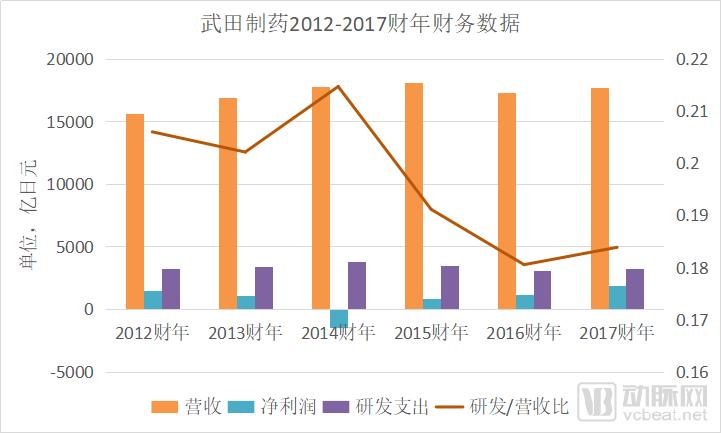
Data source: Takeda Pharmaceutical Annual Report, compiled by VCBeat
* Takeda Pharmaceutical’s fiscal year does not align with the calendar year, running from April 1 of the current year to March 31 of the following year; based on the exchange rate as of August 25, 1 Japanese yen was approximately equivalent to RMB 0.061.
Lu Yong told VCBeat that both Takeda Global and Takeda China have made substantial investments in digital innovation. Takeda Global has primarily focused its layout on AI-driven new drug development, patient services, and innovation incubators. For instance, in June 2017, Takeda Pharmaceutical Company partnered with Numerate, an AI-enabled drug discovery company, to identify small-molecule drugs in the fields of oncology, gastroenterology, and central nervous system disorders.
Takeda Pharmaceutical has also launched an integrated patient solution for Crohn’s disease, an inflammatory bowel disease, leveraging digital tools to provide diagnostic and treatment guidance as well as rehabilitation recommendations, thereby helping patients build confidence. Meanwhile, Takeda Pharmaceutical is collaborating with Boston Digital Venture to jointly incubate high-quality projects in the global digital health sector.
As CIO and Director of Digital Innovation for Takeda Pharmaceutical’s Asia-Pacific region, Lu Yong has implemented “N3“Innovation strategy, through New Model, New Tool, and New Service, connects internal and external businesses to provide better solutions for all parties in the pharmaceutical value chain.”
“Through collaboration both within and beyond the industry, we provide health solutions rather than just medications. Our initiatives under the ‘Beyond Pills’ framework—including digital marketing, academic dissemination, prescription facilitation, and patient services—reflect our practical approach, with the ultimate goal of achieving ‘value-based healthcare’ that benefits all stakeholders,” said Lu Yong.
Establishing a Digital Innovation Coordinate System for Pharmaceutical Companies: Avoiding Both Reckless Rushes and Excessive Caution
In our discussions with Mr. Lu Yong, we established the first-ever coordinate system for digital innovation in pharmaceutical companies, using technology maturity and pharmaceutical companies’ willingness to invest as the axes to map out the blueprint for digital innovation in the pharmaceutical industry.
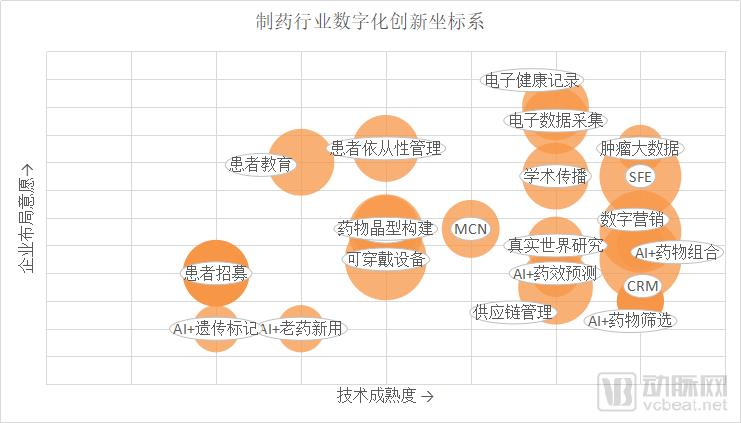
Lu Yong stated that pharmaceutical companies consider several issues during the process of digital innovation: What is the direction of innovation? Should it be developed in-house or outsourced to external vendors? And what is the purpose of the innovation?
First, in terms of innovation direction, different pharmaceutical companies make different trade-offs. Influencing factors include the therapeutic areas covered by their core product portfolios and their willingness to innovate. Broadly speaking, corporate digital innovation is undoubtedly designed to serve core business objectives. For instance, Roche has deeply cultivated its oncology product line; consequently, it naturally focuses on digital innovation within the oncology field. This strategic focus explains why Roche acquired Flatiron Health, an oncology big data company, for a total consideration of $2.1 billion.
Regarding the choice between in-house development and partnership, there has been a shift over time. In the past, pharmaceutical companies tended to favor in-house development; however, in recent years, with the rise of innovative startups, they have increasingly sought collaborations and external vendors. The IT departments within pharmaceutical companies have become the coordinating bodies for digital innovation, leveraging both internal and external resources.
As for the reasons behind innovation, the most important one is to enhance corporate competitiveness. For instance, innovative drug companies may leverage AI in drug discovery and clinical trials to strengthen their R&D capabilities and bring more new drugs to market. Meanwhile, pharmaceutical companies primarily focused on generic drugs and marketing will invest heavily in digital marketing and new distribution channels.
Certainly, from a return-on-investment (ROI) perspective, companies undoubtedly seek a clear ROI ratio and the ability to quantify the impact of innovative solutions, which will also determine the direction of their digital innovation adoption. Taking Takeda as an example, the company aims to partner with firms capable of solving problems, while emphasizing alignment with its corporate culture and development strategy, truly creating value for patients and addressing their pain points.
Within the framework of the digital innovation coordinate system for pharmaceutical companies, Lu Yong believes that AI-driven new drug development, clinical big data applications, digital dissemination of medical knowledge, and patient services are highly promising directions for the future. His rationale is that artificial intelligence integrated with drug R&D will accelerate the development process of small-molecule drugs, leading to the launch of more blockbuster medicines. Meanwhile, regulatory agencies represented by the U.S. Food and Drug Administration (FDA) are promoting the use of real-world evidence as an alternative to traditional clinical studies, which will create opportunities for the application of clinical big data.
Undoubtedly, the wave of digitalization in the pharmaceutical industry will reshape the competitive landscape and have a profound impact on its future development. Broadly speaking, two types of companies are likely to emerge as leaders. The first comprises those achieving significant technological breakthroughs and launching blockbuster new drugs—the core competency of any pharmaceutical enterprise. Past examples such as AbbVie and Amgen illustrate how success with just one or two drugs can propel a company into the ranks of top-tier pharmaceutical firms. The second type includes companies that can adapt to the times and rapidly adopt new technologies. As century-old enterprises, the world’s leading pharmaceutical companies undoubtedly possess this potential. Indeed, from their actual strategic deployments, it is these very companies that are spearheading digital innovation. Therefore, they are poised to maintain their leadership in the era of digital transformation.
Companies that are insensitive to technology and fail to keep pace are likely to face accelerated elimination. This is because new technologies reduce costs and enhance efficiency; in an increasingly competitive industry landscape, the strong grow stronger, and the gap between innovative companies and traditional firms will continue to widen.
Finally, Lu Yong offered recommendations to both pharmaceutical companies and innovative enterprises. For pharmaceutical companies, digital innovation presents a significant opportunity; however, they should adopt a balanced approach rather than swinging to extremes, finding a middle ground between excessive caution and rash, rapid expansion. Successful innovation is not accidental; it requires a stepwise strategy that prioritizes tasks based on urgency and importance, tailored to the company’s specific characteristics. Moreover, talent acquisition is often a critical factor.
For innovative enterprises providing technical services such as AI-driven drug discovery, big data, and digital marketing, it is essential to adopt a long-term perspective rather than pursuing short-sighted gains or quick profits. The ecosystem for industry innovation is crucial; companies must maintain a strong reputation for service quality and steadily advance technological and business model innovations.