

Dajing TCM's Li Wenyou: Intelligent Inheritance of Veteran TCM Doctors' Clinical Expertise to Truly Liberate Their Productivity
“Yin and Yang are the Dao of Heaven and Earth, the guiding principles of all things, the source of change, the origin of life and death, and the abode of spiritual intelligence. In treating disease, one must seek the root cause.”
——The Yellow Emperor’s Inner Canon
The Yellow Emperor’s Inner Canon is the earliest medical classic in China. Together with The Classic of Difficult Issues, Treatise on Cold Damage and Miscellaneous Diseases, and Shennong’s Classic of Materia Medica, it is recognized as one of the four great canonical works of traditional Chinese medicine. The theory of Yin-Yang and the Five Elements originates from The Yellow Emperor’s Inner Canon. Traditionally attributed to the Yellow Emperor, the text is also believed by some scholars to have been compiled during the Western Han Dynasty by multiple authors; however, these claims remain unverifiable.
What is certain today is that the *Huangdi Neijing* (The Yellow Emperor’s Inner Canon), grounded in ancient observations of life phenomena, extensive clinical practice, and basic anatomical knowledge, laid the foundation for Traditional Chinese Medicine’s (TCM) understanding of human physiology, pathology, diagnosis, and treatment. For over two millennia, TCM has safeguarded the health of the Chinese people through the ancient approach of “syndrome differentiation and treatment.” However, since the Industrial Revolution, modern Western medicine, established upon a scientific theoretical framework, has gradually replaced TCM.
As former U.S. Secretary of State Henry Kissinger stated in On China, the collision between Eastern and Western cultures under the threat of superior military force more than a century ago transformed not only China’s political structure at the time but also the Chinese people’s perception of the world order. This naturally included approaches to life and health management, with a prevailing tendency to view Western medicine as a scientific means of diagnosis and treatment.
Yet Traditional Chinese Medicine (TCM) has not faded away. Statistics show that TCM outpatient clinics in China receive 500 million patient visits annually, approximately one-quarter of the volume seen in Western medicine outpatient clinics, indicating a substantial scale. National-level emphasis has ensured the inheritance and development of TCM. Since the beginning of this century, studios led by renowned senior TCM practitioners at various levels—from National Masters of TCM and nationally recognized senior practitioners to provincially recognized and grassroots-level senior practitioners—have sprung up across public hospitals throughout the country, serving as important vehicles for the inheritance and innovation of TCM.
Since the founding of the People's Republic of China, universities of Traditional Chinese Medicine (TCM) have been established across the country, training TCM practitioners in large numbers through standardized processes similar to those used in Western medicine. However, TCM possesses unique characteristics. Emphasizing the harmony of “heaven, earth, and humanity,” TCM has, over thousands of years, evolved into distinct schools of thought shaped by local climates and cultural contexts. Consequently, uniform academic education is not entirely suitable for the inheritance and transmission of TCM.
The establishment of studios for renowned and experienced TCM practitioners is precisely aimed at protecting and inheriting Traditional Chinese Medicine (TCM). These studios adopt the “master-apprentice” model to train TCM physicians, ensuring that the clinical expertise of these esteemed practitioners is fully preserved. “The traditional ‘master-apprentice’ approach is highly inefficient and exhibits strong regional and hierarchical constraints; it not only fails to meet demand in terms of quantity but also suffers from poor horizontal and vertical mobility,” said Li Wenyou, founder of DAJING TCM and a well-known TCM media professional. He believes that artificial intelligence is the technological solution truly capable of unleashing the productivity of renowned and experienced TCM practitioners.
DAJING TCM, established in 2016, is dedicated to recording and inheriting the clinical experience of renowned senior TCM practitioners through intelligent methods. The platform has currently integrated the diagnostic and treatment approaches for over 200 predominant conditions from more than 60 nationally and provincially recognized senior TCM experts, and has established collaborative partnerships with Jiangsu Province Hospital of Traditional Chinese Medicine and Shanghai Municipal Institute of Traditional Chinese Medicine Literature.
Recently, VCBeat (WeChat ID: vcbeat) conducted an exclusive interview with Li Wenyou, who shared his unique insights on “AI + Traditional Chinese Medicine” with VCBeat. Li Wenyou believes that:
1. Ready-made, large-scale data on TCM diagnosis and treatment that are derived from the existing healthcare system and meet the requirements of AI algorithms do not exist; therefore, it is necessary to create a technological platform and commercial mechanism to acquire such data;
2. Renowned senior TCM practitioners are highly willing to embrace AI technology;
3. “AI + Junior TCM Practitioner” can be roughly equated to a renowned senior TCM master; AI technology enables junior practitioners to prescribe at a master level.
4. Only “AI + Junior TCM Practitioners” can truly unlock the productivity of renowned senior TCM experts, a feat that internet-based healthcare cannot achieve;
5. The intelligent inheritance of the diagnostic and treatment experience of renowned senior TCM practitioners can serve as a valuable supplement to the traditional “master-apprentice” model;
6. Traditional Chinese Medicine may not be a rigorous science, but it is effective medicine.
Li Wenyou believes that the diagnostic and treatment experience of renowned veteran TCM practitioners constitutes the most valuable knowledge asset in traditional Chinese medicine (TCM). Conventional AI-driven TCM solutions are typically derived from existing clinical data. However, digital infrastructure development in Chinese medical institutions started relatively late, particularly in the field of TCM, resulting in a severe scarcity of complete and accurate clinical records. Since data is the lifeblood of AI technology, many such TCM intelligence initiatives have failed to come to fruition.
DAJING TCM has taken a contrarian approach by building an intelligent platform for studios of renowned and experienced TCM practitioners. Prior to developing the platform, Li Wenyou and his team conducted in-depth research, interviewing these esteemed practitioners to thoroughly understand their studio development needs. “Our advantage lies in our deep understanding of Traditional Chinese Medicine (TCM),” said Li Wenyou. In his view, the greatest challenge in TCM intelligence is not designing AI algorithms, but rather integrating TCM with AI.
Li Wenyou’s team is capable of engaging in effective dialogue with renowned and experienced TCM practitioners, staying closely aligned with clinical realities to identify their unmet needs in medical practice, and building an intelligent platform on this basis. Li Wenyou summarizes the logic of TCM diagnosis and treatment as “Disease–Syndrome–Pathogenesis–Therapeutic Principle–Prescription–Herb.” “Disease” refers to the patient’s diagnosed disease; “Syndrome” denotes symptoms, signs, and other syndromic manifestations; “Pathogenesis” refers to the disease mechanism—TCM pattern differentiation essentially involves identifying the TCM pathogenesis, which relates to the location and nature of the disease; “Therapeutic Principle” is the treatment strategy established based on the results of pattern differentiation; “Prescription” refers to the herbal formula; and “Herb” denotes the specific medicinal ingredients that constitute the prescription. The judgment, understanding, and management of “Disease–Syndrome–Pathogenesis–Therapeutic Principle–Prescription–Herb” by renowned and experienced TCM practitioners form the chain of TCM diagnostic and therapeutic thinking.
Building on this foundation, DAJING TCM has developed key functionalities, including intelligent recording of diagnosis and treatment data, statistical analysis of such data, an embedded suite of big data mining algorithms for diagnosis and treatment, and TCM knowledge base services. These features are integrated into the DAJING TCM Intelligent Inheritance System for the Experience of Renowned Senior TCM Practitioners. This integration not only significantly enhances the efficiency of clinical practice but also substantially improves the system’s performance in medical care, education, and research as real-world case studies accumulate and machine learning capabilities advance, making it a powerful tool for establishing studios led by renowned senior TCM practitioners.
An intelligent platform that precisely aligns with the diagnostic and treatment needs of renowned and experienced TCM practitioners can resolve the issue of data integration. Another challenge following data integration is the development of intelligent syndrome differentiation algorithms. As previously mentioned, TCM schools are distinctly segmented, and their viewpoints may even contradict one another. For instance, the Danxi School posits that “Yang is often in excess while Yin is often deficient,” advocating for nourishing Yin; whereas the Pathogen-Attacking School believes that “retained pathogens damage healthy Qi,” promoting the three methods of diaphoresis, emesis, and purgation. Forcibly unifying the syndrome differentiation approaches of renowned and experienced TCM practitioners by disease category would undoubtedly lead to confusion.
In response, Li Wenyou’s solution involves extracting the diagnostic and therapeutic reasoning chains of various renowned senior TCM practitioners according to their distinct clinical thought processes, while comprehensively documenting patient signs, symptoms, as well as the practitioners’ syndrome differentiation conclusions and prescriptions. On the application side (the Clinical Decision Support System), the system ranks the diagnostic and treatment plans of these renowned senior TCM practitioners based on individual patient factors such as gender, age, and geographic location, and then recommends them to junior TCM practitioners to assist in diagnosis and treatment.
Following the completion of data collection, the focus shifted to the design of the application interface. Li Wenyou told VCBeat that DAJING TCM’s application serves two types of users: young physicians in the Traditional Chinese Medicine (TCM) departments of Grade 3A hospitals, aimed at “replication,” and TCM practitioners in primary healthcare institutions, aimed at “market penetration.”
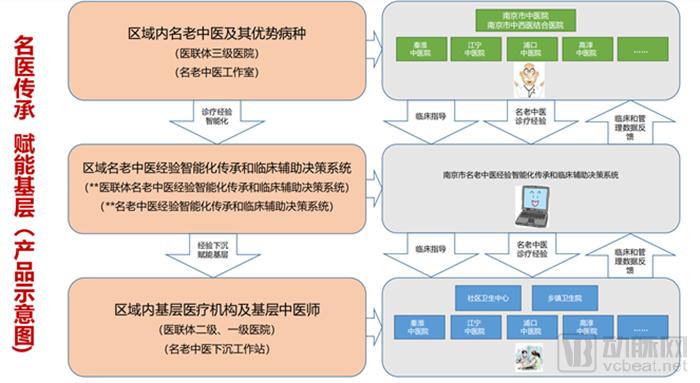
DAJING TCM Product Schematic. Image provided by DAJING TCM
Li Wenyou pointed out that even in public Grade A tertiary hospitals, the resources of renowned and experienced traditional Chinese medicine (TCM) practitioners are extremely limited, and the apprenticeship model of inheritance is inefficient. Young physicians in the TCM departments of Grade A tertiary hospitals receive little guidance from these esteemed experts. The clinical decision support functionality of the DAJING TCM intelligent platform enables young physicians to apply the expertise of renowned and experienced TCM practitioners in real-world clinical diagnosis and treatment.
Following the patient consultation, the junior physician conducts the Four Diagnostic Methods of Traditional Chinese Medicine (TCM) as guided by the system and inputs the diagnostic data into the Dajing TCM Intelligent Platform. The system then simulates the clinical reasoning of renowned senior TCM practitioners to perform syndrome differentiation and treatment planning, automatically selecting the 2–4 most appropriate treatment protocols for the junior physician’s reference based on the patient’s specific condition.
Li Wenyou told VCBeat that, as the Dajing TCM platform has been online for only two years, the accumulated number of medical cases remains limited; therefore, the system cannot yet precisely push a single, most suitable treatment plan tailored to each patient’s individual condition. In the future, once the platform has learned from a sufficient volume of medical cases, its clinical decision support functionality will evolve into a truly high-caliber intelligent TCM system.
TCM practitioners in primary healthcare institutions access the DAJING TCM Clinical Decision Support System in the same manner as young physicians in the TCM departments of tertiary hospitals. Li Wenyou believes that with the deepening implementation of tiered diagnosis and treatment, intelligent decision support is essential for primary care physicians, representing a substantial market demand.
In recent years, the efficacy of Traditional Chinese Medicine (TCM) has been widely criticized due to the chaos in the TCM diagnosis and treatment market. Some argue that TCM lacks written clinical guidelines and that TCM products are marketed without prior clinical trials, rendering TCM untrustworthy. However, Li Wenyou remains optimistic about TCM. He believes that evaluating a self-contained, ancient discipline through the framework of modern science often leads to biased conclusions.
Li Wenyou believes that traditional Chinese medicine (TCM) classical formulas have undergone countless real-world clinical trials over thousands of years, and their efficacy is beyond doubt. The true shortcomings of TCM lie in its lack of transparency: on one hand, the efficacy of TCM is opaque; on the other hand, there is a lack of academic transparency among different schools of thought.
Li Wenyou argues that Traditional Chinese Medicine (TCM) theory operates as a “black box” model, where treatment inputs are studied and adjusted based on the output responses of the body as a system. Moreover, its therapeutic efficacy is often described in qualitative terms, lacking robust data support. This has led to a situation where, unless patients have personal experience with it, outsiders tend to view TCM’s curative effects as mere “legend.” Furthermore, hospitals appear unable to provide compelling evidence regarding which renowned practitioners are more proficient in treating specific diseases.
Not only are the boundaries between different schools of Traditional Chinese Medicine (TCM) clearly demarcated, but the barriers among them are also substantial. TCM practitioners are often reluctant to disclose their proprietary formulas, resulting in a near absence of effective academic exchange. This situation undoubtedly hinders the inheritance and development of TCM.
Li Wenyou believes that using digital methods to open the "black box" of Traditional Chinese Medicine (TCM) diagnosis and treatment is precisely the way for ancient TCM to make up for its deficiencies, representing a transformation in TCM. The DAJING TCM intelligent platform has promoted this transformation while helping to pass on the diagnostic and treatment experience of renowned senior TCM practitioners. When asked whether these renowned senior TCM practitioners would reject digitization, Li Wenyou’s answer was negative. “Surprisingly, renowned senior TCM practitioners are indeed very willing to embrace digitization.” As they are the least likely to want their diagnostic and treatment experience to be lost, Li Wenyou believes that as long as communication with them is conducted in a professional manner, their attitude will not become an obstacle to the digitization of TCM.
Li Wenyou pointed out that DAJING TCM has devoted substantial effort to studying Traditional Chinese Medicine (TCM) thinking and implementing digitalization based on the ontological foundations of TCM. “What we are doing is not only transforming TCM, but more importantly, inheriting it,” Li Wenyou remarked as the interview drew to a close.
Financing
Li Wenyou introduced that DAJING TCM secured RMB 5 million in angel investment immediately upon its establishment. Subsequently, in May 2018, the company completed a Pre-A financing round of RMB 15 million. Currently, DAJING TCM’s business model has been validated, and the company is planning its Series A financing round.
“The new round of financing will be used for extensive market promotion, including collaborations with healthcare IT companies. We hope to complete the Series A financing between the end of this year and early next year,” said Li Wenyou.