

4Paradigm and Ruijin Hospital Launch AI-Powered Chronic Disease Management Platform Leveraging 170,000-Patient, 3-Year Follow-Up Dataset for Diabetes Risk Prediction
In February 2017, the General Office of the State Council issued the “Medium- and Long-Term Plan for the Prevention and Control of Chronic Diseases in China (2017–2025),” marking the first time that a chronic disease prevention and control plan was issued under the name of the State Council, thereby providing a programmatic framework for chronic disease prevention and control efforts over the next 5 to 10 years.
The Plan emphasizes a three-tier prevention framework as the core approach, highlighting integrated prevention and treatment strategies with full-course management tailored to different population groups. Chronic diseases pose a serious threat to the health of China’s residents. Chronic disease-related deaths account for 86.6% of all deaths in China, and the associated disease burden exceeds 70% of the total national disease burden, making it a major public health issue that significantly impacts the country’s economic and social development.
On August 30, at the “AI + Healthcare” Strategic Cooperation Launch Event held within the National Metabolic Management Center (MMC), China’s first AI-based product for diabetes and complication management, “Rui Ning Zhi Tang,” was officially released.
VCBeat (WeChat: vcbeat)It is reported that this product was jointly developed by the team of Academician Ning Guang, an academician of the Chinese Academy of Engineering and Vice President of Ruijin Hospital, and the AI unicorn company 4Paradigm. It can predict individuals’ potential risk of developing diabetes and related metabolic disorders, such as diabetic cardiovascular complications, over the next three years, while providing professional assessment reports and personalized intervention plans.
Furthermore, at the press conference, Ruijin Hospital and 4Paradigm jointly announced a strategic partnership to collaboratively promote the broader application of a series of AI+healthcare products in the health sector, thereby enhancing the national management of chronic diseases.
Based on the World Health Organization’s theory of tertiary prevention for chronic diseases, and leveraging the deep integration of Fourth Paradigm’s leading artificial intelligence technologies with Ruijin Hospital’s specialized research in chronic disease management, the jointly released chronic disease management product offers intelligent services including disease risk prediction, risk factor analysis, personalized interventions, intelligent consultation, and health management. This solution addresses three major challenges: low accuracy in current chronic disease screening, difficulties in implementing targeted interventions, and the lack of effective health management tools, thereby establishing a new paradigm for “AI + Healthcare” in the management and prevention of chronic diseases.
Ruijin Hospital’s Department of Endocrinology is home to the National Clinical Research Center for Metabolic Diseases and a Key Laboratory of the Ministry of Health, and has ranked first nationwide in its specialty for eight consecutive years. Fourth Paradigm is a leader in artificial intelligence technology and services, ranking first globally in the field of transfer learning.
This strategic alliance aims to address the low rates of early awareness and control of chronic diseases, such as diabetes, in China. Taking diabetes as an example, the prevalence of diabetes in China has reached 11.6%, with the prevalence of prediabetes as high as 50.1%, making it one of the greatest potential threats to modern human health. However, due to medical challenges such as low accuracy in chronic disease screening, difficulties in implementing targeted interventions, and a lack of health management tools, the awareness rate of diabetes among adults is only 30.1%.
Academician Ning Guang stated, “The scarcity of medical resources has, to some extent, left society willing but unable to effectively prevent chronic diseases; we can now leverage AI to address this challenge. For individuals at high risk of diabetes, the disease risk prediction feature of ‘Rui Ning Zhi Tang’ can enhance public awareness of self-prevention and the importance of disease management.”
"Furthermore, 'Rui Ning Zhi Tang's' AI-based personalized health solutions can help more people return to good health. Our goal is to reduce the incidence of diabetes by 1% and the prevalence of various diabetic complications by 10% within ten years. The AI technology from Fourth Paradigm has given us great confidence."
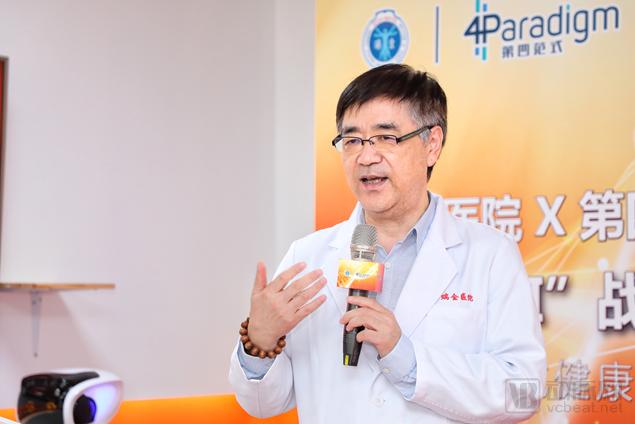
Academician Ning Guang, Vice President of Ruijin Hospital, Delivers a Speech
4Paradigm’s vision is “AI for everyone,” aiming to truly bring the benefits of AI to the general public. At this press conference, 4Paradigm simultaneously launched five products: Ruining Zhitang, Ruining Zhitang Professional Edition, Ruining Zhixin, an Intelligent Consultation System for Chronic Diseases, and an Integrated Robot for Chronic Disease Management.
Guided by the World Health Organization’s (WHO) theory of tertiary prevention for chronic diseases and aligned with China’s Medium- and Long-Term Plan for Chronic Disease Prevention and Control (2017–2025), Fourth Paradigm’s series of chronic disease management products enables users to access a comprehensive suite of thoughtful services—including precise screening, risk factor analysis, personalized intervention recommendations, and health management—simply by inputting basic health indicators. This ensures that the general public can benefit from standardized, expert-level AI-driven chronic disease management services.
Dai Wenyuan, Founder and CEO of 4Paradigm, stated, “This launch represents a milestone achievement by 4Paradigm in the healthcare sector. Since 2016, 4Paradigm has been conducting research in this field. Many of our healthcare products already demonstrate industry-leading capabilities and extensive scenario coverage. In the future, we will introduce additional 4Paradigm healthcare endpoint products to help users achieve one-stop chronic disease management across both online and offline channels, while expanding into screening and management for a broader range of diseases.”
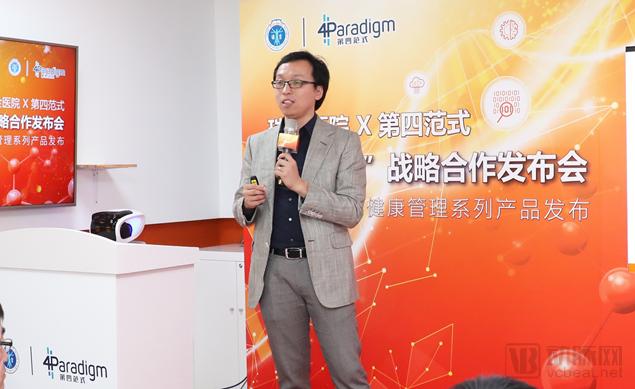
Fourth Paradigm Founder and CEO Dai Wenyuan Delivers Speech
Data is the “lifeblood” of artificial intelligence, with medical data regarded as a “treasure” by all AI companies. Under the leadership of Academician Ning Guang, Ruijin Hospital has established China’s largest biobank for metabolic diseases, conducting in-depth research and analysis on pathogenic factors and treatment management for patients with chronic diseases. This effort has made significant contributions to medical research and prevention and control of chronic diseases in China, while also providing a data foundation for the implementation of bilateral cooperation.
Since 2005, Ruijin Hospital has initiated long-term follow-up and regular monitoring of diabetes among outpatients and inpatients within the hospital, as well as across Shanghai and nationwide. In 2010, the REACTION study was conducted in collaboration with 29 institutions across different regions of China. This large-scale epidemiological survey of chronic diseases covered approximately 250,000 individuals from 29 testing centers nationwide, among whom 170,000 participants were selected for three-year follow-up data collection related to diabetes, thereby establishing the largest dataset in the field of diabetes research.
Typically, machine learning models trained and optimized on large volumes of annotated samples can achieve high-accuracy auxiliary diagnostic results based on inputs from standardized biochemical tests, imaging metrics, and overt clinical features. Unlike the common image- and symptom-based auxiliary diagnostics in “AI + Healthcare,” chronic disease prediction and management face greater challenges in data analysis and interpretation, algorithmic modeling and evaluation metrics, model interpretability, handling variations in input indicators, and providing personalized intervention recommendations.
“RuiNing ZhiTang” and “RuiNing ZhiXin,” chronic disease management products jointly launched by 4Paradigm and Ruijin Hospital, enable the assessment and prediction of the risk and risk factors for common conditions such as diabetes and diabetic cardiovascular complications in ordinary users over at least the next three years, based on simple input metrics. These products provide corresponding personalized intervention plans and support long-term self-management by users, offering targeted assistance for all three levels of chronic disease prevention as defined by the World Health Organization. Leveraging 4Paradigm’s leading artificial intelligence technologies and Ruijin Hospital’s cutting-edge research in metabolic diseases, these products feature high screening accuracy, medically interpretable predictive model indicators, personalized intervention strategies, and capabilities for sustained self-management.
To meet such stringent product application standards, Fourth Paradigm data scientists developed a comprehensive chronic disease prediction modeling framework that addressed a series of challenges, including non-standardized and inconsistent samples within the dataset, variations in sample metrics and regional disparities, optimal utilization of samples, and the need for high model interpretability.
In the modeling process of chronic disease prediction products, 4Paradigm scientists leveraged advanced patented AI algorithms, integrating the strengths of high-dimensional machine learning, transfer learning, semi-supervised learning, and interpretable machine learning. This approach addressed the issue of inconsistent data standards across different testing centers and enhanced the accuracy of modeling and predictive analytics through comprehensive data mining to uncover data correlations.
Meanwhile, by integrating transfer learning and high-dimensional machine learning techniques, we construct virtual metabolic models to generate targeted, personalized precision intervention plans for individual users. This enables an interpretable, optimized high-dimensional machine learning model to deliver four core services—precision screening for chronic diseases, risk factor analysis, personalized intervention recommendations, and health management—based on users’ basic physiological metrics.
Currently, Ruining Zhitang has summarized 500,000 new diagnostic rules for diabetes prediction, far exceeding the number of traditional clinical gold standard rules. Its accuracy in predicting diabetes is 2–3 times higher than that of predictions based on clinical gold standards.
In comparisons with the three mainstream diabetes risk assessment standards—ADA (American Diabetes Association), Finnish, and CDS (Chinese Diabetes Society)—Rui Ning Zhi Tang demonstrates a significant improvement in prediction accuracy. Based on AUC evaluation, the absolute improvement starts at 7% for the standard version and 16% for the professional version, reaching a leading level in the industry.
Similar to RuiNing ZhiTang, RuiNing ZhiXin demonstrates a 14% absolute increase in AUC for predicting cardiovascular complications in diabetes compared to the internationally renowned Framingham Cardiovascular Disease Risk Assessment Standard. This performance exceeds industry-standard prediction levels and leads global advancements in the prediction of cardiovascular complications in diabetes.
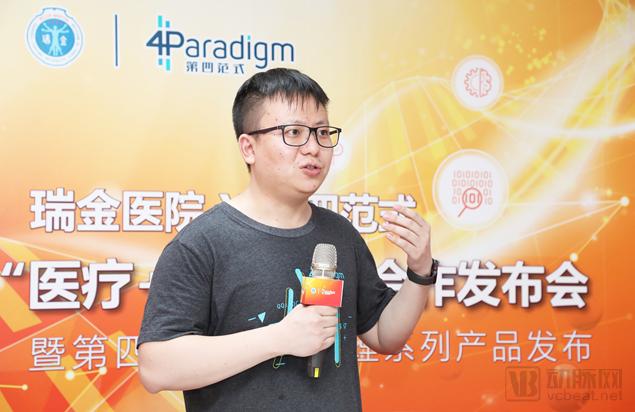
Tu Weiwei, Senior Scientist and Head of Medical Products at 4Paradigm, Launches Product
Although AI giants both in China and abroad have also laid out their strategies in the medical field, constrained by the scarcity of data—the “lifeline” of AI—in healthcare, many hyped concepts have turned into bubble-like attempts. In contrast, the Rui Ning Zhi Tang and Rui Ning Zhi Xin product series were among the first to be implemented and commercialized. At the press conference, Tu Weiwei, Senior Scientist and Head of Medical Products at 4Paradigm, explained the technical details behind this achievement.
By inputting basic indicators across six dimensions, the system generates disease risk assessments that are more accurate than those made by professional physicians. It also provides personalized health management plans tailored to each individual, enabling expansion from the management of a single condition to the management of complications.
Medical resources have always been scarce and precious. AI doctors, which combine artificial intelligence technology with the collective expertise of medical professionals, enable limited medical resources to play a greater role, helping to reshape traditional healthcare delivery models and benefit individuals and healthcare institutions alike.