

Tencent Medical AI Lab Launches Video-Based AI System for 3-Minute Parkinson’s Disease Assessment
On August 25, 2018, the First Academic Conference of the Professional Committee on Rehabilitation for Parkinson’s Disease and Movement Disorders under the Chinese Association of Rehabilitation Medicine was held in Guangzhou. At the conference, Tencent Medical AI Lab unveiled a new AI-assisted diagnostic technology for Parkinson’s disease—the Intelligent Assessment System for Motor Function in Parkinson’s Disease. Leveraging markerless motion video analysis technology, this system automatically generates Unified Parkinson’s Disease Rating Scale (UPDRS) scores from patients’ movement videos. By facilitating AI-assisted diagnosis and early screening of Parkinson’s disease, it effectively improves diagnostic accuracy and efficiency. This marks the first AI-assisted diagnostic solution for Parkinson’s disease in China based on motion video analysis technology.
At the conference, Professor Wang Jian, Deputy Director of the Department of Neurology at Huashan Hospital Affiliated to Fudan University and Principal Investigator for Parkinson’s Disease at the National Clinical Research Center for Geriatric Diseases (Huashan), introduced this collaborative technology to attendees and reported on recent advances in AI-driven monitoring and comprehensive management of Parkinson’s disease.
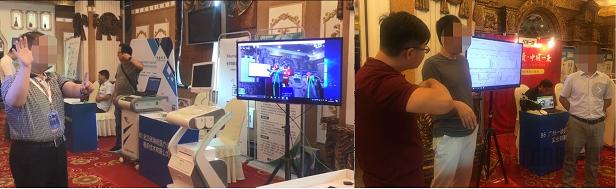
Figure: Experts attending the conference from renowned national Grade 3A hospitals experienced and tested the Intelligent Assessment System for Motor Function in Parkinson’s Disease at the Tencent Medical AI Laboratory booth. The experts paid particular attention to hand movement analysis.
Traditional Manual Diagnosis of Parkinson’s Disease Is Time- and Labor-Intensive, Lacking Simple, Objective, and Quantitative Indicators
Currently, there are approximately 3 million patients with Parkinson’s disease in China. The prevalence rate is about 1% among individuals aged 55 and older, rising to 1.7% among those aged 65 and above. As population aging intensifies, age-related neurodegenerative disorders such as Parkinson’s disease have evolved from merely a medical concern into a significant social issue. Patients with Parkinson’s disease typically experience symptoms such as bradykinesia, limb tremors, and rigidity, which severely impair their daily mobility and quality of life.
Early detection of Parkinson’s disease and objective, quantitative assessment of disease severity are crucial for evaluating treatment efficacy, slowing disease progression, and reducing complications. Currently, the common diagnostic approach involves assessing patients with Parkinson’s disease using the Unified Parkinson’s Disease Rating Scale (UPDRS). Clinicians assign itemized scores based on the patient’s performance of specified tasks, typically in outpatient or follow-up settings, and require prior specialized training.
Conventional diagnostic methods have, to some extent, limited the detection rate of Parkinson’s disease and the timely assessment of its progression. On one hand, a single UPDRS assessment requires more than 30 minutes to complete, imposing significant time and communication burdens on both physicians and patients. On the other hand, as scoring relies primarily on patients’ subjective descriptions and physicians’ visual observations—such as the distance, amplitude, and frequency of movements—the lack of quantitative metrics may introduce bias due to subjectivity.
New Breakthrough in AI-Assisted Diagnosis: Parkinson’s Disease Diagnosis Speed Increased 10-Fold
To address the drawbacks of traditional manual UPDRS scoring, which is time-consuming, labor-intensive, and lacks precision, Tencent Medical AI Laboratory has developed and launched an Intelligent Assessment System for Motor Function in Parkinson’s Disease. This technology identifies key body landmarks in movement videos and quantitatively analyzes motion metrics, thereby achieving “quantifiable” and “refined” UPDRS scoring. It enhances the accuracy of motor assessments, enables early screening for Parkinson’s disease, and improves diagnostic efficiency as well as the quality of diagnosis and treatment.
With the assistance of AI technology, users can undergo daily motor function assessments for Parkinson’s disease without wearing any sensors; simply recording video via a camera (a standard smartphone suffices) enables this evaluation. Physicians can complete the diagnostic process within three minutes, achieving a tenfold increase in diagnostic speed.
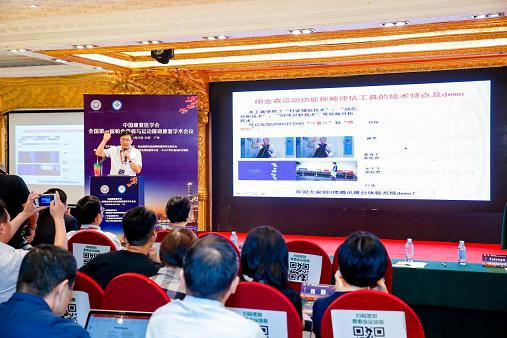
Figure: Professor Wang Jian introduced the clinical challenges, subjectivity, and inconsistency of motor analysis in Parkinson’s disease, as well as the preliminary clinical trial results of video technology jointly developed with Tencent Medical AI Laboratory.
At the conference, Professor Wang Jian stated, “Current preliminary experimental data show that the AI-generated scores from the Intelligent Assessment System for Motor Function in Parkinson’s Disease are highly consistent with expert manual ratings, fully meeting expected outcomes. Larger-scale formal clinical trials are now being actively prepared.”
Through AI technology, patients will be able to use ordinary smartphones for self-administered video capture in home settings to conduct daily assessments of motor function in Parkinson’s disease, thereby saving substantial time for both patients and physicians that would otherwise be spent on clinical visits or follow-ups.
“Let’s explore whether we can bring greater intelligence to Parkinson’s disease research by transforming AI from a ‘frenemy’ into a true friend—delegating repetitive and tedious tasks to it, so that we can devote our limited cognitive resources and time to more challenging and meaningful work,” said Professor Wang Jian at the conference.
This technology is a universal video analysis tool for movement disorders, scalable to the internationally recognized MDS-UPDRS rating system. In addition to aiding in the diagnosis of Parkinson’s disease, it can be applied to other movement disorders, such as preoperative gait analysis for patients with cerebral palsy and assessment of motor function during post-injury rehabilitation training for soccer players. Furthermore, it supports home-based and institutional elderly care settings by enabling at-home evaluation and analysis of seniors’ mobility, daily activities, and multiple health conditions, thereby effectively enhancing elderly safety and improving service efficiency in care facilities.
Leveraging the quantifiable and fine-grained assessment capabilities of this technology, a series of standardized movements can be selected for specific diseases (such as Parkinson’s disease) to establish a novel set of intelligent standards for assessing motor function. This approach overcomes the limitations of high subjectivity and low quantification inherent in traditional motor assessments, thereby providing a new framework for evaluating functional capacity in patients with movement disorders.

Figure: Group photo of some members from Tencent Medical AI Lab, some members from the Department of Neurology at Huashan Hospital, and staff from the Medical Division of Science Press
Tencent’s Intelligent Assessment System for Motor Function in Parkinson’s Disease features three core technical characteristics: dynamic feature capture (predicting whole-body joint positions via pose convolution), temporal analysis technology (ensuring temporal coherence of whole-body joints through temporal convolution), and dynamic analysis technology (leveraging memory networks and human biomechanical models to output reliable motor metrics).
Dr. Fan Wei, Head of Tencent’s Medical AI Laboratory, stated, “The motion video analysis technology we have unveiled presents greater challenges than conventional image analysis techniques. This is because its core AI algorithms must not only learn image features through technologies such as convolutional neural networks (CNNs), but also capture the temporal consistency and correlations across video frames in both spatial and temporal dimensions. In simple terms, beyond analyzing the static features of individual images, video AI technology must additionally perform more complex analyses of the spatiotemporal relationships between successive frames. Notably, due to the large number of hand joints, motion analysis of the hands is more subtle and complex than that of the torso. A single video consists of millions of frames, posing a significant challenge to computational power; therefore, the field of medical video analysis demands higher algorithmic efficiency. At academic conferences, we have demonstrated real-time motion analysis on standard desktop computers, capturing metrics such as frequency, amplitude, and stability—indicators that are difficult to observe, discern, and quantify with the naked eye.”
Currently, Tencent is actively exploring and deploying the application of artificial intelligence technologies across diverse healthcare scenarios. By developing AI capabilities and fostering a robust technological ecosystem, it aims to serve both physicians and patients, enhance operational efficiency, optimize the medical experience, and address the most pressing clinical concerns for doctors.

Tencent Medical AI Lab is an artificial intelligence laboratory dedicated to the healthcare sector, operating under a dual-center model in the United States and China. It currently has three branches located in Silicon Valley, Beijing, and Shenzhen. The lab’s primary research focuses on building intelligent platforms—such as medical knowledge engines, medical reasoning engines, clinical decision support systems, and consultation dialogue engines—based on foundational technologies including natural language understanding, medical knowledge graphs, deep learning, medical imaging, Bayesian networks, and multimodal analysis. In addition to the Intelligent Motor Function Assessment System for Parkinson’s Disease, the lab’s other key products include a Clinical Decision Support System that provides assistance for high-risk conditions prone to misdiagnosis, such as stroke and acute coronary syndrome, as well as an AI-powered ECG Analysis Software that enables automated interpretation and early warning of electrocardiogram monitoring results.