

Facebook's 10-Pronged Strategy to Capture Social Traffic and Lead Digital Health Innovation
As social media accounts for an increasing share of daily life, it has gradually become a significant component of the digital health sector.
Some governments have also recognized the potential of these platforms. For example, in January this year, the Canadian government announced an initiative to use artificial intelligence to help track social media posts that may indicate a risk of suicide; the UK’s National Health Service (NHS) launched a dating app, Tinder, to promote organ donation.
Today, when it comes to the largest social media platform abroad, Facebook stands out. The platform is used by approximately 1.45 billion people daily.
In an era where social networking sites and the healthcare sector are increasingly intertwined, VCBeat (WeChat ID: vcbeat) seeks to explore Facebook’s contributions over the past few years.
10 Ways to Embrace Digital Health
As of now, Facebook has officially launched 10 features targeting the healthcare sector.
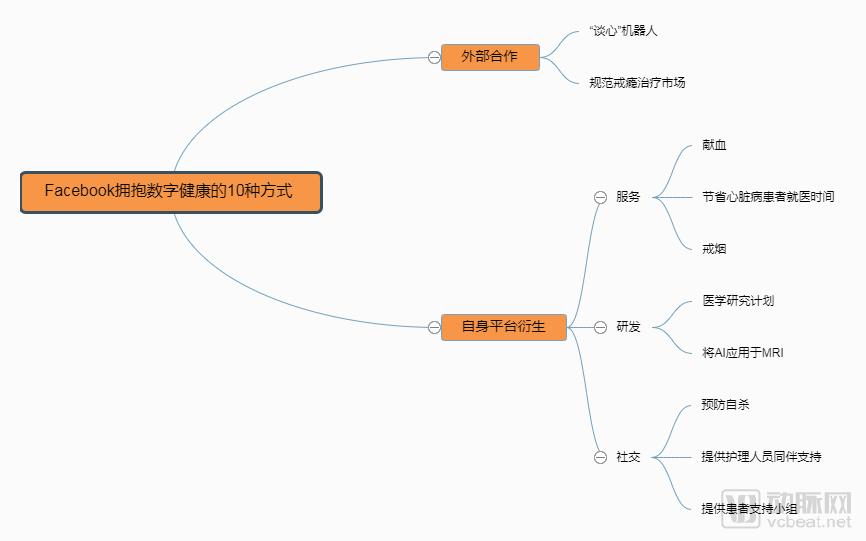
Blood Donation
According to World Health Organization statistics, more than 70 countries worldwide lack safe blood supplies, with India being one of them.
In the absence of an adequate blood supply, patients and their families must independently locate donors to ensure treatment, with social media platform Facebook serving as one such channel. According to Facebook’s statistics, thousands of people in India use its platform every week to find suitable blood donors.
In addition to India, Bangladesh and Pakistan have seen similar situations in this regard. Facebook consolidated the demand and decided to launch a blood donation feature, which was piloted in these three countries in May 2017 with positive results.
On October 1, 2017, India’s National Blood Donation Day, Facebook officially launched its blood donation feature in India. The specific services are as follows.
Caring individuals can:
Register as a blood donor;
Integrate information and organize blood donor groups;
Match appropriately based on requirements (location, blood type).
Requesters may:
Post a request (including location, blood type, and personal contact information);
Eligible blood donors based on location and blood type are notified;
Confirm blood donation and contact the recipient.
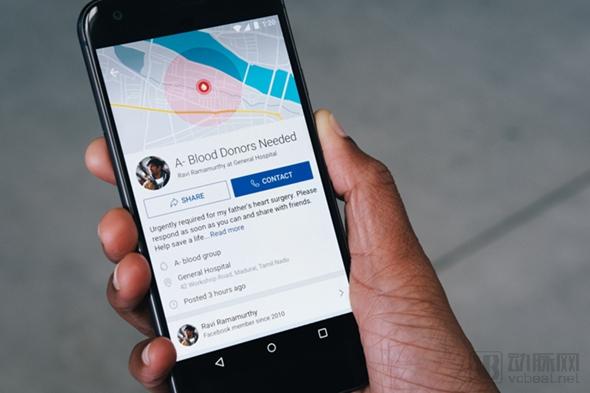
Image source: newsroom
According to Facebook statistics, as of May 2018, more than 8 million people had signed up as blood donors. Hema Budaraju, Facebook’s Health Product Manager, stated, “Our research shows that when people have access to reliable information and tools, they are more willing to donate blood, and those in need of blood can more easily find donors.”
Standardizing the Addiction Treatment Market
As more people struggle with drug and alcohol addiction, public health experts warn that some addiction treatment centers have emerged that fail to meet basic healthcare quality standards. Many of these facilities are involved in insurance fraud, while others employ unproven therapies, leaving the efficacy of addiction treatment uncertain.
In April this year, the unrestricted advertising of certain illegal rehabilitation centers on Facebook sparked heated debate among U.S. lawmakers. In July of the same year, Facebook officially issued a statement requiring that only pre-certified addiction treatment centers be permitted to advertise on its platform.
Any entity planning to advertise on Facebook in the United States must obtain LegitScript certification. LegitScript, a Portland-based company specializing in online verification for pharmaceutical-related businesses, provides screening and certification services. The company utilizes a 15-point checklist to ensure that entities under review are qualified, compliant with laws and regulations, professional, and free of any adverse history.
Facebook stated that it hopes “addicts” and their families can access safe and reliable information on the platform, and that Facebook will provide them with support.
Suicide Prevention
A survey report released by the World Health Organization shows that one person dies by suicide every 40 seconds worldwide. Experts state that one of the most effective ways to prevent suicide is for someone to promptly identify the individual’s negative emotions and provide active counseling before the incident occurs.
Facebook helps people in distress stay connected with their family and friends.
Leveraging this advantage, Facebook has been working in the field of suicide prevention for over a decade. Initially, Facebook provided a mechanism for users to report posts if they believed the content expressed suicidal intent. In 2015, Facebook offered additional resources to individuals exhibiting suicidal tendencies, allowing them to choose to connect with friends or mental health professionals for support and comfort. In 2016, Facebook expanded its reach by enabling those who reported posts to contact their friends directly.
In March 2017, Facebook officially launched its artificial intelligence (AI) screening system. This system uses AI recognition to detect posts or live videos in which users may express suicidal ideation, facilitating faster reporting and triggering a “distress signal” after verification.
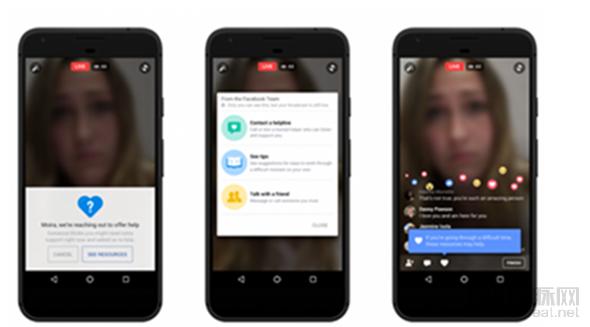
Individuals with suicidal tendencies will receive assistance from Facebook
Image source: mobihealthnews
Medical Research Proposal
Data collection plays a critical role in medical research.
In April this year, CNBC reported that Facebook was in discussions with several major U.S. hospitals about a potential partnership to match user data with patient records.
Facebook plans to use a technique called “hashing” to match anonymized patient data (including health conditions and age) with their anonymized social media profile data. This data can then be used to help healthcare professionals better understand patients and facilitate the development of intervention plans, such as:
Bridging Gaps in Patient Data: Facebook consumer data can fill gaps in existing electronic health records (EHRs), such as past experiences and medical conditions, providing physicians and researchers with comprehensive patient histories;
Powering Remote Patient Monitoring: In theory, these data can determine whether a patient has friends or family nearby; if not, the hospital can dispatch additional caregivers to attend to them.
Provide Patient Movement Trajectories: If patients contract highly infectious diseases, Facebook data can precisely track where they have been, where they reside, and whom they have contacted. This will enable hospitals not only to identify the source of an outbreak but also to mitigate further spread of the disease.
Although linking patients’ social media data with hospital records offers numerous benefits, data security remains a paramount concern, as evidenced by Facebook’s suspension of such initiatives in the wake of the Cambridge Analytica data scandal.
"Confidant" Robot
According to the American Psychological Association, 18.29% of adults in the United States (approximately 43.7 million) experienced mental health issues in 2017. Social media platforms often serve as a medium for them to “vent their grievances,” allowing them to offer mutual comfort.
In light of this, Facebook launched the “chat therapy” bot Woebot. Created by a team of psychologists and artificial intelligence experts from Stanford University, Woebot helps people manage their mental health through brief daily conversational chats, mood tracking, curated videos, and word games.
The advantages of Woebot lie in:
Low Cost, Low Barrier: As long as they are Facebook users, their “conversations” are completely free;
Timeliness: Available 24/7 for contact, with immediate resolution of any issues;
Fragmentation: Users do not need to set aside a continuous block of time for consultations; they can utilize fragmented time intervals.
Feedback Mechanism: Woebot proactively engages with users for five minutes each day to assess their status.
Human-centered: Woebot offers various tools, such as curated videos and text-based games, enabling users to recover within context rather than imposing specific treatments.
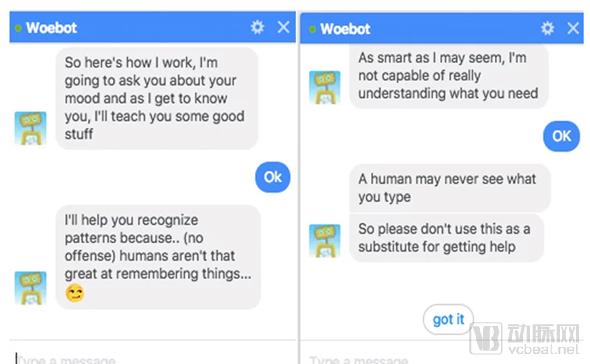
Woebot Chats with Users (Anonymous)
Image source: POPSUGAR Photography/popsugar.com
According to a survey by Stanford University, Woebot can significantly alleviate depressive symptoms in as little as two weeks, whereas traditional therapies typically require four to five weeks to show a response.
Saving Time for Cardiac Patients Seeking Medical Care
According to a study presented at the Argentine Congress of Cardiology (SAC 2017), paramedics using WhatsApp, a mobile messaging application owned by Facebook, can treat heart disease patients more quickly, thereby reducing mortality rates.
“Argentina experiences more than 42,000 heart attacks annually,” said Nicolás Lalor, a cardiologist at the Buenos Aires Cardiovascular Institute. “Patients have the highest likelihood of survival if they receive medical care within 90 minutes. However, delays occurring before and after hospital arrival can reduce the treatment’s success rate.”
Doctors on ambulances used WhatsApp to directly transmit electrocardiograms (ECGs) to cardiologists, alerting hospital staff and enabling them to prepare for the patient's arrival.
Experimental results from 896 patients indicate that using WhatsApp enables faster treatment for heart disease patients, with a mortality rate 2.34% lower than that of other patients.
Smoking Cessation
Although smoking is associated with many health problems, such as lung cancer, heart disease, and skin disorders, smokers often find it difficult to quit this habit because chemical changes deep within the brain lead to nicotine addiction. According to the World Health Organization (WHO), more than 7 million people die from tobacco use each year.
However, a new study offers a glimmer of hope. A clinical trial conducted by the University of California, San Francisco (UCSF) demonstrated that a smoking cessation intervention program delivered via Facebook was 2.5 times more likely to result in quitting than other smoking cessation programs.
The study, published in the journal Addiction, involved 500 participants with a mean age of 21 years, over 87% of whom were daily smokers. They participated in a 90-day program called the Tobacco Status Project, where they were assigned to smoking cessation groups.
Intervention methods included daily reminders, weekly on-site Q&A sessions, and weekly cognitive behavioral counseling with PhD-level smoking cessation counselors. Results showed that participants were 2.5 times more likely to quit smoking at three months compared to the control group (which used traditional smoking cessation methods) (8.3% vs. 3.2%).
However, during the subsequent follow-up period (within one year), the same effects were not sustained. Researchers indicated that long-term smoking cessation occurred only among individuals who were prepared to quit.
Provide Peer Support for Caregivers
Imagine discovering your photo in an event you never attended. Baffling, isn’t it?
This is what actually happened to some Facebook users. Next to the photo, they would see a message: “Confusing, right? You are now experiencing what it feels like to have Alzheimer’s disease.”
This is, in fact, a Facebook campaign for Alzheimer’s disease, aimed at fostering empathy and encouraging more users to join the fight against dementia by becoming members of support groups.

Image source: CNET
Caring for individuals with Alzheimer’s disease can be isolating, and studies have shown that caregivers have higher rates of depression, anxiety, insomnia, and cardiovascular disease. However, researchers at Indiana University–Purdue University Indianapolis (IUPUI) have developed a Facebook “friend-shopping” app designed to help provide support for caregivers.
The application provides caregivers with support groups on Facebook, where their questions are pushed to other members for review and response. Members who provide answers can then become part of the Alzheimer’s disease support network, thereby continuously expanding its reach.
Researchers stated that when these emotional and informational issues are addressed, caregivers feel more supported, which can alleviate their burden and reduce stress.
Provide Patient Support Groups
According to a study published in Surgery, social media (particularly Facebook groups) may be useful tools for improving patient engagement and satisfaction.
Researchers created a virtual community forum—a Facebook group—for liver transplant patients, which included family members, caregivers, and healthcare providers. Over the course of the nine-month study, a total of 350 users joined the group, with 50% being liver transplant recipients, 36% caregivers and friends, and 14% healthcare providers.
Throughout the study, group members posted a total of 339 posts, receiving 2,338 comments and 6,274 reactions. Researchers found that 98% of the posts elicited responses or comments from other group members. Compared with healthcare providers and caregivers, patients were the most active users, with 95% of respondents reporting that joining the group had a positive impact on their care. Additionally, 97% stated that their motivation for joining was to provide or receive support from other patients.
The authors of the study wrote, “These patients share common stressors, including physical and psychosocial symptoms associated with end-stage liver disease, anxiety stemming from an unknown etiology of their liver condition, and the burden of strict medication adherence. They require support from peers, physicians, and society, a need that Facebook is well-positioned to meet.”
Applying AI to MRI
Facebook AI Research (FAIR) has partnered with the NYU School of Medicine on a new project that can accelerate magnetic resonance imaging (MRI) scans by a factor of 10.
MRI scanners provide patients and physicians with more detailed images of soft tissues, but they are relatively slow. While X-rays and CT scans take less than a second or about one minute, respectively, MRI examinations can range from 15 minutes to over an hour. Such prolonged scanning times can be distressing for young children, individuals with claustrophobia, or those who have difficulty lying still. Furthermore, the scarcity of MRI equipment in many rural areas and certain countries limits access, resulting in significant patient backlogs.
Researchers have indicated that part of the reason for the slow speed of MRI is that it must individually capture many different scanning points and then reconstruct cross-sectional or three-dimensional images. The FAIR team stated that they could reduce the number of items scanned in an MRI and then use machine learning (a field dedicated to studying how computers can simulate or implement human learning behaviors to acquire new knowledge or skills, reorganize existing knowledge structures, and continuously improve their performance) to infer the missing data.
Currently, the FAIR team is utilizing New York University’s database, which comprises 10,000 clinical cases and 3 million magnetic resonance images of the knee, brain, and liver. The FAIR team hopes that this research will benefit patients, paving the way for this approach to be applied in the future to accelerate or improve other types of medical imaging.
Natural Traffic Gateway for Accessing Health Information
In February 2004, 23-year-old Mark Zuckerberg founded Facebook while studying psychology at Harvard University. Initially launched as a social networking platform for college students, Facebook has evolved into a multifaceted “composite” platform supporting diverse activities such as seeking advice, posting images and updates, selling products, and public exposure. It is now beginning to expand into the healthcare sector.
In a U.S. survey, more than 40% of respondents relied on social networks to obtain health information, and among these social media users, 94% accessed such information via Facebook. They were seeking healthy lifestyle concepts, such as diet and exercise; looking for ways to maintain their health; and viewing health education videos from hospitals, medical research institutions, and other healthcare providers.
Facebook’s massive user base has forged an inextricable link with the healthcare sector. The logic is straightforward: everyone on Facebook will, at some point in their lives, fall ill. Given the platform’s social nature, users tend to share their experiences battling diseases and seek advice from friends by posing questions to their network.
Through communication and dissemination on Facebook, healthcare professionals can provide information on influenza vaccines, epidemics, and basic preventive care. Facebook can influence how and when people respond to diseases, as well as their access to relevant knowledge.
In 2012, Facebook’s organ donation initiative prompted more than 13,000 Americans to register within a single day, a figure 21 times higher than the usual daily average.
In 2013, an article titled “How Facebook Is Changing Science and Public Health” caused a stir. It cited a highly influential case at the time involving a mother who posted photos of her sick child on Facebook. After posting the photos, she was contacted by three physician “friends,” who informed her that her son might have Kawasaki disease (mucocutaneous lymph node syndrome) and required immediate treatment.
In 2014, Facebook officially took its first step into healthcare by actively exploring the creation of online “support communities” to connect Facebook users affected by various diseases.
During this period, Facebook continuously conducted project testing, and it was not until 2017 that these projects were officially implemented.
Of course, the biggest controversy surrounding Facebook’s foray into healthcare is user data security. Reports indicate that in March alone, there were 120,000 reported cases of health data breaches in the United States, with the majority involving social media platforms.
Large Enterprises Cross Over into Healthcare
Healthcare is undergoing a profound transformation, with innovative technologies enabling faster and more accurate diagnoses, expanding access to high-quality care, facilitating more effective treatments, and strengthening the patient-provider relationship.
As the digital healthcare market expands, major technology companies have predictably entered the fray. Although the extent of their role in the future development of healthcare remains uncertain, they undoubtedly possess sufficient resources to make a significant impact.
Alphabet, Google’s parent company, is engaging in healthcare from multiple angles, ranging from scientific research to venture capital. Although many of Alphabet’s healthcare initiatives fall outside its core business scope, the company has consistently devoted substantial time, energy, and resources to recruiting top-tier talent in healthcare and the life sciences.
A common thread in Alphabet’s healthcare strategy appears to be age-related diseases. Verily, Alphabet’s life sciences division, has partnered with multiple pharmaceutical companies and biotech startups to develop a range of products, from diabetes management devices to bioelectronic medicines for the treatment of rheumatoid arthritis.
Other healthcare-related initiatives include a $32 million investment in Aspire Health, a palliative care startup, and the Google DeepMind project, which aims to determine whether machines can analyze eye scans. Regardless of the final outcomes, Alphabet is poised to play a significant role in setting standards for medical technology innovation.
Apple
Today, Apple Inc. is heavily investing in the research and development of cutting-edge healthcare technologies. The company’s widely adopted ResearchKit and CareKit software platforms enable developers to create integrated health applications for researchers, clinicians, and patients (FDA-approved). In fact, the research data collected by Apple devices is highly reliable, thereby legitimizing the use of mobile data collection in clinical trials and other research endeavors.
But software is not the end of Apple’s healthcare innovation. An email previously released by the FDA revealed that three medical products are under development: an app for diagnosing Parkinson’s disease and two cardiac devices. Managing medical devices and monitoring health data through the iOS platform will undoubtedly improve physicians’ diagnosis and management of patients’ chronic conditions.
Amazon
Unlike Apple, Facebook, and Google, Amazon has been committed to healthcare, albeit with little public attention. According to foreign media reports, the company’s digital health team, 1492, is working on projects involving telemedicine, electronic medical records, and virtual pharmacies.
Amazon has two distinct advantages in the race to launch digital health technologies. The first is its scale; with warehouses and distribution centers spanning the globe, along with pre-existing relationships with healthcare clients, Amazon can easily establish supply chains for health devices or software. The second is Alexa AI (Amazon’s artificial intelligence); as Alexa AI advances and evolves, it is well-positioned to serve as the foundation for medical devices or robotics.
As these major corporations channel resources into the healthcare sector, big tech is poised to transform the industry. We look forward to seeing what innovations these companies will bring to healthcare in the near future.
Chinese Social Platforms Expand into Healthcare
Tencent and Sina can be said to dominate half of the social media industry. VCBeat reviewed available information to explore their initiatives in the healthcare sector.
Tencent
In the VCBeat article titled “The Trend of ‘Internet + Healthcare’ Is Set: Tencent and Alibaba Are Accelerating Their Layouts—What Roles Will They Play?”, it is pointed out that Tencent’s proprietary offerings in its healthcare portfolio include WeChat, WeSure, Tencent Miying, Penguin Medical Encyclopedia, Tencent Cloud, TengAi Doctor, and TengAi Tang Daifu.
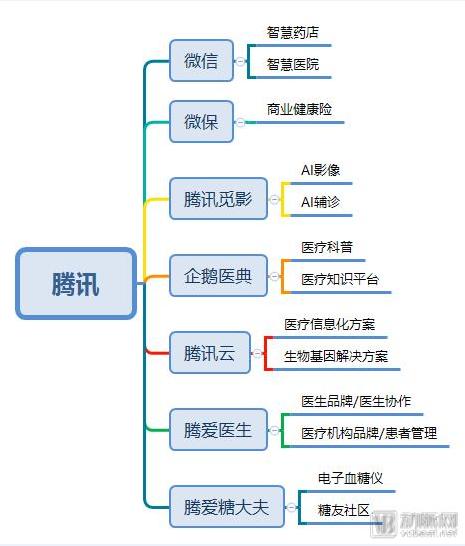
As shown in the figure above, Tencent has extended its reach into multiple areas of healthcare. However, closer examination reveals a certain “disconnect” between Tencent’s healthcare ventures and its core social networking attributes. Apart from leveraging WeChat to provide pharmacy and hospital services, all other business lines are relatively “new” offerings. In contrast, Facebook tends to leverage its inherent attributes and advantages to engage with the healthcare sector.
Sina
Compared with Tencent, Sina’s approach to the healthcare sector takes a distinctive path. Within the realm of health and medical websites, Sina Health offers a comprehensive suite of content, featuring sections on diseases, wellness, pharmaceuticals, an exposure platform for misconduct, and expert Q&A.
On its social media platform, Sina Weibo, there are approximately 50 vertical industry sectors, such as e-commerce, travel, and food. In the healthcare sector, “iAsk Doctor” has been authorized as the official operator. It boasts 6 billion instances of precise medical resources, over 20 million official followers, and an average monthly follower engagement of 150 million interactions (as of press time). Additionally, it leverages traffic recommendation channels across multiple internet platforms, having already helped 120,000 physicians generate significant economic and brand value.
Through the Aiwen Doctor platform, physicians can establish a personalized online clinic—Aiwen Clinic (with full ownership and operational rights belonging to the physician)—to rapidly build their personal brand, enhance their influence, and increase the value of their professional reputation.
On the iWenDoctor platform, physicians can increase their visibility by publishing popular science articles, participating in pro bono consultations, engaging in micro-interviews (directly synchronized with Sina Weibo), and conducting online promotion. Additionally, physicians can offer paid online consultation services, set their own pricing for image-based consultations and daily intake limits, and publish outpatient appointment information independently, thereby achieving seamless patient conversion.
Compared with Facebook, Sina Weibo has a shallower involvement in the overall healthcare industry, focusing more on perspectives from doctors and patients to facilitate medical consultations and serve as a connecting platform.
References:
“The Trend of ‘Internet + Healthcare’ Is Set: Tencent and Alibaba Are Accelerating Their Layout—What Roles Will They Play?”