

Reimagining Patient Communities: Empowering Patients Through Data-Driven Health Insights
Digital technologies, represented by artificial intelligence, machine learning, big data, and mobile health, are reshaping the pharmaceutical industry and bringing a new look to the sector. VCBeat has recently launched a special feature on “Digital Transformation in the Pharmaceutical Industry,” providing a comprehensive analysis of the technology-driven industrial changes.Click here for the special feature.
"Strength in numbers; it's easier to do business where potential consumers are concentrated. Speaking of"Patient Community,I believe this is the first reaction of many people.
In fact, the connotation and functions of patient communities have long gone far beyond this.
VCBeat (WeChat ID: VCBEAT) will explore how to leverage the valuable data from patient communities to empower upstream and downstream partners—such as pharmaceutical companies, research institutions, and insurance providers—based on a review of various patient community operational mechanisms.
There is an old saying: “A long illness makes a good doctor.” The underlying principle is that patients’ experiences with disease are, in fact, valuable. However, patient experience has largely remained untapped. In the past, the treatment experiences of both physicians and patients could only be distilled and summarized by physicians for subsequent dissemination.
However, during the process of summarizing clinical experience, physicians are often unable to account for numerous non-medical factors that can influence medical outcomes. The process by which doctors synthesize their experience is increasingly being optimized through intelligent tools such as machine learning, artificial intelligence, and algorithms. In terms of patient experience, professional patient communities essentially facilitate the sharing of medication and treatment experiences among patients with similar conditions. Moreover, by leveraging AI and other tools, it is possible to quantify patients’ subjective disease experiences, thereby unlocking greater value from patient data.
Of course, this differs from patient-driven aggregation, such as through QQ groups or Baidu Tieba. These integrated, de-identified patient data can be shared with healthcare providers, researchers, pharmaceutical and medical device companies, and insurance companies. Large volumes of patient data can help these companies improve their operations and provide precise decision support.
This business model feels all too familiar, as numerous social platforms in China also host similar patient support groups and communities. However, none have gained significant traction; they have failed to achieve professionalization and consolidation, suffer from uneven information quality, and lack adequate safeguards for privacy and data security.
The greatest difference lies in the fact that within patient-organized communities, patients remain a vulnerable group seeking assistance, and the content they share is based on self-perceived, experiential insights.
The most advanced online patient communities empower patients by quantifying their disease experiences and structuring and standardizing patient data into medical-grade evidence, thereby transforming the way patients interact with healthcare organizations.
VCBeat has found that many leading overseas online patient communities, such as PatientsLikeMe, have established collaborations with pharmaceutical companies, and their patient data have been utilized by the FDA as medical-grade evidence.
The rapid development of online patient communities is primarily attributable to the regulation and promotion by regulatory authorities.
The U.S. Office of the National Coordinator for Health Information Technology (ONC) defines Patient-Generated Health Data (PGHD) as health data created, recorded, gathered, or inferred by patients or their designees that is relevant to addressing health concerns. In certain national or local healthcare institutions or groups, PGHD has become an integral component of Electronic Health Records (EHRs) and is being utilized systematically. Technology and standards organizations have also conducted forward-looking explorations into the development of data infrastructure for PGHD.
On August 23 this year, PatientsLikeMe collaborated with the U.S. Food and Drug Administration (FDA), incorporating patient-volunteered data from its platform into a study published by the FDA. This move can be seen as part of the FDA’s exploration of diverse sources for health data across different levels of evidence.
PatientsLikeMe meets this requirement because it currently uses the Medical Dictionary for Regulatory Activities (MedDRA) for data coding, which is the FDA’s framework for coding Adverse Event Reports (AER). This ensures that patient-generated data are accessible to researchers. This also distinguishes specialized patient communities from general patient gathering platforms. Relevant reports from PatientsLikeMe and the FDA have already been published.
The FDA has recently been exploring how real-world data from diverse sources and varied patient feedback should be valued. To this end, the FDA has established the Office of Patient Affairs to more effectively solicit input from patients.
Second, the development of patient communities is driven by their position as a connective node within the value system of digital transformation in healthcare. They stand at the intersection of the big data explosion, the consumerization of healthcare services, and the advancement of personalized and precision medicine.
It is estimated that one in every twenty Google searches relates to health issues. A report by Accenture points out that 68% of patients spend several hours online each day and prefer pharmaceutical companies to engage with them through digital channels to provide health management services. A Google survey of 1,000 physicians also revealed that 73% of doctors rely on the internet to acquire clinical knowledge and address their concerns.
In the era of digitalization and consumer-centricity, patients demand greater transparency in the healthcare process. Beyond relying on physicians’ recommendations, they also seek corroborating information from relevant online communities to validate medical prescriptions. In this consumer-driven age, reviewing product comments before purchasing has become a habitual practice. Patient-uploaded data serves as a powerful endorsement for pharmaceutical companies, highlighting the intrinsic value of patient-generated data. As early as 2016, Walgreens.com incorporated patient medication reviews sourced from PatientsLikeMe.
Patients have a substantial demand for achieving symmetry in medical information. However, few platforms can deliver a user-centric, secure environment that also ensures authority and reliability. Furthermore, specialized patient communities must address the challenge of maintaining user engagement without relying on physician resources.
VCBeat Reviews Major Online Patient Platforms in China and Abroad:
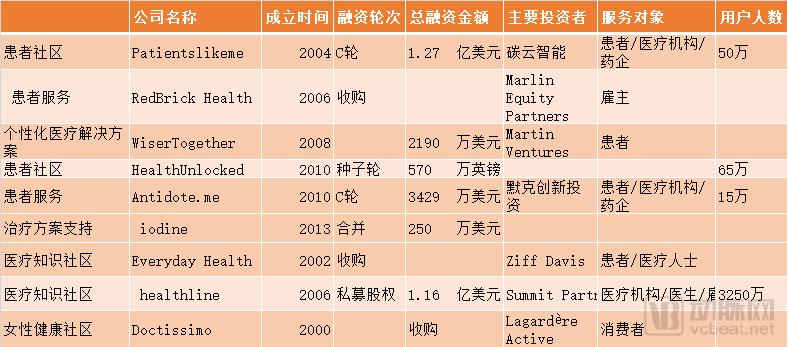
The collaboration between pharmaceutical companies and specialized patient communities is not merely about advertising and marketing; rather, it encompasses multifaceted cooperation in data-driven drug discovery, patient recruitment for clinical trials, and pharmacovigilance.
Patient recruitment for clinical trials, in particular, has proven to be a viable business model. Specialized patient communities can rapidly match suitable patients and respond quickly. A study by the University of Warwick found that while traditional healthcare organizations took nearly six months to recruit 250 participants, an online community accomplished the same task in just 48 hours.
A report from CB Insights indicates that in the United States, more than 1.7 million people were newly diagnosed with cancer in 2018. Meanwhile, over 10,000 clinical trials each need to recruit thousands of new patients to test experimental cancer drugs that could potentially save lives. However, fewer than 5% of cancer patients ultimately participate in these trials.
The situation with patient recruitment in China is no better. According to the FDA’s *2015–2016 Clinical Trial Report*, among clinical trials submitted for FDA approval, the United States, with approximately 4% of the world’s population, accounted for 40,835 trial participants, whereas China, with roughly 20% of the global population, had only 3,841 participants.
Online patient communities can accelerate the patient recruitment process for clinical trials; for instance, PatientsLikeMe has launched a dedicated feature for clinical trial patient recruitment. PatientsLikeMe established the online tool Open Research Exchange, which rapidly generates patient-reported outcomes and establishes links between symptoms and diseases.
Antidote Match provides technology-driven clinical trial matching services, serving over 250 patient communities and more than 15 million patients.
In the discovery of new drugs, the latest applications are focused on rare diseases. The decentralization brought about by online centers has led to technological democratization, granting everyone equal channels for expression. For rare diseases, patient populations that were previously marginalized within the general public can now access avenues and spaces for advocacy that were unavailable before. Historically, the treatment and research of rare diseases have faced numerous challenges. First, the number of patients with rare diseases is small and geographically dispersed worldwide. While these conditions require specialist care, many patients are unable to access the appropriate experts. Diagnosis often takes years. Furthermore, due to the small and scattered patient population, large-scale clinical trials are not feasible, and pharmaceutical companies see insufficient economic returns in the development of "orphan drugs."
Rare diseases represent one of the greatest challenges facing human medicine, with nearly 7,000 rare diseases currently identified. In China, there are over 10 million patients with rare diseases, yet fewer than 40% receive a confirmed diagnosis, and the average time to diagnosis is five years. PatientsLikeMe has begun collaborating with Shire Pharmaceuticals to conduct research on rare disease treatments.
For researchers studying rare diseases, establishing regular contact with patients and caregivers has long been a challenge. Philippe Vickers, Head of R&D at Shire Pharmaceuticals, stated in a press release: “We typically study patients at a specific point in time, and these patients may be located far away. Our partnership with PatientsLikeMe will enable Shire to understand how environmental factors influence the disease and to integrate all information onto a single platform. Our goal is to gather a more comprehensive view of the patient and caregiver experience, which may guide the development of new, more patient-centric treatments.”
In these areas, pharmaceutical companies have also made attempts. For instance, Novartis launched a social networking application for chronic urticaria in 2016. After logging in and entering their symptoms, patients can be anonymously matched with others experiencing similar symptoms. This allows patients with comparable conditions to share life experiences and manage unexpected situations.
Currently, PatientsLikeMe collaborates with the largest number of pharmaceutical companies, including Roche’s Genentech, Merck, and AstraZeneca.
In intelligent healthcare, patient data serves as the foundational infrastructure. For patient communities to establish a foothold, the most critical factor is not amassing a large patient base, but rather mastering all entry points for patient data and streamlining patient data workflows.
This entry point currently appears somewhat crowded, with wearable device companies, insurance firms, and internet companies continuously engaging in trial-and-error efforts. For instance, WeChat has partnered with WebMed, while insurance companies are leveraging wearable devices to encourage physical activity among users. Online patient communities must go beyond merely hosting patient-uploaded data; they need to acquire comprehensive, multidimensional, and dynamic user data by exploring a range of data entry points such as the Internet of Things (IoT), genetic testing, wearable devices, and sensors.
Taking PatientsLikeMe as an example, it is currently seeking richer data sources, such as data obtained from sensors and wearable devices. It is also conducting pilot projects to collect blood and DNA samples from some members. Through its partnership with iCarbonX, PatientsLikeMe will have a means to expand projects involving gene sequencing.
This partner is a member of the iCarbonX Digital Life Alliance. Comprising technology and application companies, the alliance collaborates with iCarbonX to integrate biological and patient-generated data with artificial intelligence, aiming to enhance understanding and insights into behavioral and environmental factors that may accelerate or mitigate disease in daily life.
After establishing a solid user base and expanding data channels, it is also crucial for patient communities to develop viable business models. Patient communities possess vast amounts of data, which can be easily monetized through marketing and advertising; however, this approach undermines the fundamental trust within these communities. Abroad, patient communities have pioneered a wider variety of business models.
PatientsLikeMe, which has raised over $127 million in financing, has carved out a specialized path that refuses to compromise with advertising. The PatientsLikeMe website rejects ads and generates revenue primarily by partnering with pharmaceutical companies and research institutions, monetizing its platform by selling access to the medical data it collects as a proprietary database.
PatientsLikeMe’s competitor, HealthUnlocked, has also adopted a similar business model: its patient community is free and non-profit. HealthUnlocked monetizes by leveraging AI and technology to provide precise solutions for pharmaceutical companies, the healthcare industry, and health organizations. In addition to offering clinical trial matching and industry insights to pharmaceutical firms, it provides hospitals with HER platforms to integrate more patient data. Antidote, on the other hand, focuses specifically on clinical trial matching.
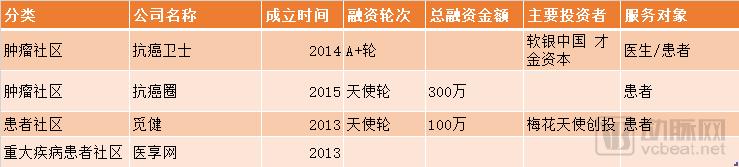
VCBeat has found that the major patient communities in China include Tongbingxianglian (Patients with Similar Conditions) and Manbingbang (Chronic Disease Help). In recent years, some vertical disease-specific communities have also emerged. Overall, the development of patient communities is still in an exploratory stage and requires time to mature. The monetization model of domestic patient communities tends to focus on providing patients with precise medical resources. However, in this regard, many platforms that already possess hospital and physician resources hold a competitive advantage, leaving patient data at a disadvantage.
Based on several long-established online patient communities in China, the key operational characteristics are as follows:
1. Disease-specific focus. Implement vertical community operations tailored to specific disease types. Patients sharing the same diagnosis have a solid foundation for interaction, fostering long-term engagement. By aggregating patients according to their specific conditions, efforts can be more effectively focused.
2. Psychological Intervention. Psychological support plays a highly positive role for patients, as nearly all of them have varying degrees of psychological needs. Taking an online patient community as an example, the organization has established a dedicated forum for psychological intervention and introduced online lectures by physicians to help patients overcome psychological barriers. Meanwhile, through “patient journey notes,” patients are encouraged to share their personal experiences and emotional journeys.
3. Integrate effective information. Information shared within patient communities comes from a wide range of targeted sources, and is supplemented by access to physician resources and professional medical consultations, helping patients identify information tailored to their individual conditions.
The development of overseas patient communities offers two key references for leveraging patient data in China:
First, address the structuring of patient data by quantifying data from the prevention phase and post-discharge period.
Second, expand the partner ecosystem. A single tree does not make a forest; by securing more partners and data sources, patient communities can enhance their authority and professionalism, establish a closed-loop data system, and penetrate a wider range of patient application scenarios.
PatientsLikeMe
PatientsLikeMe is an online health data-sharing platform. By sharing patient experiences to map the real-world progression of diseases, PatientsLikeMe generates new knowledge. As patients interact to improve their outcomes, the provided data helps researchers understand how these diseases manifest in the real world and accelerates the discovery of new, more effective treatments.
PatientsLikeMe primarily establishes online communities for patients with chronic diseases. As of January 2017, it had amassed over 500,000 patients, covering more than 2,700 disease conditions. Patients on PatientsLikeMe share treatment experiences with one another, and the community also includes healthcare professionals.
Michael Evers, Executive Vice President of Marketing, Technology, and Operations at PatientsLikeMe, said in a statement, “Whether you are just starting a new medication or exploring alternative therapies, understanding what others have experienced is invaluable.” “We are delighted that our members are helping more people understand their options and expectations, so that everyone can make more informed decisions about their health.”
HealthUnlocked
HealthUnlocked is an intelligent self-service platform that aggregates individuals' medical experience information, enabling patients to share their healthcare experiences safely.
On this platform, patient information is aggregated into vast amounts of useful data. HealthUnlocked processes this information, transforming it into actionable knowledge while ensuring security and privacy. Like PatientsLikeMe, HealthUnlocked provides a range of digital health solutions to healthcare providers, pharmaceutical companies, and research institutions.
MyHealthTeams
MyHealthTeams is a San Francisco-based company that builds highly engaged social networks for patients with chronic diseases. MyHealthTeams makes it easy for participants to find and connect with peers who understand their daily lives.
As of 2017, MyHealthTeams had established and operated 24 social networks, serving patients with chronic diseases in eight countries.