

Zhimai Engine: A Smart Marketing Platform Covering Over 10,000 Pharmacies Addresses Key Pain Points in Pharmaceutical Retail
The "Blue Book on the Development of China's Pharmaceutical Market in 2018" shows that in the first half of 2018, the sales volume of China's drug terminal market reached 859 billion yuan, a year-on-year increase of 6.9%, among which the retail pharmacy terminal sales amounted to 195.4 billion yuan, representing a year-on-year growth of 7.8%. The data from pharmaceutical retail holds significant value; however, the utilization of retail pharmacy data, intelligent operations, and smart marketing still require improvement.
The “Zhimai Engine,” a smart sales system for pharmacies, leverages patient medication data to enable precision marketing for retail pharmacies. Currently, Zhimai Engine partners with nearly 100 chain pharmacy enterprises, covering more than 10,000 stores, managing 18 million members, and processing 500 million data records, significantly improving customer repurchase rates and sales revenue for its partner pharmacies.
How Does “Zhimai Engine” Achieve This? Founder Liu Quan Granted an Interview to VCBeat (WeChat: vcbeat) and Shared His Insights on the Pharmaceutical Retail Industry.
Zhixiang Health Technology (Beijing) Co., Ltd. was established in March 2015. In 2017, it launched “Zhimai Engine,” a SaaS platform that connects pharmacies with pharmaceutical companies, integrating data, services, and marketing. For pharmacies, the platform provides services such as data analytics, member management, staff point systems, and product marketing. For pharmaceutical companies, it facilitates the deployment of marketing campaigns, tracking of sales data, and training of pharmacy staff.
Liu Quan, founder of Zhimai Engine, holds a Master’s degree in Pharmacology from Peking Union Medical College and brings 12 years of experience in the pharmaceutical industry as a serial entrepreneur. He previously served as Executive Director of Brand Planning at Tasly Holding Group, Marketing Communications Director at inVentiv Health (US), and founded Daimai Health Communications.

(Liu Quan, founder of Zhimai Engine; photo provided by the interviewee)
Co-Founder of Technology, Liu Hongyan, has 9 years of experience in big data models and enterprise application development. She previously served as the leader of the development team at US-based Qilin Yuanchuang, where she developed multi-tasking systems for large multinational corporations.
Zhao Xi, Vice President of Operations, brings nine years of experience in market communications and operations within the pharmaceutical industry. He previously served as Assistant General Manager and Director of Operations at Beijing Borui Qizhi Advertising Co., Ltd., and as a Pharmaceutical Project Manager at Gravity Media, Medmed, and Shikong Shidian Public Relations.
Wang Jun, Vice President of Business Development, has 13 years of experience in marketing, sales, and comprehensive corporate management. He previously served as Assistant General Manager at Amcare General Practice Clinic and as the Overall Head of the Olympic Project at 3M Company.
Regarding the rationale behind developing this product, Liu Quan reflected on his experience working at a pharmaceutical company. “At the time, my employer had over 10,000 employees, including a sales force of nearly 7,000. I concluded that the core responsibilities of sales personnel primarily encompass four key areas: first, customer relationship management; second, data, including store coverage, sales volume, and customer profiles; third, service, specifically providing professional support to patients or customers; and fourth, marketing, which involves sales activities targeted at specific customer segments. Among these, customer relationship management is irreplaceable, whereas the other three areas can be partially automated by systems, potentially even outperforming human efforts.”
“This involves the issue of sales efficiency, as both pharmacies and pharmaceutical companies are highly fragmented. There are nearly 460,000 pharmacies across China, half of which are independent single-store pharmacies, while on the other end, there are more than 4,000 pharmaceutical manufacturers. A substantial amount of information, services, and marketing efforts need to be conveyed and communicated between these two sectors.”The traditional model relies on human intermediaries, whereas we address the connectivity challenge between pharmacies and pharmaceutical companies through an intelligent system..” Liu Quan said.
Currently, as an intelligent operations system designed for pharmacies, Zhimai Engine features three core functionalities:
• Pharmaceutical Care System: Primarily manages members' medication processes, including providing instructions on proper drug administration, managing adverse reactions, and monitoring medication adherence.
• Smart Marketing Engine: By analyzing pharmacy customers' repurchase intervals, customer value, purchasing preferences, and cross-selling opportunities, the intelligent marketing engine can precisely segment members using tags (disease, medication, purchase timing, member value, preferences, and activity status), assign specific marketing tasks to each store associate (WeChat/phone follow-ups, SMS, or coupons), and guide associates in recommending complementary medications and implementing member marketing strategies.
• Category Analysis Engine: By analyzing different manufacturers, drugs, prices, and profit margins, provide category optimization solutions for the product procurement department.
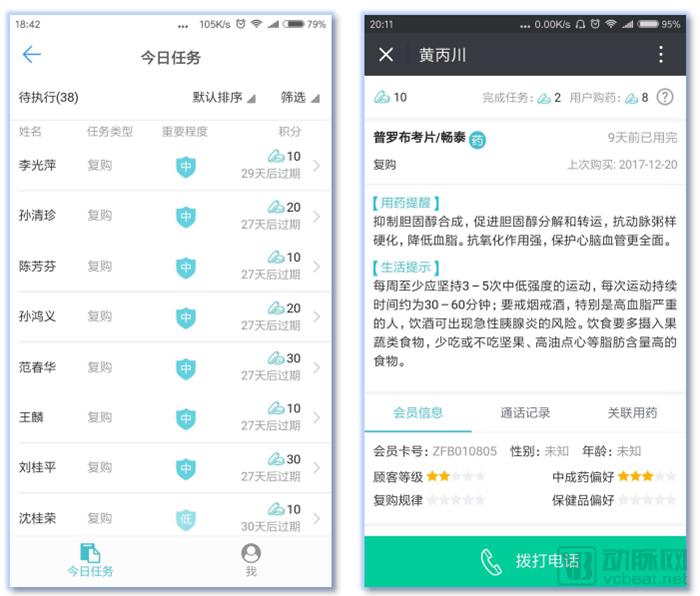
(Zhimai Engine Store Staff Interface)
When discussing the advantages of its products, Liu Quan stated, “Pharmaceutical retail is a highly specialized and complex endeavor, encompassing pharmacy, customer service, and retail operations. Given my academic background in pharmacology, combined with the extensive experience of our core team in this field, therefore”We will gain a deeper understanding of the pharmaceutical industry, pharmaceutical care services, and pharmaceutical products themselves., launched the medication repurchase model and intelligent category analysis engine, weTransform Data into Concrete Marketing Actions, these products will also provide greater practical benefits to pharmacies.”
“Teams with a background in software development tend to approach problem-solving from a technical perspective. We address the cross-sector communication challenges between pharmaceutical companies and pharmacies from the standpoint of the pharmaceutical industry itself, rather than focusing solely on the pharmacy segment. This is both the advantage of our product and its strategic positioning for the future,” said Liu Quan.
After a year and a half of development, Zhimai Engine has partnered with nearly 100 chain pharmacy enterprises, including 22 of the top 100 chain pharmacy companies. The collaboration covers more than 10,000 stores, manages 18 million members, and involves a data volume of 500 million records.
Application evidence from pharmacies demonstrates that the Zhimai Engine can increase the repeat purchase rate of chain customers and single-store sales. For instance, one pharmacy chain previously had a customer repurchase rate of less than 20%. After launching the Zhimai Engine in March 2017, the activation rate of dormant users reached 21.3%, and the customer repurchase rate rose to over 25%. Furthermore, another chain’s sales growth rate was below 4% prior to implementation; after launching the Zhimai Engine in April 2017, its average single-store sales increased by 14% year-on-year.
It is reported that in January 2015, Zhixiang Health Technology Company secured RMB 6 million in angel investment from Hongli Venture Capital. In January 2017, its “Zhimai Engine” product raised nearly RMB 10 million in Pre-A financing from the Qingdao Luxin Chicheng Fund, affiliated with Luxin Venture Capital. The company is currently seeking its third round of financing.
Meanwhile, the current “Zhimai Engine”Business model: pharmaceutical companies' marketing expenses + product agency sales commissions + pharmacy service feesThis model is based on forecasts for various business segment markets. The market size for pharmacy SaaS services (excluding ERP) was only RMB 200 million in 2022. Pharmaceutical companies allocate a significant proportion of their budgets to marketing and promotion in retail pharmacies, accounting for approximately 20% of their revenue. With total national retail pharmacy sales currently at around RMB 500 billion, marketing and promotional expenditures amount to roughly RMB 100 billion. In addition, the market size for product agency sales also exceeds RMB 100 billion.
Regarding future development plans, Liu Quan stated, “We have already secured a leading position in the industry, and we aim to become the pioneer in smart retail for pharmaceuticals through our continued growth. In the coming years, we expect to cover 80,000 pharmacies, partner with 100 pharmaceutical companies, and achieve RMB 100 million in revenue. The ultimate positioning of ‘Zhimai Engine’ is to serve as an intelligent marketing platform that integrates pharmaceuticals, healthcare, and insurance, establishing collaborations with 100,000 pharmacies.”
Regarding product upgrades, Liu Quan stated, “Our intelligent operations system essentially transfers tasks traditionally reliant on manual labor to automated systems, thereby achieving intelligent automation. For instance, in category optimization, relying solely on manual calculations by the merchandise procurement department makes it difficult to achieve comprehensive and precise analysis. We aim to continuously enhance the intelligence of this system, which will significantly reduce the workload for pharmacies in the future.”
“In terms of breadth, we will expand our functionalities to include inventory management, automated smart retail, and facial recognition. We have already started laying the groundwork in this area. While we do not develop facial recognition technology ourselves, we provide solutions for content delivery based on post-recognition data. In terms of depth, we will leverage big data-driven intelligent systems to gradually automate manual processes. Furthermore, we plan to progressively engage in pharmaceutical companies’ marketing efforts by using our system to connect demand from both ends, thereby driving foot traffic and optimizing resource allocation for pharmacies. Nevertheless, our core business remains focused on pharmacies, facilitating the exchange of information, data, and services between pharmacies and pharmaceutical manufacturers.”
Liu Quan also shared his views on the pharmaceutical retail industry with VCBeat, “Currently, the sales model of pharmacies in the pharmaceutical industry remains relatively traditional. With the emergence of new retail models, there will be a gradual phase of integration, and the boundary between online and offline channels will become increasingly blurred in the future.. From a long-term perspective, our system will help pharmacies and pharmaceutical companies adapt their product marketing to this integrated landscape. Although the pharmaceutical industry is relatively traditional and conservative, with stringent regulatory requirements and a high degree of specialization, we will assist pharmacies and pharmaceutical enterprises in transitioning in this direction.”