

Behind the H1 2018 Financial Reports: Neusoft Surpasses RMB 570 Million in Revenue, Maitian Achieves Over 80% Gross Margin in China's Medical IT Sector
In August, listed companies involved in the medical IT business successively announced their 2018 semi-annual reports. Neusoft Group, Winning Health, and DHC Software claimed the top three positions with total revenues exceeding RMB 500 million. The specific revenue figures are shown in the table below:
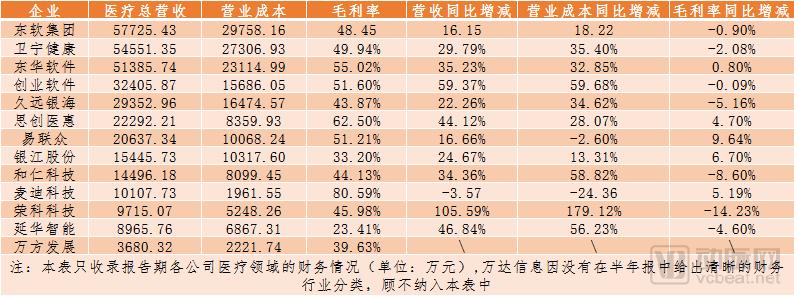
Data Source: 2018 Semi-Annual Reports of Each Company
In terms of gross profit margin, based on the data for various companies in the table, the average gross profit margin for the medical IT industry is estimated to be approximately 41.74%. However, there are companies such as Meditech with gross profit margins exceeding 80%.
Based on the comprehensive findings from this semi-annual report survey, VCBeat has drawn the following conclusions:
1. Reducing the cost of outsourced products and strengthening the sales of high-gross-margin IT solutions in anesthesia, critical care, and operations & maintenance services can significantly improve the gross profit margin of healthcare IT companies;
2. With policy support, IT companies across the industry, such as Donghua and Yanhua, are increasing their market focus on the healthcare sector;
3. Cloud-based next-generation hospital business systems, healthcare payments, and artificial intelligence are the primary innovation directions for medical IT companies today.
MediTech, with a Gross Profit Margin as High as 80%
Let us focus on the gross profit margin column. While peers typically report gross margins of 40%–50%, MediTech’s gross margin, exceeding 80%, stands out prominently. Moreover, it is one of only two companies in the table to register a decline in operating costs.
According to the official statement in the semi-annual report, the company’s operating costs decreased, indicating a relative increase in the proportion of revenue from high-gross-margin products such as anesthesia, critical care, and operation and maintenance services among projects accepted during the period. Additionally, the cost of externally purchased software and hardware for integrated solution products, including digital operating rooms, decreased relatively, leading to an overall decline in operating costs.
Generally, excluding the impact of financial leverage, industries with lower asset turnover ratios require higher gross profit margins to achieve the same return on equity (ROE). Companies in the medical IT sector primarily serve public hospitals in China as their accounts receivable customers. Due to budget constraints and payment process management systems, these hospital clients typically have longer payment cycles, resulting in lower asset turnover for medical IT firms. However, such clients generally possess strong creditworthiness, minimizing the risk of bad debts. As IT companies continue to expand their operational scale, the increasing amount of retention money may keep accounts receivable balances at a relatively high level.
Taking Madi Technology as an example, the company’s accounts receivable balance stood at RMB 239.2028 million as of the end of June 2018, representing a substantial amount. Due to the nature of its products, companies like Madi Technology typically enjoy high gross profit margins. Nevertheless, Madi Technology’s gross margin remains unparalleled. Therefore, it is essential to analyze the competitive advantages of this company.
Currently, large and medium-sized medical institutions in China have established Hospital Information Systems (HIS) with basic functionalities, as well as foundational Clinical Information Systems (CIS) such as Picture Archiving and Communication Systems (PACS), Radiology Information Systems (RIS), and Laboratory Information Systems (LIS). The development of clinical medical management information systems is beginning to extend into departments with more intensive diagnostic and treatment activities, such as operating rooms and Intensive Care Units (ICUs). Among the companies that won the most bids for public hospital informatization projects in the first half of 2018, according to a recent survey by VCBeat, Meditech and its competitor Jiahua Meikang firmly secured positions in the top ten, driven by a substantial number of hospital orders for clinical systems.
The following two figures show the bid evaluation results for the Guangzhou Women and Children’s Medical Center’s procurement of a Surgical Medical Procedure Management System and for Sun Yat-sen University Affiliated Stomatological Hospital’s purchase of Anesthesia and Critical Care System services, respectively.
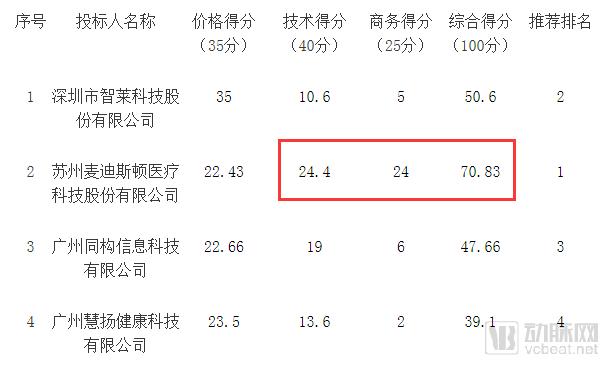
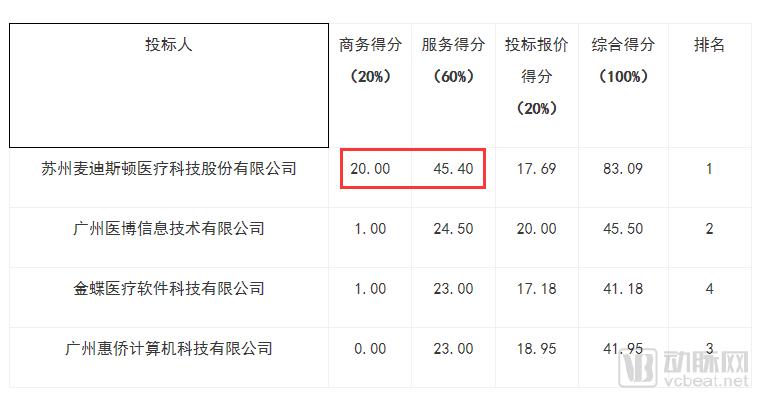
Data Source: China Government Procurement Network
Excluding the qualification requirements for business scoring, it is evident that Meditech’s technical strength was the decisive factor valued by the client, even though its pricing was not competitive.
VCBeat has learned that MediTech’s business operations are categorized into four segments: proprietary software, integrated solutions, sales of third-party hardware and software, and operation and maintenance services. For its proprietary software, MediTech performs installation and commissioning based on mature products. Given the variations in medical documentation across different hospitals and the personalized requirements for management reports, customized development is necessary for some clients during the installation process.
Through years of project implementation and practical application by hundreds of clients, Meditech has accumulated extensive solutions for interfacing with diagnostic and treatment equipment, as well as insights into clients’ “personalized” needs. Building on this foundation, the company has continuously enriched its product modules and enhanced product functionality. As a result, it can rapidly and effectively identify and meet customer demands, thereby strengthening the competitiveness of its products.
Furthermore, the company emphasizes software modularity and productization rates in technological R&D and product architecture, enabling flexible combinations based on project requirements.To reduce the cost of customized development, shorten the implementation cycle, achieve rapid fulfillment, and enhance customer experience.
Furthermore, Madi Technology adopts a combined approach of product standardization and customization in its product research and development, enabling rapid response to customers’ bespoke development needs and enhancing the efficiency of customized development. Meanwhile, by establishing a comprehensive and efficient version control mechanism, the company ensures that common requirements from hospitals are promptly incorporated into the main release, thereby guaranteeing the completeness and leading-edge nature of the baseline version’s functionalities.Reduces the cost of secondary development, improving the efficiency of rapid response.
Based on the above information, VCBeat believes that it is precisely due to MediTech’s advantages in clinical informatics product technology that the company has been able to secure a substantial volume of high-gross-margin clinical system orders without resorting to low-price bidding strategies. Furthermore, leveraging its technological edge allows the company to reduce its R&D and secondary development costs, resulting in an overall gross margin that is significantly more prominent compared to other peers in the same sector.
Intelligent and Cloud-Based, Neusoft's2018
In 2018, Neusoft secured a continuous stream of major contracts. In addition to its established hospital IT business, the company also sought to expand its product portfolio by leveraging artificial intelligence and big data.
In 2018, the Neusoft Intelligent Medical Research Institute was officially unveiled and established at the Neusoft Software Park in Shenyang.
Neusoft Intelligent Medical Research Institute focuses on the integration and application of the entire health industry chain, encompassing AI platforms, big health data platforms, and sectors including payment, medical services, hospitals, scientific research, and health management. Leveraging the Neusoft Intelligent Medical Research Cloud Platform, CareVault, it provides AI tools and datasets via a cloud-based model to continuously build, optimize, and accumulate high-quality sample data and cognitive models. It offers a service platform for physicians to support clinical practice and research, provides research institutions such as hospitals with a scientific research platform based on artificial intelligence and big data methodologies and tools, and serves as an incubation platform for the commercialization of research outcomes for medical institutions and research institutes.
It is reported that the founding members of the Neusoft Intelligent Medical Research Institute include eight medical institutions: China Medical University, Qiqihar Medical University, Xuanwu Hospital of Capital Medical University, the General Hospital of Shenyang Military Region, the First Bethune Hospital of Jilin University, the First Affiliated Hospital of Zhengzhou University, Henan Provincial People's Hospital, and Liaoning Cancer Hospital. The founding members also include three technical partners: the State Key Laboratory of Software Architecture at Neusoft Group, Professor Li Xue’s team from the University of Queensland in Australia, and the Sino-Dutch Biomedical and Information Engineering School of Northeastern University.
In the field of regional health and hospital informatization, Neusoft activated nearly 300 new clients, including health commissions and hospitals, during the reporting period. Furthermore, in the construction of cloud hospital platforms, Neusoft secured several major contracts, each valued at over RMB 20 million.
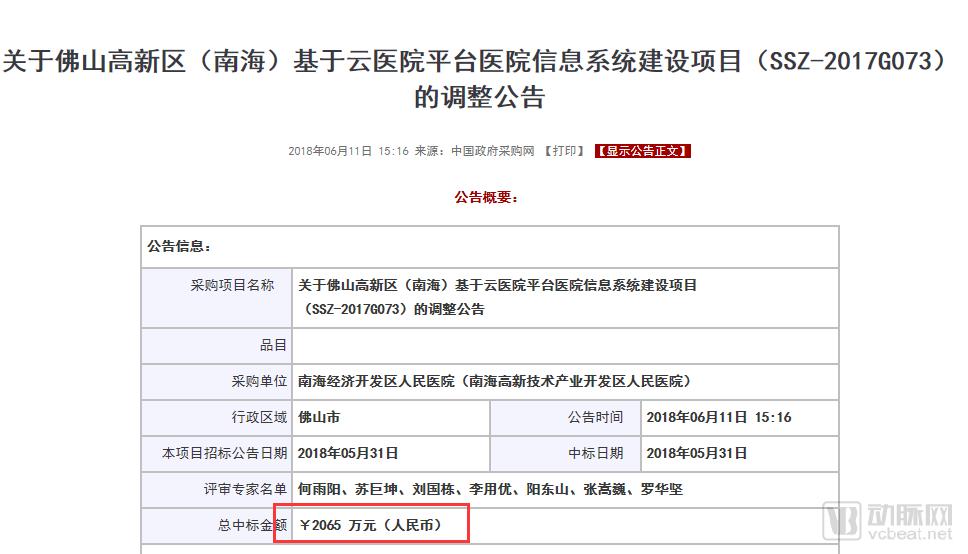
Data source: China Government Procurement Network
In the field of medical insurance management, during the reporting period, the company undertook Phase II of the Jilin Medical Insurance Bureau’s monitoring system and the cross-regional medical treatment project.
In the bank-hospital collaboration sector, Neusoft has partnered with multiple banks to undertake projects at institutions such as Jiangxi Provincial People's Hospital, the Third Affiliated Hospital of Sun Yat-sen University, and Shanghai Chest Hospital, driving continuous business growth.
In the human resources and social security sector, Neusoft provides HR and social security-related services to provinces, cities, districts, and counties across China through multi-channel, comprehensive software solutions and multifunctional service terminals. These information technologies aim to improve China’s social security system and foster a collaborative, win-win, and healthy ecosystem.
As of the end of the reporting period, Neusoft’s business covered the Ministry of Human Resources and Social Security (MOHRSS), 21 provincial-level departments, and 174 municipal bureaus, with a market share exceeding 50%. Its services reached over 600 million individuals, more than 10 million insured entities, and over 160,000 designated medical institutions and pharmacies. Furthermore, the company undertook human resources and social security projects in multiple provinces and cities, including Henan Province, Jilin Province, Shenyang City, and Wuxi City, adding more than 200 new human resources and social security clients and 140,000 pharmaceutical and healthcare service users.
Policy Trends: Medical IT Welcomes a New Round of Development Opportunities
In the first half of 2018, the state successively issued policies and other specific guiding principles and management specifications, including the Notice on Printing and Distributing the Action Plan for Further Improving Medical Services (2018–2020), the 2018 Government Work Report, the Standards and Specifications for Hospital Information Construction in China (Trial), and the Guiding Opinions on Promoting the Development of “Internet + Healthcare.” These documents put forward clear requirements for future medical institutions to establish systems such as appointment-based diagnosis and treatment, telemedicine, clinical pathway management, mutual recognition of examination and test results, and medical social work and volunteer services. Furthermore, they mandated innovations in medical services across ten areas, including “patient-centered promotion of multidisciplinary diagnosis and treatment models” and “innovation of emergency and critical care services with a focus on severe and critical cases.”
Amid the clear support for the development of “Internet + Healthcare,” many IT companies across various sectors have increased their investments in the healthcare IT industry, such as Neusoft, Donghua Software, and Yanhua Intelligent. This trend is partially reflected in the proportion of revenue derived from the healthcare sector:
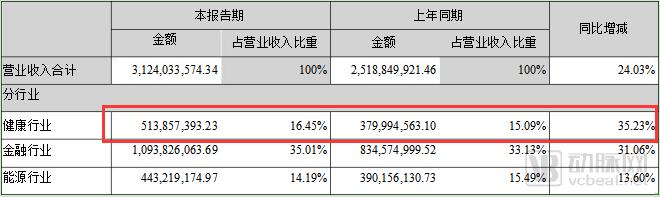
Data source: DHC Software 2018 Semi-Annual Report
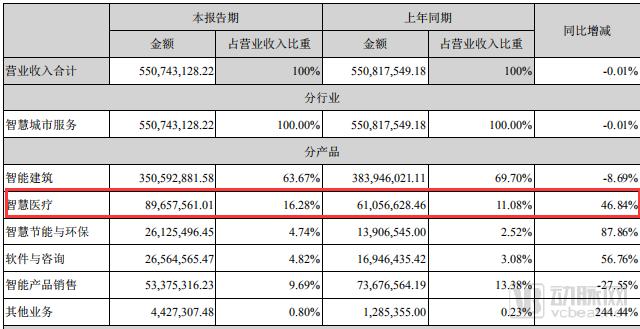
Data Source: Yanhua Smartech 2018 Semi-Annual Report
Where Did the Innovation in HIT Lie in 2018?
New technologies in industries such as artificial intelligence and big data have brought fresh development perspectives to healthcare IT companies, with solutions based on these emerging technologies continually appearing in the industry. Due to differences in business focus among various healthcare IT companies, the forms of their innovative products also vary. Currently, cloud-based next-generation hospital business systems, healthcare payment solutions, and artificial intelligence represent the primary directions for innovation among healthcare IT companies.
In 2018, Heren Technology developed a new-generation hospital information system that integrates the Hospital Information System (HIS) and Electronic Medical Record (EMR) system based on its original EMR platform. It is currently the largest new-generation core hospital business system in China built on HTML5 and cloud computing technologies, supporting cloud deployment as well as applications for hospital groups and medical consortia.
Meanwhile, the system integrates various business systems—including emergency care, triage, mobile healthcare, clinical pathways, HRP (Hospital Resource Planning), and infection control—into a unified operational management framework, thereby establishing an integrated management system for the hospital’s core business operations.
In 2018, B-Soft Corporation, aligning with the new landscape of “Healthy China 2030,” leveraged advanced technologies—including big data, artificial intelligence, mobile internet, the Internet of Things (IoT), cloud computing, and blockchain—to continuously expand its product and service ecosystem in key areas of big data and AI. This strategy strengthened the company’s core competitiveness and diversified its revenue streams.
The Empowerment Platform for Diagnosis and Treatment of Complex Diseases is a representative innovative product. Centered on core applications including integrated critical care, multidisciplinary team (MDT) telemedicine, specialized disease prevention and prognosis management, and AI- and big data-driven healthcare solutions, it serves as the core business platform for enhancing diagnostic and therapeutic capabilities for complex and critical conditions.
In terms of business operations, B-Soft’s multidisciplinary teleconsultation system integrates electrocardiography (ECG), pathology, medical imaging, education, and ultrasound into a unified, integrated consultation platform that includes electronic medical records (EMR) and health archives. Physicians can access a patient’s complete information on a single platform interface, utilizing multiple screens for comprehensive review.
Furthermore, Chuangye Software delivers diagnostic-grade data through exceptionally high network transmission efficiency. Even for dynamic imaging modalities such as B-mode ultrasound, its core technologies ensure diagnostic quality. In terms of cross-platform compatibility, any hospital’s system can be integrated into the platform.
Centered on patients with complex and critical conditions, the platform establishes a cloud-based support system for the diagnosis and treatment of such cases, forming an integrated provincial-level medical service ecosystem characterized by core hospital leadership, multi-institutional participation, whole-process coverage, and multi-center collaborative care.
In 2018, in the field of regional health, Donghua comprehensively optimized systems related to the National Health Information Platform, achieving full-process monitoring of master data system data. It developed a mobile dashboard and large-screen monitoring system for comprehensive health management, facilitating real-time monitoring of data indicators by leaders of the Health and Family Planning Commission. In the elderly care sector, it continuously conducted exploration and research, with a focus on developing a health management system for wellness and elderly care.
Furthermore, the research and development of the Donghua Cloud HIS management platform has been completed. The company has signed contracts for and implemented several projects, including the National Procurement Platform Construction Project, the software upgrade for the National Drug and Medical Service Price Monitoring System, the upgrade and transformation of the National Resident Health Card Integrated Management Platform, the Ankang City Universal Health Information Platform, and the Shanghai United Imaging Cloud HIS.
In the field of artificial intelligence, during the first half of 2018, Donghua successively assisted hospitals in establishing models such as the risk model for postoperative recurrence of pituitary adenomas and the model for predicting fetal weight based on ultrasound measurements of fetal growth parameters. This achieved the integration of clinical medicine with information technology, providing effective technical support for clinical diagnosis, treatment research, and decision-making in precision medicine big data.
In the development of “Internet + Healthcare Services,” Donghua pursues a parallel strategy across three lines: platforms, B-side products, and C-side products. The platforms include the Hospital Internet Open Platform, Unified Payment Platform, and Messaging Platform. B-side products comprise Collaborative Outpatient Services, Dean’s Daily Report, Mobile Ward Rounds, and Queue Management and Calling Systems. C-side products include the Patient App, Alipay Lifestyle Account, WeChat Service Account, and Mini Programs. These diverse product offerings have been deployed and gone live in more than 200 hospitals, providing healthcare institutions with robust integrated capabilities in messaging, APIs, payments, video services, and appointment registration. Additionally, Donghua has collaborated with Tencent on the Electronic Health Card project.
In June 2018, Shanghai Yunxin Venture Capital Co., Ltd. (hereinafter referred to as “Shanghai Yunxin”) became the Company’s fourth-largest shareholder through an agreement-based transfer. Meanwhile, Shanghai Yunxin injected RMB 193 million into the Company’s wholly-owned subsidiary, Internet Technology, acquiring a 30% equity stake therein. Additionally, the Company, together with Shanghai Yunxin and its shareholder, Zhejiang Ant Small and Micro Financial Services Group Co., Ltd. (hereinafter referred to as “Ant Financial”), jointly signed the Framework Cooperation Agreement to collaboratively promote the development of “Internet + Healthcare.”
Leveraging the respective strengths of each platform and business, we will pilot the integration of medical payment services with Alipay. By fully utilizing Alipay’s leading third-party payment industry expertise, technology, and real-name user authentication capabilities, we will collaborate on medical expense payments. This initiative aims to facilitate public handling of medical fee-related transactions, alleviate pressure on manual service counters, and enhance the convenience of medical payments in scenarios such as hospitals.
In addition, in 2018, Winning Health partnered with Shanghai Children’s Hospital and Shanghai Jiao Tong University Affiliated Children’s Hospital to jointly develop the “CHBoneAI – Artificial Intelligence Bone Age Assessment System,” which was officially integrated into hospital PACS/RIS systems for parallel operation and initiated clinical application. To date, the AI-based bone age assessment has been applied in over 5,000 clinical cases. The system generates a bone age diagnostic report from image analysis in approximately 30 seconds, while bone age reading alone is achieved in sub-second time. This not only significantly saves time but also achieves a mean absolute error of only 0.43 years and a diagnostic accuracy rate of 98%.
In 2018, Yilianzhong continued to advance the development and implementation of Fujian Province’s province-wide medical security information system, centered on the “integration of three insurance schemes.” By the first half of 2018, the system had gone live for provincial-level entities as well as in the cities of Fuzhou, Sanming, Longyan, Quanzhou, and Ningde. This “integration of three insurance schemes” information system supported innovation in Fujian Province’s medical insurance system reform, provided a model for medical insurance reforms under the new round of healthcare system reform, and laid a solid foundation for expanding business markets outside Fujian Province.
In terms of industrial cooperation, Yilianzhong has signed a "Framework Cooperation Agreement" with Zhejiang Ant Small and Micro Financial Services Group Co., Ltd. By leveraging both parties' innovative achievements in the internet sector, they aim to achieve deep integration in fields such as human resources and social security, healthcare, and jointly promote the development of "Internet + Human Resources and Social Security," "Internet + Healthcare," and "Internet + Livelihood Industry Payments." Meanwhile, they will also collaborate in emerging technology areas including big data, industrial finance, biometric identification, and blockchain.
In addition, E-Lianzhong signed a “Strategic Cooperation Agreement” with Haihong Enterprise (Holdings) Co., Ltd. (now renamed Guoxin Health Security Service Group Co., Ltd.), under which the two parties will engage in comprehensive strategic cooperation in health insurance fund management and development, medical big data research, and business synergy, so as to promote their joint development in the field of health security.