

Gilead Strikes Back with Digital Innovation: A Strategic Collaboration with Google's Verily to Accelerate Drug Development
Based on VCBeat’s (WeChat ID: vcbeat) previous overview of major pharmaceutical companies, it is evident that in the digital health sector, whether through acquisitions, investments, or collaborations, pharmaceutical companiesFrequent Moves。
However, some pharmaceutical companies remain conservative, standing firm regardless of external pressures. Gilead Sciences is one such example; it was once rated by CB Insights as the least active company in digital innovation within the pharmaceutical industry. Yet Gilead has since reversed its stance and begun to engage in digital innovation efforts. Its first major move was a collaboration with Google. As a titan in the field of serious diseases, what initiatives has Gilead undertaken in a short period during its digital transformation? VCBeat has compiled an overview.
Among the top 10 pharmaceutical companies, Gilead Sciences can be described as young and promising. While Johnson & Johnson, Novartis, and Roche have weathered centuries of challenges, Gilead has just celebrated its 30th anniversary. Its blockbuster drugs propelled Gilead into the ranks of the top 10 pharmaceutical companies, but also laid the groundwork for subsequent difficulties.
When discussing Gilead’s history, one cannot overlook Sovaldi and Harvoni, two “miracle drugs” for hepatitis C with cure rates as high as 90%. After developing these two medications in 2011, Gilead’s market capitalization surged from $30 billion to over $100 billion. Propelled by this blockbuster drug, Gilead rapidly ascended into the ranks of the top 10 pharmaceutical companies globally. Gilead’s ability to launch these two drugs was not due to deep R&D accumulation, but rather stemmed from a bold gamble: the acquisition of Pharmasset.
When Gilead acquired Pharmasset, the latter had no marketed drugs and was solely developing an oral therapy for hepatitis C virus (HCV), while continuing to operate at a loss. Nevertheless, Gilead acquired Pharmasset at $137 per share, representing a 97% premium, for a total consideration of $11 billion—a deal that stunned Wall Street.
Most people considered it a surefire money-losing venture, but subsequent facts proved it to be an extremely lucrative deal for Gilead. In 2013, Gilead pioneered the development of sofosbuvir (Sovaldi), an oral medication for hepatitis C, raising the cure rate from 50% to 90%. Its first-year sales surpassed $10 billion, propelling Gilead into the top 10 global pharmaceutical giants.
However, the advent of hepatitis C drugs did not eradicate the disease worldwide. Gilead’s hepatitis C medications are expensive; for example, a course of Sovaldi costs $84,000, while Harvoni costs $94,500 per course. Gilead’s high cure rate of up to 90% will also shrink the population eligible for affordable drug options.
Currently, Gilead’s hepatitis C sales are sluggish. In 2015, Gilead’s Sovaldi ranked second in sales revenue. However, by 2017, due to drug pricing pressures, competition from rival products, and the shrinkage of the hepatitis C market since 2015, Harvoni’s sales have continued to decline. Harvoni’s sales reached $9 billion in 2016, a 35.1% decrease from 2015; in 2017, the drug’s sales are expected to fall further to $7 billion.
Expanding drug accessibility is one way to sustain the growth of hepatitis C medications. In China, Zhejiang Province’s critical illness insurance program included Gilead’s hepatitis C drug Sovaldi in its reimbursement list by the end of 2017. However, inclusion in the national reimbursement list subjects pharmaceutical companies to pressure for price reductions, potentially leading to a 50% drop in prices. Expanding market share in China is no easy feat. Currently, besides Gilead, other pharmaceutical companies—including Bristol-Myers Squibb (BMS), AbbVie, and Ascletis—are also racing to capture a foothold in China’s innovative hepatitis C drug market.
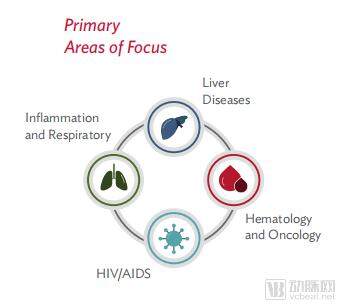
Gilead’s Key Therapeutic Areas
Although Gilead rose to prominence with its hepatitis C drugs, the company’s initial fortune was made from HIV medications. In the field of AIDS therapeutics, there is a saying: “Drug sales champions come and go, but Gilead remains steadfast.”
In 2017, Gilead’s global sales of HIV medications reached $15 billion. Among these, the first TAF/FTC-based single-tablet integrase inhibitor regimen, which was poised for launch in China, generated $3.7 billion in sales in 2017, ranking among the top 25 prescription drugs worldwide by sales volume.
In 2006, Gilead launched the world’s first single-tablet regimen (STR) for the complete treatment of HIV infection, revolutionizing antiretroviral therapy and improving medication adherence among patients with HIV/AIDS. Currently, Gilead has 13 HIV products marketed worldwide.
Gilead may lead the pack in HIV therapeutics, but it cannot afford to be complacent, as the HIV drug market is a fiercely contested battleground. In the field of HIV/AIDS, besides Gilead, other major players include GSK, Merck & Co., and Johnson & Johnson. GSK has been steadily increasing its market share, underscoring its significant influence. To strengthen its position, GSK partnered with Pfizer and Shionogi to establish ViiV Healthcare (in which GSK holds an 80% stake), driving growth in its HIV drug business. In 2015, GSK further acquired Bristol-Myers Squibb’s entire pipeline of investigational HIV drugs. GSK is now well-positioned to engage in direct competition with Gilead.
Gilead’s two pillar businesses are both facing challenges. To be sure, Gilead is also pursuing self-rescue through traditional means. In 2017, Gilead completed its acquisitions of Kite Pharma and Cell Design Labs, beginning to advance and accelerate its work in cancer immunotherapy and cell therapy. The $12 billion acquisition of Kite Pharma represented a bet on novel cancer therapies. This move was also viewed as Gilead’s attempt to replicate the miracle of its Pharmasset acquisition. However, Kite Pharma generated only $68 million in revenue in the second quarter, making it currently difficult for the subsidiary to bear the heavy responsibility of supporting Gilead’s growth.
Gilead, often dubbed the “Apple of the biopharma industry,” does not sit idly by in the face of challenges. The days of raking in easy profits from its blockbuster drugs are long gone; once dismissive of digital innovation, Gilead launched multiple digital transformation initiatives in 2018.
Gilead has made a striking entry into digital innovation, making an immediate and significant impact. Its first announced partnership in 2018 was with Verily Life Sciences, a subsidiary of Alphabet Inc., Google’s parent company. Under the collaboration model, Gilead provided data, while Verily contributed its Immunoscape big-data analytics platform. According to Forbes, Gilead paid $90 million for this project.
John McHutchison, Chief Scientist at Gilead Sciences, stated: “Previously, we made little headway in our research on white blood cells. However, by leveraging Verily’s technology, these cells can be separated into more than 20 distinct subtypes, enabling the generation of RNA expression profiling data for each subtype. As a result, the data volume for each patient tested will reach the terabyte (TB) level, delivering an unprecedented amount of information.”
John McHutchison also stated frankly that Gilead had been observing Verily’s technology for some time prior to the collaboration, and that Gilead could evaluate the collaborative outcomes in volunteers and across other diseases.
Previously, such massive volumes of data were simply unmanageable and unimaginable. However, with the support of advanced computing technologies, the landscape has changed. Charlie Kim, Research Lead at Verily, stated, “He began researching this platform two years ago. He was deeply attracted by Alphabet’s ability to generate and process vast amounts of data. Historically, you might have avoided projects of this scale simply because the computational challenges were too daunting. Now, computation is no longer an issue.”
An analysis of the Gilead-Verily partnership reveals that Gilead provided substantial data to meet Verily’s needs. Verily’s objective is not to develop industry-disrupting hardware devices, but rather to continuously explore new application scenarios for digital medical devices and collect the highest-quality data. Gilead’s ability to deliver this was no coincidence; it stemmed from the company’s prior implementation of robust data management practices.
Data from Veeva, a world-leading SaaS platform, shows that Gilead has long been one of its major clients. As Gilead expands globally, it continues to subscribe to Veeva’s services to enhance its modernized management practices. Gilead directly integrates partners into high-quality workflows, thereby improving data integrity, accelerating cycle times for processes including batch processing, and ensuring suppliers are kept informed of current policies and procedures.
2018 Digital Health Plan
VCBeat has previously noted that in their digital innovation efforts, major pharmaceutical companies have launched incubation programs tailored to their unique strengths. For instance, Johnson & Johnson favors integrated healthcare and consumer-focused initiatives through its QuickFire Challenge, while Roche and Pfizer have established investment subsidiaries that have funded numerous digital health companies. Gilead, having just begun its foray into digital health, has also launched its own digital innovation incubation program.
In 2018, Gilead launched a digital health initiative aimed at soliciting applications and designs for projects, tools, and services that support digital healthcare. The call sought projects capable of improving patient outcomes and quality of life through information and communication technologies (ICT). Gilead’s primary disease areas of focus included HIV, liver diseases, hematologic cancers, and invasive fungal infections.
Gilead noted that similar project examples could include: telemedicine apps, VR, social media, the Internet of Things (IoT), artificial intelligence (AI), and big data. The primary functions of these projects may include: predicting and monitoring risks; monitoring patients’ treatment pathways; improving patient adherence and providing patient education; empowering patients, healthcare professionals, and medical institutions; connecting local or regional networks of physicians and healthcare facilities to support diagnosis, assistance, and patient care; and evaluating the effectiveness of existing digital health services and tools. Gilead has set a maximum prize of €40,000 for each project.
It is evident that Gilead has not yet made large-scale investments across all aspects of digital innovation. Its digital health initiatives primarily focus on projects that deliver services to patients. This suggests that Gilead aims to extend its role beyond pharmaceutical manufacturing, placing greater emphasis on providing patient-centric services.
This is also evident from Gilead’s recent digital marketing efforts.
Digital Marketing Strategies
Gilead has begun to leverage harmless sexual humor, akin to Durex’s marketing style, to promote HIV prevention. This approach reflects the recognition that medication-related issues are not solely about disease but are deeply rooted in diverse social contexts. The drug promoted by Gilead in this campaign is Truvada, which is used for pre-exposure prophylaxis (PrEP) against HIV. Currently, it is the only FDA-approved medication for preventing HIV infection. Although Gilead received FDA approval for Truvada as early as 2012, it did not begin targeting the PrEP market with the drug until last year.
This marketing campaign, executed by the agency Digitas Health LifeBrands, leveraged Tumblr, Snapchat, and YouTube, as well as gay dating apps such as Grindr, Jack’d, and Hornet. A post on Gilead’s sexual health blog on Tumblr stated: “From HIV testing to threads, coordinate with your partner. Being on the same page means you're in position…for any position.”
Gilead’s marketing strategy does not directly endorse its medications; instead, it encourages patients to adopt healthier, lower-risk lifestyles and enhances their understanding of HIV/AIDS. Gilead’s advertisements direct viewers to honestlyitstime.com and healthysexuals.com, two websites that offer extensive resources, including listings of LGBT-friendly healthcare providers. These providers may prescribe PrEP (pre-exposure prophylaxis) and distribute free condoms.
“In any other FDA approval, there would be glossy advertisements, extensive television coverage, and significant media promotion heralding this as a new tool to protect people from HIV infection. Gilead chose not to do that,” said Ernest Hopkins of the San Francisco AIDS Foundation.
In March this year, the U.S. Centers for Disease Control and Prevention released an analysis finding that more than one million Americans could benefit from PrEP. However, estimates published earlier this month by Gilead Sciences indicate that only 167,000 people in the United States are currently taking the medication.
Pharmaceutical companies are facing increasingly stringent compliance requirements for advertising. Since early May, following President Trump’s call to lower prescription drug prices, the U.S. government has begun taking concrete actions to implement this initiative. For example, in late August, the U.S. Senate passed a bill amendment requiring pharmaceutical companies to disclose advertising expenditures for drugs promoted directly to consumers.
Controlling the cost of prescription drugs in a transparent manner is also what the public wants. A poll conducted by the Kaiser Family Foundation at the end of June showed that 76% of people believe the federal government should require pharmaceutical companies to disclose pricing information in their advertisements.
Identifying new and appropriate marketing approaches to reach consumers will become a fresh challenge for pharmaceutical companies, while Gilead’s recent initiative has earned it considerable positive feedback within specific target groups.
Summary:
Gilead’s entry into digital innovation in the pharmaceutical industry can be seen as a response to global trends. In 2017, Gilead was still one of the most conservative pharmaceutical companies in terms of digital health. By 2018, however, Gilead had become eager to accelerate its digital transformation. Compared with other pioneers in digital innovation previously reported by VCBeat, Gilead’s digital transformation was not as comprehensive. Nevertheless, Gilead’s data-driven practices have demonstrated that only by being always prepared can one keep pace with the changing times.