BioMap Unveils Next-Gen AI Antibody Design Engine with Breakthrough Against GPCR Targets

BioMap
Developer of Innovative Drug R&D Platform

Introduction
If traditional chemotherapy drugs are "carpet bombing," then antibody drugs are "precision-guided." With extremely high precision, they strike the target directly and have reshaped the treatment landscape for cancer and autoimmune diseases — whether it's immune checkpoint inhibitors that extend patients' lives or TNF-α inhibitors that control inflammation, both stand as testaments to their remarkable efficacy.
However, although antibody drugs have broad prospects, their development has long relied on "trial and error," a time-consuming and labor-intensive process akin to finding a needle in a haystack. Not only is this costly, but it also makes it difficult to precisely control antibody functions, especially when dealing with complex transmembrane protein targets like GPCRs.
The introduction of AI is disrupting this traditional paradigm.Through multimodal modeling, AI can achieve precise navigation in the vast design space, directly generating target molecules and pushing antibody discovery into a predictable and programmable engineering era.
In this wave of transformation, BioMap, a global leader in foundational large models for the life sciences, has overcome the core barriers in GPCR nanobody design by leveraging its self-developed AI infrastructure and multimodal large models. The results are highly compelling:
Experimental Validation: Zero-shot design success rate as high as 20%;
Structural Analysis:The computational model is highly consistent with the experimentally resolved structure, achieving a paradigm revolution from "random binding" to "rational design";
Efficiency Leap: Compressing the traditional discovery cycle of up to half a year to within 2 months.
This is not only a technical validation, but also a solid declaration of the industrialization of AI-driven antibody development, redefining the ceiling of industry efficiency.
The relevant paper has been published on the bioRxiv platform:
Title of the Paper:
De Novo Computational Design of VHH Nanobodies Against LGR5
Paper link:https://www.biorxiv.org/content/10.64898/2025.12.02.691880v1
Introduction
If traditional chemotherapy drugs are "carpet bombing," then antibody drugs are "precision-guided." With extremely high precision, they strike the target directly and have reshaped the treatment landscape for cancer and autoimmune diseases — whether it's immune checkpoint inhibitors that extend patients' lives or TNF-α inhibitors that control inflammation, both stand as testaments to their remarkable efficacy.
However, although antibody drugs have broad prospects, their development has long relied on "trial and error," a time-consuming and labor-intensive process akin to finding a needle in a haystack. Not only is this costly, but it also makes it difficult to precisely control antibody functions, especially when dealing with complex transmembrane protein targets like GPCRs.
The introduction of AI is disrupting this traditional paradigm.Through multimodal modeling, AI can achieve precise navigation in the vast design space, directly generating target molecules and pushing antibody discovery into a predictable and programmable engineering era.
In this wave of transformation, BioMap, a global leader in foundational large models for the life sciences, has overcome the core barriers in GPCR nanobody design by leveraging its self-developed AI infrastructure and multimodal large models. The results are highly compelling:
Experimental Validation: Zero-shot design success rate as high as 20%;
Structural Analysis:The computational model is highly consistent with the experimentally resolved structure, achieving a paradigm revolution from "random binding" to "rational design";
Efficiency Leap: Compressing the traditional discovery cycle of up to half a year to within 2 months.
This is not only a technical validation, but also a solid declaration of the industrialization of AI-driven antibody development, redefining the ceiling of industry efficiency.
The relevant paper has been published on the bioRxiv platform:
Title of the Paper:
De Novo Computational Design of VHH Nanobodies Against LGR5
Paper link:https://www.biorxiv.org/content/10.64898/2025.12.02.691880v1
First TargetedGPCRDesign of Nanobodies for New Epitopes
In this project,BioMapSelected oneIn PDB(Protein Structure Database) does not yet haveAntigen-GPCR Recorded in Antibody Complex StructuresTarget, focusing on a previously unreported epitope with antibody binding as the design goal, developed through AIAntibody Design.
AIDe Novo Design
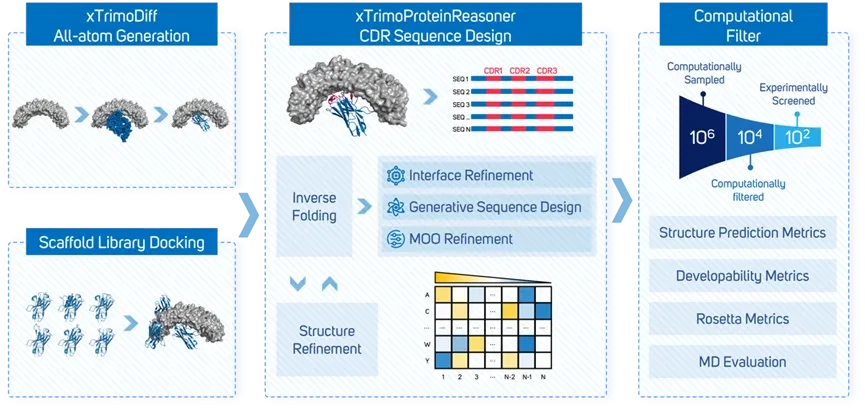
Relying on the BioMap AI antibody design platform, the team first generated candidate nanobody molecules using an antibody generation model based on target sequence/structure information and the desired epitope. Subsequently, a sequence design model was applied for further optimization, and a structure prediction model was used to validate the antigen-antibody complex. Finally, an antibody property prediction model (e.g., affinity, stability, epitope binding accuracy) was employed for ranking and screening.

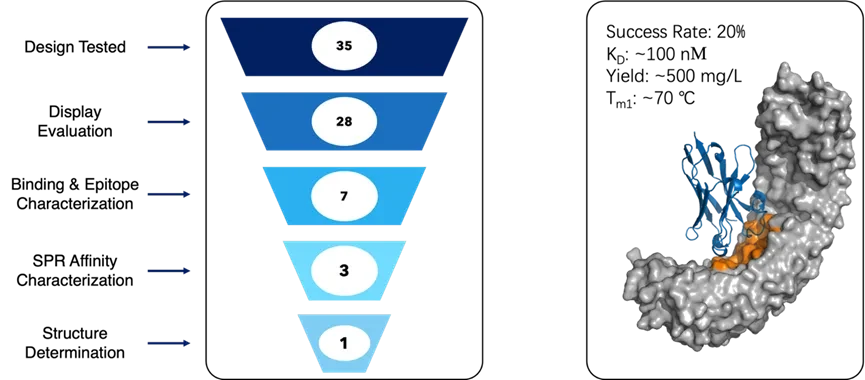
Experimental Validation: Zero-shot Design Hit Rate20%
In a round of zero-shot design,BioMapDesigned35A molecular experiment was used for verification, among which there were7One showed binding activity and achieved nanomolar affinity. More importantly, it was validated by epitope experiments.This7Each targeting molecule precisely binds toBioMapOn the preset designed epitope。
Structural Analysis: Computational Model Highly Consistent with Experimental Analysis Structure
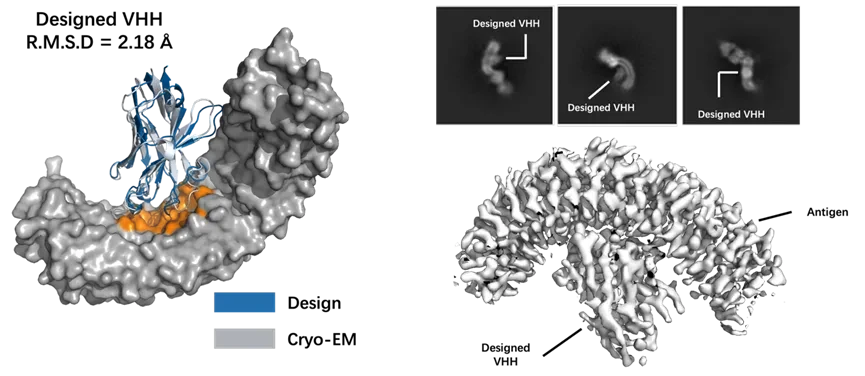
BioMapFurther selection of the best combined molecule was performed using cryo-electron microscopy (Cryo-EM) Structural analysis, obtained high-resolution structural information, strongly validatedAIHigh Precision in Design:
- The quality of the electron cloud density in cryo-EM has reachedAtomic Precision Level, based on this, the structure of the antigen-antibody complex with extremely high confidence was parsed out.
- Experimental Analysis Structure andBioMapThe computational model is highly consistent, overall frameworkRMSDApproximately 2 ÅLeft and right.
- From the perspective of computational design,BioMapIn antigen-The key residues and interactions introduced at the antibody interface have all been validated in the experimental structure.Indicates that its antibody design has achieved the expected precision at the residue atom level.。
This series of data fully proves,BioMap AIAntibody design platform capable of handling high difficultyGPCRAchieved on the targetAIA full-process closed loop from de novo design → experimental validation → structural analysis, greatly enhancing the predictability and success rate of antibody development, and laying a solid foundation for future large-scale, industrialized antibody development.
Compared with existingAI + The Uniqueness of Antibody Design Work
At present, although many academic institutions or companies have proposed " AI + "Antibody design" solutions, but overall, the following limitations still exist:
Most projects only stay at the experimental verification level of "whether binding occurs," without further verifying whether the antibody specifically binds to the preset epitope. There are few in-depth reports on epitope control, yet epitope validation is precisely the key to whether antibody functions (such as antagonism, agonism, and regulation) can be achieved. Currently, there are relatively few AI antibody design projects that have completed structural analysis. As of now, BioMap is one of the very few AI antibody projects that have accomplished this task.
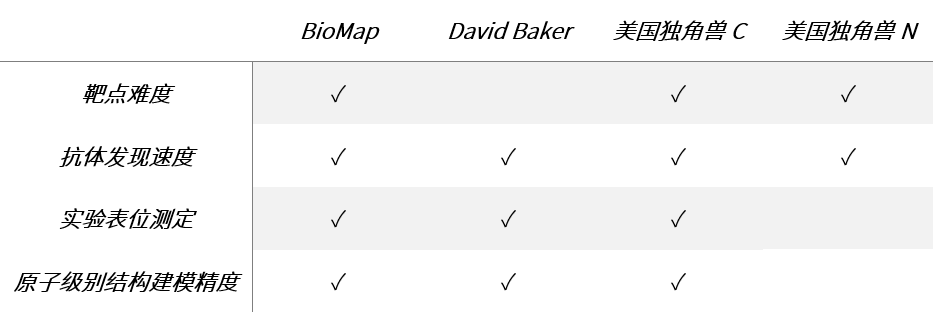
In antibody design, precise locking“Epitope”Like precision-guided. With COVID-19 antibodiesSotrovimabAs an example, it achieves broad-spectrum neutralization of variants by targeting highly conserved rare epitopes. This reveals a core principle:The selection of epitopes directly determines the breadth and anti-variation capability of antibodies.
AndBioMapThe choice is even bolder and more forward-looking: it not only challenges the structure databaseUnprecedentedGPCRTarget, and more targetedA completely new epitope that has never been reported before, and successfully designed high-activity nanobodies from scratch.
More importantly,BioMapCompleted from“AIDe novo design → Experimental validation → Structure analysis” The complete closed loop, will“Rational Design”From concept to visible and verifiable facts. Compared with similar advancements in the industry, this work...In terms of the depth of validation and the certainty of implementation, a new benchmark has been set.
Build the Next GenerationAIAntibody Drug Design Engine
BioMapWithAIA profound accumulation in the field of antibodies has built a solid platform composed of three core advantages:
AIComputing Power Platform, specifically designed for complex antibody model training and large-scale inference optimization.
Full-linkAIModel Library Platform, covering every key link from antibody generation to property prediction.
xTrimoDiff, a full-atom antibody generation model based on Flow-Matching, can design antibody structures and sequences that bind to specific antigens and output the complete all-atom binding conformation of antigen-antibody complexes. The model supports multiple optional conditional constraints, including antigen structure, antigen epitope, antibody framework structure and sequence, antibody CDRs length, key amino acid atomic coordinates of antibodies, and physical energy at the binding interface, to balance the diversity and rationality of the generated results.
xTrimoProteinReasoner, the world's first multimodal chain-of-thought foundational model for life sciences. Within the CoT framework, this model uses evolutionary spectra as explicit reasoning steps to connect structures and sequences, supporting tasks such as multi-conformation structure prediction, Inverse Folding, and Fitness prediction. Additionally, the model establishes a novel paradigm for protein optimization based on contextual learning, enabling mutation reasoning and generation tailored to specific attributes and multi-objective awareness.
xTrimoProteinNext, a new generation of protein language model based on the MOE architecture, has built a series of antibody property prediction models on the foundation model, including expression levels, thermal stability, and more.
Integrated Design Platform,enabling end-to-end precision design from target input to molecular output.
The three work together to enableBioMapAccurately generate, deeply optimize, and comprehensively validate antibody candidate molecules, thereby successfully overcomingGPCRThe industry challenge of nanobodies.
Future Applications and Ecological Value
BioMapTheAIBreakthroughs in antibody design are reshaping the industry at three levels:
First, it is to reshape drug development“New Efficiency”。In the antibody market worth hundreds of billions of dollars,AIWill disrupt the traditional R&D model that is time-consuming and labor-intensive. It not only enables faster and more accurate antibody design for emerging infectious diseases and personalized cancer, but also promotesADC, bispecific antibodies and other complex drug modalities, thereby opening the door to trillion-dollar new markets in neuroscience, metabolic diseases, and more.
Secondly, it is about initiating fundamental scientific research.“New Horizons”。AICan design targeted therapies for previously“Undruggable”Tool antibodies for proteins provide a powerful new tool for life science research, directly accelerating scientific discoveries in cutting-edge fields.
Ultimately, it is about building industrial synergy.“New Paradigm”。BioMapA platform-based and scalable design capability makes it an ideal co-research partner, and through open collaboration, jointly build a smarter and more efficient antibody innovation ecosystem.
Conclusion
BioMapThis breakthrough not only validates itsAIThe maturity of the antibody platform further proclaims that antibody development has officially entered“Experience-Driven”Step into“Algorithm Definition”A new paradigm. In the future,BioMapWill be committed to buildingInAINext-generation antibody industrial system at its core: Continuously evolving foundational models and design systems, strengthening core advantages in fields such as structural prediction and generative design, and building a scalable intelligent engine to driveDual-track Innovation in Drug Development and Research Tools; Tackle more difficult drug targets andAIThe application has been expanded to a broader field of protein science.BioMapWe are willing to join hands with global partners to build an open innovation ecosystem, transforming antibody design into a“Art”Transform into engineerableIndustry Engine, becoming a leader inAIKey Driver of the Antibody Era.
BioMap Research is the frontier technology research center of BioMap, dedicated to building a world-leading new engine for AI technology in life sciences and expanding the new boundaries of biological computing.