

Takeda Pharmaceuticals Bets on Digital Innovation to Navigate Global Drug Price Pressures and Reinvent Its Growth Strategy
Technology has bestowed immense wealth upon the pharmaceutical industry, fostering its unprecedented prosperity. Digital technologies, represented by artificial intelligence, machine learning, big data, and internet healthcare, are reshaping the pharmaceutical sector and ushering in a new era. VCBeat has recently launched a special feature on “Digital Transformation in the Pharmaceutical Industry,” providing a comprehensive analysis of the industry-wide changes driven by technology.Click here for the special feature.
As the largest pharmaceutical company in Asia, Takeda Pharmaceutical surpassed Gilead Sciences in market capitalization after its 2017 “snake-swallowing-elephant” acquisition of Shire, breaking into the top 10 global pharmaceutical companies. What has fueled Takeda’s sustained success? Digital health may well be the focus of Takeda’s development over the next decade.
Takeda Pharmaceutical’s CEO stated that the company aims to become a leader in digital health by 2025.
VCBeat (WeChat ID: vcbeat) has found, by analyzing the motivations and reasons behind Takeda Pharmaceutical’s digital innovation, that digital innovation is a strategy equally important to Takeda as its acquisition of Shire. Takeda’s digital innovation efforts are primarily aimed at consolidating its leadership position in its core therapeutic areas.
"Made in Japan" has long been regarded as a hallmark of quality, enjoying an excellent reputation. Japan’s resurgence from the ashes of World War II to become a manufacturing powerhouse hinged on its transition from imitation to surpassing. In the postwar era, Japan leveraged policy advantages to extensively replicate American products. However, rather than settling for mere counterfeiting, Japanese firms disassembled these products to study their design principles and pursued independent innovation built upon imitation. This approach was formally defined by the Japanese government as "reverse engineering."
This strategy of “selective adoption” has also been a key driver of Takeda Pharmaceutical’s growth. Between 1950 and 1970, supported by Japanese government policies, Takeda introduced licensed technologies, refined and improved upon existing patents, and developed its own portfolio of incremental patents. In the following decade, the company transitioned from producing “me-too” generic drugs in the 1980s to developing “me-better” innovative generics in the 1990s, thereby embarking on global expansion. Notably, since the 1970s, Takeda has consistently maintained its R&D expenditure at 20%–25% of sales, a relatively high ratio within the pharmaceutical industry.
The benefits that policies brought to Takeda Pharmaceutical were not limited to these. In the 1960s, Japan implemented a national health insurance system, which reduced out-of-pocket medical expenses for patients, while physicians benefited financially from the sales volume of prescribed drugs. During the same period, the Japanese government established a regime characterized by high drug prices and stringent review processes to restrict the entry of foreign pharmaceuticals into the domestic market. Foreign pharmaceutical companies seeking to sell their products in Japan were required to engage local pharmaceutical firms as distributors. With such government-backed facilitation and barrier removal, Japanese pharmaceutical companies reinvested a greater share of their revenues into research and development, laying the foundation for subsequent overseas expansion and product innovation.
Often, flowers grown in greenhouses cannot withstand the storms, and being tough only within one’s comfort zone is hardly a sign of true strength. Yet Takeda Pharmaceutical has become the largest pharmaceutical company in Asia and the only Asian pharma firm to rank among the global top 10, having successfully pursued a remarkable path of deglobalization from its domestic roots.
Takeda began distributing its pharmaceutical products in Europe as early as 1978. By the late 20th century, Takeda Pharmaceutical had successively established research and development centers in the United Kingdom, the United States, Ireland, and continental Europe. Impacted by Japan’s drug cost-containment policies, Japan joined the International Council for Harmonisation of Technical Requirements for Pharmaceuticals for Human Use (ICH) in 1997 and fully opened its pharmaceutical market, prompting Takeda to urgently reduce its reliance on the domestic market. Through collaborative drug development partnerships with companies such as Abbott, GSK, Novo Nordisk, and Eli Lilly, Takeda Pharmaceutical successfully navigated the rigorous FDA approval process to bring its drugs to market.
According to Takeda’s fiscal 2017 data, sales from the Japanese market accounted for only 32.8% of Takeda’s revenue. Given Takeda’s acquisition of Shire in 2018, its reliance on the domestic market is expected to drop below 20%.
Globally, many pharmaceutical companies have undergone restructuring, divesting non-core businesses to focus on their core pharmaceutical operations. For instance, Johnson & Johnson sold its diagnostics business. Shortly after taking office, the CEO of GlaxoSmithKline also chose to restructure the R&D department. Takeda’s acquisition of Shire is another example of this wave of pharmaceutical industry restructuring.
It is well-founded that pharmaceutical companies are taking concerted actions. Major players have generally pursued two strategies: one is restructuring, specifically through mergers and acquisitions of new companies; the other is collaborating with external partners. Restructuring serves as a means of mutual support during challenging times, while partnerships with digital innovation firms act like striking a match in the dark.
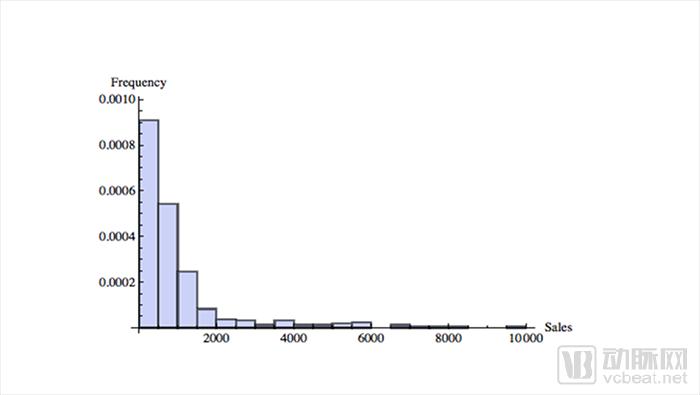
2012 Pharmaceutical Sales Data
Pharmaceutical sales exhibit a random distribution. The chart above illustrates sales revenue on the x-axis, arranged from low to high, and the corresponding sales volume of pharmaceutical products on the y-axis. The further to the right, the higher the sales revenue of the drug. As can be seen from the chart, a very small number of drugs account for a substantial proportion of total sales revenue. This distribution pattern remains remarkably consistent across years in pharmaceutical sales. For instance, in the case of oncology drugs, data from IQVIA indicates that the top 35 drugs account for 80% of total expenditure.
The challenge for pharmaceutical companies lies in these “long-tail” distributed drugs. A few rare blockbuster products determine the productivity of a company and the entire industry, such as Gilead and Amgen.
In contrast, most mature enterprises exhibit incremental growth that approximates a normal distribution, with relatively similar products clustered around the mean, thereby avoiding extremely high or low sales volumes. Consequently, production outcomes are generally predictable. Product improvements require only moderate updates and can be implemented through careful planning and regular execution.
The chart above also illustrates that the expiration of patents for blockbuster drugs can deliver a devastating blow to pharmaceutical companies. Although Takeda is ambitious in its global strategy, it must still contend with existing pressures from various stakeholders.
First, financial pressure mounted as patents for blockbuster drugs such as lansoprazole, pantoprazole, and candesartan successively expired. Takeda’s sales no longer experienced the rapid growth seen prior to 2012; they declined in 2016, with sales amounting to approximately USD 16 billion. In fiscal year 2017, revenue reached USD 16.7 billion, still failing to achieve strong growth.
In terms of policy, due to severe population aging and the pressure of cost containment, the Japanese government set a target for generic drugs to account for 70% of sales volume by 2017, and to reach 80% between 2018 and 2020. Pharmaceutical companies that fail to respond promptly may struggle to bear the burden imposed by these policy changes, potentially leading to a significant downturn.
Past performance is not indicative of future success, a principle that holds particularly true for pharmaceutical companies. So, how should this challenge be addressed? Following a rigid, formulaic approach by concentrating product manufacturing within a single therapeutic pipeline to establish dominance in one specific area is undoubtedly a path to self-destruction, as it leads pharmaceutical companies into the dead end of over-reliance on a single product.
Another approach is the restructuring strategy already being employed by pharmaceutical companies, which allows them to focus on their core products while expanding their product portfolios. Takeda Pharmaceutical’s acquisition of Shire serves precisely this purpose. Through this acquisition, Takeda has completed its global restructuring, concentrating operational resources on core therapeutic areas such as oncology, gastroenterology, and neuroscience, while divesting non-core businesses. Takeda also aims to improve the financial position that deteriorated as a result of the Shire acquisition. Furthermore, Shire’s strong presence in the rare disease sector helps broaden Takeda’s product pipeline.
Takeda Pharmaceutical CEO Christophe Weber stated, “Takeda focuses on areas such as gastroenterology, oncology, and neuroscience. With the acquisition of Shire, we will add rare diseases as another key therapeutic area.”
Takeda Pharmaceutical also stated that the acquisition of Shire would save at least $600 million in R&D expenses. Reducing R&D costs and increasing drug diversity have become Takeda Pharmaceutical’s primary objectives.
Beyond restructuring and acquisitions, another path is diversification: partnering with smaller, more focused innovative companies. Digital health firms are emerging as leaders across various stages of the pharmaceutical lifecycle, including R&D, commercialization, and post-treatment care. Pharmaceutical companies can build an innovation ecosystem by investing in, acquiring, or collaborating with these digital health entities, thereby mitigating risks and enhancing portfolio diversity.
Pharmaceutical companies are adopting a two-pronged strategy. Internally, they are focusing on narrowing down therapeutic areas, targets, mechanisms of action, and compound types in drug R&D, which may improve the success rate of drug development. Externally, they are collaborating with other companies to enhance their external R&D capabilities.
These two strategies are complementary, as external collaborations can mitigate the reduced diversity and heightened risks associated with an inward-focused approach. In other words, while pharmaceutical companies, like large trees, prune excess branches to ensure the quality of their core outputs, they also need to nurture wildflowers and weeds at their base. These resilient plants bring greater diversity to the ecosystem.
Having understood the drivers behind digital innovation, we must now identify the direction of Takeda Pharmaceutical’s digital initiatives. To solidify its position among the top 20 global pharmaceutical companies, Takeda must first launch a portfolio of products that withstand rigorous scrutiny. Consequently, Takeda needs to concentrate its resources on a select few therapeutic areas. Likewise, Takeda’s digital innovation aims to strengthen its R&D and therapeutic capabilities in its core disease areas.
Takeda has not adopted the model of rolling out digital innovation across the entire value chain, as seen among pharmaceutical giants. Instead, it prioritizes digital innovation projects that address urgent needs and solidify its market position.
Gastrointestinal Diseases + Data
Takeda’s best-selling drug, Entyvio (vedolizumab), is indicated for the treatment of gastrointestinal disorders, and Takeda has established its leadership position in this therapeutic area through this product. However, the company cannot afford to rest on its laurels. The Asia-Pacific market for colorectal cancer therapeutics is projected to grow from USD 5.3 billion in 2017 to USD 7.9 billion by 2024, representing a compound annual growth rate (CAGR) of 6%. In terms of digital innovation, Takeda Pharmaceutical has begun leveraging wearable devices to monitor the health status of patients with inflammatory bowel disease (IBD).
Takeda collaborates with Texas Digestive Disease Consultants and the Vanderbilt University Medical Center. This pilot collaboration, named iBData, involves approximately 100 patients with inflammatory bowel disease (IBD) using a specialized wearable device to track their symptoms and lifestyle factors. The collected data will be compiled into reports to enhance patient–physician communication and improve the quality of care.
Bruno Villetelle, Chief Information Officer at Takeda, stated, “We will continue to face challenges in how we view and utilize data, ranging from simple data collection to data aggregation and prediction. Understanding digital collection and assessment technologies is a key driver of innovation across every segment of the healthcare ecosystem.”
Another company collaborating with Takeda in the field of gastrointestinal diseases is Litmus Health. Litmus Health specializes in collecting wearable device data for pharmaceutical companies, leveraging this information to enhance drug development efficiency during Phase I and Phase II clinical trials. Takeda Pharmaceutical provided funding for Litmus Health’s collaboration with the University of Chicago. The study primarily focuses on the impact of daily activities, sleep, and diet on patients with inflammatory bowel disease (IBD).
The value Litmus Health offers to pharmaceutical companies lies in revolutionizing data collection methods. Although many patients now complete online questionnaires, this approach differs little from traditional paper-based versions, as patients still need to manually enter data. Litmus Health is capable of collecting data from various models of smart devices to monitor patients’ vital signs and disease status.
The specific operational process involves Litmus Health collecting data from the smart devices used by clinical trial participants, whether these devices are from Fitbit, Garmin, or other smartphones. Litmus Health also needs to integrate and standardize this data. Pharmaceutical companies then receive a consolidated data report, through which they can directly assess patients’ medication adherence and lifestyle status.
Collecting patient data is not uncommon, but companies like Litmus Health that focus specifically on pharmaceutical firms are rare. Daphne Kis, CEO of Litmus Health, believes their focus on the pharmaceutical sector is driven primarily by two factors: First, the current clinical trial process is excessively costly and unsustainable in the long term, with each successful trial effectively subsidizing nine failed ones. Second, to meet the FDA’s stringent data standards, pharmaceutical companies require data analytics providers with a higher degree of specialization.
Litmus Health commits to complying with HIPAA and FDA regulations. Compliance has always been a key focus for pharmaceutical companies, which need to ensure that any data is acceptable to the FDA.
Takeda Pharmaceutical has also launched an integrated patient solution for Crohn’s disease, an inflammatory bowel disease, leveraging digital tools to provide diagnostic and treatment guidance as well as rehabilitation recommendations, thereby helping patients build confidence. Meanwhile, Takeda Pharmaceutical is collaborating with Boston Digital Venture to jointly incubate high-quality projects in the digital health sector globally.
Mental Disorders + Patient Services
Another key therapeutic area for Takeda Pharmaceutical is mental illness, specifically central nervous system (CNS) disorders. Currently, there is a lack of effective treatment options and insufficient understanding of these conditions. Takeda aims to address the fact that patients with certain psychiatric disorders have even fewer available pharmacological treatments than those with schizophrenia or depression.
Takeda Pharmaceutical Chooses to Partner with Biomarker Company Mindstrong Health to Jointly Explore Alzheimer’s Disease and Treatment-Resistant Depression.
In recent years, neuropsychiatric disorders have been the leading cause of disability among individuals under the age of 50, and the cost of care for mental illnesses is the highest among all diseases. This is partly because neuropsychiatric disorders often have an early onset and can lead to disability at an early stage.
For individuals in their later years, neurodegenerative diseases are becoming increasingly prevalent, with one-third of those aged 80 and older affected by dementia. Given the current lack of highly effective pharmacological treatments, the most effective approach to managing degenerative mental disorders is early prediction and intervention.
Takeda Pharmaceutical Company has partnered with digital biomarker diagnostics firm Mindstrong Health to explore improved prevention and interventional treatments for mental health disorders. Mindstrong Health has developed digital biomarkers that leverage smartphone-collected data to continuously monitor brain function. The company’s digital phenotyping approach gathers data from smartphones to provide measures of emotional, cognitive, and behavioral states.
Digital phenotyping utilizes three types of signals from smartphones: activity, location, and social metadata (such as message counts) measured by sensors; keyboard performance captured during human-computer interaction, including typing and tapping; and speech and voice data analyzed using natural language processing, which can provide insights into emotional and cognitive congruence. Together, these signals constitute what Mindstrong Health refers to as the digital phenotype—a comprehensive picture of an individual’s mood, cognition, and behavior.
Takeda’s technology, combined with the powerful Mindstrong Health platform, has the potential to leverage digital biomarkers to stratify mental health conditions and predict remission with new therapeutic interventions.
Cognition Kit
Pharmaceutical companies need to provide “beyond the pill” services to better serve patients, particularly those with mental illnesses, for whom prevention and post-discharge adherence are also critical. Takeda Pharmaceuticals U.S.A., Inc. has entered into a research collaboration with Cognition Kit to deploy a specially designed application on Apple Watch to monitor and assess depression patients’ insight into their own mental health status. Regularly accessing data from daily life can inform clinical decision-making, enabling healthcare professionals to obtain patient data and enhance patient engagement in treatment.
Cognition Kit is a joint venture between Cambridge Cognition Holdings PLC and Ctrl Group Limited. It has garnered significant attention since the launch of its wearable cognitive technology in 2016, which marked Cognition Kit’s first contract.
Nicole Mowad-Nassar, Vice President of Takeda U.S., stated, “This pilot initiative aims to build a robust body of evidence for new methods of measuring mental health outcomes. Technology enables us to establish real-time, objective measures to assess the impact of depression, facilitating early engagement between patients and clinicians, thereby transforming patient care. We are encouraged by the study results and look forward to gaining deeper insights into the integration of technology and healthcare.”
In addition, Takeda held a digital health app competition for the treatment of major depressive disorder.
Digital innovation has always aimed to control clinical trial costs and accelerate new drug development. Takeda Pharmaceutical, biopharmaceutical companies, and academic institutions worldwide are seeking to enhance their internal drug R&D capabilities by leveraging external innovative capacities. Takeda Pharmaceutical has partnered with Numerate to utilize AI for the discovery of new drug compounds.
Numerate is a software company that has developed an algorithm capable of analyzing vast amounts of data to help Takeda Pharmaceutical Company identify novel drug compounds. By leveraging both public data and Takeda’s proprietary data, Numerate can explore new frontiers in drug discovery. In addition to large-scale data analysis, Numerate employs unique algorithms to optimize the design of compound combinations in drug development, ultimately leading to the discovery of high-quality compounds.
Previously, individuals could access vast amounts of data and apply modeling techniques; however, the human mind has limited capacity for processing such information. What sets Numerate’s technology apart is its ability to sift through large datasets to identify opportunities that might otherwise be overlooked. In addition to discovering new compounds, Numerate’s algorithms can guide pharmaceutical companies in restructuring compounds to enhance drug performance or uncover novel properties.
Weitz said, “We hope that the AI platform can leverage computational power to analyze vast amounts of data, enabling Numerate to deliver high-quality compounds for new therapies that have the potential to address patients’ substantial unmet needs.”
The collaboration model primarily involves Numerate providing an AI analytics platform, while Takeda Pharmaceutical’s main responsibility is to drive the commercialization of any newly discovered compounds. Typically, Takeda requires one year to bring a drug to market.
To build an innovation ecosystem from the outside, one approach is through collaborations, and another is by identifying excellent partners via the incubation of innovative projects. In Japan, Takeda and Whiz Partners established a joint investment fund to promote the development of Japan’s drug discovery innovation ecosystem. This investment fund, named “Drug Discovery Gateway Investment Limited Partnership” (DDG Fund), was set up in November 2018.
Takeda Pharmaceutical will contribute its wholly owned drug discovery subsidiary, Axcelead Drug Discovery Partners, and a drug discovery platform company as in-kind investments to the DDG Fund in exchange for limited partnership interests. The DDG Fund will engage domestic and international financial investors, as well as biopharmaceutical and pharmaceutical companies, to join the fund as limited partners. Through this approach, certain academic and strategic investments can facilitate new drug development with support from Axcelead.
Axcelead was formerly the R&D division of Takeda Pharmaceutical Company. It later spun off to become Japan’s first integrated drug development solutions provider in the pharmaceutical industry.
Axcelead possesses all capabilities related to non-clinical drug discovery research, along with personnel who have extensive skills, knowledge, and experience across various fields. Therefore, Axcelead provides one-stop solution services to meet the diverse needs of innovative medical institutions engaged in drug research and development in Japan and other countries. Furthermore, these services span a wide range of therapeutic areas, covering everything from exploratory research and optimization of candidate compounds to the transition into clinical development.
Summary:
The case of Takeda Pharmaceutical demonstrates that pharmaceutical companies must directly embrace digital innovation to achieve growth. By integrating digital innovation with its existing flagship drugs to provide more comprehensive solutions for patients, and by strengthening both internal capabilities and external collaborations, Takeda has demonstrated robust growth potential.