

China Releases First Economic Evaluation Report on Independent Clinical Laboratories, Highlighting Over RMB 10 Billion Annual Savings for National Health Insurance
Whether it is the hierarchical diagnosis and treatment system being promoted by the state, or the construction of medical alliances, there is consistent support for the development of professional third-party medical laboratories, with encouragement to incorporate them into regional healthcare resource planning to provide integrated services to various medical institutions. After years of policy implementation, what have been the actual outcomes? On September 5, 2018, the Health Development Research Center of the National Health and Family Planning Commission released China’s first report on the effectiveness evaluation and experience summary of third-party medical laboratories.
The report indicates that third-party medical laboratories not only enhance the service capabilities of primary healthcare institutions and support the tiered diagnosis and treatment system, but also improve the efficiency of healthcare resources, thereby facilitating the establishment of a high-quality and efficient healthcare service system. Third-party medical laboratories demonstrate significant cost-reduction advantages; calculations show that under the “medical insurance + medical testing” service model, they currently save nearly 1% of annual medical insurance expenditures, amounting to over RMB 10 billion. It is reported that this marks the first time national authorities have conducted an effectiveness evaluation of third-party medical laboratories, which holds substantial significance for promoting, encouraging, and regulating their development, as well as advancing the equalization of medical resources, particularly technical medical resources.
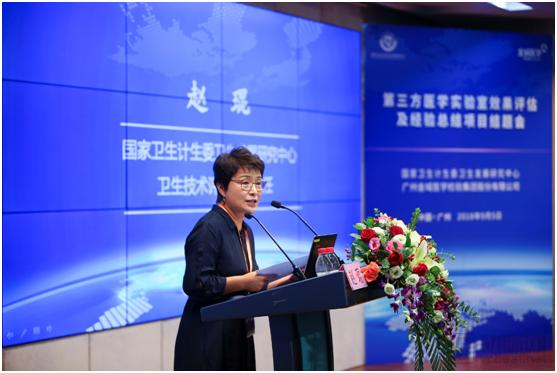
Zhao Kun, Director of the Center for Health Technology Assessment at the Health Development Research Center of the National Health and Family Planning Commission and Professor, presided over the project closure meeting.

Address by Feng Hongxiang, Researcher of the Medical Administration Division, Guangdong Provincial Health and Family Planning Commission
The third-party medical testing industry is a new service model resulting from the optimized allocation of healthcare resources. Its primary entities are Independent Clinical Laboratories (ICLs), which are medical institutions specializing in clinical diagnostics, possessing independent legal entity status, and licensed by health administrative authorities.
Third-party medical laboratories first emerged in the United States. In mature markets such as the United States, Europe, and Japan, third-party medical laboratories have become a well-established industry, accounting for 36%, 50%, and 67% of the medical testing market, respectively.
The report points out that China’s third-party medical laboratories started relatively late, with their origins traceable to the mid-1990s. Driven by market demand and technological advancements, a large number of hospitals have outsourced testing items beyond their capabilities, thereby accelerating the rapid development of the third-party medical testing industry, which has achieved an annual growth rate of 40% in recent years. Statistics show that in 2017, the number of independent clinical laboratory centers and independent pathology diagnostic centers in China increased to 759 and 207, respectively, representing year-on-year growth of 59% and 276%.
Currently, among enterprises with a strategic focus on third-party medical laboratories, KingMed Diagnostics, Dian Diagnostics, and Adicon rank in the top three, accounting for nearly 70% of the market share in this sector. It is estimated that the total size of China’s clinical testing market is approximately RMB 280 billion. The market size of domestic third-party medical laboratories stands at around RMB 14 billion, equivalent to about 5% of the overall market. Although the current proportion of third-party medical testing in China’s total clinical testing market remains relatively low, the potential future market space is substantial. From 2018 to 2020, the third-party medical laboratory market is projected to maintain a growth rate of 30%–35%, reaching 7%–9% of the total market share, with a scale approaching RMB 30 billion.
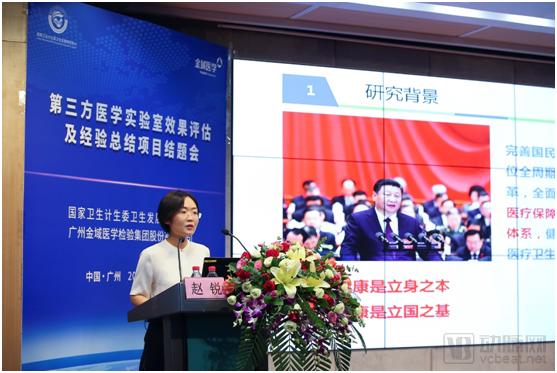
Zhao Rui, Associate Research Fellow at the Health Development Research Center of the National Health and Family Planning Commission, Presents Findings from the Study on Performance Evaluation and Experience Summary of Third-Party Medical Laboratories
In recent years, with the rapid advancement of various forms of medical consortiums in China, the restructuring of the healthcare service system, and the deepening of comprehensive reforms in public hospitals and health insurance payment methods, the requirements for controlling the growth of medical expenses have become more explicit, leading to changes in the service models of third-party medical laboratories.
These diverse service models include: regional centralized testing, such as the integrated “medical insurance + medical laboratory” service model in Qingdao; regional specialized medical consortia for laboratory medicine led by core regional hospitals, such as the Conghua District Maternal and Child Health Laboratory Medical Consortium in Guangzhou; regional laboratory centers co-established by third-party medical laboratories and lead hospitals of medical consortia, such as the Regional Laboratory Center in Wei County, Baoding City, Hebei Province, and the Regional Laboratory Center in Yanjiang District, Ziyang City, Sichuan Province; regional precision medicine centers developed through complementary collaboration with tertiary hospitals, such as the Precision Medicine Center at Qingyuan People’s Hospital in Guangdong Province; and telemedicine collaboration models, exemplified by KingMed Diagnostics’ Remote Pathology Collaboration Network.
The report provides an in-depth analysis of Qingdao’s integrated service model of “medical insurance + medical testing” and the maternal and child health laboratory medical consortium model in Conghua, Guangzhou. It finds that third-party medical laboratories can effectively optimize regional resource allocation, enhance the service capabilities of primary healthcare institutions, and support the establishment of a tiered diagnosis and treatment system as well as a high-quality and efficient healthcare service system.
In Qingdao, Shandong Province, to ensure the healthy development of the community outpatient pooling system, reduce costs for community healthcare institutions, and guarantee testing quality and standardized operations, the Qingdao Medical Insurance Bureau selected Municipal Hospital and KingMed Diagnostics as two third-party medical testing agencies through expert review and city-wide public tendering. These agencies were included in the scope of bundled reimbursement payments under the medical insurance outpatient pooling scheme, requiring all primary healthcare institutions across the city to centralize their specimen submissions, thereby achieving integration between medical services and insurance coverage. In Conghua, Guangdong Province, the Conghua District Maternal and Child Health Hospital leveraged laboratory testing as a focal point to collaborate with KingMed Diagnostics. With the Conghua KingMed Testing Center serving as the lead entity, a “Conghua Laboratory Specialty Medical Consortium” was established with 15 healthcare institutions within the region.
The report indicates that both aforementioned models, through collaboration with KingMed Diagnostics, have enabled primary healthcare institutions to access laboratory professionals and advanced instrumentation equivalent to those available at tertiary Grade A hospitals, along with rigorous quality control standards. This has provided strong support for addressing the shortage of medical service supply, resolved the inadequacy of primary-level laboratory testing capabilities, bridged the “last mile” gap, and facilitated the implementation of “primary care first” visits, thereby promoting the adoption of tiered diagnosis and treatment.
It is worth noting that under these new models, third-party medical laboratories have all taken on government public health initiatives, such as hypertension screening programs for middle-aged and elderly individuals over 40 years old and public health services for birth defect prevention. These efforts are driving a shift in service models from disease-centered care to health-centered care, and from a focus on diagnosis and treatment to a strategy prioritizing prevention while integrating preventive and therapeutic measures.
Further analysis in the report reveals that, while ensuring quality, third-party medical laboratories demonstrate significant cost-reduction advantages within the healthcare service system and also play a prominent role in enhancing the overall clinical diagnostic capabilities of medical consortia.
In the early stages, medical testing was primarily conducted by hospital laboratories and pathology departments. Tertiary hospitals typically offered 300–500 test items, while primary healthcare institutions provided only a dozen or so. In contrast, large third-party medical laboratories now offer more than 2,000 test items. Taking KingMed Diagnostics as an example, it conducts over 2,500 testing procedures, including specialized tests unavailable in other laboratories. The company has not only passed external quality assessment programs but also obtained quality accreditations such as ISO/IEC 17025, ISO 9001, ISO 15189, ISO 15190, and CAP accreditation. While effectively complementing public medical institutions, it helps primary and secondary healthcare facilities significantly enhance their laboratory service capabilities. Under the model of the Conghua Maternal and Child Health Hospital Medical Consortium, more than 1,000 additional testing services were introduced to the Conghua region.
An in-depth economic evaluation of implementation outcomes reveals that third-party medical laboratories can reduce costs through intensification. In Qingdao’s integrated service model combining “medical insurance and medical testing,” centralized submission of tests under medical insurance saved nearly RMB 10 million in insurance expenditures between 2013 and 2017 for routine testing items alone. Similarly, the Conghua model reduces diagnostic costs for the public by nearly RMB 5 million annually. Based on 2016 as the baseline year, the Health Development Research Center of the National Health and Family Planning Commission projected that third-party medical laboratory institutions could save RMB 10.4 billion, RMB 13.7 billion, RMB 17.6 billion, RMB 22.1 billion, and RMB 27.4 billion in testing costs from 2016 to 2020, respectively. Assuming that medical insurance expenditures grew at a constant annual rate of 3% during 2016–2020, it can be concluded that third-party medical laboratory services can save nearly 1% of medical insurance spending each year.
Regarding the future development of the third-party medical laboratory industry, the report points out that third-party medical laboratory institutions should proactively integrate into the hierarchical diagnosis and treatment system and the construction of medical consortia. They should establish regional laboratory medical centers or regional clinical laboratory centers as collaborative healthcare platforms, with a focus on county-level medical communities as units. Serving as a beneficial supplement to the public medical service system, they aim to enhance primary-level testing and examination capabilities and promote the balanced distribution of healthcare resources. Relevant authorities should also strengthen overall planning and provide active guidance by integrating high-quality medical laboratory resources to foster deep integration of premium medical testing, diagnostics, and clinical services within counties.
The report suggests that new types of medical institutions, such as third-party clinical laboratories, can fully serve as hubs and bridges to promote integration between healthcare and insurance, as well as between healthcare and disease prevention. Pilot monitoring programs may be implemented first. Under the value-based strategic purchasing framework of medical insurance, costs for medical tests conducted by designated third-party clinical laboratories should be included in medical insurance coverage. Relevant authorities can also play a leading role through precise policy design, leveraging health insurance’s function in purchasing health outcomes for patients. This would guide third-party clinical testing institutions to provide higher-quality, more affordable, and precise diagnostic services, thereby reducing examination costs. Early screening for chronic diseases, cancers, and other conditions would enable timely classification and targeted treatment. Such measures would not only enhance prevention and control effectiveness, advance precision diagnosis and effective treatment, and conserve medical resources, but also improve the efficiency of medical insurance fund utilization and alleviate financial pressure on the medical insurance system.
The Health Development Research Center of the National Health and Family Planning Commission is a directly affiliated public institution under the National Health Commission. As a national-level research institute, it serves as the technical advisory and think tank body for the National Health Commission.