

Tmunity Therapeutics Files for IPO: Advancing T-Cell Therapies Through Technological Innovation and Manufacturing Optimization
Unicorn Company: A term generally used in the investment community to refer to companies with a valuation exceeding $1 billion and a relatively short founding history.
During the growth trajectory of startups, two extreme phenomena often emerge: some companies toil for years only to secure meager funding, while others, akin to fundraising powerhouses, are courted by investors and rapidly close multiple rounds of substantial financing within just a few years, swiftly ascending to become industry unicorns.
What kinds of companies can become unicorns? What characteristics do they possess, and where lie their competitive advantages that set them apart from the rest?
VCBeat has recently launched the “Super Unicorn” special feature, compiling a list of companies that achieved unicorn status within three years of founding based on the VCBeat knowledge base, and rigorously selecting six companies for case studies. If you are active in this industry, you are welcome to engage with the authors at any time; for media coverage inquiries, please contact VCBeat directly. (Click here for the special feature)
“Controlling T cell activation in vivo is key to developing better therapies for devastating human diseases.”
—James L. Riley, PhD, Co-founder of Tmunity Sciences
The U.S. FDA’s successive approvals of CAR-T therapies from Novartis and Kite Pharma instantly ignited global interest in CAR-T. Although the treatment cost reaches hundreds of thousands of U.S. dollars, many patients are still willing to make this substantial financial commitment, as it represents the only potential cure for cancer.
On August 6, 2018, Nature Reviews Clinical Oncology published the “Management guidelines for paediatric patients receiving chimeric antigen receptor T cell therapy.” This marks the first comprehensive set of guidelines for CAR-T therapy, signaling that clinical application of CAR-T therapy is poised for widespread adoption.
T Cell Therapy
As a crucial component of the immune system, T cells constantly safeguard our health. In 2013, Japanese scientists successfully cultured T cells capable of killing cancer cells for the first time, paving the way for the emergence of T cell therapy.
T-cell therapy refers to the process of isolating T cells from a patient’s blood, genetically modifying and expanding them ex vivo to generate T cells capable of specifically recognizing and eliminating cancer cells, and then reinfusing them into the patient.
The advantage of T-cell therapy lies in the fact that the engineered T cells are harvested from the patient’s own body, thereby minimizing the risk of severe immune rejection upon reinfusion. Furthermore, these modified T cells circulate throughout the bloodstream, targeting and eliminating tumor cells systemically. Consequently, T-cell therapy offers a potential cure even in advanced stages of cancer with metastasis.
Among current T-cell therapies, CAR-T and TCR-T are the most mature, alongside others such as TILs and MASCT. However, only CAR-T has passed clinical validation and entered the market; other technologies remain in the research and development or clinical trial stages.
CAR-T therapy has been applied to the treatment of acute leukemia and lymphoma, achieving certain therapeutic efficacy. However, CAR-T has not yet demonstrated significant effectiveness in the treatment of solid tumors. Consequently, attention is shifting toward TCR-T therapy, with hopes that it can treat solid tumors and, in combination with CAR-T, contribute to a cure for cancer.
Leveraging the University of Pennsylvania's Tmunity
Tmunity is a company born out of this wave. Founded in Pennsylvania in 2015, Tmunity remained relatively obscure for several years until its $135 million Series A financing round in 2018 propelled it into the spotlight.
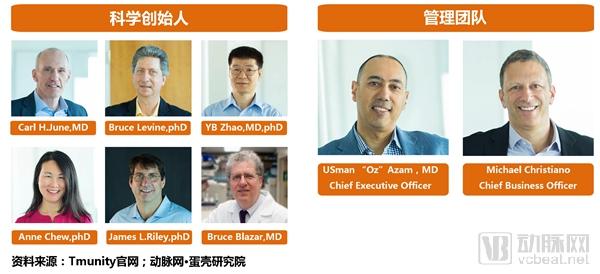
Figure 1: Tmunity Team
Tmunity was founded by six academic elites, who subsequently recruited former Novartis executives to serve as CEO and Chief Business Officer. This combination of academic luminaries and corporate executives is a proposition that capital finds nearly impossible to refuse. Coupled with CAR-T and TCR-T, the two most prominent therapeutic technologies of the moment, Tmunity has rapidly expanded, showing strong potential to become a unicorn.
Five of the six academic founders are affiliated with the University of Pennsylvania. At the inception of Tmunity, the University of Pennsylvania, together with Lilly Asia Ventures, provided $10 million in venture capital funding. The University of Pennsylvania also extended support during Tmunity’s subsequent growth. Tmunity and the University of Pennsylvania have established a research and development collaboration focused on T-cell therapies for the treatment of cancer, infectious diseases, and autoimmune disorders, jointly advancing the development of T-cell therapies.
Two core members of Tmunity’s management team have many years of experience in the biopharmaceutical industry, with extensive expertise and deep insights into cell and gene therapies. Prior to joining Tmunity, both held positions at Novartis Pharmaceuticals, where they respectively led the cell and gene therapy team and the Business Development & Licensing (BD&L) department. As Novartis is one of only two companies with U.S. FDA approval to deliver CAR-T therapies, these executives possess thorough knowledge of T-cell therapies. For Tmunity, such a seasoned leadership team represents a significant strategic advantage.
Advancing Manufacturing Process Improvements to Accelerate the Rollout of T-Cell Therapies
Tmunity integrates the ideas, tools, and insights of its scientific founding team to develop next-generation cell therapies, enabling patients to access novel T-cell treatments earlier.
“We have already assembled all the puzzle pieces for T-cell therapies at Tmunity. More importantly, the founders and core management team possess unparalleled expertise in research, clinical development, and business operations, enabling them to integrate these components in a novel and exciting way,” said Anne Chew, one of the founders.
As Anne Chew noted, Tmunity is not developing new technologies per se. Instead, it aims to accelerate the clinical translation of CAR-T and TCR-T therapies by leveraging its proprietary T-cell clinical translation platform and large-scale manufacturing processes. Tmunity’s product development focuses on enhancing the cytotoxic potency of CAR-T and TCR-T therapies through genetic modification of T cells, combined with other drugs and technologies.
In addition to clinical advancements, Tmunity believes that improvements in manufacturing processes are equally critical to the widespread adoption of T-cell therapies as clinical progress. Currently, the cost of CAR-T therapy reaches hundreds of thousands of dollars, a price tag that places it out of reach for most patients. Process optimizations that reduce treatment costs would not only enable more patients to access therapy but also facilitate the expansion of the T-cell therapy market.
“We are striving to advance the clinical staging of our ongoing T-cell therapy products while continuously enhancing their efficacy, quality, and reliability. In such a nascent field as T-cell therapy, if manufacturing processes are not improved in tandem with technological R&D, even clinical success would be difficult to translate into patient-ready products,” said Bruce Levine, one of the founders.
Focus on the Solid Tumor Sector to Seize Early Market Leadership
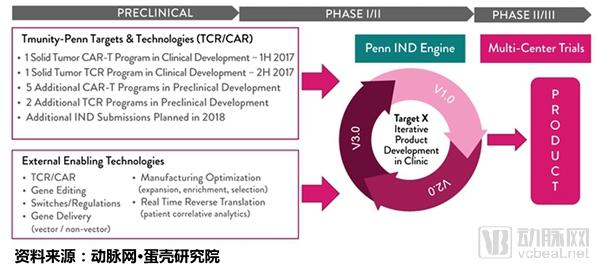
Figure 2: Tmunity Product Roadmap
Currently, Tmunity has nine products in development: six based on CAR-T technology and three based on TCR-T technology, with the two most advanced candidates having entered clinical trials. Additionally, Tmunity plans to initiate new product programs within 2018.
Tmunity’s two most advanced products are both T-cell therapies targeting solid tumors. While CAR-T therapy has demonstrated exceptional therapeutic efficacy in hematologic malignancies, it has yet to achieve significant success in solid tumors. Tmunity aims to leverage its proprietary platform to enhance the efficacy of T-cell therapies for solid tumors, thereby securing a first-mover advantage in the solid tumor treatment market.
Tmunity's Ambition
Tmunity aims not only to develop T-cell therapies with enhanced therapeutic efficacy but also to create solutions that better serve patients. Current T-cell therapies are plagued by high costs, limited indications, and technological homogeneity—challenges that Tmunity is determined to overcome. To address prohibitive pricing, the company is optimizing manufacturing processes to control costs; to expand beyond hematologic malignancies, it is advancing research into solid tumor therapies; and to diversify its technological platform, it is pursuing parallel development of both CAR-T and TCR-T modalities. These strategic moves underscore Tmunity’s ambition to disrupt the industry.
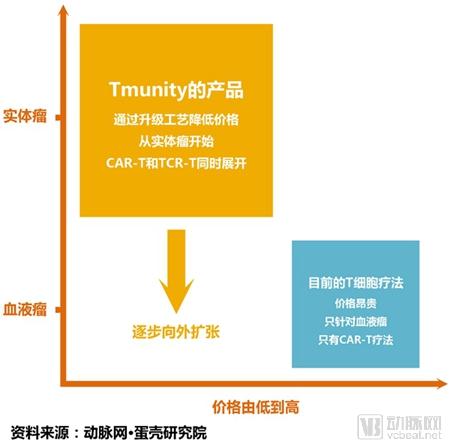
Figure 3: Tmunity’s Development Roadmap
However, as a growing company, Tmunity does not wish to engage in direct competition with large pharmaceutical companies that already have CAR-T products on the market. Therefore, despite the ready availability of therapies for hematologic malignancies, Tmunity has no product plans targeting these indications and is instead dedicating all its resources to the development of therapies for solid tumors.
If Tmunity’s solid tumor products prove effective, it will not only be a boon for patients but also open up a broader market for T-cell therapies. Having secured a leading position in solid tumor treatment, Tmunity is expected to maintain its competitive edge in this area while expanding its therapeutic scope, ultimately achieving comprehensive coverage across oncology, infectious diseases, and autoimmune disorders.
Funding History
Tmunity has raised a total of $145 million in financing to date, with significant participation from Chinese capital. In addition to investment firms and pharmaceutical companies, the University of Pennsylvania also participated in Tmunity’s funding rounds. From strengthening collaborations to providing financial support, it is evident that the University of Pennsylvania has strong confidence in Tmunity.
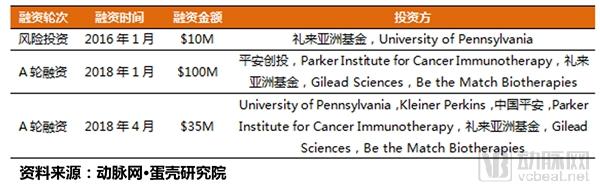
Figure 4: Tmunity's Financing Status
Among investment firms, Gilead stands out prominently. In August 2017, Gilead acquired Kite Pharma for $11.9 billion; Kite Pharma was one of only two companies with CAR-T therapies approved by the U.S. FDA at that time. It can be said that the current CAR-T therapy market is dominated by a duopoly between Gilead and Novartis. Gilead’s recent investment in Tmunity underscores its strong confidence in the broader T-cell therapy market.
Industry Peer Benchmark — TCR2
Both founded in 2015, both focused on the field of T-cell therapy, and both prioritizing solid tumors, Tmunity and TCR2, as pioneering companies in the T-cell therapy industry, share numerous similarities.
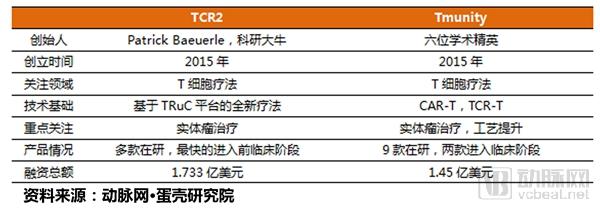
Figure 5: TCR2 vs. Tmunity
The primary distinction lies in the fact that TCR2 aims to consolidate the advantages of existing T-cell therapies to establish a superior approach, namely the TRuC platform developed by TCR2. In contrast, Tmunity remains grounded in current T-cell therapies, seeking technological breakthroughs and process improvements to better serve patients.
Currently, the total financing amounts of the two are nearly identical, and both are making steady progress in product development. The one that first passes clinical validation will have the opportunity to take the lead in capturing the vast market for solid tumor therapies.
Implications for Chinese Entrepreneurs
Currently, there are a total of 26 Investigational New Drug (IND) applications for CAR-T therapies in China, with over 80% targeting CD19. This is primarily because the CAR-T therapies approved by Novartis and Kite Pharma both target CD19. Such a product development strategy offers higher success rates, lower risks, and cost savings. However, chasing existing market trends is not an optimal market strategy for startups. It is difficult for startups to capture market share from large companies that have already established a strong foothold in the market.
Immature technological R&D poses risks for startups, but it also brings opportunities. Tmunity’s market strategy is clear: start with untapped markets and avoid direct confrontation with the large companies currently dominating the industry. Such a strategy requires substantial capital investment, and risks are pervasive throughout the process from R&D to clinical trials. However, an excellent team and advanced technology enable Tmunity to navigate these challenges successfully. Once its products reach the market, the solid tumor market accessible to Tmunity will be significantly larger than the current CAR-T therapy market for hematologic malignancies, and there will be no competitors in the short term.
Domestic companies should shift their mindset more significantly, moving from attempting to penetrate existing markets toward developing new ones. China’s research capabilities are not weak; they are fully sufficient to support startups in developing novel therapeutic solutions. Eli Lilly’s investment in Tmunity also demonstrates that as long as a company possesses strong core competencies, there will always be capital willing to bear the associated risks. If startups merely strive to compete in existing markets, the result will inevitably be futile and self-destructive.