

China's Internet Medical Information Sector Emerges with Global Giants Like $13B M3; Tencent Enters with 'Tencent Yidian'
A survey report by the Pew Research Center in the United States shows that in 2005, 80% of American internet users had already begun searching for health information online. The development of the Internet has provided new channels for the dissemination of medical information, giving rise to specialized websites and information platforms.
In terms of medical social platforms, they can be broadly categorized based on their target user groups intoA health information platform for patients and the general public, and a physician community serving professional doctors, VCBeat (WeChat: vcbeat) has compiled this information and analyzed the impact of internet healthcare platforms on the digital marketing of pharmaceuticals.
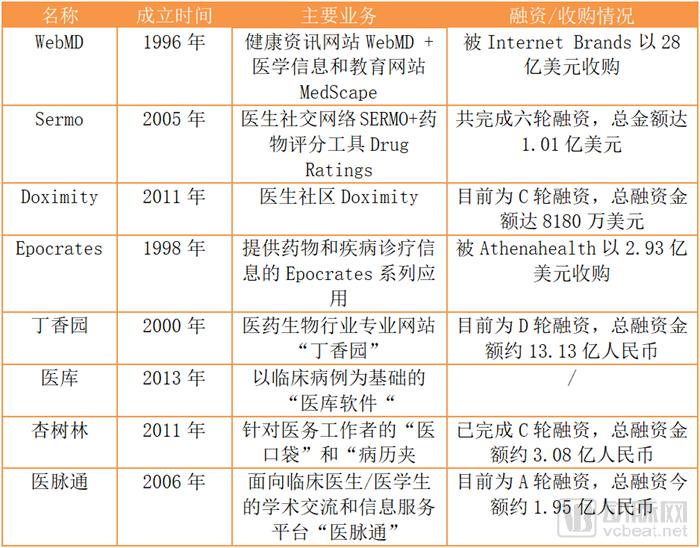
Globally, the largest company in the physician community sector is Japan’s M3, with a market capitalization of approximately $13 billion. The second-largest is the U.S.-based WebMD, which was acquired by investment giant KKR for about $2.8 billion in 2017. Other companies with similar business models include Sermo, Doximity, and Epocrates. In China, the main competitors include DXY, Medlive, Apricot Forest, and Medlive Technology.
WebMD
WebMD is one of the most popular health websites among consumers and healthcare professionals in the United States, providing an online platform for patients and physicians to access and exchange medical information. In addition to aggregating clinical reports from physicians across the country, it offers the latest and most comprehensive medical database. In July 2017, WebMD was fully acquired by Internet Brands, a portfolio company of the private equity firm KKR, in a transaction valued at approximately $2.8 billion. Statistics show that more than 40% of physicians in the United States are loyal members of WebMD. The information it provides meets the diverse needs of both healthcare professionals and the general public for real-time information, education, and community engagement online.
WebMD’s core business consists of two segments, the first of which isWebMD’s Main Site for the General Healthy Population, providing medical news, health information, and tools for testing and nursing care; users can also choose from multiple databases for searching; secondly,MedScape Platform for Clinicians and Healthcare Professionals, providing high-quality professional medical information such as literature, news, and academic updates. MedScape is the largest website on the internet offering free access to clinical medical literature and continuing medical education resources.
Sermo
Sermo is the world’s leading social network for physicians, where nearly 800,000 verified and licensed doctors from more than 150 countries discuss real-world medicine, collaborate on patient cases, respond to healthcare opinion surveys, and earn compensation for participating in research.
In May 2017, Sermo launchedDrug Ratings: The World's Only Peer-to-Peer Prescription Drug Review SystemThrough this drug rating tool, physicians can evaluate and score specific medications based on efficacy, safety, tolerability, accessibility, and adherence, while sharing their treatment experiences with peers in real time to facilitate more informed decision-making. As of March 2018, over 40,000 physicians had submitted evaluations, totaling 625,000 ratings covering more than 2,100 drug brands, making Drug Ratings the world’s largest professional database for drug feedback.
Doximity
Doximity is currently the largest physician community in the United States.With over 1 million medical professionals, including more than 70% of U.S. physicians and 45% of physician assistants and nurse practitioners. Doximity alone added nearly 250,000 members in 2017, achieving a growth rate of 32%. Doximity provides healthcare professionals with a secure platform for industry networking, information exchange, and medical collaboration, helping them share professional experiences, engage in high-level professional discussions, collaborate on case diagnoses, and find referral physicians, testing facilities, pharmacies, and other resources.
Doximity is exclusively open to healthcare professionals, including general practitioners, specialists, registered nurses, and physician assistants. This powerful, closed social network is built upon comprehensive physician data. Doximity deeply integrates 21 public databases, including the National Provider Identifier database and the U.S. Medicare database, as well as physician databases from a range of healthcare institutions such as medical schools, hospitals, medical imaging centers, and pharmacies. ThereforeDoximity possesses public profiles for nearly all U.S. physicians.
Epocrates
Epocrates is the world’s first publicly traded mobile health company,Focused on providing information services to medical professionals, including clinical practice guidelines, convenient billing codes, and drug information. Its flagship products are databases for drugs and clinical treatments. The company has successively launched apps including Epocrates Rx (free) and Epocrates Essentials ($159.99 annual subscription) for physicians, as well as Enterprise (free) for businesses. These applications provide drug and disease diagnosis and treatment information to physicians. Drug information includes efficacy, identification, supplier details, pharmacopeia data, and regulatory approval status; disease diagnosis and treatment information includes clinical guidelines and updates to prescribing regulations.
At the time of its IPO in 2010, Epocrates reached 40% of physicians across the United States. In 2012, Epocrates generated approximately $120 million in revenue, with 75% derived from pharmaceutical companies, primarily through targeted advertising and survey services. In January 2013, Epocrates was acquired by Athenahealth, a U.S. healthcare technology provider, for $293 million.
DXY
Dingxiang Yuan is China’s leading connector in the healthcare sector and a provider of professional services in the digital domain. Over the past 17 years, Dingxiang Yuan has established the country’s premier medical academic forum and a suite of mobile products, and has wholly funded and built offline clinics. Through its platform for sharing professional and authoritative content, extensive and comprehensive data accumulation, and standardized, high-quality medical services, Dingxiang Yuan connects hospitals, physicians, researchers, patients, biopharmaceutical companies, and insurance providers. It boasts 5.5 million professional users, including 2 million physicians.
CurrentlyDingxiangyuan provides services to physicians, pharmaceutical companies, hospitals, and patients., specifically, it provides physicians with services such as communication platforms, literature search, and medication information; offers e-marketing and data mining services to pharmaceutical companies; conducts e-commerce operations for biological reagents and consumables targeting pharmaceutical companies; provides medical talent recruitment services for hospitals; and offers medication guidance to patients.
MedVault
Yiku’s core product, “Yiku Software,” provides solutions for the informatization of clinical medical care., enabling physicians to rapidly document medical records via mobile devices. It features a navigation system structured according to the clinical case collection sequence, leverages smart terminals to capture multimedia case information through images, videos, audio recordings, and documents, and subsequently performs data organization, statistical analysis, and summarization on PC and cloud platforms.
The core functionalities of Yiku Software can be categorized into four aspects: Literature Search—submitting requests for literature retrieval, providing complimentary literature search assistance, and supporting medical researchers in manuscript preparation and study design; Excellent Case Studies—aggregating and showcasing high-quality medical records from various departments, enabling physicians to engage in learning and comment on cases; Medical Videos—offering video content covering medical education, coursework, and patient health education to facilitate professional development among healthcare providers; and Q&A Challenges—providing subject-specific question banks with authentic exam questions to support autonomous learning for doctors, nurses, and medical students.
Apricot Forest
Xingshulin aims to provide healthcare professionals with clinical information services based on smartphones and tablets.The company’s flagship products—“Medical Literature,” “Yi Pocket,” and “Medical Record Clip”—are smartphone applications specifically tailored for healthcare professionals. They primarily provide physicians with personalized literature and reference materials, including pharmacopoeia, laboratory test information, medical calculators, and mobile-based medical record management. The platform currently boasts over 200,000 users, with a weekly active user rate exceeding 40%.
In November 2011, Xingshulin secured hundreds of thousands of dollars in angel financing from BlueRun Ventures. It subsequently raised millions of dollars in Series A financing from China Broadband Capital (CBC), and tens of millions of dollars in Series B financing led by Shuanghu Investment with participation from Kaiwu Investment. In early 2016, Xingshulin completed its Series C financing round, led by Tiancheng Industrial, a wholly-owned subsidiary of the listed company Joincare Pharmaceutical Group Industry Co., Ltd., with continued participation from Kaiwu Capital. Currently, Xingshulin’s valuation has exceeded $200 million.
Medlive
Medlive is an academic website specifically designed for clinicians and medical students.Currently, the website has amassed over one million users and accumulated a vast and comprehensive repository of medical information resources. The main functions and services of the Medlive website include: Medical News—real-time updates on medical news and academic advances in domestic and international fields closely related to clinical practice; Clinical Guidelines—one-stop search for domestic and international clinical guidelines, along with interpretations and translations; Case Imaging Review—carefully selected real-world clinical cases with detailed explanations of diagnostic and treatment processes; Diagnosis and Treatment Knowledge Base—adhering to evidence-based principles and tailored to the practical needs of Chinese physicians, this disease-centric knowledge base features six major knowledge axes, 30 data fields, and over one hundred key points to support disease diagnosis and treatment; Physician’s Toolkit—including a comprehensive medical and pharmaceutical dictionary, drug reference guide, medical calculation formulas, and laboratory test assistant.
The internet is a primary source for many individuals seeking health information, while social networks facilitate better communication between healthy individuals and physicians. The emergence of mobile internet and smartphones has driven a structural transformation in the digital healthcare industry, reshaping how both the general public and medical professionals access and share information.
Meanwhile, the pharmaceutical industry is increasingly adopting a patient-centric approach and implementing multi-pronged strategies by investing more in social media and online resources. These initiatives include developing applications for physicians and consumers, monitoring consumers’ online behaviors, and tracking the therapeutic areas of interest to healthcare professionals.Pharmaceutical companies have been increasing their investment in digital marketing strategies., including websites, digital marketing, and social media.There are four main driving factors behind this trend::
• The return on investment (ROI) for traditional media is very low, in order toCut Advertising Spending, pharmaceutical companies are shifting from traditional television and print advertising to lower-cost digital marketing.
• An increasing number of companies willResource Allocation to Mobile ChannelsA report by Cutting Edge Information indicates that approximately 69% of companies stated they utilize mobile technologies in their marketing or medical affairs operations, such as mobile applications designed for healthcare professionals including physicians, patients, and pharmacists.
• The report also shows that one-third of peopleUsing Social Media to Discuss Medical Issues, which is sufficient to give pharmaceutical companies a reason to get involved. Pharmaceutical companies have found that by observing consumer perceptions of drug brands, they can develop more effective marketing strategies. For example, AstraZeneca’s real-time interactions on Twitter and Facebook have provided it with a certain amount of feedback on its medications.
• Digital marketing in pharmaceutical companies is also subject toThe Impact of Regulatory Agencies, regulatory agencies have provided guidelines for corporate communications in the digital space. For instance, 57% of respondents indicated that the U.S. Food and Drug Administration’s guidance on direct-to-consumer social media would significantly impact their company’s strategy.
Medical social networks are becoming a necessity for pharmaceutical companies, as they serve not only as tools for rapid content sharing and promotion but also as comprehensive online marketing platforms. By integrating content management, social media, and big data analytics, marketers can save significant time and money, disrupt traditional pharmaceutical marketing models, and help pharmaceutical enterprises leverage digital platforms to achieve precision marketing and rapid transformation, thereby generating greater value.
For instance, Pfizer partnered with Sermo as early as 2007, becoming one of the first major pharmaceutical companies to enter online social networks. By leveraging digital channels, pharmaceutical companies can identify optimal ways to communicate with physicians and provide drug and disease information tailored to their needs. Pfizer believes that collaborating with Sermo effectively addresses the issue of information insufficiency, meaning that sources of medical information are no longer limited to articles in medical journals and clinical trial data.
Currently, internet healthcare platforms are demonstrating strong growth momentum and possess significant market potential.
Taking physician communities as an example, on one hand, existing platforms have continuously evolved, aggregating numerous professionals and accumulating substantial resources, thereby establishing significant brand influence. By forging partnerships with pharmaceutical companies, these platforms can enhance the stability and sustainability of their revenue streams. Furthermore, physician communities exhibit strong scalability; with physicians at the core, a broader range of services can be expanded, such as doctor-patient communication and offline clinics.
On the other hand, reducing the sales force has a rather limited impact on cost savings and performance improvement. Pharmaceutical companies still rely on sales to generate revenue, but traditional promotional methods clearly need improvement. Many pharmaceutical companies have keenly recognized that online promotion may be a viable path. With the continuous development of internet healthcare, digital marketing methods and channels have become more diversified, and the rise of medical communities has also provided more possibilities for the digital marketing of pharmaceuticals.
China is also continuously seeking breakthroughs and innovation in this field. For instance, this August, Tencent and WebMD jointly held a press conference in Beijing to announce an exclusive strategic partnership in China. Leveraging professionally curated medical information and health education content exclusively licensed from WebMD, Tencent’s inaugural medical information product, “Penguin Medical Encyclopedia,” will provide Chinese users with professional, easy-to-understand, user-friendly, and trustworthy popular science content on medicine.
Tencent will also collaborate with WebMD, renowned experts across various medical specialties, authoritative industry associations, and foundations to jointly build a smart medical information platform. Additionally, it will launch the “Medical Enterprise Star” initiative, which aims to select 100 multidisciplinary star physicians for science popularization through various forms such as domestic and international exchanges, training programs, and competitions, thereby encouraging the creation of high-quality medical science content.
As early as September 2014, Tencent invested $70 million in DXY.cn, officially announcing its strategic entry into the healthcare sector. Through this investment, DXY.cn and various Tencent platforms launched a series of collaborations, including the exploration and integration with the WeChat ecosystem. After securing the investment, DXY.cn continued to invest capital and resources in developing healthcare products tailored for physicians, enterprises, and the general public. It also facilitated connections between physician resources and pharmaceutical companies, helping to establish more compliant and effective multi-channel academic interaction platforms between enterprises and physicians.
Leveraging its extensive digital healthcare resources and advantages in medical interaction platforms, mobile health, and brand influence, DXY is poised to become the next “WebMD,” providing pharmaceutical companies and healthcare institutions with more precise and high-value digital marketing solutions.
References:
1.https://hitconsultant.net/2018/06/18/digital-health-market-2024/