

Tencent Healthcare Doubles Down on AI with Focus on Efficiency, Primary Care, and Precision Medicine
Recently, the inaugural Computer Vision Summit, co-hosted by Tencent Youtu Lab—one of Tencent’s three major AI laboratories—and the Science family of journals, the official publications of the American Association for the Advancement of Science (AAAS), was held in Shanghai. This marked Youtu Lab’s first proactive public debut and the first press conference hosted by a technical team under Tencent. Concurrently, Youtu Lab was officially upgraded to the Computer Vision Laboratory.
The unique nature of this conference underscores Tencent’s determination to accelerate its strategic layout in the AI sector. Although Tencent has made significant strides in the field of artificial intelligence, with Youtu delivering impressive products across retail, social networking, industrial, entertainment, and healthcare sectors, companies cannot afford to focus solely on the present. At the conference, Tang Daosheng, Senior Executive Vice President of Tencent, stated, “In future R&D efforts, our new laboratories will not be assigned KPIs. I hope that in the future, machines will not only be able to ‘see’ but also ‘understand what they see,’ and even help humans ‘see further.’ This is highly challenging fundamental research, and we are committed to making patient, long-term investments in this area.”
In the latter half of the conference, leading experts—including Professor Qiao Youlin from the Department of Epidemiology at the Cancer Hospital, Chinese Academy of Medical Sciences; Professor Cen Lingping, a committee member of the Ophthalmology Branch of the Chinese Medical Association and professor at the Joint Shantou International Eye Center of Shantou University and The Chinese University of Hong Kong; Professor Yang Guang-Zhong, Director and Co-Founder of the Hamlyn Centre for Medical Robotics at Imperial College London and Editor of Science Robotics; Dr. Qian Tianyi, Chairman of the Tencent Medical Health Technology Committee; and Dr. Zheng Yefeng, Head of Medical AI and Scientist at Tencent Youtu Laboratory—engaged in an intellectual exchange on the future of AI in medicine, discussing its current state and prospects.
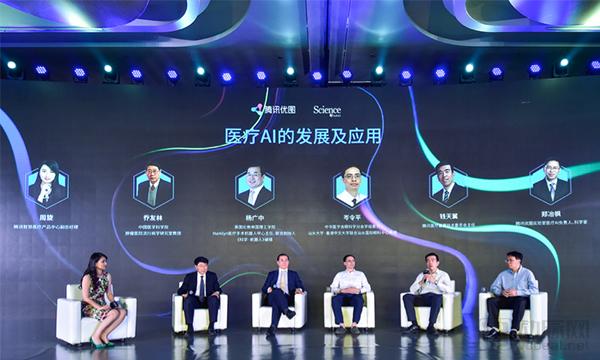
Yang Guangzhi pointed out that the application of AI in healthcare can be summarized into three development directions: first, optimization of medical processes; second, disease diagnosis and prediction, which corresponds to the AI-based medical image processing that most current AI medical solutions focus on; and third, precision medicine, particularly precision surgery. “Lesions are now being detected at increasingly earlier stages and at smaller sizes, making it difficult for the human eye or traditional surgical methods to locate them with precision.”
As a benchmark for AI in medicine in China, Tencent Miying has enabled AI-powered medical image analysis to assist physicians in screening for esophageal cancer, pulmonary nodules, diabetic retinopathy, colorectal tumors, breast cancer, and other conditions. Additionally, its AI-assisted diagnostic engine helps clinicians identify and predict risks for over 700 diseases. Tencent Miying has established collaborations with more than 100 top-tier Grade III Class A hospitals across China. The rapid development of Tencent Miying precisely mirrors the trajectory of AI in medicine.
Dr. Qian Tianyi, Director of the Tencent Medical Health Technology Committee, analyzed that from a technical perspective, medical AI has the potential to play a more significant role in three categories of medical fields in the future: The first category involves scenarios that do not require seniority or extensive experience but demand substantial mental effort for judgment. In these cases, AI can achieve excellent results, conserve physicians’ energy, improve diagnostic efficiency, and free clinicians from trivial and mundane tasks. The second category pertains to primary healthcare systems lacking specialist physicians. Training specialists takes several years and requires time, clinical exposure, and mentorship. By learning from the knowledge of specialist experts, AI products can serve as assistants to primary care physicians in settings with a shortage of specialists, providing them with specialized medical knowledge. The third category is precision medicine. AI can not only identify lesions but also accurately measure their density, volume, and other parameters, offering greater precision and smaller margins of error than manual measurements by physicians. AI assistants extract precise data for physicians, enabling them to save time using tools and redirect their efforts toward breakthroughs in scientific research, thereby advancing the field of medicine.
“China’s medical resources are unevenly distributed. We hope to provide better healthcare conditions for the general public by developing medical AI.” Dr. Qian Tianyi further pointed out that while “AI + Healthcare” presents opportunities, it also faces numerous challenges: substantial investments in human, material, and financial resources are required to acquire data suitable for effective AI training; there is a need for more interdisciplinary talents who possess both technical expertise and medical knowledge to integrate technological advancements with clinical application scenarios, thereby developing superior medical AI products better suited for physicians’ use; furthermore, regarding clinical registration, regulatory authorities and the industry must jointly explore evaluation and assessment standards for AI-based medical products.
“AI + Healthcare” is a brand-new field of “medical-engineering integration.” Driven by technologies such as big data, artificial intelligence, and cloud computing, the growing capabilities of “AI medical assistants” have generated great anticipation within the medical community.
Professor Qiao Youlin from the Department of Epidemiology at the Cancer Hospital, Chinese Academy of Medical Sciences, successfully developed an HPV screening method that directly contributed to the creation of the HPV vaccine and significantly promoted the widespread adoption of cervical cancer screening in China. In his view, the research, development, and application of AI-powered electronic colposcopy in China have not only improved the speed and accuracy of screening but also provided technical support for remote screening.
The World Health Organization has proposed that by 2030, 90% of girls under the age of 15 should receive the HPV vaccine, and 70% of women over the age of 35 should undergo at least two rounds of HPV-primary screening. “After these two screenings, electronic colposcopy comes into play. I eagerly anticipate the day when our AI-enabled electronic colposcope is launched; in other developing countries with limited access to high-quality medical services, primary care physicians, equipped with only a basic electronic colposcope and supported by AI-driven remote assistance, will be able to determine sampling sites and identify lesions within seconds.”
It is reported that, under the guidance of Professor Qiao Youlin, Tencent Miying and the Youtu Lab are advancing research on an AI system for early cervical cancer screening. They are developing an intelligent detection and screening tool to assist gynecologists in rapidly identifying precancerous lesions and pinpointing cancerous areas, thereby facilitating the formulation of corresponding biopsy and treatment plans.
In the field of ophthalmology, the application of artificial intelligence has also revealed innovative prospects for physicians. Professor Cen Lingping from the Joint Shantou International Eye Center of Shantou University and the Chinese University of Hong Kong noted that diabetic retinopathy is the most widely used and extensively studied area of AI in ophthalmology. “We hope to develop an AI-powered product capable of recognizing all types of fundus diseases,” he stated.
In October last year, the Western Ophthalmology Alliance partnered with Tencent to establish a joint laboratory for AI-based medical imaging. Leveraging Tencent’s leading artificial intelligence technologies, such as image recognition and deep learning through its “Tencent Miying” platform, the two parties will conduct in-depth research and practical applications in fundus screening. This collaboration aims to assist physicians in fundus examinations, significantly improve diagnostic accuracy, and help address the scarcity of medical resources and the uneven distribution of healthcare capabilities in western China.
Dr. Zheng Yefeng, Head of Medical AI and Scientist at Tencent Youtu Lab, cited AI-assisted lung cancer screening as an example to illustrate the rapid advancements in AI medical technology: In 2014, the FDA approved CT-based products for lung cancer detection. At that time, traditional machine learning methods offered limited accuracy, with more than six to seven false positives per CT scan at a sensitivity of 90%. With the advent of deep learning technologies, performance has significantly improved, achieving sensitivities above 95% while reducing false positives to one or two, or even lower. He pointed out that, leveraging the rapid development of AI technology, China’s AI medical applications have the opportunity to achieve leapfrog development akin to high-speed rail and mobile payments. “We can collaborate with hospital experts to train AI algorithms that approach or match their diagnostic proficiency, and ultimately deploy these solutions at the primary care level. Indeed, by harnessing new technologies, we can substantially improve the accuracy of primary healthcare.”
When discussing Tencent Youtu’s core competitiveness in the medical AI sector, Dr. Zheng Yefeng candidly told VCBeat that competition in the AI-plus-medical imaging industry is currently intense. Prior to obtaining approval from the National Medical Products Administration (NMPA, formerly CFDA), companies primarily cite their own data results, making objective evaluation difficult. Nevertheless, given the high incidence and mortality rates associated with lung cancer, we must continue to invest in its R&D and ensure product completeness to advance our overall strategic layout.
As a “national team” player in artificial intelligence, Tencent is continuously advancing its comprehensive strategic layout, which extends beyond mere products. The collaboration with Science magazine announced at the conference underscores Tencent’s emphasis on scientific and technological culture, while the “Youtu Science” mini-program showcased at the event enables consumer-end users to easily access the medical ecosystem.
Currently, Tencent Miying has partnered with more than 100 Grade-A tertiary hospitals in China. This constitutes Miying’s distinctive advantage and the fruit of its long-term investment. With its comprehensive strategic layout, Tencent Miying is poised to secure a leading position in the future “AI + Healthcare” industry once regulatory approvals are granted.