

Jack Ma's Retirement Signals Deeper Commitment to Healthcare: Alibaba's 'Double H' Strategy and Health Tech Ambitions
Jack Ma, who has been a teacher, loves teaching, and aspires to continue teaching in the future, suddenly announced his “retirement,” seemingly intent on joining the fray and boosting his popularity as Teachers’ Day approaches, while also celebrating his birthday in this manner.
VCBeat (WeChat: vcbeat) reporters are not too forgetful; they still remember that this is not the first time Jack Ma has said goodbye to Alibaba.
In May 2013, Jack Ma stepped down as CEO of Alibaba, held a farewell event, and announced, “I will not be coming back. Even if I wanted to return, I wouldn’t. Because my return would serve no purpose; you will do even better.”
A quick calculation reveals that when Jack Ma proposed the “Double H” strategy and marched into the healthcare and wellness sector in 2015, he had already been retired for nearly two years. There is no need to elaborate on Alibaba’s prominent position in the healthcare and medical industry.
Nowadays, Jack Ma says he is retiring again and plans to live his retirement life like Bill Gates.
With that in mind, professionals in the healthcare sector should be even more vigilant.
Do you know what Bill Gates has been doing since his retirement? Someone summarized seven major initiatives Gates has undertaken post-retirement, five of which are surprisingly related to healthcare and medicine, including funding vaccine research and development, investing in digital pills, and sponsoring research.Alzheimer's Disease……
From this perspective, Jack Ma, who was said to be retiring, looks more and more like he’s going all in on the health sector?!
Keep in mind that Jack Ma has made many predictions about the “endgame” in the health sector, all of which are yet to come to fruition.
Today is September 10, Teachers’ Day, and also Jack Ma’s 54th birthday.
In fact, September 10 holds even deeper significance for Jack Ma. He was born on September 10, 1964, which is Teachers’ Day in China. After graduating from university in 1988, he was assigned to Hangzhou Institute of Electronic Engineering, where he served as a lecturer in English and International Trade. Moreover, Alibaba Group was officially founded on September 10, 1999.
According to previous reports by The New York Times, Jack Ma will step down as Chairman of Alibaba’s Board of Directors to “devote more time to education.” Whether Mr. Ma will truly “retire” remains uncertain; even if he announces his retirement, he is expected to continue influencing Alibaba and its affiliated companies’ future development in terms of equity ownership, personnel decisions, and corporate values.
On the Occasion of Jack Ma’s “Retirement,” VCBeat Reviews the Healthcare Layouts of Jack Ma and the Alibaba Ecosystem. We Found That, Regardless of Retirement, Jack Ma Remains an Indispensable Figure in China’s Healthcare Sector.
In 2015, Jack Ma proposed the “Double H – Health & Happiness” strategy, which was seen as a significant signal of the Alibaba Group’s large-scale entry into the healthcare sector.
In fact, Alibaba had already set its sights on the healthcare sector long before this strategy was formally designated. Its first move was to establish a “flagship platform”—Alibaba Health. In January 2014, Alibaba, in partnership with Yunfeng Capital, made a strategic investment of US$170 million (approximately RMB 1.037 billion) in the Hong Kong-listed company CITIC 21st Century, acquiring a 54.3% stake in the latter.
Since its establishment, Alibaba Health has primarily focused on two key initiatives within the group. First, it has continuously integrated pharmaceutical e-commerce-related businesses, including the operated services for Tmall Pharmacy, the “Blue Hat” health supplement business, and the recently incorporated medical device e-commerce segment. Second, it has secured entry points for its services on platforms such as Taobao and Alipay, thereby facilitating the integration and conversion of internal resources.
The impact of resource injection has been particularly significant, driving Ali Health’s revenue to sustain robust growth—surging from RMB 30.42 million in fiscal year 2015 to RMB 2.442 billion in fiscal year 2018. With the integration of its medical device e-commerce business, future revenue growth is expected to be even stronger.
Most notably, Alibaba Health has effectively become the “leading player” in China’s pharmaceutical e-commerce sector. Annual report data show that in fiscal year 2018, the combined gross merchandise volume (GMV) of Tmall’s pharmaceutical categories operated by Alibaba Health and the acquired health food category e-commerce platform services exceeded RMB 30 billion, while the annual GMV of Tmall’s medical device business reached RMB 20.561 billion.
This indicates that Alibaba Health controls the entry point to an e-commerce business for pharmaceuticals, medical devices, and health supplements valued at over RMB 50 billion, while the total size of China’s pharmaceutical e-commerce market has only just surpassed RMB 100 billion. In other words, in the realm of “Internet Plus” circulation of pharmaceuticals and medical devices, Alibaba Health wields considerable influence.
In addition to its e-commerce operations, Alibaba Health also boasts promising ventures in smart healthcare, product traceability, and health management. Its smart healthcare division has developed the “Doctor You” medical AI system, which has been deployed in multiple hospitals. The product traceability business has expanded beyond its original tracking capabilities to include marketing and interactive features, attracting companies specializing in health supplements and traditional Chinese medicine patent drugs to join its platform. Meanwhile, the health management division has partnered with several smart device manufacturers to monitor and manage user health through intelligent devices, while also extending its services into the commercial health insurance sector.
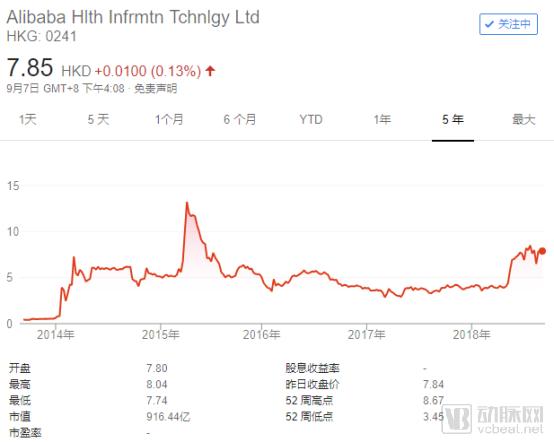
Of course, what we remember most easily are the numbers. In January 2014, before Alibaba’s investment, the share price of CITIC 21 was around HK$0.5, with a market capitalization of just HK$2 billion. As of September 7, the share price of Alibaba Health reached HK$7.85, with a market capitalization of HK$91.644 billion. This represents a 50-fold increase over four years, yielding an astonishing return on investment.
Alibaba Health Stock Price Trend
If the establishment of Alibaba Health can be described as “building a platform,” then the healthcare initiatives undertaken by other companies within the Alibaba ecosystem represent “strategic extension”: leveraging their substantial technological advantages and extensive user base, these entities are well-positioned to expand into the healthcare sector and generate synergistic effects. Strategic alignments consistent with this “extension” logic include Alipay, Alibaba Cloud, Taobao and Tmall, and DingTalk.
Overview of Alibaba’s Healthcare and Medical Layout
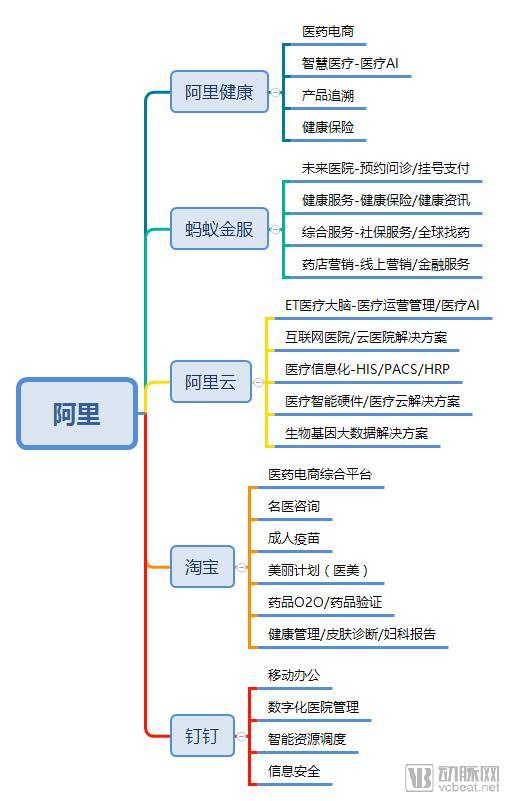
We have crafted a “one-sentence introduction” for each healthcare company within the Alibaba ecosystem, enabling quick identification and recall of their respective roles:
Alibaba Health — The Flagship Platform of Alibaba’s Medical Layout;
Ant Financial—Building the “Future Hospital” with Payment and Credit;
Alibaba Cloud — Empowering Healthcare with a Powerful Brain;
Taobao—The “Super Entry Point” for C-End Users;
DingTalk – A Smart Hospital Management Tool and Enterprise User Portal.
In addition to the aforementioned Ali Health, Alipay, Alibaba Cloud, Taobao, and DingTalk, other business segments within the Alibaba ecosystem will also serve as entry points or service providers for medical services, delivering healthcare solutions to both enterprise and consumer (C-end) customers.
For instance, Ele.me provides pharmaceutical O2O services, UC Browser delivers health information, and Youku offers health-related video content. With its extensive product portfolio and strong service penetration capabilities, the Alibaba ecosystem can comprehensively cover consumer-end users. If these resources are effectively integrated and interconnected, they will create a “super entry point” for medical and healthcare services, enabling the provision of more comprehensive and precise healthcare solutions.
By pursuing two strategic pathways—“building platforms” and “extending services”—Alibaba has secured control over the entry points to healthcare services and the core technological capabilities of “Internet+.” For sectors characterized by high entry barriers, long investment cycles, or heavy asset intensity, Alibaba has opted to enter through investments. Consequently, capital from the Alibaba ecosystem has become a significant force in healthcare and medical investment.
Overview of Alibaba’s Capital Investment Strategy
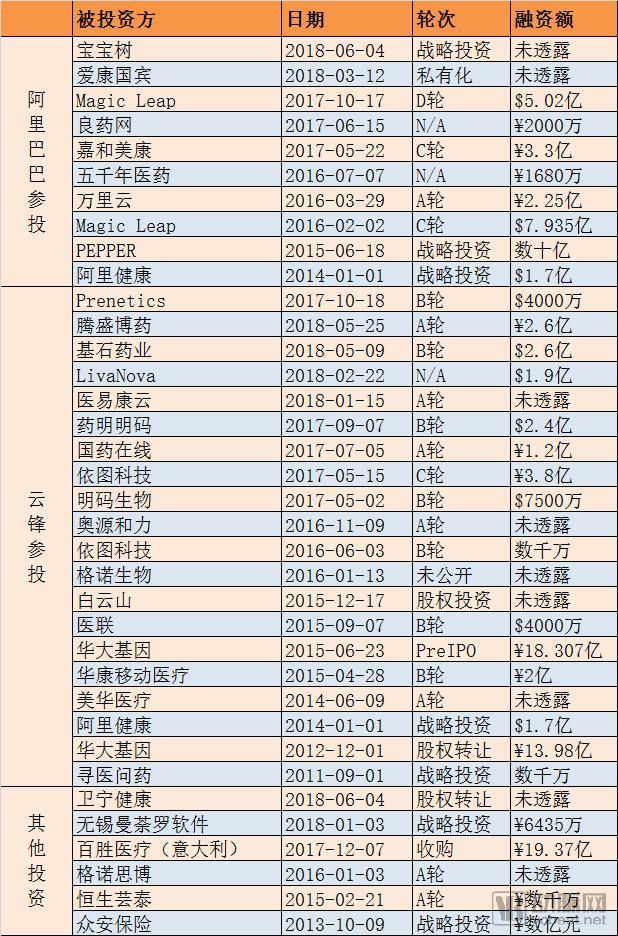
As can be seen, Alibaba-affiliated capital has made extensive investments in the healthcare sector, with targets both domestically and internationally. These investments span pharmaceuticals, genomics, healthcare informatics, pharmaceutical retail, consumer healthcare, insurance, physical examinations, and medical big data. Notable portfolio companies include Bestinmed (Italy), BGI Genomics, Baiyunshan, ZhongAn Insurance, and iKang Guobin.
Currently, it is difficult to distill a core logic from the Alibaba ecosystem’s capital investments in the healthcare and medical sector. These investments are largely driven by strategic considerations, covering a diverse range of tracks. As Alibaba’s healthcare strategy takes shape, high-quality resources can be integrated into its healthcare portfolio, creating a comprehensive, end-to-end healthcare ecosystem. For instance, iKang Guobin’s health examination services can be incorporated into “Alibaba Clinic,” while Winning Health’s capabilities and resources in healthcare informatization can generate synergies with the “Future Hospital” initiative and medical payment services.
Alibaba served as the lead investor in some of these projects and a follow-on investor in others, making it difficult to determine the exact amount of its investments. However, if calculated at half of the financing amounts raised by the companies involved, Alibaba’s total investment in the healthcare sector may exceed RMB 3 billion. This figure is relatively low compared with Alibaba’s investments in other sectors; for instance, its participation in the privatization of Youku Tudou alone cost at least USD 3.7 billion.
Alibaba’s corporate culture embraces “endgame thinking,” which essentially means that a company should envision what the future will look like and then strategically position itself accordingly. This is exemplified by Jack Ma: from online yellow pages to e-commerce and then to cloud services, Alibaba persisted in these endeavors even when they were met with widespread skepticism, driven by the belief that “because we believe, we see.”
There is a widely circulated video of Jack Ma, in which he roughly stated that in 30 years, doctors would struggle to find jobs, hospitals would become fewer, and pharmaceutical companies would significantly decrease. This has been regarded as Jack Ma’s bold proclamation to “disrupt” healthcare. Internet communication often takes things out of context, and Jack Ma’s remarks are frequently interpreted as his ambition to “disrupt” the medical industry.
In fact, Jack Ma’s exact words in the video were: “Going forward, Alibaba aims to focus on two sectors—health and happiness. How can we make people healthier and happier? The answer is not by building more hospitals or hiring more doctors, and certainly not by constructing more pharmaceutical factories. Rather, if we (as investors) get it right, then in 30 years’ time, doctors should find themselves out of work, there will be fewer hospitals, and significantly fewer pharmaceutical factories. This would indicate that we have done the right thing.”
So, what exactly should be done? The key lies in prevention. Jack Ma has stated that future human health should stem more from healthy lifestyles and disease prevention, rather than solely seeking treatment after illness occurs.
During the process of diagnosis, treatment, and rehabilitation, internet technologies and platforms can be leveraged to address issues of information asymmetry and lack of transparency in the healthcare system. For instance, patients can use online platforms for appointment scheduling, payment, follow-up consultations, and prescription refills. Additionally, patients can rate their diagnostic and treatment experiences on these platforms, thereby exerting a constraining influence on the healthcare system.
In fact, this aligns with the current mainstream direction of “value-based healthcare” and the vision of a “patient-centered” healthcare system. The operation of the healthcare system revolves around people, rather than the other way around.
To be honest, it is genuinely difficult to establish a truly patient-centered healthcare system. The specialized nature of medicine often places patients in a passive position within healthcare services, making it challenging for them to fully understand the actual circumstances or make informed judgments based on those realities. Most importantly, checks and balances are crucial: how can we empower patients with equal authority so that patients, hospitals, physicians, pharmaceutical companies, and insurers can effectively balance one another’s interests?
Judging from Alibaba’s current layout in the healthcare and medical sector, it is difficult to claim that an “endgame” has emerged. A major distinction between healthcare and the internet industry is that healthcare rarely follows a “winner-takes-all” dynamic. While the internet sector can reduce costs through scaling up, healthcare cannot.
The future belongs to the era of “precision medicine,” which involves accurately identifying the causes of diseases, especially cancer, developing new drugs by combining genomics and biomarkers, gaining insights from both in-hospital and out-of-hospital data, and validating pharmacoeconomics and safety. In this “endgame,” blockbuster drugs will become fewer, replaced by precise targeted therapies; disciplinary authorities will diminish, giving way to experts in specialized fields. In the ultimate landscape of healthcare, “Internet+” becomes less critical, whereas “+Internet” extends the boundaries of medical capabilities—this is where the Alibaba ecosystem finds its opportunity.
If Jack Ma truly steps away from Alibaba-affiliated affairs, he is highly likely to shift his focus to healthcare, in addition to education and philanthropy. Indeed, there is a precedent for this: Bill Gates, the former world’s richest person, has been dedicating himself to the work of the Bill & Melinda Gates Foundation (hereinafter referred to as the “Gates Foundation”) since retiring from Microsoft, a commitment that has now lasted nearly nine years.
The Bill & Melinda Gates Foundation has donated $12 billion to the global healthcare sector and made substantial investments in areas such as infectious disease control, medical artificial intelligence, and biopharmaceuticals. Based on 2017 data alone, the foundation invested in 14 healthcare projects that year, accounting for 64% of its total number of investments, with a total investment amount exceeding $500 million.
Jack Ma once said that he would never be as wealthy as Bill Gates, but he could retire earlier. Bill Gates stepped down as Microsoft’s CEO in 2014 at the age of 54. At the same age of 54, Jack Ma is likely to accomplish a similar feat.
In a New York Times report, there is another intriguing detail: Due to the success of Alibaba, Ant Financial, and other companies, Jack Ma’s personal wealth reached $40 billion, making him one of the richest people in China. He is revered by many Chinese people, some of whom display his portrait in their homes for worship, much like they venerate the “God of Wealth.”
Indeed, Jack Ma’s public image has long transcended that of an ordinary business leader. Not to mention the frequent circulation of motivational clichés such as “Jack Ma’s Latest Speech,” “Ten Pieces of Advice from Jack Ma to Young People,” and “Breaking: Jack Ma Takes Action.” At the highest levels of government, Ma has also cultivated an elite circle of connections, maintaining close ties with current and former leaders of countries including the United States, Germany, and Canada, thus embodying a quintessential figure at the intersection of politics and business.
As Spider-Man says, “With great power comes great responsibility.” When one’s capabilities are as formidable as Jack Ma’s, it is natural for excessive expectations to be placed upon them. In recent years, Jack Ma and the Alibaba ecosystem have made extensive strategic moves in the healthcare sector, covering online pharmacies, medical services, and health insurance, thereby spanning the entire “pharmaceuticals–healthcare–insurance” value chain. These initiatives have been widely regarded by staunch supporters as a panacea for breaking public-sector monopolies and addressing the longstanding challenges of difficult and costly access to medical care.
In any case, best wishes to Jack Ma, “the person most indispensable to the motherland’s healthcare cause.”