

Key Highlights: New Internet Healthcare Regulations Take Effect – Exploring Future Trends Through 9 Business Models of Leading Enterprises
Highly Anticipated! Regulations on Internet-Based Diagnosis and Treatment and Internet Hospitals Have Finally Been Released.
Recently, the official website of the Hainan Provincial Health and Family Planning Commission reposted the “Notice on Issuing Three Documents, Including the ‘Administrative Measures for Internet Diagnosis and Treatment (Trial)’” (hereinafter referred to as the “Notice”) (Guo Wei Yi Fa [2018] No. 25), jointly issued by the National Health Commission and the State Administration of Traditional Chinese Medicine.
VCBeat (WeChat ID: vcbeat) reported on it immediately and released"Major Update! National Health Commission Issues Latest Regulations: Key Measures for Online Consultations, Telemedicine, and Internet Hospitals!"article.
Soon, the article was widely shared and read by industry insiders, making VCBeat the primary source for stakeholders across various sectors to access this information.
What are the core points of these three documents? Which enterprises serve as exemplary models? What is the current operational model? What adjustments are required following the introduction of the new regulations? How are the functions of physical medical institutions at various levels delineated?
To this end, VCBeat conducted in-depth interviews with the CEOs of multiple digital health companies to provide a comprehensive interpretation of the new regulations, while also comparing and analyzing the business models of leading enterprises.
This notice covers a total of“Administrative Measures for Internet Hospitals (Trial),” “Administrative Measures for Internet-based Diagnosis and Treatment (Trial),” and “Specifications for the Management of Telemedicine Services (Trial).” These documents cover detailed practice guidelines for internet-based diagnosis and treatment, basic standards for internet hospitals, and supervisory management. As the most comprehensive and detailed policy issued by the state specifically for internet healthcare, it holds profound significance for the internet medical industry and even the entire healthcare sector.
In short, the introduction of this policy not only legitimizes internet healthcare companies but also provides a reference for their development pathways.
It is foreseeable that, first, the development of this industry will become increasingly standardized, with leading enterprises exerting a stronger demonstrative effect; second, as more companies enter the internet healthcare sector, competition will intensify, and the natural law of survival of the fittest will apply equally; third, physical medical institutions will become increasingly open, not only accepting third-party (corporate) involvement but also witnessing more frequent mobility of medical talent, thereby breaking down the so-called "hospital walls."High-Quality Medical Resourcesflow in an orderly manner; fourth, people will have more convenient access to medical services; fifth, capital investment in internet healthcare will also increase, albeit with a greater preference for projects that possess resources of physical medical institutions.
A total of three documents were issued: the Administrative Measures for Internet-based Diagnosis and Treatment, the Administrative Measures for Internet Hospitals, and the Management Specifications for Telemedicine Services. Their key points are illustrated in the figure below:
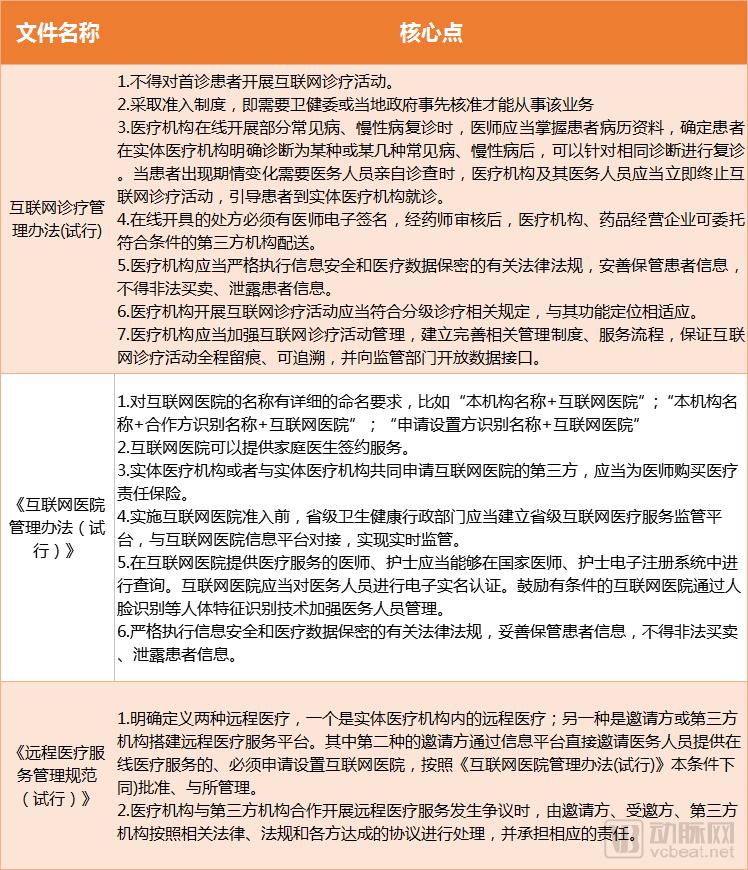
It is evident that the regulatory documents concerning internet hospitals are the most extensive and comprehensive. For enterprises, while their business operations may encompass online diagnosis and treatment, internet hospital services, and telemedicine, all such activities are conducted in partnership with physical medical institutions rather than as independent entities. In other words, regardless of the specific type of service involved, compliance with the relevant regulatory requirements is mandatory.
Zhang Qunhua, President of Wuzhen Internet Hospital, stated on his WeChat Moments: “The National Health Commission has released three documents on internet healthcare, and the innovative model of Wuzhen Internet Hospital has been incorporated into these policy documents. The future development of internet hospitals holds immense promise.”
Zheng Haihua, Head of the Internet Hospital Business Department at Weimai, stated: “Currently, internet hospitals across China are experiencing accelerated growth. The state’s formulation of these detailed management regulations serves to refine relevant operational standards and norms from a regulatory perspective, gradually establishing a supervisory framework for this emerging model of internet hospitals. Simultaneously, from a safety standpoint, it addresses issues regarding the legitimacy and legal protections of physicians’ online practice, thereby enhancing the quality and safety of internet-based diagnosis and treatment processes. These measures will play a positive role in the overall development of the industry.”
Taking Weimai as an example, its business model is based on collaborative development with physical hospitals. It establishes and improves internet-based diagnosis and treatment quality control and service systems in accordance with the Administrative Measures for Internet-Based Diagnosis and Treatment. By constructing a framework of “One Platform, Six Business Systems”—namely, the Internet Hospital Platform, along with medical consultation services, online hospital services, health management, tiered referral systems, telemedicine, and online physician education—it delivers convenient, safe, and efficient internet healthcare services to patients, hospitals, and physicians. Currently, multiple internet hospitals are operational, including the Internet Hospitals of Xiangyang Central Hospital, Jinhua Central Hospital, and Foshan Chancheng Central Hospital.
In addition, what other product lines do current internet healthcare companies have? As shown in the figure:
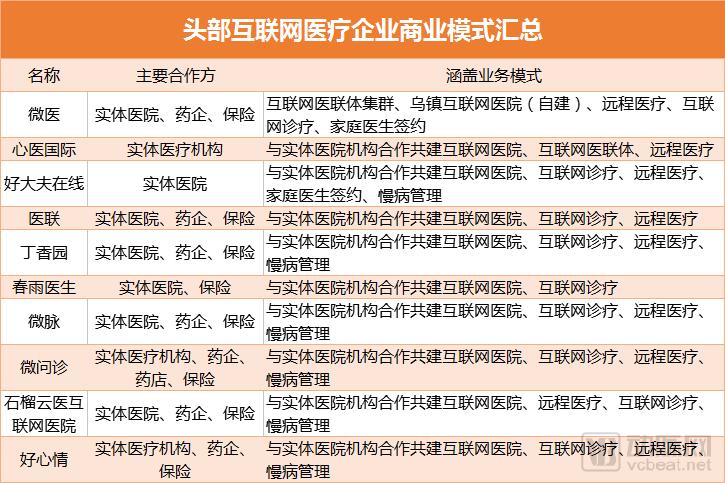
From this perspective, WeDoctor currently boasts the most comprehensive product portfolio in China’s internet healthcare sector. The company not only maintains an extensive network of partners but also offers a wide range of services, including internet-based medical consortium clusters, its self-built Wuzhen Internet Hospital, telemedicine, online diagnosis and treatment, and family doctor contracting. Meanwhile, it has secured the largest amount of financing and achieved the most rapid growth among its peers.The opening of its Wuzhen Internet Hospital in 2015 pioneered a new business model for internet hospitals, drove the development of the entire industry, and provided a reference and benchmark for subsequent entrants.
Chronic disease management is also a key focus for many internet healthcare companies, including four enterprises such as Wei Wenzhen, Weimai, and Shiliu Cloud Medical Internet Hospital (formerly known as “Qilekang Internet Hospital”).Among them, Shiliu Yunyi Internet Hospital issued the highest volume of prescriptions for chronic disease management and was the earliest in China to position itself as a provider of chronic disease diagnosis and treatment. According to the latest data, in 2017, the Qilekang internet platform accumulated hundreds of millions of medical big data records, covered tens of millions of general users, and provided services to chronic disease patients more than 1.2 million times throughout the year.
The recently released “Measures for the Administration of Internet-based Diagnosis and Treatment (Trial)” highlights that “medical institutions conducting internet-based diagnosis and treatment activities shall strictly comply with prescription management regulations, including the ‘Measures for the Administration of Prescriptions.’ After reviewing patients’ medical records, physicians may issue online prescriptions for certain common and chronic diseases. Online prescriptions must bear the physician’s electronic signature and, after verification by a pharmacist, may be delivered by qualified third-party agencies entrusted by medical institutions or pharmaceutical distributors.”Shiliu Cloud Medical Internet Hospital’s development path is also consistent with policy regulations.According to Shi Zhenyang, doctors and patients currently exhibit a relatively high level of dependency on the Shiliu Yunyi platform, with a physician prescription recommendation success rate reaching 90%. Meanwhile, the platform has accumulated a drug library comprising more than 30,000 SKUs, including over 12,000 prescription drugs.
In addition, Shiliu Cloud Medicine has now fully integrated with high-end diagnostic services across China. It has launched operations in 26 provinces and municipalities, offering over ten major categories and more than 200 specific tests, including PET-MR, PET-CT, color Doppler ultrasound, capsule gastroscopy, coronary MRI, genetic testing, and biochemical assays. Users can generally receive their test reports within one day.
In the field of telemedicine, China-Japan Friendship Hospital stands out as a representative of collaborations among physical healthcare institutions, with its telemedicine model having gained national recognition. Meanwhile, Xinyi International exemplifies the “enterprise + physical healthcare” partnership model. By leveraging three core pillars—resources, operations, and medical specialties—it provides in-depth services to physical healthcare institutions, builds an internet-based healthcare platform for coordinated development, and collaborates with hospitals to establish a sustainable new model of “Internet + Healthcare.”
Throughout its development, Xinyi International has continuously summarized experiences and engaged in strategic reflection. Even before the release of these three documents, the company had already prepared to assist medical institutions in advancing this area of development in accordance with their specific needs. Leveraging its competitive products and solutions for Medical Consortiums, Xinyi International comprehensively initiated the upgrading of Internet Hospitals and Internet-based Medical Consortiums. By consistently anchoring its efforts in physical medical institutions, the company aims to extend the reach of professional services to a broader range of hospitals.
The issuance of this notice has already positioned some companies as frontrunners in internet healthcare. So, what should be the next step?
Chen Guanwei, CEO of Haoxinqing, believes, the internet healthcare scenario is capable of resolving the majority of user issues online, leveraging technical systems to enhance diagnostic accuracy for physicians, and enabling users to conveniently access high-quality medical services. He envisions an internet healthcare model centered on serving both physicians and patients, identifying precise practical application scenarios to address user needs. His strategic plan has been clearly defined: first, identify the needs of various stakeholders within the platform ecosystem and determine monetization capabilities; second, accumulate data assets; and third, develop intelligent systems to serve as auxiliary tools for psychiatrists and psychologists, integrating artificial intelligence technologies.
Tai Congyue, President of Xinyi International, stated thatUnder the “Internet + Healthcare” framework, Xinyi International has built an open and integrated internet healthcare platform based on physical hospitals. Leveraging its advantages in resources, operations, and medical specialties, the company has spent eight years developing an implementation model for “Internet + Healthcare” rooted in physical medical institutions. This model enables data flow, bridges the information asymmetry gap, and addresses the mismatch of medical resources through professional patient navigation and access channels, thereby facilitating precise diagnosis and treatment for patients. Currently, the internet healthcare platform constructed by Xinyi covers more than 5,700 hospitals at various levels.
However, Wang Shirui, founder of Medlinker, believes that managed care will be a major trend in internet healthcare.Medlinker has been committed to building the “HMO” (Health Maintenance Organization) model, a major form of managed care. The greatest advantages of this model lie in the integration of healthcare and insurance, along with a strict tiered diagnosis and treatment system, aiming to establish a community of shared interests among pharmaceuticals, healthcare providers, and insurers, thereby allowing medical professionals to focus solely on patient care. In the future, Medlinker will leverage core resources and technologies such as medical big data and artificial intelligence to integrate resources from medical institutions, pharmaceutical and medical device manufacturers, and insurance companies, continuously improving its entire industry chain with smart internet hospital solutions at its core. Meanwhile, Medlinker will also consider investing in and acquiring outstanding enterprises within the industry to enhance its diversified layout in the broader health sector, ultimately growing into a comprehensive, innovative leading healthcare enterprise covering the entire “Internet + Healthcare” industry chain.
Coincidentally, Liao Jieyuan, founder of WeDoctor, has just announced the establishment of its first HMO base in Chengdu. Since first proposing the concept in September 2015, it has now been implemented across the entire region this year. WeDoctor has turned the HMO model, which most entrepreneurs aspire to build, into a reality. Additionally, it has introduced services such as 24/7 one-click consultations, remote consultations via smart infirmaries, one-click prescription pickup with remote prescribing, cloud-synchronized health records, and convenient referrals between general practitioners and specialists.50% of common diseases and health maintenance are managed at home, 35% of disease diagnosis and treatment are handled at nearby medical facilities, and the remaining 15% of complex cases are treated in large hospitals.
Chunyu Yisheng’s strategy is to first establish a robust entry point and platform services, positioning itself as a distribution platform for online medical services, a standardized platform for the accumulation and management of health big data, and a user-centric platform for personalized healthcare service customization. On this foundation, a more diversified business ecosystem will evolve. They believe that, in the future, three trends will emerge: first, the acquisition and distribution of medical services via the internet will become increasingly prevalent; second, a health big data system based on clinical informatics will be gradually established; and third, medical services will progressively shift from diagnosis and treatment toward prevention and management.
The greatest challenge at present lies in the systemic transformation of the healthcare industry itself, which remains a lengthy process. Policies, regulations, and standards, such as those mentioned above, lack detailed implementation rules and timelines. Furthermore, significant progress is still required in areas including healthcare informatization, pharmaceutical distribution, and health insurance payment systems. Additionally, the level of informatization in fields related to medical services, such as inspection and testing, remains low, and there is still a considerable gap in the application and promotion of research findings based on proteomics, genomics, and metabolomics.
Setting aside broader macro-environmental issues, the most significant challenge facing internet healthcare remains the availability of medical resources. Enabling the acquisition and distribution of as many medical resources and services as possible through online platforms is a common problem that all industry practitioners need to address at this stage.
With the introduction of this wave of policies, the number of internet hospitals is likely to increase, and their names are becoming longer. Job postings by enterprises will also see new roles related to internet hospitals or online diagnosis and treatment. Once the responsibilities and rights between enterprises and partner hospitals are clearly defined, hospitals will have fewer concerns... In short, this is the outcome that most industry insiders have been eagerly anticipating.
However, for hospitals, governments, and enterprises alike, while building internet hospitals, telemedicine platforms, and online consultation services is relatively straightforward, driving user adoption remains a significant challenge. If patients do not engage with these digital health solutions, even substantial financial investments and state-of-the-art medical equipment will prove futile. Achieving success requires multi-stakeholder collaboration: hospital management must motivate physicians to participate; enterprises should provide on-site support to assist doctors, offering explanations to both physicians and patients to save physicians’ time; after returning home, patients should be able to consult their doctors anytime they have questions; and medications should be delivered to their doorsteps via third-party logistics, thereby creating a closed-loop healthcare ecosystem. Although the road ahead is long and arduous, this small step in national policy formulation can propel the industry forward by leaps and bounds. We hope that this initial spark will ignite a prairie fire of widespread adoption and growth.