

China's First Health Management Vocational College Opens, Training 'Special Forces' for the Industry
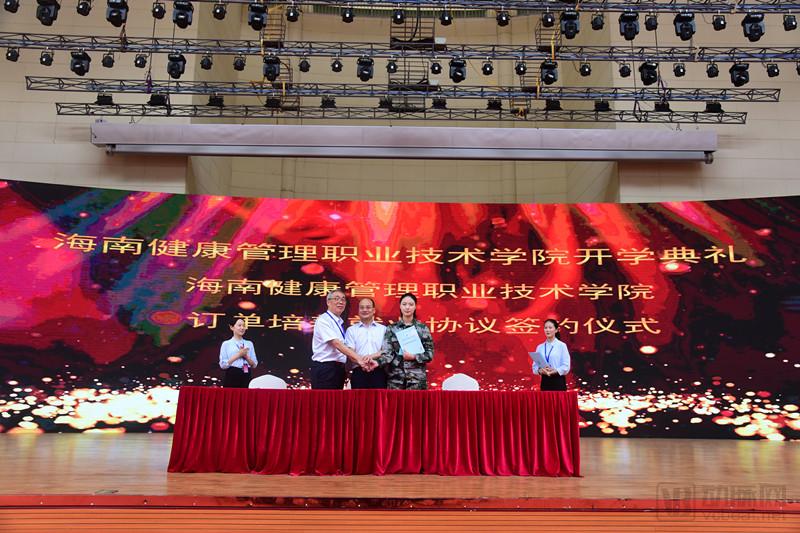
Recently, China’s first university dedicated to health management—Hainan Vocational College of Health Management—officially opened its doors. All 235 students enrolled in the inaugural year are undergoing integrated, order-based training, ensuring direct employment in the health management industry upon graduation. The launch of this institution, hailed as the “Whampoa Military Academy” of the health management sector, also marks the implementation of a core pillar within WeDoctor’s fully promoted “four-medical linkage” system—integrating healthcare, pharmaceuticals, medical insurance, and medical education—with the “medical education” component now firmly established.
In recent years, the healthcare industry has ushered in significant development opportunities, driven by the vigorous implementation of national-level strategies and a sharp rise in social demand. The National Health and Wellness Conference held in August 2016 proposed “integrating health into all policies.” Subsequently, the Central Committee of the Communist Party of China and the State Council issued the Outline of the “Healthy China 2030” Plan, calling for a shift in healthcare services from a disease-centered approach to a health-centered one. On April 26 this year, the General Office of the State Council released the Opinions on Promoting the Development of “Internet Plus Healthcare,” urging the vigorous application of advanced technologies such as the internet and artificial intelligence in the healthcare sector.
As is well known, general practitioners (GPs) are key to implementing tiered diagnosis and treatment and providing comprehensive, full-cycle health management for the public. However, the lack of domestic GP education has resulted in a persistent shortage of truly qualified GPs. Currently, China’s 180,000 GPs account for only about 3% of the 2.5 million licensed physicians. To meet the target of having 2–3 GPs per 10,000 residents by 2020, China faces a shortfall of 300,000–400,000 GPs.
WeDoctor has been actively exploring the general practitioner training system for many years. In April 2016, it collaborated with Professor Zhu Shanzhu, a leading expert in general practice medicine in China, to establish the country’s first Academy of General Practice. It also launched a General Practice Fund and pooled domestic and international expert resources to develop standardized training processes and systems. Furthermore, Hainan Vocational College of Health Management will serve as an incubator for general practice talent in China’s healthcare industry, cultivating professional personnel for the health management sector on a large scale and to high standards.
It is reported that Hainan Vocational College of Health Management, approved by the Hainan Provincial People’s Government and registered with the Ministry of Education, is China’s first independently established higher vocational college dedicated to health management. Jointly founded by WeDoctor Group (Zhejiang) Co., Ltd., China Institute for Reform and Development (Hainan) Co., Ltd., and Zhuhai Yihuatong Investment Co., Ltd., the college is committed to cultivating “special forces” talent for China’s health management industry.
The college has also achieved a major innovation in its talent development model. Chi Fulin, Chairman of the Board of Hainan Vocational College of Health Management and Dean of the China (Hainan) Institute for Reform and Development, stated that China’s public health services are undergoing a transition from a disease-centered approach to a health-centered one. It is against this backdrop that Hainan Vocational College of Health Management was established. The college adopts a combined approach of degree and non-degree education, partnering with leading companies in the healthcare industry, such as WeDoctor, to jointly explore an “order-based talent training” model that integrates education with industry. This model ensures seamless alignment between academic education and employment, as well as between classroom theoretical instruction and practical training at internship bases.
“We are committed to establishing a truly modern college that leads the industry. Faculty members and experts, both within and outside the college, will collaborate closely to nurture our students and develop our disciplines,” said Liao Jieyuan, Founder of WeDoctor, Vice Chairman of the Board, and Executive Dean of Hainan Health Management Vocational and Technical College, at the college’s opening ceremony. “The college and enterprises will maintain close coordination. Upon graduation, every student should possess solid academic knowledge, access to the most advanced equipment, and mastery of the most professional tools, thereby becoming ‘special forces’ in the health management industry.”
As a leading healthcare technology platform in China, WeDoctor has spent eight years building an ecosystem encompassing “cloud, medical care, pharmaceuticals, insurance, and education.” This ecosystem is underpinned by WeDoctor Cloud and drives integrated innovation across four key sectors: medical care, pharmaceuticals, health insurance, and medical education. From pioneering China’s first internet hospital and independently developing the healthcare industry’s first cloud platform, to establishing five self-operated general practice centers, launching the first HMO (Health Maintenance Organization) base, and facilitating the founding of China’s first university dedicated to health management, WeDoctor has successfully achieved a closed-loop system through its fully implemented “four-medical-sector integration” strategy.
Within the “online + offline, general practice + specialty” medical service ecosystem built by WeDoctor, medical talent serves as the most critical foundational driver. There is substantial demand for professionals such as general practitioners, triage and guidance staff, health managers, nutritionists, nurses, prescription-review pharmacists, and pharmacists across WeDoctor’s business segments, including the WeDoctor portal, WeDoctor General Practice Centers, intelligent clinics, prescription-sharing platforms, and cloud pharmacies. At the opening ceremony, WeDoctor finalized a targeted training agreement with the college, enabling outstanding graduates from relevant programs to join WeDoctor directly upon graduation.
Just as Alibaba and JD.com had to excel in logistics and electronic payments to truly popularize e-commerce, beyond its robust capability in integrating and supplying medical resources, the establishment of standardized service quality and a sustainable talent supply system for health management will serve as crucial guarantees for WeDoctor’s continued rapid growth, and become a significant driving force for the quality improvement and upgrading of China’s health industry.