

Titans and Capital: Two Decades of Ups and Downs in China's Pharmaceutical E-commerce
Unbeknownst to many, China’s pharmaceutical e-commerce sector has already traversed a full 20 years.
Looking back on the path we have traveled, one cannot help but sigh with emotion.
1997 marked the inaugural year of e-commerce in China. The launch of China Chemical Network became the country’s first e-commerce website.
In 1998, Shanghai No. 1 Pharmacy launched its own online store, becoming the first “pharmaceutical e-commerce” platform in China.
If we could turn back the clock to that moment, we would find Jack Ma experiencing the shattering of his second entrepreneurial dream. At the end of the year, he took his team to a small pub in Beijing, where they couldn’t help but embrace and weep bitterly. At that time, he had not yet come up with the name “Alibaba.” It would be another year before Alibaba emerged in China.
In 1998, Liu Qiangdong was a recent graduate with only two years of post-graduation experience. He rented a stall in Zhongguancun to sell CD burners. It would not be until six years later, in 2004, that JD.com entered the e-commerce sector.
Compared with the meteoric rise of Alibaba and JD.com, medical e-commerce has truly lived up to the saying, “Woke up early, only to arrive late for the market.”
In this heavily regulated industry, innovation is akin to dancing in shackles. When policies are favorable, the industry thrives; when regulations tighten, innovation becomes arduous.
Over the past two decades, national policies on “medical e-commerce” have undergone multiple adjustments. The online store of Shanghai No. 1 Pharmaceutical was shut down due to the lack of a policy basis and has long since disappeared from the scene.
On August 31, 2018, the E-Commerce Law of the People's Republic of China was adopted and will come into effect on January 1, 2019, bringing significant benefits to medical e-commerce.
Nowadays, the scale of pharmaceutical e-commerce has exceeded 100 billion yuan, standing on the eve of a new round of explosive growth. Companies are gearing up, with some securing financing and others going public, creating a bustling scene.
For two decades, the medical e-commerce sector has been a burgeoning frontier and a competitive arena dominated by industry titans and capital. Recently, VCBeat (WeChat ID: VCBEAT) had the opportunity to interview many of these key figures, revisiting the tumultuous history of their rise and fall.
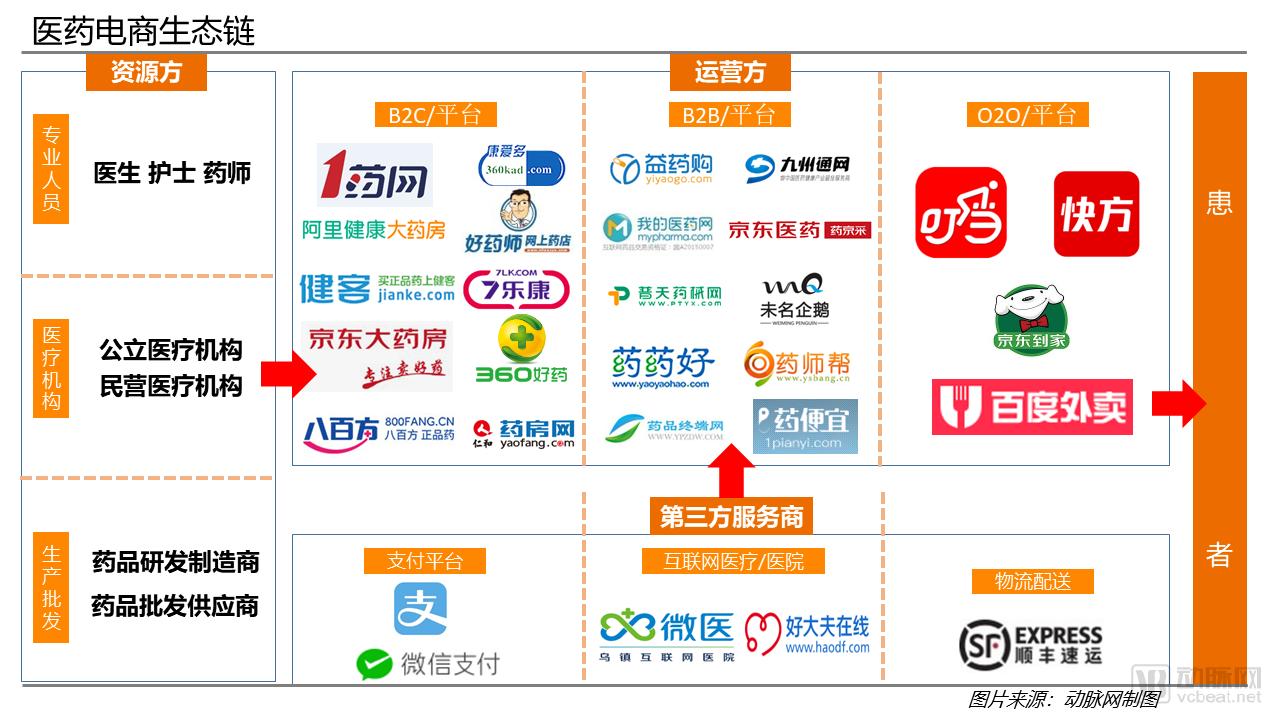
Leaders in the pharmaceutical e-commerce industry generally come from two backgrounds: internet or pharmaceutical. These different backgrounds imbue the platforms they found or join with distinct characteristics—the former emphasizing operational expertise, while the latter prioritizing offline investment.
For instance, Li Hongbo, founder of Yaofang.com and hailed as the “pioneer of pharmaceutical e-commerce,” came from Jingwei Chain Pharmacy, which specialized in new and specialty drugs. After entering the pharmaceutical e-commerce sector in 2005, he continued to apply chain-store operational strategies, deploying a nationwide pharmacy network through an integrated model of “online platform + offline stores + CRM,” while also building self-operated logistics and delivery systems—a vision that was truly ahead of its time. A decade later, Renhe Pharmaceutical acquired a 60% stake in Jingwei Yuanhua for RMB 600 million, with Li Hongbo remaining as General Manager and successfully driving the Direct-to-Patient (DTP) model for high-value drug deliveries.
Renhe Pharmaceutical’s foray into pharmaceutical e-commerce represents Yang Wenlong, Chairman of the Board of Renhe Group’s “second entrepreneurial venture.” In addition to Yaofang.com, Mr. Yang also invested in Dingdang Medicine and Dingdang Express Pharmacy. The former was acquired with an investment of RMB 72.12 million (since divested), while the latter adopts the currently popular O2O model of “online ordering with in-store pickup or home delivery.” With self-built retail stores and delivery teams, it emphasizes “free home delivery within 28 minutes.” Although well-received, this model incurs substantial costs, and few players remain in this competitive sector.
Mr. Yang maintains a private venue in Beijing called “Renhe Xiaoguan,” which he uses for hosting guests and fostering exchanges, often drawing full houses. These gatherings have two distinctive features. First, they invariably involve more than one table; in addition to VIPs, employees from Renhe Group frequently attend to report on their work and exchange ideas with Mr. Yang. Second, the events conclude early, as Mr. Yang devotes even greater attention to operating Dingdang Kuaiyao than to Renhe Group itself. After the banquet ends, he returns to review data, identify issues, and formulate strategies. Leading figures in Beijing’s pharmaceutical e-commerce sector are regular honored guests at Renhe Xiaoguan.
In the capital, under the imperial gaze, numerous pharmaceutical e-commerce platforms have emerged. Early entrants include Jinxiang.com, Dekai Pharmacy, 111 Medicine Hall, and Haoyaoshi, while later players such as Kuaifang Songyao and Rongguan E-commerce have also entered the fray. These companies operate under diverse business models, with B2B, B2C, and O2O models all flourishing.
Certainly, within the Beijing-centric pharmaceutical e-commerce circle, there has been substantial talent exchange. Xia Yu and Kang Kai, both with backgrounds in the software industry, managed the early e-commerce operations of Jinxang.com. Xia Yu later joined Baite New Special Drugs and Souyao Song, and currently serves as the CEO of Dekai Pharmaceutical. Kang Kai moved to No. 1 Pharmacy (the predecessor of 111.com), where he served as General Manager of Tmall Medicine and Vice President of Ali Health; he is now a partner and CEO at Kangfu Zhijia. Incidentally, Kangfu Zhijia acquired Dekai Pharmacy in 2014, bringing Peter (Xia Yu) and Kevin (Kang Kai) back into the same trench. Come to think of it, their reunion makes for quite a compelling “couple” narrative.
The driving force behind Kangfu Zhijia’s acquisition of Dekai Pharmaceutical is Bai Yu, Chairman of Kangfu Zhijia. A female colleague of mine is an ardent admirer of Mr. Bai: she never misses his speeches, always reads his articles, and closely follows his updates. She even leveraged her professional position to interview him several times, rating him nearly perfect in every impression. Born in 1977 under the zodiac sign Leo, Bai Yu came from a humble background and began working in Beijing at the age of 15. In 2005, he used wedding gift money to establish Kangfu Zhijia, a specialty store for home medical devices. The company has since grown into a group corporation with a full industry chain covering medical devices, e-commerce, equipment leasing, and health management. Health changes destiny.
Rongguan E-commerce, a rising star in Beijing’s pharmaceutical e-commerce sector specializing in B2B services, officially announced that its annual online transaction volume for 2017 had exceeded RMB 50 billion. Leading the team to this remarkable achievement is Yao Xiaofei, Founder and Chairwoman of Rongguan E-commerce. In a business world dominated by men, she may be considered an “outlier,” with labels such as overseas returnee, corporate elite, beautiful female executive, and entrepreneurial icon. Yao studied abroad during her secondary school years and later attended the University of Warwick and the London School of Economics and Political Science in the UK, where she earned a Bachelor’s degree in Accounting and Finance and a Master’s degree in Information Management, marking a mid-career transition into the industry.
Besides Beijing, Shanghai and Guangdong are also highlands of e-commerce. Shanghai has Shangyao Cloud Health, Sinopharm Online, 1 Drug Store, Pharmacy Network Mall, Yun Kai Ya Mei, Jian Yi Wang; Guangdong has Jianke, Qilekang, Kang Aiduo, Kang Zhijia. “The three places of Beijing, Shanghai, and Guangdong compete for supremacy, with a great showdown between the southern and northern factions.” This basically summarizes the overall situation of pharmaceutical e-commerce in China.
1Drug.com is a remarkable presence in the “Internet + Healthcare” sector, enjoying an exceptionally favorable reputation among both industry peers and ordinary consumers. With strengths in technology, supply chain, user traffic, and brand reputation, 1Drug.com listed on the U.S. capital markets on September 12, becoming China’s first independent pharmaceutical e-commerce platform to go public in the United States.
The backgrounds of the two co-founders significantly bolster 111.com’s credibility. Having managed Yihaodian, China’s first online supermarket, Yu Gang and Liu Junling’s entry into the pharmaceutical e-commerce sector can be regarded as a “higher-dimensional strike.”
Of course, both were newcomers to the field of pharmaceutical e-commerce. Yu Gang, whose ancestral home is in Shandong Province and who was born in Shanxi Province, is straightforward and values personal relationships. He graduated from Wuhan University in 1982, then went to the United States for further studies, earning a master’s degree in theoretical physics from Cornell University and a Ph.D. from the Wharton School. He later served as a professor at the University of Texas at Austin. During his 15-year academic career, Dr. Yu remained highly productive, publishing more than 80 academic papers and four books, and holding three patents, making him a bona fide scientist.
Before founding Yihaodian, Dr. Yu Gang had already achieved considerable success and recognition. In 1995, he founded Kale Technology in the United States; its aviation management system was adopted by many major U.S. airlines, and the company was acquired by Accenture in 2002. In the summer of 2008, Yihaodian went online, pioneering the online supermarket model. 111.com (Yao Wang) represents Dr. Yu’s second entrepreneurial venture, and its listing on a U.S. stock exchange marks a phase-wise victory.
Timing is more important than haste. Yaofang.com, also based in Shanghai, launched its online pharmacy platform as early as 2007. At that time, there were few players in the online pharmacy sector, and the industry’s true boom would not occur until five years later. Yaofang.com has provided small and medium-sized pharmacies with resources such as platform infrastructure, technology, and traffic, while adhering to an open strategy to encourage broader participation from pharmacies. Currently, Yaofang.com connects pharmacies across 600 cities and counties throughout China, serving over 1,000 pharmacies, and has established the largest online platform for small and medium-sized pharmacies in the country. It is no small feat for Yaofang.com to have reached this position while sticking to its principle of “no external financing, no paid promotion, and no self-operated sales.”
In April 2018, VCBeat hosted an industry salon in Shanghai, attended by Zhong Yi, founder of Yaofangwang Mall; Chen Hua, CEO of 360 Health; and Huang Hui, Deputy General Manager of Yun Kai Ya Mei. The participants discussed industry developments, generating significant intellectual exchange.
Chen Hua has spent 17 years navigating the internet healthcare sector. In his early career, he worked at 39 Health Network. In 2010, he joined No. 1 Pharmacy (the predecessor of 1 Drug Net) as CEO, and in 2015, he moved to 360 Health. As a pharmaceutical portal under Qihoo 360, 360 Health operates a pharmaceutical e-commerce platform and provides internet-based and cross-border medical services. A glance at its homepage reveals a striking similarity to 39 Health Network, with both prioritizing content. However, Chen Hua places greater emphasis on “empowering” pharmacies and e-commerce businesses by leveraging SaaS solutions to enable more pharmacies to capitalize on the benefits of e-commerce—a endeavor that has demanded considerable expertise and dedication.
Huang Hui, Deputy General Manager of Yun Kai Ya Mei, is a rare female leader in the e-commerce sector and has been dubbed the “Number One Beauty in E-Commerce.” Her team originally handled agency operations for organ transplant pharmaceuticals under Hisun Pharmaceutical, bearing a strong traditional heritage. Rather than competing through traffic volume or price wars, the company has pursued a path as a vertical service-oriented e-commerce platform, with its core strengths lying in customer service and online Contract Sales Organization (CSO) capabilities.
Another major figure in Shanghai’s pharmaceutical e-commerce circle is Wang Letian, General Manager of Sinopharm Online. Mr. Wang comes from an internet industry background, having previously worked in telecommunications value-added services, streaming media, music, and digital rights management. He entered the pharmaceutical sector in 2013, serving as CTO at Haoyaoshi, a subsidiary of Jointown Pharmaceutical Group, before joining Sinopharm Online in 2015. Sinopharm Online serves as the external online cooperation portal for more than 400 retail and distribution companies under China National Pharmaceutical Group (Sinopharm). The company has received investments from Yunfeng Capital, founded by Jack Ma, and Fosun International, led by Guo Guangchang. In terms of management structure, it falls under Sinopharm Holdings and operates at the same hierarchical level as Sinopharm Accord, Sinopharm Co., Ltd., and provincial distribution companies, effectively constituting a “department-bureau level” entity.
Also making the transition from the internet industry to pharmaceutical e-commerce is Xie Fangmin, CEO of Jianke. He previously oversaw sales at eLong.com and was one of Baidu’s earliest employees, serving in various roles including Sales Manager for South China, Senior Manager, and Sales Director.
On September 4, Jianke announced that it had secured $130 million in Series B financing. The round was led by GTJA Capital, with participation from funds including HBM, while Kaixin Capital, the investor from its Series A round, continued to follow on. Jianke also stated that it plans to go public in the United States next year.
The e-commerce industry is notoriously grueling. Based in Guangzhou, Wang Yanxiong, founder of Kang Aiduo, “made it out” far earlier than most of his peers in the sector. A native of the Chaoshan region with a background in traditional Chinese medicine and prior experience as a grassroots civil servant in drug regulation, Wang eventually ventured into business—reflecting the Chaoshan people’s well-known affinity for and aptitude in commerce. Kang Aiduo capitalized on the early traffic dividends of Tmall’s Pharmacy Pavilion, earning the moniker “Prince of Condoms” and once claiming the top spot in the industry. In 2014, the publicly listed company Tai’an Tang acquired Kang Aiduo for RMB 350 million. Wang Yanxiong then gracefully exited, raised an industrial fund, and reinvented himself as a startup mentor.
Wang Lijue, Chairman of Aikang Health, also previously served at Kangaiduo. Aikang Health aims to empower the industry through integrated supply chain services, with the mission of “making no medicine hard to find.” Its key strategic focuses include chronic disease management, out-of-hospital care, primary healthcare, and the “Internet Plus” pharmaceutical model. The company has been highly active recently, forging partnerships with various stakeholders and securing tens of millions of yuan in financing led by GF Xinde, signaling strong momentum in its development.
Zhang Yibing, who previously worked at Kangaiduo, has also joined Akang Health. A veteran of the pharmaceutical e-commerce industry, Zhang spent five years early in his career at Jointown Pharmaceutical Group, where he was responsible for online B2B operations and served as Website Operations Manager. He joined Kangaiduo in 2011 and left in 2014, having served as Assistant to the General Manager and Marketing Director. He subsequently joined Simcere Zaikang as General Manager and became Chief Operating Officer (COO) of Haoyaoshi in 2015. After various career moves, he has returned to Guangzhou, unable to part with the distinctive flavors of Cantonese cuisine.
Operators of pharmaceutical e-commerce platforms from diverse industry backgrounds often approach issues with distinct mindsets. Those hailing from the internet sector tend to employ “pain-point thinking,” focusing on identifying key pain points within the industry—such as information asymmetry, uneven resource allocation, and the lack of evaluation mechanisms—and addressing them through internet-based solutions.
Executives from the pharmaceutical industry prioritize "return on investment." The internet is merely a technology, while websites, apps, and online healthcare services are just tools. Ultimately, the core challenges to be addressed remain supply chain management, customer acquisition and retention for physical stores, and last-mile delivery.
Therefore, cross-disciplinary thinking is rare, and cross-disciplinary talent is even rarer. In summary, while “Internet + Healthcare” is easy to talk about, “Healthcare + Internet” is difficult to implement.
In the e-commerce sector, U.S. platforms such as eBay and Amazon are the pioneers, which paved the way for the emergence of Chinese counterparts like Alibaba and JD.com. Similarly, in the pharmaceutical e-commerce space, data from the United States is frequently cited as validation.
In terms of scale, the United States is the world’s largest pharmaceutical market. According to Statista data, U.S. drug expenditure reached $450 billion in 2016. In the same year, global drug expenditure totaled $1.1 trillion, meaning that Americans “consumed” 40% of the world’s pharmaceuticals, well deserving the title of “biggest pill-popper.”
The United States enforces a strict "separation of prescribing and dispensing" system, coupled with comprehensive prescription management, resulting in a pharmaceutical distribution terminal structure that differs significantly from China’s. Based on sales volume, the ratio of in-hospital to out-of-hospital channels in the U.S. pharmaceutical market is approximately 3:7. Major out-of-hospital channels include retail chain pharmacies, independent pharmacies, PBM mail-order services, and supermarket pharmacies.
Independent pharmaceutical e-commerce is not well developed in the United States. According to combined data from eMarketer and Statista, the U.S. pharmaceutical e-commerce market was valued at approximately $20 billion in 2017, accounting for about 4.5% of the total pharmaceutical retail market. In contrast, China’s B2C pharmaceutical e-commerce market ranged between RMB 30 billion and RMB 50 billion, representing over 13.5% of the market at the upper end.
The United States has developed robust mail-order and “online-to-offline (O2O) integration” models. Mail-order pharmacy services are typically provided by Pharmacy Benefit Managers (PBMs)—such as the major players CVS Caremark and ESI—who deliver medications to enrolled members via postal services. In 2017, CVS Health’s pharmacy services revenue (including mail-order) reached $130.6 billion, significantly surpassing its retail segment’s $79.4 billion. Walgreens and CVS are also pioneers of the O2O integrated model, leveraging websites and mobile apps to seamlessly connect online and offline channels for medication delivery to members. For instance, Walgreens’ walgreens.com and drugstore.com are among the most well-known pharmaceutical e-commerce platforms in the United States.
Of course, the “pharmacy + clinic” model is also a distinctive feature of the U.S. pharmaceutical retail industry. Walgreens operates more than 400 “Healthcare Clinics,” while CVS has over 1,100 “MinuteClinics.” By staffing pharmacies with qualified healthcare professionals to provide basic medical services to members, these clinics offer convenience, speed, and affordable pricing, earning strong favor among both members and payers.
The U.S. model certainly offers valuable experience and insights for China’s pharmaceutical retail and e-commerce sectors, such as robust pharmaceutical care capabilities, omnichannel integration, and coordination with insurance providers. For domestic chain pharmacies and e-commerce platforms operating against the backdrop of prescription outflow, challenges remain regarding prescription sources, drug supply assurance, pharmaceutical care capabilities, and integration with medical insurance. In this context, the U.S. model holds significant reference value.
Xie Fangmin, CEO of Jianke, also stated that due to the differing national conditions between China and the United States, predictions regarding the industry cannot be generalized. The United States features a “unitary structure,” with minimal regional or urban-rural disparities, whereas China has a “dual structure,” characterized by significant regional and urban-rural differences that lead to an uneven distribution of high-quality medical resources. In the context of “Internet Plus,” internet-enabled healthcare and pharmaceutical services can be leveraged to address the imbalance in medical resource allocation. This approach aligns with policy directives and holds strong prospects for development.
Capital participation in pharmaceutical retail and e-pharmacy is a significant trend. In recent years, professional investment institutions such as GF Xinde and Hillhouse Capital, along with industrial enterprises including GPC Baiyunshan, Tasly Group, and Buchang Pharmaceuticals, have actively engaged in investments and mergers and acquisitions within the pharmaceutical retail sector. Coupled with listed pharmaceutical retail companies intensifying their acquisition of small chain pharmacies, the industry has witnessed a vigorous “land grab” campaign. Meanwhile, the entry of internet-plus-pharmaceutical companies, such as Ali Health, has introduced additional counterbalancing forces to the industry.
Certainly, Alibaba Health itself was also fueled by capital. In January 2014, Alibaba partnered with Yunfeng Capital to invest $170 million in acquiring a controlling stake in the Hong Kong-listed CITIC 21, which was trading at around HK$0.5 per share with a market capitalization of just HK$2 billion. As of September 13, Alibaba Health’s share price stood at HK$7.36, with its market capitalization reaching HK$85.9 billion. This represents a 50-fold increase over four years, yielding an astonishing return on investment.
In fact, the entry of major platforms such as Alibaba and JD.com has become a significant factor shaping the landscape of pharmaceutical e-commerce. Taking Alibaba as an example, Ali Health serves as its “flagship platform” in the healthcare sector. Financial report data shows that the Gross Merchandise Volume (GMV) of the Tmall Pharmaceutical platform, operated and represented by Ali Health, exceeded RMB 50 billion, making it the largest comprehensive gateway for pharmaceutical e-commerce. In other words, it is virtually impossible to engage in pharmaceutical e-commerce without leveraging the Alibaba platform.
The vast pharmaceutical e-commerce market has attracted numerous capital players. The major ones include Yunfeng Capital, Fosun Group, IDG Capital, Matrix Partners China, SoftBank, and Northern Light Venture Capital, while smaller funds and individual investors are also present. Pharmaceutical e-commerce possesses both internet and retail attributes, requiring significant offline investment, thus constituting an “asset-heavy” business model. This implies that it is not a winner-takes-all market; as scale expands, costs rise correspondingly, creating inherent “boundaries.” Therefore, it is difficult to simply bet on the sector as a whole, necessitating company-by-company due diligence. However, there is always the possibility that a firm like China Renaissance may emerge to facilitate consolidation among the players.
Financing Overview of Select Pharmaceutical E-commerce Platforms
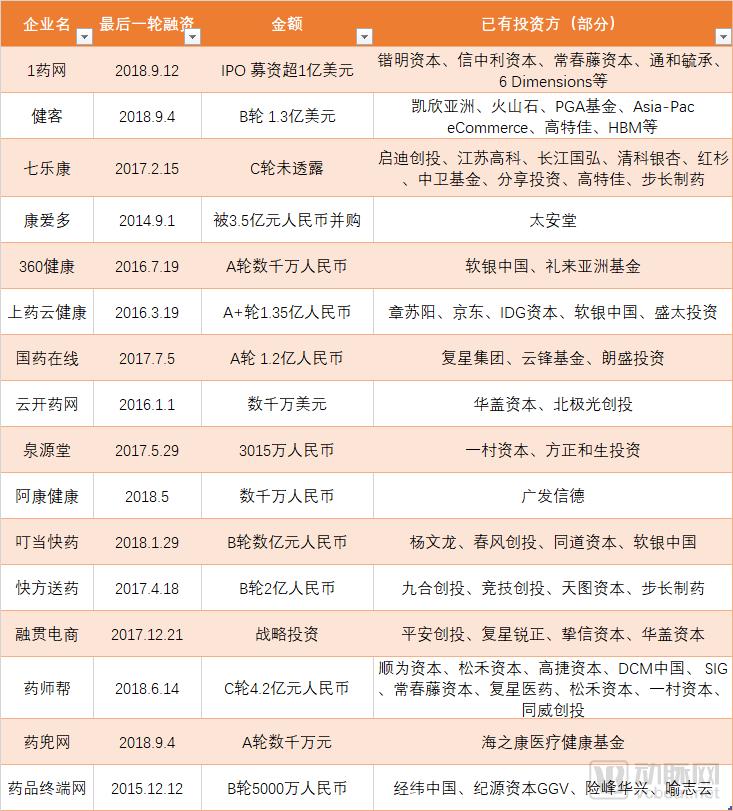 Data source: VCBeat
Specialization is another major feature, with participation in outpatient prescription outflow, new and specialty drug pharmacies, and Direct-to-Patient (DTP) pharmacies, among others. In terms of outpatient prescription outflow, companies such as Baiyang Yifuzhen, WeChat, Ali Health, Jointown Pharmaceutical Group, and Yaoshiquan are currently positioning themselves in this sector. Policies in cities like Xi’an, Chengdu, Chongqing, and Tianjin are also relatively supportive; however, a nationwide, large-scale system for the external circulation of hospital prescriptions has not yet taken shape. Traditional giants such as Shanghai Pharma, Sinopharm, and China Resources Pharmaceutical are focusing on DTP pharmacies, with a market size exceeding RMB 30 billion.
The online pharmaceutical e-commerce sector has never been an independent industry; it is deeply intertwined with medical services, pharmaceutical retail, and even public and commercial health insurance. Over the past two decades, amidst fluctuating policies and intermittent capital involvement, the industry has advanced along a tortuous path. Fortunately, leading enterprises with clear strategies, excellent teams, and steadfast commitment to their direction have emerged, underpinning the “fundamentals” of industrial development.
"Year after year, the new waves push the old; river grass and flowers bloom fresh everywhere."
[References]
"Pharmaceutical E-Commerce," by Wang Hao
The Past of Chinese E-commerce, The Heart of Woodcutters
Understanding Pharmaceutical E-Commerce in One Article, VCBeat
Competitiveness Report on Pharmaceutical E-commerce, VCBeat