

Lilly's Strategic Focus: Biopharma, Oncology, and Genomics — Backing Innovators with Recent IPO Filings
Among multinational pharmaceutical companies, Eli Lilly has remained active in venture capital. As early as 2008, Eli Lilly established Lilly Asia Ventures, focusing on investing in healthcare enterprises in Asia, particularly in China. The Lilly Asia Venture Fund is the earliest venture capital fund backed by a multinational pharmaceutical company, dedicated to China’s life sciences and healthcare sectors. Currently, Lilly Asia manages three U.S. dollar-denominated funds and two RMB-denominated funds.
Over the past decade, Eli Lilly has invested in nearly 30 companies, achieving exits with high returns on investment for some of them. Meanwhile, Eli Lilly has also yielded fruitful results through multi-party collaborations with Chinese local enterprises. For instance, the recently inspiring fruquintinib, the first independently innovated anti-cancer drug developed and produced in China, was completed with the participation of 28 clinical drug research institutions across China, including Fudan University Shanghai Cancer Center, Hutchison MediPharma, and Eli Lilly and Company.
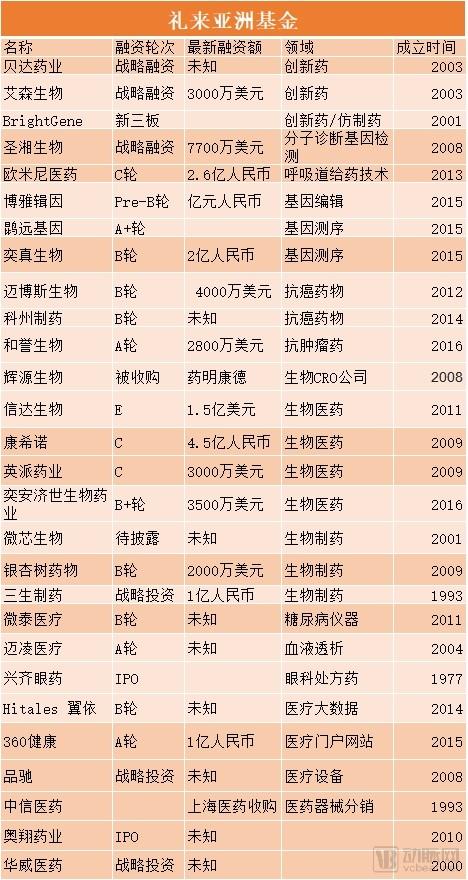
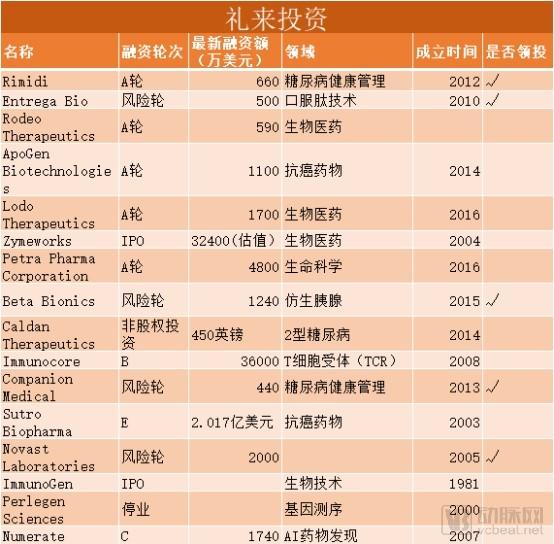
VCBeat (WeChat ID: vcbeat) has found in its analysis that Eli Lilly Asia Venture Fund has invested in more projects than Eli Lilly’s headquarters has invested in companies abroad. In terms of investment strategy,Eli Lilly favors biopharmaceutical companies, followed by anticancer drug and gene sequencing companies., in recent years, new faces such as AI plus big data have emerged in the investment team of Eli Lilly Asia Venture Fund. This investment trend is also consistent with the global investment direction of multinational pharmaceutical companies.
Eli Lilly established its Asia Investment Fund as early as 2008. Last year, the company realigned its global organizational structure, with its China subsidiary reporting directly to headquarters, signaling a further elevation of the Chinese market’s strategic importance within Eli Lilly’s global framework. David A. Ricks, CEO of Eli Lilly, stated, “China has now become one of Eli Lilly’s four core markets, and I believe that business growth in the Chinese market will outpace that of other countries in the future.”
IMS previously issued an industry forecast stating that the growth gap between mature markets and emerging pharmaceutical markets would continue to widen in the coming years. The report indicated that by 2018, pharmaceutical sales in emerging markets were projected to account for one-third of the global market’s total value (on par with the U.S. market) and contribute nearly 60% to the growth in market value (excluding rebates and discounts). In contrast, all developed country markets (including the United States) were expected to contribute only 25% to the growth in market value during the same period.
Not only in forecasts, but recent revenue data from pharmaceutical companies also show that the Chinese market has become a growth engine. In the 2017 financial reports of multinational pharmaceutical companies, emerging markets represented by China became the primary markets driving their performance.
Taking AstraZeneca as an example, China has become its second-largest market. In 2017, AstraZeneca’s performance in the U.S. and European markets was weak, with year-on-year declines of 16% and 6%, respectively. The company’s growth was primarily driven by emerging markets, particularly China, where revenue reached $2.955 billion in 2017, representing a 12% increase. Roche achieved a 3% year-on-year growth in revenue and profit for its core business in 2017, with the Asia-Pacific region (up 15%) and the Chinese market (up 21%) serving as the two major growth engines for Roche Diagnostics. Notably, China has now become the second-largest global market for Roche Diagnostics.
Another reason for the optimistic outlook on the Chinese market is strong policy support, including the issuance of the “Healthy China 2030” Planning Outline and policies accelerating the review and approval of new drugs, which have created a favorable environment for the launch of innovative medicines.
The Chinese government has also announced a series of major reforms to the drug review and approval system, actively encouraging and supporting the research and development of innovative drugs aimed at addressing significant public health needs. Examples include the Opinions on Deepening the Reform of the Review and Approval System to Encourage Innovation in Drugs and Medical Devices, the Amendments to the Drug Administration Law of the People’s Republic of China, and the Provisions for the Administration of Drug Clinical Trial Institutions. Relevant guidelines issued by the China Food and Drug Administration (CFDA) explicitly stipulate that registration applications for innovative drugs that have not been marketed domestically or abroad, or those whose production has been transferred to China, will receive priority review and approval.
VCBeat noted that Jim Li, President and General Manager of Eli Lilly China, once stated, “As the world’s second-largest pharmaceutical market, China boasts proactive and forward-looking macro health policies, a concentration of scientific elites, dynamic entrepreneurs, and excellent infrastructure. It is poised to become fertile ground for cultivating the decisive models of future global drug R&D. In the future, Eli Lilly will invest its resources in the most valuable innovative products to better ‘root itself in China and benefit China.’ We are committed not only to introducing new drugs from our laboratories into the Chinese market but also to collaborating with high-quality local innovative original research enterprises to create a win-win environment. This will help accelerate the achievement of the ‘Healthy China 2030’ goals and ultimately bring greater well-being to Chinese patients.”
The establishment of the Lilly Asia Ventures was also driven by policies encouraging the return of overseas talent, enabling better utilization of resources to meet the demands of China’s healthcare market. Approximately one-quarter to one-third of these returning professionals specialize in the pharmaceutical and medical sectors.
While investing in biopharmaceuticals and innovative drugs is considered a golden rule, Eli Lilly places greater emphasis on a company’s capability for innovative drug R&D. Such companies must not only perform well in the domestic market but also demonstrate strong competitiveness in the global marketplace. After all, in the pharmaceutical industry, a single “blockbuster” drug can generate substantial profits with minimal effort.
Many founders of domestic companies earned their first pot of gold from generic drugs. Now, as they seek to elevate their businesses, two strategies stand out: First, transitioning from generics to innovative drugs, since the pricing power of generics is inevitably on a downward trajectory. Second, expanding overseas, because while domestic firms compete for just 15% of the market against 4,500 pharmaceutical manufacturers at home, they can target 85% of the global market abroad by competing with foreign companies, where Chinese firms often hold a pricing advantage.
Hitales (Shanghai Yiyi Information Technology) derives its core competitiveness from leveraging natural language processing and machine learning technologies to structure vast amounts of clinical case data, thereby providing data support for precision medicine. It helps physicians unlock the value of massive, fragmented datasets, organizes information using visualization tools, and assists doctors in gaining deeper insights into the nature of diseases. As a medical data services company, Hitales is committed to enhancing healthcare efficiency and shaping the future through advanced data technologies.
After completing the first step of structuring medical records, Hitales employs machine learning algorithms to engage in continuous daily learning, thereby enhancing its intelligence. To date, Hitales has processed 30 types of diseases and 500,000 pages of clinical medical records.
Currently, Hitales’ main product offerings include DoctorPlus, Haitai Health, and Hitales Insight. The DoctorPlus platform currently features three products: the DoctorPlus website, the DoctorPlus app, and the DoctorPlus Health Edition app. Built on robust data management capabilities and in-depth user needs research, the DoctorPlus platform is dedicated to helping physicians manage their clinical careers, master clinical data, and advance medical research. It also focuses on assisting patients in managing their health records, facilitating efficient communication with physicians, and providing one-on-one health consultations.
Hitales boasts a robust team, including three physicians from top-tier (Grade 3A) hospitals in Shanghai, as well as former members who previously held positions at Oracle and Agilent.
An analysis reveals that Eli Lilly Asia Fund’s primary investment focus is biopharmaceuticals, which aligns with the main investment direction of global pharmaceutical corporate venture capital funds, both domestically and internationally. The second key area is diabetes care, a core business segment for Eli Lilly. The company also favors enterprises involved in the new drug development process, including contract research organizations (CROs) and healthcare big data companies. Furthermore, Eli Lilly has entered the highly competitive field of oncology drugs within the pharmaceutical industry.
The prospects for investing in anticancer oncology drugs are immense. According to IQVIA’s analysis and forecasts, global spending on cancer drugs has continued to rise, with expenditures on treatment and supportive care reaching $133 billion in 2017, up from $96 billion in 2013. Spending on cancer drugs is heavily concentrated on a limited number of therapies: the top 35 drugs account for 80% of total expenditure, while more than half of all cancer drugs generate annual sales of less than $90 million. Over the past decade, launch prices for new anticancer drugs have steadily increased; the median annual cost of new anticancer drugs exceeded $150,000 in 2017, compared with $79,000 in 2013.
Oncology-focused biotech companies have emerged as blockbuster investment targets for pharmaceutical giants. In addition to Eli Lilly, other major pharmaceutical companies such as Pfizer, Novartis, and GlaxoSmithKline have actively invested in cancer startups over the past five years, placing bets to avoid missing out on opportunities to strengthen their oncology drug pipelines.
In the 1970s, the most significant revolution in new drug development was antibiotics. The 1980s saw the rise of gastrointestinal drugs. The 1990s were dominated by cardiovascular medications. Since 2000, the healthcare industry has focused primarily on oncology (cancer). Although many new drugs have been introduced, cancer treatment is still in its early stages, leaving substantial room for growth.
Eli Lilly demonstrated keen foresight by investing in Numerate, an AI-driven drug discovery company, as early as 2014. Today, Numerate has become a highly sought-after partner, with Takeda Pharmaceutical and the U.S. Department of Defense vying for collaboration.
Numerate, founded in 2007 and headquartered in San Bruno, California, integrates advanced developments in computer science and statistics with traditional medicinal chemistry approaches to provide a drug design platform for companies developing small-molecule therapeutics. The platform primarily focuses on advancing drug programs for cardiovascular diseases, metabolic disorders, neurodegenerative conditions, Alzheimer’s disease, and Huntington’s disease. Numerate currently maintains comprehensive access to all available industry information.
Numerate’s core competency lies in its proprietary ADME and toxicity prediction.
ADME is an acronym for “Absorption, Distribution, Metabolism, and Excretion,” describing the disposition of a pharmaceutical compound within an organism. These four parameters determine drug concentration and the kinetics of tissue exposure; therefore, ADME serves as a measure of the compound’s performance as a drug and its pharmacological activity.
Traditional biotechnology and pharmaceutical startups generally focus on a limited number of targets or a single therapeutic area, whereas new drug design platforms primarily leverage machine learning techniques to simulate the pharmacological properties of small-molecule compounds, such as target binding affinity and specificity, pharmacokinetic and metabolic profiles, and toxic side effects. The typical drug screening workflow of such platforms uses specific models for drug activity, specificity, and ADME (absorption, distribution, metabolism, and excretion) to select 25 million compounds from a library of one trillion virtual compounds for in silico testing.
Studies have shown that the entire process can be completed in just one week, with a testing cost of $0.0001 per simulated compound. Chemists analyze the test results to select the most promising simulated compounds for synthesis and experimental validation. The experimental data are then used to refine and improve the accuracy of the simulations. As this cycle continues, the candidate compounds generated by the simulation system become increasingly targeted. Thus, Numerate’s pharmaceutical platform leverages machine learning to address biological challenges with high efficiency and cost-effectiveness, utilizing the platform to focus on and validate data, thereby enhancing the entire pharmaceutical industry.
Numerate has also partnered with Takeda Pharmaceutical to leverage AI in accelerating the drug discovery process. Eli Lilly invested in Numerate back in 2014, and it is evident that Numerate’s value has now come to the forefront. Last year, Numerate announced a collaboration with Takeda, under which Numerate will lead Takeda’s drug discovery efforts. This partnership primarily focuses on utilizing AI to identify clinical candidates in Takeda’s core therapeutic areas, including oncology, gastroenterology, and central nervous system disorders.
Numerate has now secured multiple orders, including those from Takeda, the U.S. Department of Defense, and the NHS.