

HuiMei Healthcare Files IPO Prospectus: Leveraging Mayo Clinic Knowledge Base to Transform Clinical Decision Support with AI
Recently, the “Notice on Further Promoting the Construction of Information Systems in Medical Institutions with Electronic Medical Records as the Core,” issued by the Bureau of Medical Administration and Medical Services, has elevated the informatization of electronic medical records to a new level. Future electronic medical records will achieve full coverage of all diagnosis and treatment service stages, provide clinical decision support for diagnosis and treatment, and promote system integration and interoperability.
Nowadays, electronic medical records (EMRs) are evolving toward intelligence and knowledge-based systems. The core value of EMRs lies in meeting the information needs at the point of clinical care and effectively enhancing physicians’ clinical decision-making. With the widespread adoption of EMRs and the continuous advancement of digitalization, Clinical Decision Support Systems (CDSS) have increasingly become a key driver for healthcare institutions striving to achieve higher quality of care and strengthen their core competitiveness. CDSS helps compensate for and improve clinicians’ decision-making skills, thereby truly transforming health informatics applications and big data into tangible clinical value.
Leveraging the Mayo Clinic Knowledge Base, Huimei Medical starts from clinical decision-making. It is not content with merely digitizing electronic medical records (EMRs); rather, it aims to use artificial intelligence to interconnect vast amounts of EMR data, mine deep insights therefrom, and provide physicians with enhanced decision support.
Huimei’s artificial intelligence system leverages cutting-edge AI technologies, including Deep Learning and Natural Language Processing (NLP), and integrates the knowledge framework of Mayo Clinic along with the latest clinical guidelines and literature. It provides comprehensive, intelligent, and efficient support for healthcare management and clinical decision-making.
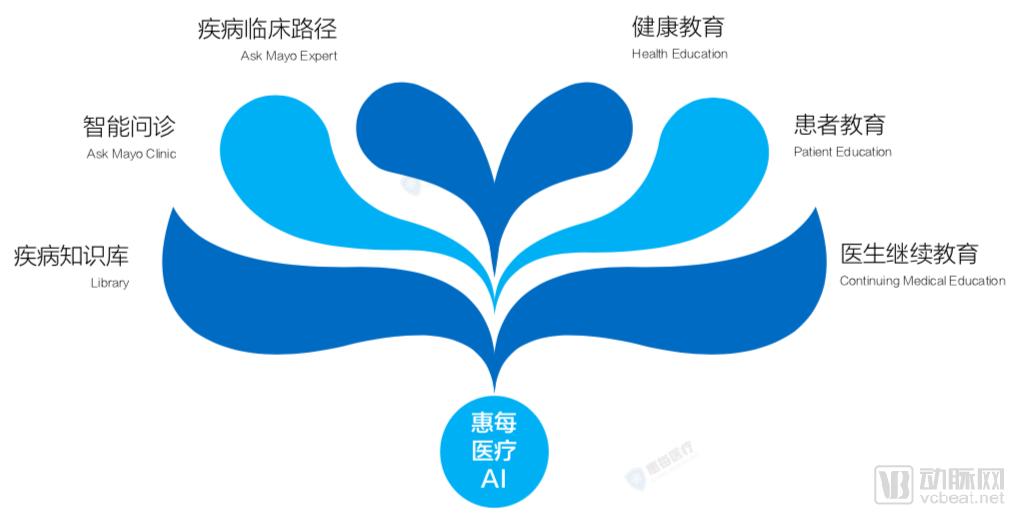
Designed to assist physicians, this AI system centers its medical AI solutions on clinical decision support, with functionalities extending to healthcare informatics, medical record quality control, and hospital management and operations. Whether through a portable mobile app or the hospital’s Clinical Decision Support System (CDSS), Huimei’s AI can be integrated into various hospital scenarios to enhance efficiency.
Currently, the AI-based Huimei Clinical Decision Support System (CDSS) has undergone multiple iterations and upgrades, covering outpatient, emergency, and inpatient settings, as well as workflows involving physicians, pharmacists, nursing, laboratory testing, and quality control. It is closely integrated with clinical practice and has reached a mature stage of application.
With the continuous advancement of “Internet + Healthcare,” patients can now seek medical consultations not only in person but also directly through dedicated apps to obtain doctors’ advice online. The Huimei AI system adopts the original Ask Mayo Clinic decision tree, enabling it to handle over 300 common symptom selections. It conducts concise and structured Q&A interactions with users, intelligently assesses the urgency and severity of their potential conditions, and provides corresponding home healthcare guidance or recommendations for seeking medical attention.
For offline AI-assisted consultations, Huimei integrates its AI into hospitals’ traditional inquiry robots, transforming them from mere mascots that enhance hospital image into genuine tools for patient triage and operational burden reduction. For online consultations, the AI can be embedded into relevant community and hospital service apps, making traditional automated responses more standardized, scientific, and intelligent.
This AI system can be integrated into corresponding mobile applications or Hospital Information Systems (HIS) to enhance the capabilities and efficiency of general practitioners. Encompassing differential diagnoses for over 2,000 common diseases, the system provides detailed symptom prompts to assist primary care physicians in rapidly identifying acute, critical, and cross-specialty conditions, thereby improving diagnostic accuracy and reducing the risks of missed or misdiagnoses. Furthermore, tailored to the characteristics of primary healthcare, the AI system enables intelligent, end-to-end chronic disease management—from assessment and medication to follow-up—meeting the daily clinical and health management needs of primary care providers.
In many remote areas, and even in grassroots communities of numerous towns, general practitioners (GPs) often struggle to play their intended role. On one hand, residents lack a proper understanding of the role of GPs; on the other, GPs’ clinical skills have certain limitations. Today, supported by the Mayo Clinic Knowledge Base, GPs can download corresponding mobile apps to directly look up difficult and complex cases encountered during consultations. AI not only assists physicians in assessing patients’ conditions but also provides appropriate, evidence-based recommendations, thereby enhancing the efficiency of general practitioners.
Huimei AI’s specialty product line covers outpatient, emergency, and inpatient services at university hospitals, providing physicians with intelligent assistance throughout the entire care process. Functioning as a senior physician’s assistant by the doctor’s side, the system analyzes patients’ clinical manifestations and laboratory/imaging results in real time during diagnosis and treatment, intelligently identifies suspected conditions, recommends assessment scales with automated scoring and result calculation, and formulates treatment plans.
For a long time, writing reports for outpatient and emergency departments has been a heavy burden for doctors. All operational results generated through the AI system can be automatically written back into medical records, reducing the amount of documentation required from physicians and improving the efficiency of outpatient and emergency care.
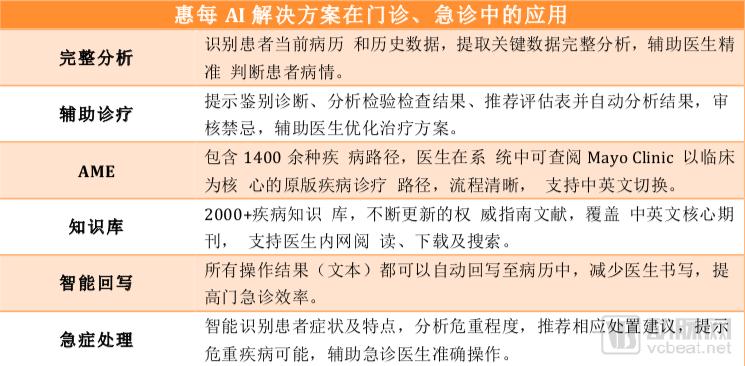
The application of this system in inpatient care presents both similarities and differences. In response, Mayo Clinic AI Solutions has developed distinct interfaces tailored to different user groups. For physicians, the AI provides comprehensive intelligent diagnostic decision support, enabling timely and accurate judgments and interventions for inpatients with complex, dynamic, or multi-specialty conditions. For nursing staff, the AI recognizes physical examination parameters such as body temperature and heart rate, offers real-time nursing recommendations, and intelligently documents feedback on nursing outcomes. For medical technology departments, the AI conducts a thorough analysis of the patient’s current diagnosis, chief complaints, relevant laboratory and imaging results, and historical data, providing intelligent alerts with AI-derived judgments and rationale to assist in diagnostic decision-making.
The effectiveness of AI technology ultimately hinges on its users—physicians.
Data from the recently concluded “Xuanwu Hospital Stroke AI Quality Control (Phase I)” project show that, within less than a month, the average achievement rate of 11 quality control indicators for acute cerebral infarction in the hospital’s neurology wards increased from 70.19% to 93.85%, representing a 33.7% improvement—higher than the hospital’s average level. Each percentage point gain translates into better patient outcomes and fewer recurrences.
Meanwhile, the system visualizes quality control data and enables real-time reporting, providing data-driven support for management. Building on defect alerts, it further recommends diagnostic and treatment suggestions as well as interventions based on evidence-based knowledge rules, thereby assisting clinical decision-making and ultimately improving healthcare quality.
Physicians at Xuanwu Hospital stated in an interview, “AI has proven far more beneficial to our work than I had anticipated. It can alert physicians to whether medications are prescribed, administered on time, and dosed adequately, as well as identify the reasons for insufficient dosing. AI effectively ensures compliance with all standardized protocols.”
Compared with traditional CDSS, Huimei’s greatest advantages can be broken down into three points.
First, Huimei’s AI solutions leverage the Mayo Clinic Knowledge Base as their core knowledge engine, establishing the product’s authority. Given the differences in ethnicity, physical environments, and medical equipment between China and other countries, directly importing foreign medical knowledge bases into the Chinese market could lead to significant compatibility issues. To ensure the authority and generalizability of the Mayo Clinic Knowledge Base and enable its broad application in China’s healthcare market, Huimei has implemented multiple measures to localize this century-old asset.
First, Huimei partnered with Peking University Health Science Center to localize general practice knowledge, while simultaneously building a medical team composed of clinicians from multiple specialties to localize specialized knowledge based on the latest domestic guidelines and literature. Finally, Huimei collaborated with numerous hospitals to organize disease diagnosis and treatment pathways tailored to each hospital’s specific expertise and characteristics. These pathways were then applied to lower-tier institutions within the medical consortium, thereby localizing knowledge for corresponding conditions and addressing standardization challenges.
Second, leveraging AI and natural language processing technologies, Huimei’s Clinical Decision Support System (CDSS) can accurately interpret unstructured or semi-structured medical records written by physicians, extract key information from the text, and provide real-time analytical alerts to assist clinicians in decision-making and error correction during diagnosis and treatment. The entire analysis and data extraction process is fully synchronized in real time, offering immediate decision support without requiring physicians to interrupt their workflow to compile patient reports during breaks.
Third, Huimei’s AI technology has been extensively implemented in real-world settings. Unlike many medical AI solutions that remain at the “conceptual” or “experimental” stage, Huimei’s medical AI has been widely deployed in nearly 30 large hospitals over the past two years. Its algorithms have been refined and nurtured by high-quality application data from top-tier tertiary hospitals such as Xuanwu Hospital. This enables it to meet diverse application needs across multiple dimensions, including intelligent hospital information system development and clinical quality improvement, making it a mature and systematic medical AI solution.
To date, Huimei has partnered with nearly 30 Grade A tertiary hospitals, including The First Affiliated Hospital of Zhejiang University School of Medicine, The Second Affiliated Hospital of Zhejiang University School of Medicine, Xiangya Hospital, and Xuanwu Hospital. Furthermore, Huimei has assisted Henan Provincial People’s Hospital, Huangshi Central Hospital, Jiande First People’s Hospital, Beijing Children’s Hospital Affiliated to the Capital Institute of Pediatrics, and Hangzhou First People’s Hospital in achieving Level 5 in the Graded Evaluation of Functional Application Levels of Electronic Medical Record Systems. Huimei’s AI solutions are among the products with the highest compliance with domestic healthcare informatization standards in China.
As product applications continue to deepen, clinical needs are constantly emerging. It is certain that the clinical value and role of medical AI extend far beyond current capabilities. This is particularly true for systems like Clinical Decision Support Systems (CDSS), which involve numerous indicators and massive data volumes, creating substantial demand among hospitals for data processing and monitoring. In the future, Huimei’s CDSS applications will expand into perioperative care and innovative cancer treatments. Furthermore, we aim to leverage AI technologies to analyze CDSS data, ultimately reducing postoperative complications and improving patient prognosis.
“CDSS is not only about improving the standardization of medical care; it can also improve patient outcomes,” said Zhang Qi, CEO of Huimei Technology. “Quality control is one of our key focus areas. Based on real-world patient outcomes, we can make predictions for adverse events or conduct risk assessments. This requires more comprehensive research, integrated with follow-up and longer-term observation—a research direction we are very keen to pursue.”
Furthermore, in disease research, Huimei, backed by the Mayo Clinic knowledge base, can more easily conduct research on new disease types. For instance, in the case of cerebral infarction patients, general practitioners and specialists follow different treatment pathways across various physicians and healthcare institutions. General practitioners cannot perform surgeries or CT scans but can conduct electrocardiograms and other tests to identify early clinical manifestations. In contrast, specialists have a broader scope of clinical treatment options and decision-making pathways.
Regardless of how the landscape evolves, the focus must remain on physicians themselves. As we leverage AI to explore unknown clinical knowledge, we need to give Huimei some time.