

Sanofi's Dual-Track Digital Strategy to Defend Its Leadership in Diabetes Care
How Can Pharmaceutical Companies Systematize Digital Solutions for Patients? Sanofi Has Partnered with Tech Giants Like Google to Create a Reference Model.
According to PharmExec’s rankings, Sanofi generated $34.078 billion in prescription drug revenue in 2017, ranking sixth globally. Sanofi is also a leader in the diabetes medication sector, with revenues from this class of drugs reaching $6.56 billion in 2017, a 12.90% decline from the previous year.
However, due to various factors, Sanofi’s dominant position in the diabetes market is being shaken—U.S. sales of its diabetes portfolio declined by one-fifth in 2017. Sanofi’s growth engine is gradually shifting toward specialty drugs in oncology, immunology, and other therapeutic areas.
To better serve patients and maintain its market position, Sanofi is actively innovating by providing digital solutions in an effort to reverse its declining momentum. In contrast to the tentative steps taken by other pharmaceutical companies, Sanofi’s more substantial and systematic investment amounts to a last-ditch stand.
In addition, Sanofi has partnered with multiple digital health companies specializing in wearable devices, big data, and biomarkers to conduct comprehensive clinical trials, thereby advancing its overall digital transformation. VCBeat (WeChat ID: vcbeat) provided an analysis of this development.
One of the key challenges Sanofi needs to address first is the decline in revenue from its diabetes business. After the patent for Sanofi’s best-selling drug, Lantus, expired in 2015, sales dropped by nearly 20% in 2017. Although Toujeo, marketed as an enhanced version of Lantus, was launched, the diabetes business continues to show an overall downward trend.
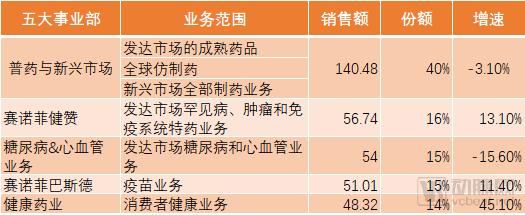
Data Source: Xin Kang Jie (Unit: €100 million)
For Sanofi’s diabetes medications, which have long treatment cycles and have been on the market for many years, patients tend to consider brand reputation and services when choosing among drugs with comparable efficacy. Furthermore, the management of chronic conditions such as diabetes requires a focus on prevention and prognosis, with interventions aimed at improving patient adherence and behavioral management. These unique characteristics of diabetes create opportunities for the integration of digital health management solutions.
Strengthening the management of diabetes medications is also a requirement for controlling health insurance costs. In the United States, for example, chronic diseases account for 86% of healthcare expenditures. The treatment of chronic conditions requires greater patient engagement in behavioral changes. While such advice was often ignored in the past, digital health tools now provide robust support, enabling patients to achieve better post-discharge management. This approach reduces the risk of complications and hospitalization rates, lessens the disease’s impact on daily life, and simultaneously meets the objective of controlling health insurance costs.
Diabetes, Sanofi’s primary therapeutic area, has become a fiercely contested battleground for digital innovation among pharmaceutical companies. A survey by Research2Guidance shows that a total of 325,000 health apps were launched in 2017, with 27% of mHealth apps targeting diabetes. Compared to developers in other fields, pharmaceutical companies have invested heavily in this segment. As shown in the table, spending on diabetes-related apps accounts for 40% of their total app investment, second only to investments in medication management apps.
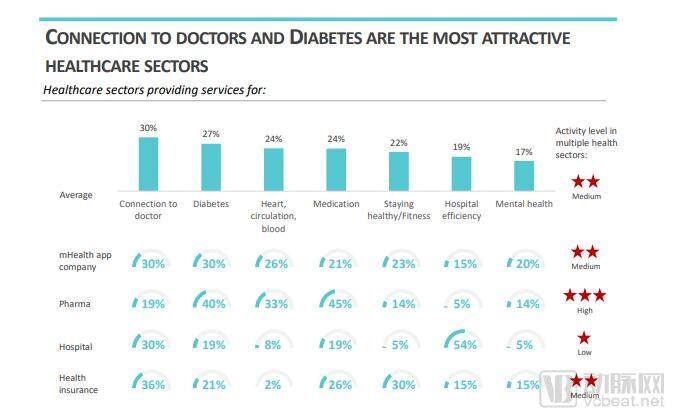
Data Source: Research2Guidance
Whether it is the crisis brought on by the surge of generic drugs or the concerted efforts by governments worldwide to cool down drug prices, pharmaceutical giants are reshaping their strategic layouts under these various pressures. Discussing the reasons behind Sanofi’s collaboration with digital health companies, Rachel Sha, Vice President at Sanofi, stated, “Investors, entrepreneurs, and other major corporations in the digital health sector are beginning to form an ecosystem that cannot be ignored, and they possess sustained insights. Their long-term goal is to improve patients’ health outcomes, and they have set ambitious targets—which align with Sanofi’s own objectives.”
Established a joint venture with Google's Verily to launch a virtual diabetes clinic
In 2016, Sanofi and Verily established the joint venture Onduo.Google’s Verily and Sanofi jointly invested $500 million. Both partiesA comprehensive virtual diabetes clinic was designed on Onduo.
Onduo aims to integrate hardware and software tools for type 2 diabetes into a single platform accessible via smartphones. In addition to personalized care and daily support, Onduo’s platform is dedicated to keeping diabetic patients connected with their physicians. It assigns a personal care manager to each user to help develop care plans and track patient status during every medical visit.
Many companies have announced integrations with the upcoming Onduo platform, including Voluntis Insulia (a digital insulin dosing recommendation and guidance system) and Glytec’s Glucommander Outpatient.
Following its establishment, Onduo announced that it would pilot the platform in clinical care settings. In 2018, the platform was to be deployed within hospital and insurer networks; the specific organizations involved have not yet been disclosed. Currently, its most prominent partner is the Blue Cross Blue Shield Association.
It can be said that Onduo primarily integrates healthcare providers and digital health companies. On the patient-facing side, Sanofi collaborates with biomarker companies to transform patients’ daily behaviors and activities into data that can be leveraged to improve treatment outcomes.
Collaborate with Evidation Health to collect more real-world, valid patient data
In 2017, Sanofi announced a partnership with the biomarker company Evidation Health to collect more real-world, valid patient data and improve diabetes treatment. “Evidation”The term means "transparent." Evidation Health, as a digital biomarker company, primarily focuses on quantifying patients' health in their daily lives. For example, digital biomarker companies can analyze metrics such as message counts, taps, and clicks, and employ natural language processing to analyze speech, thereby gaining deeper insights into patients' health status.
Sanofi announced that over the next three years, it will leverage Evidation Health’s Real Life Learning Platform to gain insights into patients’ disease status in their daily lives and innovatively develop solutions to help improve treatment outcomes. For example, Sanofi has already partnered with Evidation Health to guide patients with type 2 diabetes in making lifestyle changes.
Evidation Health was chosen by Sanofi primarily due to its expertise in quantifying the impact of real-life factors on patients’ ultimate treatment outcomes.
Partnering with Nutrino to Transform Dietary Habits of Patients with Chronic Diseases
To enable behavioral change in patients, it is necessary to establish a comprehensive ecosystem. In addition to integrating its diabetes care systems, Sanofi is also driving changes in patients’ daily lives, including their diet, clothing, housing, and transportation. Nutrino is one such example.
Nutrino is a digital health company focused on nutritional wellness. Sanofi will subsequently provide Nutrino’s FoodPrint service to educate users on the connection between food and health.
The primary goal of the partnership is to change the dietary habits of patients with chronic diseases. Yaron Hadad, CEO of Nutrino, stated in an interview with MobiHealthNews: “Our aim is to help people with various chronic conditions better manage their diets, particularly in relation to the medications they are taking. We started with diabetes, and we are likely to focus on other chronic diseases as well.”
Hadad said, “I believe that people generally underestimate the power of food, especially when it is combined with medication. I am thrilled to have the opportunity to provide people with genuine insights into food through FoodPrint, enabling them to truly visualize and understand how food affects their bodies in a highly personalized manner.”
Previously, Sanofi also launched a mobile game for children with type 1 diabetes in the UK. Aimed at families and children affected by type 1 diabetes, the game seeks to disseminate knowledge about diabetes care. Patients can earn mobile points by playing the game and unlock relevant educational content. Another diabetes app, Monster Manor, was co-developed by Sanofi and Ayogo. This app rewards children with type 2 diabetes for regularly monitoring their blood glucose levels.
In addition, Sanofi and its partner AgaMatrix launched the iBGStar blood glucose meter, one of the first medical devices to connect with the iPhone.
Sanofi Vice President Rachel Sha stated that Sanofi adopts a two-pronged approach to digital innovation. “At Sanofi, we are fortunate to have a very clear set of digital priorities, backed by the company’s top leadership and even the Board of Directors, so we know what matters most to us.”
She stated that although Sanofi’s innovations encompass all aspects of pharmaceuticals, from research and development to administration, the company focuses on two key areas regardless of the specific domain: drug discovery and “drug plus,” which involves integrating medications with hardware and software to improve treatment outcomes. Across all fields, Sanofi extends its services through collaborations with external partners.
TriNetX Enhances Patient Recruitment
TriNetX has a massive database that allows Sanofi to pre-test the feasibility of trial designs. In the past, pharmaceutical companies have faced situations where they designed studies only to discover later that the target patient population did not actually exist. To address this, Sanofi is now running all trial designs through TriNetX’s platform to assess the feasibility of conducting these studies and to confirm patient availability. TriNetX also leverages electronic health record (EHR) systems to optimize patient recruitment.
Furthermore, Sanofi has partnered with MDConnect and TrialSpark to conduct online patient recruitment for clinical trials, thereby accelerating time-to-market for its drugs.
Science 37 Reduces Clinical Trial Failure Rates
In addition to accelerating patient recruitment, Sanofi’s clinical trials also require improved patient retention to reduce trial failure rates. Sanofi has partnered with Science 37 to reimagine the clinical trial process by shifting trial sites from hospitals to patients’ homes. This approach has reduced the time required for patient recruitment and increased both participant retention rates and diversity.
Science37 leverages telemedicine to enable patients to participate in clinical trials from home, while also providing remote patient monitoring. The real-time, continuous monitoring further enhances the outcomes of clinical trials.
Parexel Enhances the Effectiveness of Clinical Trial Management
Sanofi states that wearable devices are a core component of its digital trial strategy.Sanofi Chooses to Partner with Parexel to Enhance the Effectiveness of Clinical Trial Management.
Although many clinical trials have begun to pilot the use of sensors, their validity and accuracy have not yet been sufficiently validated; the collaboration between Sanofi and Parexel is precisely aimed at exploring this area.
Sanofi and Parexel are leveraging their respective expertise in clinical operations, regulatory affairs, logistics, and technology to determine how wearable devices can optimize data collection and study performance, ultimately accelerating drug development.
Parexel President Xavier Flinois stated in a press release: “We believe that using wearable devices to collect data from trial participants represents a breakthrough in the industry’s digital transformation. In partnership with Sanofi, we see a strong opportunity to simplify and automate data collection from multiple devices, remotely gather high-quality data, and generate meaningful results, while reducing the burden on patients and sites and lowering costs.”
Flinois stated at the time, “Given the ever-evolving regulatory and reimbursement standards in today’s healthcare market, there is a growing need to leverage alternative data sources in clinical trials. Wearable devices and sensors have the potential to transform Phase I–IV trials and observational studies. However, appropriate infrastructure and versatile, specialized equipment are required to generate valid data. Parexel’s offerings may break the industry standard of collecting data solely during on-site visits, enabling biopharmaceutical companies to more readily demonstrate safety or efficacy and differentiate themselves through diverse approaches and other remote monitoring measures.”
Sanofi has also made other forays into wearable devices; in a small-scale experiment, it used wearables to track the daily lives of allergy patients, aiming to identify points at which exposure to allergens could be interrupted.
Beyond partnerships, another channel through which Sanofi is positioning itself in digital innovation is by leveraging venture capital to penetrate the core of digital health enterprises.
VCBeat has observed that venture capital investments in pharmaceutical companies generally remain focused on biopharmaceuticals, with the aim of discovering the next blockbuster drug. However, Sanofi’s strategy is more diverse and bold, as it has invested in numerous digital therapeutics companies.
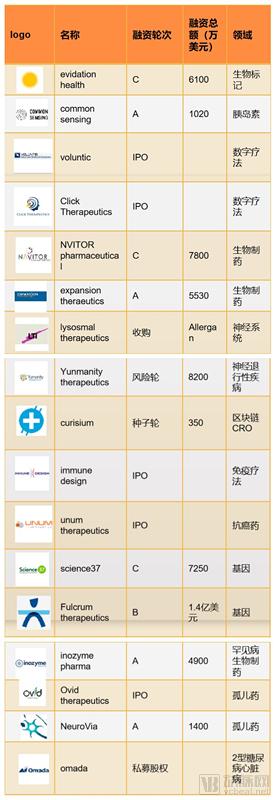
Company 1: Click Therapeutics
Sanofi invested in the digital prescription therapy company Click Therapeutics this July. Click Therapeutics raised a total of $17 million in financing, led by Sanofi Ventures.
Digital prescription therapy combines digital products such as apps, sensors, and smart devices with pharmaceuticals, and multiple products have already received FDA approval.
Currently, Click Therapeutics’ flagship product is Clickotine, a smoking cessation app. Clickotine is designed to help people quit smoking by digitally deploying cessation strategies, such as teaching controlled breathing exercises, enabling users to log their smoking habits and emotions, and sending motivational messages, among other features. The company stated in an email that the app has been adopted by more than 30 enterprises, including insurance companies.
Bernard Davitian, Senior Vice President and Managing Director of Sanofi Ventures, stated, “We have evaluated numerous companies in this space, and we believe that Click Therapeutics’ mobile patient engagement platform positions the company to become a leader in the field of prescription digital therapeutics. Click’s platform enables the company to efficiently target multiple indications, and our investment aims to foster collaboration across various therapeutic areas. Sanofi Ventures is delighted to join Click on its journey to establish a new pillar in modern medicine.” Following the completion of the financing round, Davitian also joined Click’s Board of Directors.
Company 2: Curisium
Curisium: A Blockchain-Based Platform Facilitating Patient-Centric Innovative Healthcare Contracts. The Curisium platform leverages cutting-edge blockchain and secure computation technologies to enable payers, healthcare providers, and life sciences companies to efficiently and securely engage in patient-centric, value-based innovative contracts. Curisium aims to transform healthcare by disrupting existing frameworks and implementing a value-based contracting system at the individual patient level.
Peter Kim, Co-founder and CEO of Curisium, stated: “Payers, providers, and life sciences companies are increasingly entering into various forms of innovative contracts. However, costly logistical operations, lack of trust, and difficulties in verifying patient-level outcomes hinder effective implementation today.”
Alibaba Health
In 2016, Sanofi and Ali Health signed a strategic cooperation framework agreement. The two parties will share high-quality resources in their respective fields, engage in multi-faceted strategic collaboration in the healthcare sector, and join forces to provide better pharmaceutical and health services to patients in China. They will explore an O2O (Online-to-Offline) model that integrates online and offline channels, leverage their combined pharmaceutical, health, and technological resources, and build a safe, professional, and convenient healthcare service network.
Currently, the key collaborative initiatives implemented by Sanofi and Ali Health include the “Peace of Mind at Your Fingertips” program for safe medication use and disease management, launched in late 2017. All of Sanofi China’s prescription drug products have been fully integrated into Ali Health’s third-party traceability platform, “Ma Shang Fang Xin.” Sanofi has become the first multinational pharmaceutical company to join the “Ma Shang Fang Xin” platform, integrating product traceability with health management services.
Exscientia
Exscientia is a renowned AI-driven drug discovery company that has established collaborations with pharmaceutical giants such as GSK and Sanofi. Sanofi announced an investment of €250 million to partner with Exscientia in the development of bispecific small-molecule drugs for diabetes. Exscientia will design so-called bispecific small-molecule therapeutics targeting metabolic disorders, including diabetes, non-alcoholic steatohepatitis (NASH), and obesity. Sanofi will provide support not only in compound synthesis but also assume full responsibility for preclinical and clinical development.
Currently, the two parties have selected 45 metabolic disease targets and approximately 1,000 dual-target combinations. Exscientia claims to possess technology capable of filtering out undruggable molecules, with the aim of designing dual-target drugs with a molecular weight of less than 500 Da. Previously, Exscientia collaborated with Japan’s Sumitomo Pharma to develop central nervous system bispecific drugs, and it is currently partnering with Evotac to develop immunotherapy agents.
Sanofi’s path toward digitalization is very clear,Through two pathways: drug discovery and “drug plus”, not only efficiently developing new drugs, but also enabling existing medications to deliver greater value. From partnerships to investments in digital health companies, improving patient treatment outcomes not only provides disease management tools for patients and physicians, but also reduces overall healthcare costs.
It is worth noting that within the entire digital health ecosystem, new apps and innovations emerge every day. While some individuals may not yet be accustomed to this rapid evolution, Sanofi has already begun to assume the role of an integrator. Particularly in its area of expertise—diabetes care—Sanofi aims to deeply embed itself across all patient journey touchpoints while simultaneously integrating the upstream and downstream segments of the industry chain.