

Beijing Sunshine City's Decline: Lessons for China's CCRC Development and Insights from the U.S. Model
Those familiar with senior living communities are likely well-acquainted with Beijing Sun City.
This once-glorious success story has served as a model for many to learn from. The elderly care industry is home to numerous talents who have emerged from Beijing Sun City, and even many industry leaders have previously worked there.
However, it has recently been exposed that multiple public welfare facilities have ceased operations: the hospital within the residential community has closed, supermarkets and the Postal Savings Bank of China have withdrawn, and even ATMs have been removed.
Looking back, Sun City introduced a new model of “aging in place within the community” from the United States and opened China’s first CCRC.
In 2010, Beijing Sun City obtained approval for a residential real estate project. In response to the growing elderly population and increasing demand for elder care, Sun City voluntarily allocated 30% of the land originally designated for residential housing to develop rental apartments, a hospital, an elderly community center, a supermarket, and other facilities, while using the remaining 70% of the land for senior housing.
The Dilemma of Sun City Raises a Practical Question: How Should Senior Living Communities Develop?
VCBeat (WeChat ID: VCBEAT) has conducted a special thematic survey on this topic. This article will discuss CCRC as follows:
What Is CCRC, and How Do CCRCs Operate in the United States?
Introduction to the 10 Largest CCRCs in the United States as Case Studies;
What CCRC institutions are there in China? How are they classified? An analysis and introduction of typical cases;
What Insights Does the U.S. CCRC Model Offer to Chinese Elderly Care Communities?
There is an interesting phenomenon: many people immediately think of CCRC (Continuing Care Retirement Community) when senior living communities are mentioned, and some even equate senior living communities with CCRCs. So, what exactly is CCRC, and how does it differ from a senior living community?
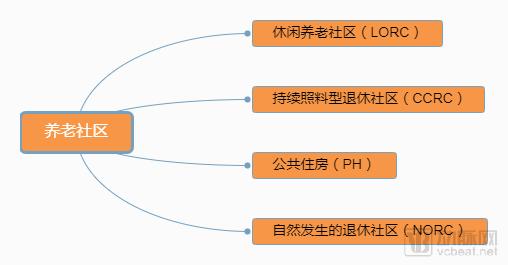
Source: Encyclopedia; compiled by VCBeat
Senior living communities comprise four segments. Among them, Leisure-Oriented Retirement Communities (LORC) emphasize the provision of diverse leisure activities, services, and facilities; Naturally Occurring Retirement Communities (NORC) highlight their organic formation through demographic shifts over time; and Public Housing (PH) focuses on welfare provisions for low-income seniors. Over time, Continuing Care Retirement Communities (CCRC) have played a pivotal role in the U.S. senior care system, capturing a significant market share.
CCRC (Continuing Care Retirement Community) is a multifaceted senior living community. Residents can enjoy a vibrant social life while in good health and receive specialized medical treatment and care when their physical condition requires it, offering seniors a new model of aging—living and growing old in a familiar environment.
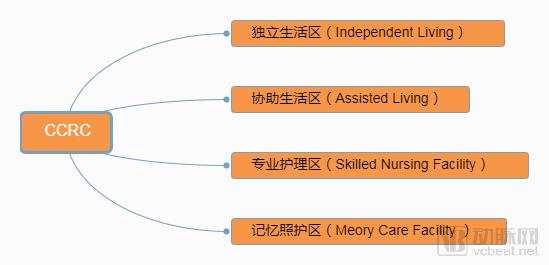
Source: Internet (compiled by VCBeat)
CCRC retirement communities primarily serve four categories of seniors: The first category consists of independent living seniors, aged 55 to 65, who reside in private units within the community. The second category comprises assisted living seniors, who require personal care and reside in the assisted living area. The third category includes skilled nursing seniors, who are completely unable to perform activities of daily living and receive 24-hour professional monitoring in the skilled nursing area. The fourth category is special care units (not available in all facilities), which are dedicated memory care areas designed specifically for individuals with Alzheimer’s disease.
In summary, CCRC is a comprehensive senior living model that provides “one-stop” care for the elderly, ranging from independent living to bedridden care. It witnesses and participates in the gradual aging process of seniors, delivering services at every stage. Due to these advantages, such communities are relatively expensive.
So, how does such a CCRC that “draws on the strengths of many” charge its fees?
In the United States, as CCRCs provide a “continuum” of services, clients are generally required to pay a one-time “entrance fee” (entrance fee = refundable portion + non-refundable portion), ranging from $20,000 to $700,000. The refund percentage is tied to the pricing of the entrance fee and monthly fees, typically ranging from 50% to 90%, with the non-refundable portion generally covering administrative and service charges.
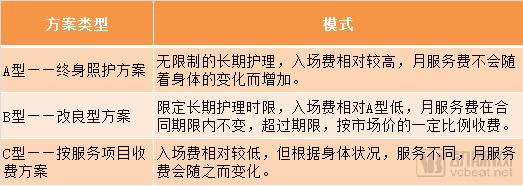
In addition to the "entrance fee," CCRCs also charge monthly or annual fees, which typically consist of service fees, meal costs, and basic utilities, with variations depending on the type of plan selected:
So, what are some examples of CCRCs in the United States for our reference?
In the United States, large senior living companies are typically composed of several segments. In addition to the CCRC segment, they also operate other types of communities, such as independent living communities, assisted living communities, and memory care communities.
According to the latest data released by Senior Living Executive, VCBeat has compiled a list of the ten largest CCRCs in the United States.
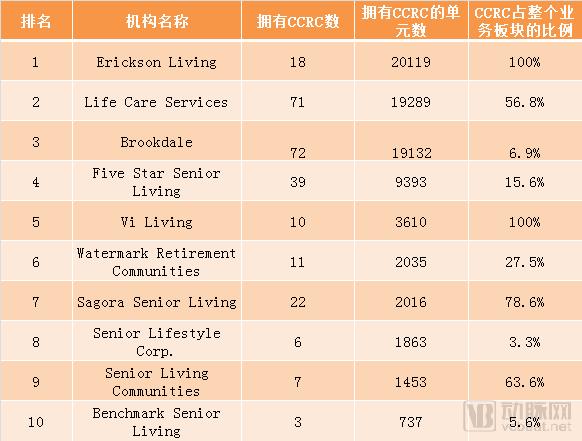
Note: The data is current as of October 31, 2017; changes may have occurred since then.
Source: Senior Living Executive (compiled by VCBeat)
Among the aforementioned enterprises, some operate CCRC segments exclusively (accounting for 100%), while others do not prioritize CCRCs. In terms of scale, there are a total of 259 CCRCs comprising 79,647 CCRC units. The top ten enterprises have already established such a significant presence, and when combined with the CCRC layouts of other companies, it is evident that retirement living within CCRCs has become a common choice for the American middle class and above. VCBeat has analyzed and compiled data on the top three enterprises in this sector.
Erickson Living
Erickson Living is a pure-play CCRC operator that specializes in UBRCs (University-Based Retirement Communities). By locating these retirement communities adjacent to or within university campuses, seniors can access university resources such as libraries, dining halls, and open lectures. This setup facilitates interaction with students, infusing the community with youthful vitality. The key distinction between this model and traditional CCRCs lies in location.
Erickson Living, formerly known as Erickson Retirement Communities, was founded in 1983 and is headquartered in Baltimore, Maryland. It currently employs nearly 14,700 people and serves more than 24,000 residents across the United States. Its communities primarily operate in three segments: independent living, assisted living, and skilled nursing.
Erickson Living stands out from other retirement communities through three key innovations:
Erickson Health Medical Group: The largest integrated health and wellness system for seniors in the United States. Created by geriatric care specialists, the Retirement Health Network leverages modern tools and technologies to connect a multidisciplinary team of over a dozen experts—including physicians with an average of 19 years of experience, fitness coaches, dietitians, and professional chefs—to collectively ensure high-quality services for the elderly;
“Tribune”: A monthly publication featuring recent news on the elderly. This unique publication offers a variety of feature articles, columns, blogs, and contests. All editorial content is original, with a current circulation of approximately 500,000.
Erickson Advantage Health Insurance Plan: Erickson Living is the only CCRC in China authorized to offer its own health insurance plan, allowing members to freely choose primary care and specialist physicians who accept Medicare, to seek out suitable doctors without referrals, while Erickson Advantage staff can assist with scheduling specialist appointments and arranging transportation services.
Life Care Services
Life Care Services is a comprehensive provider of senior care services, with its Continuing Care Retirement Community (CCRC) projects—incorporating University-Based Retirement Communities (UBRC)—accounting for more than half of its portfolio. Founded in 1971 and headquartered in Des Moines, Iowa, the company currently employs nearly 24,700 staff members and serves over 33,000 residents across the United States. Its CCRC operations primarily encompass four segments: independent living, assisted living, skilled nursing, and memory care.
What sets Life Care Services apart is:
Prioritizing Interpersonal Relationships: Social interaction is equally important for the elderly. Life Care Services is committed to integrating residents, their families, and community staff to safeguard the physical and mental well-being of seniors.
Ensure a Smooth Transition to CCRC: When elderly individuals decide to move away from their original living environment, they often experience significant discomfort; Life Care Services is dedicated to helping seniors adapt to this change.
Risk Emergency Preparedness: Life Care Services communities have developed specialized emergency measures to address risks such as hurricanes, earthquakes, fires, tornadoes, or blizzards.
Brookdale
Although Brookdale ranks only third among CCRC providers, it holds the top position in terms of its overall senior care footprint. As of December 31, 2017, Brookdale operated a total of 1,039 senior living facilities, more than three times the number of the second-largest senior care provider in the United States. Its 72 CCRCs accounted for just 6.92% of its total portfolio.
Brookdale, founded in 1978 and headquartered in Brentwood, Tennessee, currently employs nearly 85,000 people and serves over 100,000 residents. Its Continuing Care Retirement Communities (CCRCs) primarily offer independent living, assisted living, and skilled nursing services, with memory care available in select communities.
It is difficult to pinpoint what makes Brookdale unique, as its brand competitiveness far surpasses that of all other CCRC companies in the United States. Brookdale has consistently adhered to providing high-quality services, top-tier facilities, and a superior living environment. Its CCRC communities feature their own social calendars, including cooking classes, dance lessons, and movie nights, allowing seniors to fully enjoy their lives.
Having discussed the top CCRCs in the United States, let us now examine the development of CCRCs in China.
Due to the high capital requirements of CCRCs, as well as the need for strong brand value and corresponding property management capabilities, large scale, diverse functions, and comprehensive supporting facilities, the entities involved in this sector in China are predominantly real estate developers and insurance companies, along with some large-scale state-owned enterprises (some of which have collaborative projects with foreign partners).
With the rise of internet insurance, traditional insurance companies are actively transforming and upgrading to further enhance their competitiveness. In the face of a fiercely competitive market environment, these insurers are pursuing diversified development strategies by leveraging their core insurance businesses as a foundation, targeting the “silver wave” through the development of elderly care insurance products and the establishment of CCRC (Continuing Care Retirement Community) senior living communities.
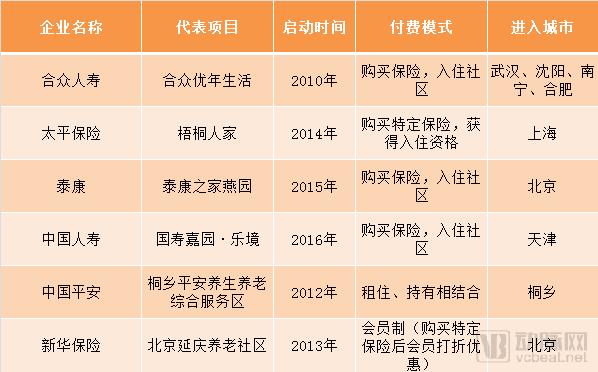
VCBeat has compiled this information from publicly available online sources. Please feel free to provide supplements or corrections if any omissions or errors are found.
Currently, the elderly care initiatives of domestic insurance companies are primarily positioned as CCRC communities, and nearly all are linked to their own insurance products. Customers must purchase insurance policies of a specified amount to qualify for residency (or to receive discounts).
Union Life InsuranceIt was the first enterprise in the insurance industry to launch a CCRC project. Initially, it aimed to create an “airlifted U.S. Sun City elderly care model.” The chairman personally traveled to the United States for inspections and recruited experts from abroad.
United Younian Living Community is equipped with a comprehensive operations management team and a professional care team with a high caregiver-to-resident ratio, ensuring that residents’ dietary and social needs are met while providing health management services to safeguard their physical and mental well-being.
It is staffed with medical and nursing teams, catering teams, community service teams, and property management teams, working together to create a “peace-of-mind home” for the elderly.
The community is designed for seniors aged 70 and above, offering a systematic suite of services that includes independent living, assisted living (including memory care), and skilled nursing care (including rehabilitative care). Furthermore, the on-site community hospital, equipped with medical capabilities comparable to those of Tier-3 Grade-A hospitals, enables specialists to provide face-to-face medical consultations to residents, thereby achieving the goal of “managing minor illnesses without leaving home and accessing health consultations within the community.” Meanwhile, through partnerships with hospitals, the community has established an exclusive “green channel” for expedited emergency medical access.
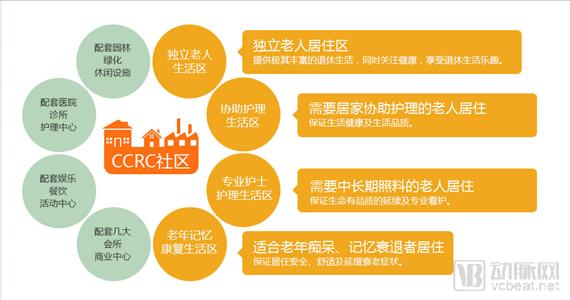
(Image source: Official website; compiled by VCBeat)
Compared with other CCRCs, Hezhong Younian targets the middle-class demographic, with total costs comprising ① bed fees + ② service fees + ③ meal fees, priced at approximately RMB 2,800–5,500 per month.
In 2017, the sales volume of China’s real estate market reached RMB 13 trillion, a level widely regarded as the industry’s ceiling. The general consensus was that the market size would hover around this level for several years before entering a downturn. Among all developers, the largest and most prominent enterprises were the first to hit this ceiling. In recent years, major real estate developers have actively pursued diversification strategies, with particular emphasis on the elderly care industry.
Currently, domestic real estate companies are not as "focused" as insurance companies in their exploration of elderly care. CCRC is only one aspect of their efforts. For example, Vanke, which has made significant progress in elderly care projects, currently explores three models: institutional (with an emphasis on high-level nursing care), CCRC, and community-embedded.
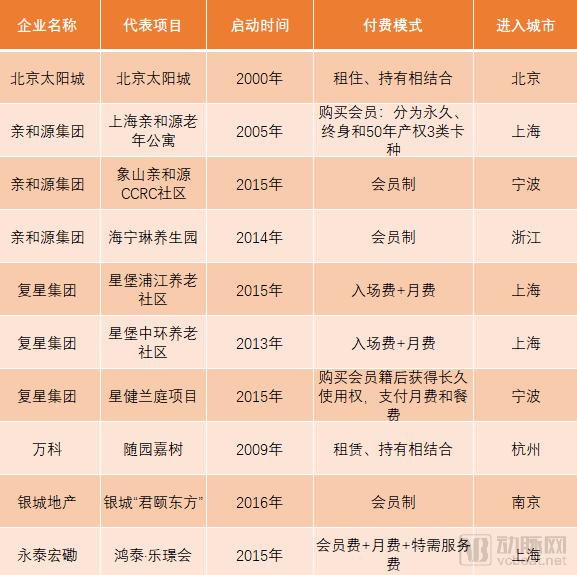
VCBeat compiled this information from publicly available online sources. Please feel free to provide supplements or corrections for any omissions or errors.
Among the aforementioned companies, payment models generally fall into two categories: one primarily based on a membership system, and the other involving partial sales with the remainder retained for external leasing.
QinheyuanAs one of the earliest real estate developers to enter the elderly care sector and currently operating a significant number of CCRC projects, its greatest impact on China’s elderly care service industry stems from being the first to introduce a membership card model/system in the domestic market.
Affinity Source centers its operations on a membership-based model and has established the “Member Council” as a permanent community body. Composed of member representatives democratically elected by senior residents through consultative processes, together with apartment complex representatives, the Council voices seniors’ suggestions and preferences, coordinates and communicates with service providers, and participates in the oversight and evaluation of other operational management and services within the senior living community.
In addition, Qinyuan’s “secretary-style” services, technology-enabled elderly care services, and public welfare classroom services are also highly distinctive. For instance, the provision of life secretaries, health secretaries, and wellness secretaries can meet the daily needs of older adults:
Additionally, the “Time Bank” initiative promotes mutual aid among elderly volunteers, enabling seniors to transition from being “dependents” to practicing “self-reliant aging.” Meanwhile, public welfare classes organize seniors to provide training in recitation, table tennis, harmonica, painting, and other skills to the community, allowing them to personally experience how “public service fulfills the value of older adults.”
In addition to the aforementioned specialized services, to meet seniors’ demand for “medical care,” Qinheyuan has established a hospital and a nursing home within the community, enabling residents to access “hospital-level care at their doorstep.” In case of emergencies, a green channel is available for prompt transfer to tertiary Grade A hospitals.
With the development of China's elderly care industry, some domestic companies in this sector have successively invested in asset-heavy construction and operation of CCRCs since 2010. In terms of payment models, a relatively large number of enterprises have adopted membership systems, with most projects located in first-tier cities.
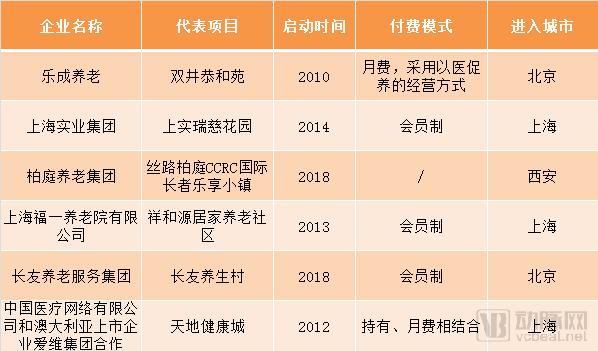
VCBeat compiled this information from publicly available online sources. Please feel free to provide additions or corrections for any omissions or errors.
Shuangjing GongheyuanIt is one of the few CCRCs located in the city center, offering convenient transportation and close proximity to medical resources as well as family members and friends. Situated in the core Guomao area on Beijing’s East Third Ring Road, where land is extremely valuable, the community is modest in scale. It consists of two buildings (north and south), covers an area of 13,000 square meters, and has a total of 269 rooms.
Targeting seniors aged 60 and above, this community was designated by the Beijing Municipal Government in 2013 as the first pilot institution for “integrated medical and elderly care.” It integrates specialized medical services, personalized nursing, and community-based living amenities. Catering to seniors who are independent, dependent, or living with dementia, it provides comprehensive, multi-dimensional care services, including daily living assistance, nutritional meal planning, preventive healthcare, rehabilitation therapy, and holistic well-being programs.
As a designated pilot institution for the integration of medical care and elderly care, its “medical” component stands out as a key feature. The Gongheyuan Medical Center operates as the Shuangjing Second Community Health Service Center, offering services including basic diagnosis and treatment, rehabilitation medicine, traditional Chinese medicine (TCM), general practice, and preventive healthcare. Renowned medical experts from Beijing are engaged to provide regular outpatient consultations, ward rounds, and rehabilitation guidance. The center also serves the surrounding community by establishing personal health records for residents, delivering general practice services and chronic disease management, providing guidance on rational medication use, and offering clinical nursing services such as intravenous infusion, pressure ulcer prevention, and catheter care.
The hospital also hosts a 120 emergency station, enabling rapid transport to nearby hospitals in emergencies. It has established two-way referral and remote consultation systems with renowned Grade A tertiary hospitals in Beijing, such as Peking Union Medical College Hospital, Beijing Tongren Hospital, and Beijing Chaoyang Hospital, thereby enhancing the hospital’s medical capabilities.
Additionally, the facility employs professional dietitians who conduct nutritional assessments for each resident, provide dietary guidance, and customize meal plans. Under the leadership of a nurse manager with a graduate degree, the nursing staff has developed a unique methodology that enables rapid proficiency, high efficiency, and attentive care.
As of now, CCRC projects implemented in China have been gradually expanding and strengthening. Upon localization in China, some derivatives of this model have emerged, such as: CLRC (Continuing Life Retirement Community), adopted by Chunxuanmao; ACCE (All-Inclusive Care Community for Elderly), referred to as the “comprehensive care community covering all elderly needs,” adopted by Ai Zhaohu; and CCHC (Continuing Care Health Community), adopted by Nanfang Sun City · Xiyuan.
In reality, regardless of the terminology used, senior living communities must ultimately shift from conceptual hype to rational deliberation, moving away from various gimmicky concepts and returning to their essential role as providers of elderly care services. This means refocusing on the fundamental needs of older adults—namely, the desire for a higher quality of life in the second half of one’s journey.
Returning to the core demand for elderly care, bursting the conceptual bubble of retirement communities, and focusing on elderly care services—shifting from the phase of marketing concepts to the phase of operational delivery of comprehensive elderly care service solutions—is the key path forward for the development of retirement communities.
I. Multi-party Collaboration for Mutual Benefit
In China, the leading players in the senior living community sector are primarily real estate developers and insurance companies. Unlike specialized elder care service providers in the United States, these entities face significant constraints due to their inherent business natures.
Real estate enterprises hold advantages in the development and marketing of senior living community projects, but they face relatively difficult financing conditions and lack proficiency in post-development operations. Insurance capital exhibits a high degree of compatibility with the elderly care industry; however, insurance companies have relatively limited experience in real estate development and project operations. Furthermore, constrained by numerous regulatory restrictions on real estate investments, they lack flexibility in exploring operational and profitability models. In contrast, state-owned enterprises have access to relatively less capital compared to the aforementioned two types.
Therefore, collaboration among different types of enterprises to pursue mutual benefits and build a stronger team is a way to break the deadlock.
II. Expand the Development of Memory Care Units
The United States is vigorously developing memory care communities, closely aligning with the evolving demands of the aging market, industry trends, and advancements in medical technology.
Currently, China has the largest number of Alzheimer’s disease patients in the world, exceeding 10 million, and is one of the regions with the fastest growth rate globally. Consequently, the market demand for caregiving services for Alzheimer’s patients far outstrips current supply. Establishing dedicated memory care units within existing communities, equipped with specialized care models tailored to this population, represents a significant blue-ocean opportunity in the industry.
III. The community establishes a complete elderly care industry chain and introduces capital from multiple sources
U.S. senior living communities feature a multi-tiered service system that covers various market segments and is staffed by professional care teams—including physicians, nurses, rehabilitation therapists, social workers, and psychiatrists—to achieve the integration of medical care and elderly care.
The U.S. senior living community sector encompasses a complete industry chain with robust market competition. Investors, developers, and operators each fulfill their distinct responsibilities—unlike in China, where these roles are often integrated—allowing all parties to thrive within their respective operational models. The development of financial instruments such as private equity funds and Real Estate Investment Trusts (REITs) has facilitated the entry of private capital into the senior living sector, thereby boosting the growth of the elderly care industry.
IV. New Entrants Leverage Their Strengths to Position Themselves at Key Nodes of the Industry Chain
Riding the wave of sustained national policy support for the elderly care services market, new entrants into the senior living community sector now come from increasingly diverse industry backgrounds.
Large enterprises can extend into the elderly care sector based on their existing core businesses, as exemplified by Longfor’s recently launched Chunshan Wanshu project (see the VCBeat article “Cross-Industry Entry into the Elderly Care Sector: Longfor Launches Its Elderly Care Brand, Chunshan Wanshu”). Small enterprises, on the other hand, can provide specialized services at various nodes of the elderly care community industry chain, adopting an “Internet Plus” model as their entry point. An example is Beijing Yibotong Technology Co., Ltd., which has introduced an AI-based home elderly care system (see the VCBeat article “Pingshow’s Tale of Two Cities: From Silicon Valley to Beijing, Cloud-Based Deployment Reaches 5 Million Global Users, Embedding Over a Dozen Self-Developed Patents into Internet Healthcare”).
V. Promote Smart Elderly Care, but Never Replace Humanistic Care
With the advancement of technology, the application of smart devices such as one-touch emergency call systems and video calling appears to facilitate the management of elderly residents in senior living communities and streamline communication between seniors and their families and friends. However, in reality, these technologies create a barrier characterized by a "double-layered screen" separation.
Therefore, when addressing the needs of elderly individuals living away from home, senior living communities should leverage smart elder care models while increasing human resource support—such as social workers and psychological counselors—to help residents adapt to their new lives. This includes maintaining regular communication with the elderly and engaging in periodic discussions with their families to facilitate ongoing family connections.
Note: Source of background imageErickson Living Twitter