

Experts at 2018 World Artificial Intelligence Conference Discuss AI Integration in Healthcare; Related IPO Filing Submitted
The 2018 World Artificial Intelligence Conference was held in Shanghai this week. To implement the national strategy for smart healthcare, accelerate applied research on artificial intelligence in clinical diagnosis and treatment and drug safety, improve the quality and efficiency of hospital care, and ensure medication safety for the public, the AI-Assisted Clinical Diagnosis and Treatment and Drug Safety Summit was successfully held on September 19. The event was guided by the Orthopedics Branch and the Science Popularization Branch of the Chinese Medical Association, supported by the Drug Safety Cooperation Alliance, and organized by Senyi Intelligence.
Bian Zhenjia, former Deputy Director of the State Food and Drug Administration and Special Researcher at the Counselors’ Office of the State Council; Yi Chengdong, Deputy Director of the Shanghai Municipal Health and Family Planning Commission; Liu Fan, Vice Chairman of the Orthopedics Branch of the Chinese Medical Association; Zhang Wenhu, Secretary-General of the Drug Safety Cooperation Alliance; Zhang Shaodian, CEO of Senyi Intelligence; leaders from the Ministry of Industry and Information Technology, the National Health Commission, and other relevant ministries and commissions; as well as nearly 100 distinguished guests from major hospitals, including hospital presidents, clinical experts, representatives from associations and societies, and enterprises, attended the forum. They engaged in in-depth discussions on topics such as smart healthcare and practical innovation, how artificial intelligence can empower future healthcare, medication safety, and real-world studies.
At the opening of the 2018 World Artificial Intelligence Conference, President Xi Jinping sent a congratulatory letter stating that China is committed to achieving high-quality development, and that the development and application of artificial intelligence will significantly enhance the level of intelligence in economic and social development, as well as effectively improve public services and urban management capabilities. As one of the most important application scenarios for AI, the integration and innovation of artificial intelligence within the healthcare industry are receiving increasing attention.
Shanghai has consistently remained at the forefront of innovation in smart healthcare. In mid-March 2018, the Shanghai Municipal Health and Family Planning Commission launched a special research initiative on smart healthcare, selecting 39 projects from more than 300 candidates. These included eight major medical imaging projects and 31 key projects, injecting further momentum into Shanghai’s smart healthcare development and accelerating its rapid advancement.
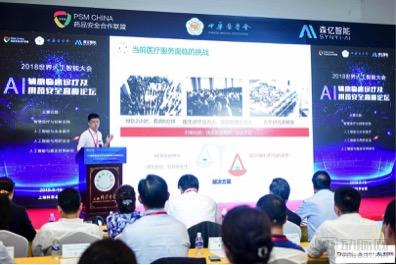
Synyi Intelligence CEO Zhang Shaodian Shares Insights on Smart Healthcare Projects
At the forum, Zhang Shaodian, CEO of Senyi Intelligence, drew on his extensive experience in medical informatization to share insights on how artificial intelligence can drive the efficient utilization of medical data. By leveraging technologies such as machine learning and natural language processing, these solutions genuinely help physicians and hospitals enhance healthcare quality and optimize the supply of medical resources.
Zhang Shaodian stated, “The challenges facing the healthcare industry are fundamentally rooted in the scarcity of high-quality medical resources. Currently, the country is implementing supply-side reforms to increase and optimize supply. A critical aspect of optimizing supply is improving the efficiency of existing resources, which is precisely what China’s informatization initiatives, big data processing, and artificial intelligence technologies aim to address. For instance, tasks that previously took nurses five minutes per patient per day can now be reduced to 20 seconds or even 10 seconds through technological advancements.”
“I do not fully agree with the prevailing view that artificial intelligence (AI) will replace physicians in the future. Medical AI focuses on three core objectives: first, to make data usable; second, to leverage machine learning methods to train AI models using data, thereby empowering physicians and healthcare professionals; and third, to ensure practical implementation. Currently, many AI solutions remain confined to the laboratory stage and are not applicable in clinical settings. We aim to utilize new technologies to ultimately enhance medical efficiency and help address the shortage of healthcare supply in China. For scientific research, we provide an integrated research platform for physicians to enhance their capabilities in precision medicine research. For clinical practice, we offer a clinical diagnosis and treatment decision support system to standardize physician behavior throughout the workflow. For hospital management, we provide an in-hospital disease quality control platform for hospital directors and medical affairs departments, optimizing the allocation of internal medical resources and improving healthcare quality. We hope to harness AI and big data technologies to help hospitals and physicians improve capabilities and efficiency, ultimately assisting physicians in making more precise, better, and optimized medical decisions at every stage of the diagnostic and treatment process.”
Hou Lengchen, Director of the Medical Affairs Department at Shanghai Tenth People’s Hospital, shared insights on a research project focused on an intelligent prediction and clinical decision support system for venous thromboembolism (VTE) based on medical natural language processing. Hou stated, “The VTE project involves text, numerical values, indicators, and data. We value Senyi’s capabilities in natural language processing, their team’s clinical background, as well as their technology and algorithms. Their products can reduce the workload and burden on physicians.”
Regarding the integration of smart healthcare and artificial intelligence, Zhang Shaodian stated, “IT professionals must maintain a sense of reverence for the medical field. I often hear IT practitioners claim they will ‘disrupt’ healthcare at the drop of a hat, a stance I strongly disagree with. Conversely, clinicians also need to embrace new technologies and keep an open mind toward them. The integration of healthcare and AI is challenging because we lack an educational system in medical informatics that trains these two groups together. If we can address this issue in terms of both attitude and methods of integration, our healthcare informatization and artificial intelligence will undoubtedly advance further and achieve better outcomes in the future.”
Fan Xiaohong, Vice President of Shanghai Chest Hospital, stated, “We should embrace each other with an open mind. The development of artificial intelligence is rapid, and so is the advancement of medical technology. If these two fields converge, they will undoubtedly yield greater outcomes, opening up new horizons for prevention, diagnosis, and treatment.”
Yi Chengdong, Deputy Director of the Shanghai Municipal Health and Family Planning Commission, stated: “The convening of the Summit on AI-Assisted Clinical Decision-Making and Medication Safety holds significant practical importance. It will promote applied research on artificial intelligence in the fields of clinical diagnosis and treatment as well as drug safety, continuously improve the quality and efficiency of hospital care, and provide practical experience and theoretical exploration for safeguarding public medication safety. Smart healthcare will empower the new era.”