

End of the Queue Era? World's First Alipay Facial Recognition Payment Hospital Goes Live
The long-standing “three longs and one short” dilemma—long waiting times, lengthy examination procedures, protracted payment processes, and brief consultation periods—that has long plagued patients is poised to be transformed into a “three shorts and one long” model, characterized by shorter wait times and longer doctor-patient consultations.
Recently, VCBeat (WeChat Official Account: vcbeat) learned that Jiangxi Provincial People’s Hospital, with a century-long history, has launched Alipay self-service checkout and facial recognition payment, becoming the first hospital worldwide to support Alipay’s facial recognition payment. Since Alipay announced the commercialization of its facial recognition payment service on August 15, this once high-end technology, akin to “the swallows that formerly graced the halls of nobility,” has now become an everyday convenience accessible to the general public.
Data shows that in Grade A tertiary hospitals in first-tier cities such as Beijing, Shanghai, Guangzhou, and Shenzhen, the average outpatient visit duration is 177.2 minutes, with queuing time accounting for a staggering 75%.
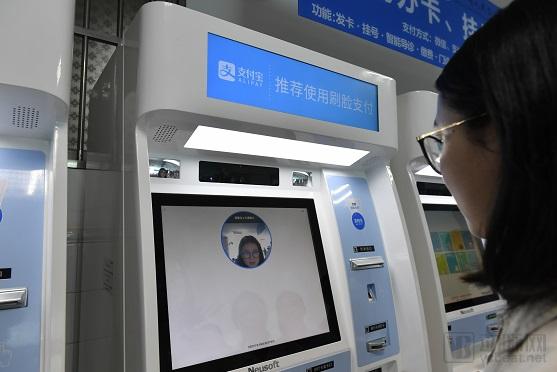
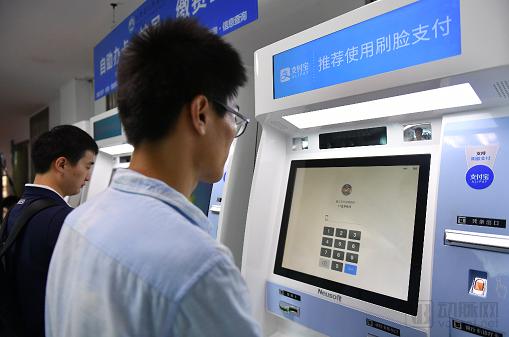
It is reported that after deploying more than 40 self-service kiosks equipped with Alipay’s facial recognition payment function, patients at Jiangxi Provincial People’s Hospital can independently perform tasks such as appointment scheduling, registration, payment, and topping up their hospitalization deposit on these machines.
This model has effectively alleviated the phenomenon of long queues for payment at hospitals during peak hours, thereby improving patients’ healthcare experience. Data show that cashier settlement efficiency has increased by more than 50%, reducing patients’ waiting time. Meanwhile, over 40 additional payment channels have been added without the need to open more payment windows, effectively saving the hospital’s overall operational costs.
Our reporter also experienced the entire self-checkout process on-site and found that it took no more than 10 seconds from selecting the payment method, choosing facial recognition payment, to printing the invoice. Many parents visiting with pediatric patients were able to complete the operation single-handedly while holding their children, making it extremely quick and convenient.
In the view of Huo Yanan, Vice President of Jiangxi Provincial People’s Hospital, the technological upgrade brought by Alipay’s facial recognition payment can alleviate long queues at large hospitals, marking an important step toward building smart hospitals. Shorter waiting times will help ease patient anxiety and facilitate the flow of people within hospital premises. Pressure on registration, cashier, and pharmacy counters will be reduced, while costs associated with maintaining order and environmental hygiene in hospitals will also decrease accordingly.
It is understood that while Alipay’s facial recognition payment service has been launched in scenarios such as supermarkets, restaurants, and pharmacies, its deployment in hospitals has been significantly delayed. In response, Sun Guofeng, Director of Alipay’s Healthcare Business, stated, “On one hand, hospital systems are complex and require lengthy renovation cycles. Given their direct impact on public welfare, the requirements for implementation are more cautious and stringent. Commercialization is only pursued after the technology has matured through applications in other industries. On the other hand, verified real-name identity is a critical need for hospitals. Many steps in the medical process require the patient’s personal participation, making it essential to ensure that the person receiving care is indeed the registered patient. With over 700 million active users in China and robust real-name identity verification capabilities, Alipay is well-aligned with these hospital requirements.”
As early as 2016, the National Health and Family Planning Commission required the launch of pilot programs for real-name medical registration. Results from these pilots indicate that real-name registration enhances the uniqueness and continuity of medical visit information, ultimately benefiting patients. This system ensures consistency among the patient, their identity document, and their medical card, thereby guaranteeing accurate and complete patient records and preventing misidentification during medical consultations.
Real-name registration for medical visits also facilitates accurate diagnosis by physicians. When treating patients, doctors can access comprehensive patient history through more detailed information systems, thereby enabling more precise diagnostic judgments and further safeguarding patient safety.
However, this also requires patients to bring their ID cards for each visit, and many hospitals are unable to provide medical services if patients forget to bring their IDs. This time, in addition to launching facial recognition payment, Jiangxi Provincial People's Hospital has also introduced Alipay's identity verification feature. Due to the real-name registration system of Alipay, users can verify their identity through facial recognition even if they forget to bring their ID cards, helping patients save time.
In addition, addressing concerns about the security of facial recognition payments, Sun Guofeng stated that Alipay’s facial recognition payment system is primarily built on its years of accumulated expertise in facial recognition technology. Alipay was the first financial-grade app to enable facial recognition login. By integrating hardware and software, intelligent algorithms, and risk control systems, it comprehensively ensures accuracy and security, currently achieving a recognition accuracy rate of 99.99%.
“Unlike many applications on the market that employ 2D facial recognition technology, Alipay’s ‘Face Scan Payment’ utilizes 3D facial recognition technology to determine whether the captured face is a photograph, video, or software-generated simulation, thereby more effectively preventing identity fraud caused by various forms of facial forgery,” said Sun Guofeng.
Sun Guofeng further stated that, in addition to facial recognition payment capabilities, Alipay has also opened up its credit and marketing capabilities to service providers. These providers then integrate these capabilities into modular solutions to serve merchants. “In this project, Alipay made its facial recognition technology available to Neusoft Group, which in turn leveraged these capabilities to serve hospitals. In the future, we will roll out each capability as soon as it reaches maturity.”
According to reporters, in addition to its initial application in commercial scenarios such as retail, catering, and healthcare, facial recognition technology has been widely adopted in the “Internet + Government Services” sector. Currently, users in over 100 cities can complete identity verification via Alipay’s facial recognition feature, enabling them to easily access public services online, including housing provident fund inquiries and withdrawals, individual income tax queries, pension eligibility certification, and electronic credentials.
Source: Ant Financial