

Ascentage Pharma Announces Five-Year Strategic Collaboration with MD Anderson Cancer Center for Oncology Drug Development
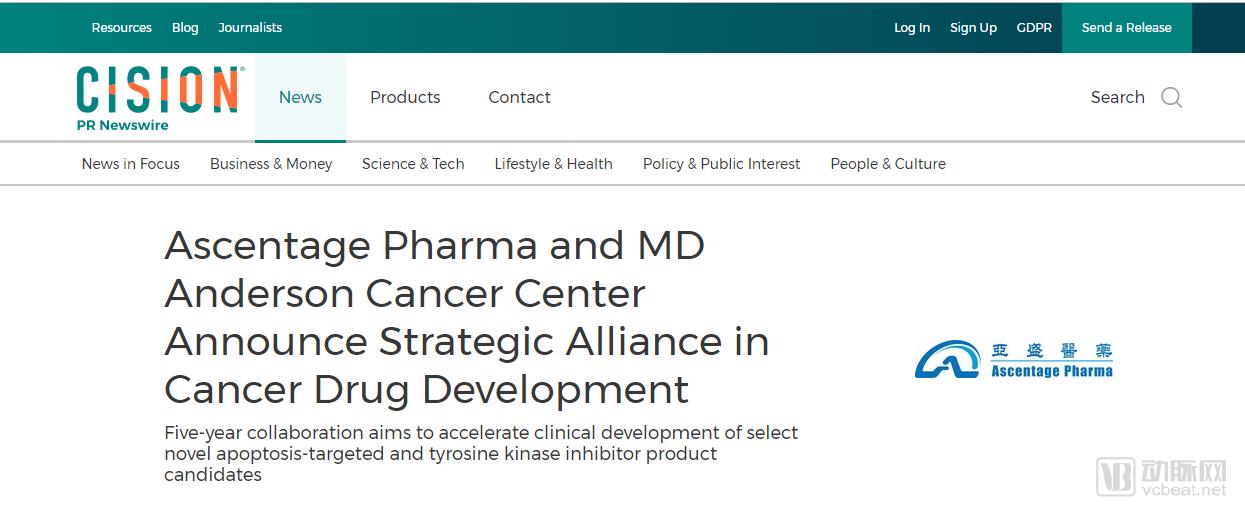
On January 7, 2019, Ascentage Pharma and The University of Texas MD Anderson Cancer Center jointly announced a five-year strategic collaboration to conduct joint research in oncology, aiming to advance the clinical development of five investigational novel oncology drug candidates.
MD Anderson Cancer Center is the world’s leading comprehensive cancer care institution, at the forefront of oncology research and treatment globally. This collaboration aims to jointly develop a series of novel oncology drugs based on Ascentage Pharma’s proprietary protein–protein interaction (PPI) drug discovery platform.
It is reported that the leukemia research team at MD Anderson Cancer Center will collaborate with Ascentage Pharma to advance the clinical development of multiple apoptosis-targeting and kinase-targeting drug candidates under investigation by Ascentage Pharma. These candidates include the Bcr-Abl inhibitor HQP1351, the Bcl-2/xL inhibitor APG-1252, the selective Bcl-2 inhibitor APG-2575, the IAP inhibitor APG-1387, and the MDM2-p53 inhibitor APG-115. The study will involve monotherapy as well as combination therapy with other agents for the treatment of various malignant hematologic tumors.
The collaboration will fully leverage MD Anderson Cancer Center’s extensive expertise in translational medicine and clinical research to accelerate the clinical development of partnered drugs. The two parties are poised to provide new therapeutic options for various malignant neoplasms, including acute myeloid leukemia (AML), chronic myeloid leukemia (CML), acute lymphoblastic leukemia (ALL), myeloproliferative neoplasms (MPN), and myelofibrosis.
“MD Anderson Cancer Center has been committed to developing and providing more effective treatments for patients. This collaboration will help us explore new therapies for curing cancer. We will conduct research on this series of candidate drugs and are particularly interested in their novel mechanisms of action,” said Dr. Kantarjian.
Dr. Yang Dajun, Chairman of Ascentage Pharma, stated, “We are delighted to enter into this significant collaboration with MD Anderson. We will work closely with the MD Anderson team to accelerate the clinical development of relevant products, thereby providing new treatment options for cancer patients worldwide at an earlier date.”
Public information indicates that Ascentage Pharma is a clinical-stage biopharmaceutical company, headquartered in China with a global outlook, dedicated to developing innovative drugs in the therapeutic areas of oncology, hepatitis B, and age-related diseases. The company possesses a proprietary drug design platform targeting protein-protein interactions.
Ascentage Pharma’s R&D pipeline primarily focuses on inhibitors of key proteins in the apoptotic pathway, such as BCL-2, IAP, and MDM2-p53, to reactivate apoptosis in tumor cells; it also includes second- and third-generation inhibitors targeting kinase mutants that emerge during cancer treatment. The company currently has eight new drug candidates in Phase I–II clinical development in China, the United States, and Australia.
MD Anderson Cancer Center, located in Houston, Texas, is one of the most renowned cancer centers globally, dedicated to providing patient care, research, education, and prevention. The institution’s sole mission is to end cancer for patients and their families worldwide. MD Anderson Cancer Center is one of the 49 Comprehensive Cancer Centers designated by the National Cancer Institute (NCI).
In U.S. News & World Report’s “Best Hospitals” survey, MD Anderson Cancer Center ranks No. 1 in cancer care and has received a National Cancer Institute (NCI) Cancer Center Support Grant from the National Institutes of Health (P30 CA016672). Since the inception of this survey in 1990, MD Anderson Cancer Center has consistently ranked among the top two hospitals for cancer care in the United States, securing the No. 1 position 14 times over the past 17 years.
Notably, the collaboration will be personally led by Dr. Hagop Kantarjian, Chair of the Department of Leukemia at The University of Texas MD Anderson Cancer Center, whose prior research has contributed to the U.S. Food and Drug Administration’s approval of more than 20 leukemia drugs.