

Qianhe Medical Files IPO Prospectus: Zero-Marketing-Cost Expansion with 10 Top-Tier Hospitals in 5 Months, Pioneering Pediatric Post-Diagnosis Management
The pediatric healthcare market has attracted significant attention from entrepreneurs and investors in recent years. Some are establishing pediatric clinics, while others are focusing on the pediatric follow-up care market.
In the pediatric follow-up care market, Qianhe Medical stands out as the only provider of post-consultation management solutions capable of large-scale integration into the public pediatric healthcare system, extensive interfacing with hospital HIS (Hospital Information Systems), and deep integration with in-hospital medical service workflows. Post-consultation management has become a core component of end-to-end healthcare management, delivering comprehensive post-visit services for children during both treatment and recovery phases.
Since its launch in September 2017, the platform has signed contracts with 10 hospitals, with an additional 17 potential partner hospitals. It currently serves over 10,000 patients and has nearly 500 registered physicians, with weekly consultation volumes exceeding 200.
Accordingly, VCBeat (WeChat ID: vcbeat) conducted exclusive interviews with He Lingying, founder of Qianhe Medical, and Liu Lei, former data expert at Alibaba, to further explore how Qianhe Medical has established its foothold in the post-diagnosis follow-up market.
In the interview, He Lingying told reporters that rehabilitation follow-up has long been an underdeveloped component of the clinical care pathway. Physicians at various hospitals have made numerous attempts to establish post-discharge connections with patients through home visits, telephone follow-ups, and emails. However, due to factors such as contextual constraints and patient emotional states, these efforts have yielded poor effectiveness and efficiency.
For patients, regular hospital visits for follow-up consultations and prescription refills require considerable time and effort. Although such follow-up visits may only take a few minutes of the physician’s time, the high daily outpatient volume leaves physicians with insufficient time and energy to adequately attend to follow-up patients.
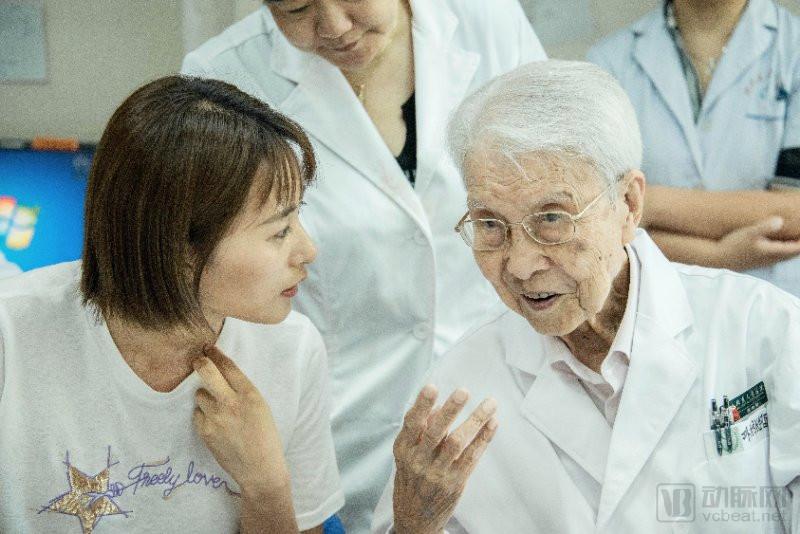
Photo: Qianhe Medical Team Reporting to Academician Zhang Jinzhe
Therefore, physicians strongly desire a product to assist them with patient follow-up, particularly in the field of pediatrics. Take Academician Zhang Jinzhe of Beijing Children’s Hospital as an example. Now 97 years old, he continues to work on the clinical frontline. Over his more than 40-year medical career, he has treated numerous patients, but many were subsequently lost to follow-up. He remains unaware of their recovery status, whether they experienced relapses, or if any complications arose. This situation feels akin to losing one’s own child, becoming an enduring concern throughout his life.
To this end, she aspired to create an efficient and convenient rehabilitation follow-up tool, which became the prototype of Qianhe Medical. She believes that the rehabilitation follow-up market is not merely a simple follow-up consultation market, but rather a post-diagnosis market encompassing follow-up visits, reconsultations, and the entire post-diagnostic rehabilitation process.
Currently, pediatric medical resources in China are extremely scarce, and follow-up visits to hospitals impose a burden on both patients and the healthcare system. According to data released by the National Health and Family Planning Commission, the ratio of in-hospital expenditures to out-of-hospital rehabilitation costs is 1:1. However, there is a notable gap in China’s market for systematic, commercialized post-diagnosis care. While demand for post-diagnosis services is urgent, hospitals alone are insufficient to extend their reach into out-of-hospital rehabilitation, creating an pressing need for a bridge connecting in-hospital diagnosis and treatment with out-of-hospital rehabilitation.
He Lingying also serves as a core member of the Beijing Children’s Hospital Group. She previously held the positions of Deputy General Manager at Tongren Hospital Industry Group and Deputy Director of Kunming Tongren Hospital, bringing extensive medical expertise and a deep understanding of post-diagnosis rehabilitation management.
Owing to He Lingying’s involvement, the initial concept for Qianhe Medical took shape within Beijing Children’s Hospital, with its products first targeting departments characterized by a strong demand for follow-up care for severe and chronic conditions. At Beijing Children’s Hospital, there is a high concentration of pediatric cases involving major diseases: outpatients and inpatients from other regions account for 60% and 70%, respectively. Nearly half of China’s pediatric patients with hematologic disorders and one-third of those with tumors receive treatment at this hospital. Consequently, Qianhe Medical was able to reach a substantial population of children with severe and chronic conditions through its presence at Beijing Children’s Hospital alone.
Meanwhile, the Beijing Children’s Hospital Medical Consortium comprises 21 partner institutions, and Qianhe Healthcare has also established collaborative partnerships within this consortium.
However, medical resources alone are far from sufficient; Qianhe Medical also needs to seek technical support and build a complete team. Last August, Liu Lei, a former data expert at Alibaba, took his child to Beijing Children’s Hospital for treatment as a patient’s parent. It was during this visit that he met He Lingying. At the time, Liu Lei was exploring new projects, and after preliminary discussions with her, he found Qianhe Medical’s vision and forward-thinking approach highly promising. He recognized that his technical expertise could effectively address the company’s shortcomings, leading the two to quickly reach an agreement and decide to collaborate.
Qianhe currently has a team of 17 members, covering areas such as technology R&D, management, business development, and commercial insurance. He Lingying, with her network in the medical industry and experience in healthcare management, is primarily responsible for managing operations in the medical sector. Liu Lei, a co-founder with extensive entrepreneurial experience and a former data expert at Alibaba, oversees internet and product operations. Yao Guang, founder of Huabao Lequn Medical and possessing many years of experience in large insurance companies, serves as Qianhe Medical’s commercial insurance consultant.
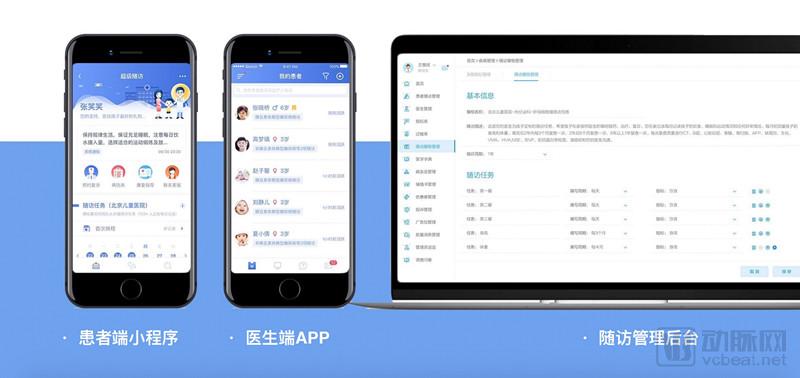
Building on decades of valuable expertise from specialists at Beijing Children’s Hospital, Qianhe Medical has been formally spun off as an independent company. Prior to its establishment, the team conducted three years of project research and developed an intelligent medical follow-up model database covering 2,785 pediatric conditions. This database incorporates 167 general medical follow-up indicators and 409,395 disease-specific indicators, averaging 147 follow-up indicators per pediatric condition. To date, Qianhe Medical’s “Super Follow-Up” APP has been in clinical use for two years, serving over 5,000 patients and receiving widespread acclaim from both hospitals and parents of pediatric patients.
In terms of detailed processing, the "Super Follow-up" APP closely aligns with the actual needs of the diagnosis and treatment process. The video follow-up function embeds whitening effects on the doctor's side, while the patient's side uses native color image quality to ensure accurate transmission of disease information; it supports artificial intelligence reading of medical documents, improving the convenience of follow-up visits; and conveys doctors' professional terminology through methods such as comics, voice messages, and video lectures, making it easier for patients to accept.
Compared with other follow-up products on the market, He Lingying stated that Qianhe Medical's core competitiveness is mainly reflected in the following aspects:
First, integrate with the hospital’s HIS system to effectively enable bidirectional communication of information resources and achieve their consolidation.Hospital data refers to in-hospital patient data, while the “Super Follow-up” app collects extensive out-of-hospital data and transmits it back to the hospital as a supplement to patient information. After the two systems are integrated, physicians can access patients’ complete medical records. Regardless of location, follow-up physicians can obtain comprehensive diagnostic and treatment information, including medication adherence and clinical symptoms at home, thereby establishing an informational closed loop that spans in-hospital diagnosis and treatment with out-of-hospital rehabilitation. Meanwhile, the system can proactively schedule 2- to 5-year post-discharge rehabilitation follow-up plans for patients with chronic diseases, monitor their effective implementation outside the hospital, evaluate rehabilitation outcomes, and facilitate two-way communication between healthcare providers and patients in the outpatient setting.
Second, zero-cost team business development has secured contracts with 10 hospitals, with 17 more awaiting signature.Qianhe Medical has long positioned itself as a partner to hospitals, deeply integrating with large public hospitals to assist them in reform and integrated management, providing a comprehensive growth strategy. Through collaboration, partnered medical institutions have extended their service radius beyond the hospital walls, improving existing medical services while uncovering more high-value-added services to generate additional revenue for hospitals. The platform charges a proportional information service fee, achieving a win-win outcome for both the hospitals and the platform. This operational model has gained widespread recognition from major medical institutions, creating favorable conditions for Qianhe Medical’s further business expansion.
Third, establish the only model in the niche market that integrates remote diagnosis and electronic prescriptions.Electronic prescriptions are issued through the in-hospital HIS system, which differs from external internet hospitals and does not require internet hospital qualifications. Patients purchase medications and make payments via this platform, with pharmaceuticals delivered through logistics channels, followed by subsequent rehabilitation follow-up.
Fourth, leverage an effective postoperative follow-up service system to deliver customized insurance services.Conduct actuarial rate calculations based on specific scenarios, design insurance products, and enhance hospitals' gross profit margins. Currently, Qianhe Medical collaborates with Xiaoyusan Insurance to leverage big data on patients, create post-diagnosis management scenarios, and assist in product design. Each hospital adopts customized products, offering different surgical packages and designing distinct insurance products. These are embedded into medical service processes as surgical service packages, rather than directly marketing insurance to hospitals or physicians. The company is currently in discussions with Taikang Insurance.
Fifth, patient operation models such as C-end patient management, knowledge sharing, and third-party overseas medical services are being continuously explored.The company has already piloted the "Donation Follow-up Mini-Class" initiative and plans to introduce modest fees in the future, positioning it as a channel for monetizing medical knowledge.
In He Lingying’s view, all diseases require rehabilitation; while the duration of rehabilitation varies across different conditions, current medical resources are scarce, and the coverage of rehabilitation follow-up remains inadequate. In light of this situation, Qianhe Medical will focus on expanding the reach of rehabilitation follow-up services in its future development, aiming to establish a nationwide pediatric care network that enables information and data sharing among hospitals at all levels.
Meanwhile, individual health and medical records are established for each child, further extending diagnostic and treatment information from childhood growth stages to adult hospitals, thereby achieving seamless continuity of medical care from childhood through adulthood. As of now, since its launch in September 2017, Qianhe Healthcare has registered over 10,000 patients and more than 500 physicians, with weekly platform consultations exceeding 200 users. The company has signed contracts with 10 hospitals and maintains a pipeline of 17 additional hospitals awaiting contract finalization.
“In the future, we aim to expand our network to 200 hospitals by 2020 and achieve profitability across both B-end and C-end segments,” He Lingying candidly stated, while deeply exploring monetization strategies.
For instance, in the B2B sector, we aim to establish a business model centered on “commercial insurance integration” and “value-added fees” this year, attempting to achieve profitability at individual pilot sites. Next year, we plan to replicate this profitable model across large-scale healthcare systems, secure a dominant market position within one such system, and expand our services to one or two additional large-scale healthcare systems.
In the B2C segment, optimize consumer-facing processes and user experience, and pursue profitable partnerships with one or two B2C partners—for example, by expanding paid monetization models.
In other areas, the focus is primarily on conducting preliminary big data and AI explorations using post-consultation data, leveraging clinic data to support B-side commercial operations, participating in hospital-based scientific research, and developing deeply customized products for commercial health insurance.
Optimizing the post-consultation market for pediatric patients has always been the primary strategy in Qianhe Medical’s long-term planning. The company has previously secured millions in financing and is currently undertaking its Series A funding round.