

Dia Master 'Ruining Assist-Sugar' Debuts at China's First Diabetes AI Competition, Set for Grassroots Healthcare Expansion
Recently, the inaugural Diabetes Artificial Intelligence Competition was held in Wuxi. The diabetes AI system “Rui Ning Zhu Tang” collaborated with physicians from community health service centers to jointly “compete against” a team of physicians from tertiary hospitals. Both groups conducted diagnoses and proposed medication regimens for identical diabetes cases, with their performance evaluated by an expert panel. The competition not only showcased the latest advancements in the application of artificial intelligence in chronic disease management but also explored broader possibilities for the future development of medical AI.
In the past two years, artificial intelligence (AI) technology has flourished, with its applications in healthcare gaining significant momentum. Currently, in morphological recognition tasks such as medical imaging and pathology, AI has even achieved higher accuracy than physicians. However, there are few AI systems capable of logical reasoning for disease diagnosis and drug selection. To date, IBM’s Watson for Oncology remains one of the relatively successful examples.
In China, metabolic diseases are highly prevalent, with the number of adult patients with type 2 diabetes alone reaching 114 million. In contrast, the current diagnosis and treatment of metabolic diseases in China rely primarily on tertiary hospitals, while primary healthcare resources are severely insufficient, failing to meet patients’ needs for standardized testing, diagnosis, treatment, and post-discharge health management.
Prevention and treatment must embrace new concepts, methodologies, and measures. With the advancement of internet and Internet of Things (IoT) technologies, AI-driven approaches to diabetes prevention and management have begun to emerge. Is it possible to develop an AI-assisted diagnostic and treatment system to support physicians in clinical decision-making? This is widely recognized as a pressing need among many healthcare professionals. In response, Dia Master (Rui Ning Zhu Tang), the first AI-powered medication assistance engine in the field of chronic diabetes care, was jointly incubated by Academician Ning Guang and his team together with Ali Health.
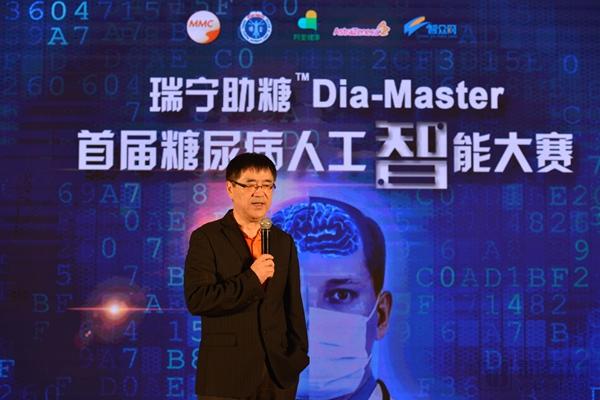
Academician Ning Guang Serves as Chair of the Inaugural Diabetes AI Competition
The Diabetes AI Competition was structured as follows: five physicians from tertiary hospitals and five from community health service centers were invited to participate. Together, they diagnosed five randomly selected diabetes cases and provided medication recommendations. Physicians from tertiary hospitals made their judgments independently, while those from community health service centers collaborated with “Rui Ning Zhu Tang” to complete the diagnosis, treatment, and medication plans.
The medication regimens of the two groups of physicians will be evaluated by five renowned experts in the field. The scoring criteria include drug selection, initial dosage, and administration method, with each item scored out of 10 points.
Ultimately, the tertiary hospital group had an average score of 72.9 points, while the community hospital + Ruining Zhutang group had an average score of 69.3 points.
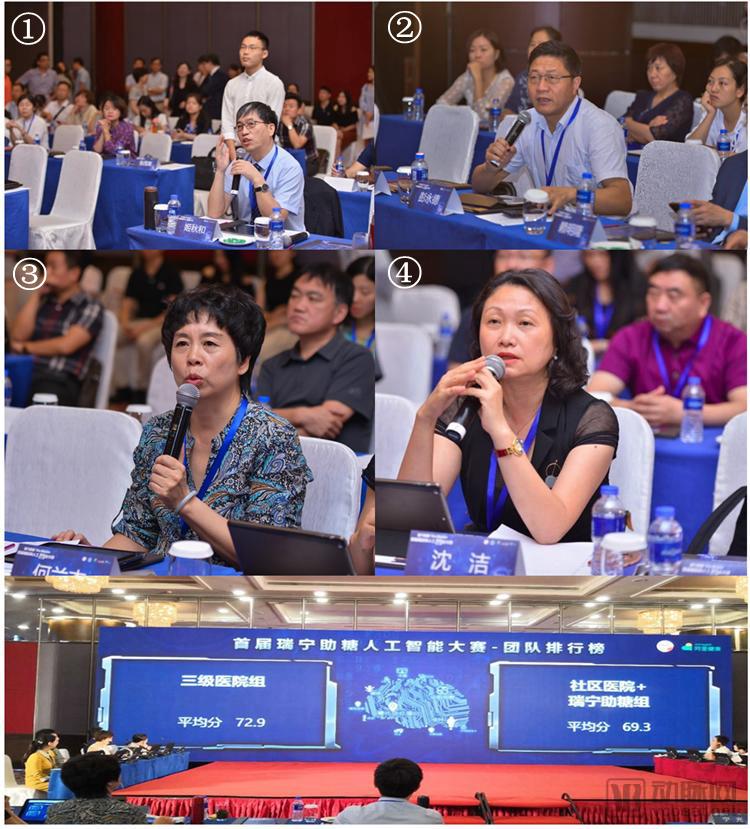
Professor Ji Qiuhe of Xijing Hospital, Air Force Medical University (Figure 1)
Professor Peng Yongde of Shanghai General Hospital, Shanghai Jiao Tong University School of Medicine (Figure 2)
Professor He Lanjie (Figure 3), Qilu Hospital of Shandong University (Qingdao Campus)
Professor Shen Jie, The Third Affiliated Hospital of Southern Medical University (Figure 4)
Academician Ning Guang commented on the competition results, stating, “I expected this outcome. It highlights the gap in diabetes diagnosis and treatment capabilities between community hospital physicians and those at tertiary hospitals. However, AI can help community physicians enhance their skills and proficiency, thereby narrowing this gap.” Particularly in the context of tiered diagnosis and treatment and two-way referral systems, only by improving the competence of community hospital physicians can primary care facilities effectively manage and retain patients.
Academician Ning Guang pointed out that although there are many applications of AI in the medical field, few are focused on diabetes. The reason lies in the relative complexity of diabetes diagnosis and treatment, where medication and dosage must be tailored to individual patients; rigidly adhering to guidelines makes it difficult to develop high-level AI for diabetes management. From this perspective, RuiNing ZhuTang still requires extensive practical application.
Medical artificial intelligence is iterating at a rapid pace. Academician Ning Guang humorously remarked to the physicians present that even if one could study without eating or sleeping, it would still be impossible to keep up with AI’s learning speed. He expressed strong confidence that within two to three months, the capabilities of RuiNing ZhuTang will improve once again; whether it will reach or even surpass the proficiency level of physicians in tertiary hospitals remains to be seen.
“Rui Ning Zhu Tang,” an AI-powered physician that rose to prominence in this human-machine competition, is the first artificial intelligence-assisted medication engine in the field of diabetes, jointly developed by the National Clinical Research Center for Metabolic Diseases and Ali Health.
It is well known that an endocrinologist typically requires over a decade, or even several decades, of specialized education, clinical practice, and advanced training to achieve “expert” status. Yet “Rui Ning Zhu Tang,” which officially launched only this May, has already reached a level comparable to that of these seasoned experts. What lies behind this achievement?
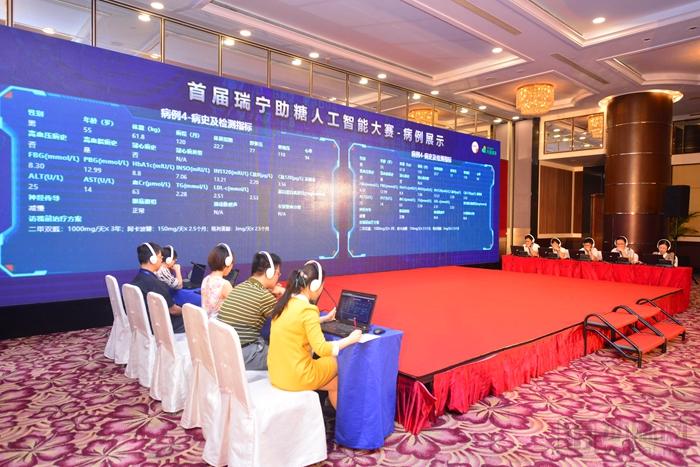
On-Site of the First AI in Diabetes Competition
"Oceanic Knowledge Model"
Unlike traditional manual learning methods, Ruining Zhutang has constructed a proprietary medical knowledge graph that integrates the latest domestic and international diabetes guidelines and key medical literature, enabling real-time search and continuous accumulation of disciplinary knowledge. Meanwhile, AI experts have employed specialized algorithms to establish connections among medical knowledge points, allowing machines to continuously “comprehend” newly published literature.
Empirical Models Replicate "Expert Thinking"
Unlike traditional approaches that rely on manual learning, peer exchanges, and the long-term accumulation of clinical experience, Ruining Zhutang has enlisted nearly 300 endocrinology experts across China to participate in data annotation and draws upon therapeutic insights from thousands of de-identified real-world electronic medical records. It is a young yet highly experienced “expert-level” contender.
Shining in Real-World Practice
In practical applications, physicians are no longer confined to their individual experience and knowledge. After inputting patient-related information, medical history, and laboratory and diagnostic test results, “Rui Ning Zhu Tang” first standardizes and integrates the de-identified data, then combines it with data from a medical knowledge graph to provide AI-driven medication recommendations, thereby offering more standardized and personalized diagnosis and treatment for patients with diabetes.
Currently, “RuiNing ZhuTang” offers three sets of personalized and targeted treatment plans for diabetic patients with varying conditions. By integrating a dual-model framework of “knowledge model–experience model,” it provides clinicians with endocrinologist-level assistance and guidance in clinical decision-making, thereby enhancing their proficiency and achieving standardized diabetes diagnosis and treatment. Furthermore, through continuous AI learning, the precision of “RuiNing ZhuTang” in optimizing treatment plans will continue to improve.
A physician from the People’s Hospital of Longkou City, Shandong Province, present at the event, told VCBeat that she considers hosting such a competition highly meaningful. It not only disseminates the latest advancements in medical AI but also tangibly helps physicians enhance their capabilities in diabetes diagnosis and treatment. This is particularly beneficial for primary-care physicians, who often face deficiencies in diabetes care due to disparities in professional expertise and learning resources; with the assistance of medical AI, they can engage in continuous learning and improvement.
In fact, this is also the vision of Academician Ning Guang and his team. “Rui Ning Zhu Tang,” as a clinically available auxiliary diagnostic and therapeutic system, will be piloted at MMC (National Standardized Metabolic Disease Management Centers) in the future.
As a co-developer of Ruining Zhutang, Ke Yan, Senior Vice President of Alibaba Health, also pointed out that Alibaba Health has always believed that medical AI, which combines artificial intelligence technology with the collective wisdom of experts, can help primary care physicians make more scientific and efficient decisions, continuously access the most cutting-edge medical knowledge, and enhance their professional skills, thereby benefiting more patients. This is also the original intention behind Alibaba Health’s development of medical AI.
The National Metabolic Disease Management Center (MMC), led by Academician Ning Guang, was jointly initiated by the Chinese Medical Doctor Association, the National Clinical Research Center for Metabolic Diseases, and the Shanghai Institute of Endocrinology and Metabolism, with support from multiple enterprises including AstraZeneca and Zhizhong Medical. Adhering to the philosophy of “One Center, One Standard, One-Stop Service,” MMC is committed to providing personalized, high-standard, whole-course disease management for diverse patients.
The ongoing National Standardized Metabolic Disease Management Center project is driving profound changes in the diagnosis and treatment of metabolic diseases in China. By providing one-stop diagnostic and therapeutic services, it significantly reduces patients’ healthcare-seeking time. Leveraging data interoperability and artificial intelligence technologies, the project establishes personalized, high-standard, standardized, and user-friendly workflows for screening, diagnosis, treatment, and follow-up, enabling patients to receive expert-level care at community hospitals near their homes.
Leveraging long-term collaborations with tertiary hospitals and AI-assisted diagnostic and treatment tools is expected to significantly enhance the diagnostic efficiency and disease management capabilities of primary healthcare institutions, thereby contributing to improved overall prevention, control, and medical service quality for metabolic diseases in China.
The collaboration between tertiary hospitals and primary healthcare institutions, coupled with vast patient data, will further drive an increase in patient referral rates. This provides a viable pathway for advancing the tiered diagnosis and treatment of chronic diseases in China and offers robust support for the formulation and optimization of relevant public health policies.
Academician Ning Guang stated, “The construction of the centers has already begun to yield results. Moving forward, we will vigorously promote the MMC model across China, striving to achieve the goal of ‘establishing 1,000 MMC centers and managing 10 million patients with diabetes’ as soon as possible. We also aim to reduce the incidence of diabetes in China by 1% and various complications by 10% within ten years, thereby benefiting more patients with metabolic diseases.”