

GoodRx: The Disruptive Prescription Drug Price Comparison Platform Valued at Nearly $3 Billion Within Seven Years
GoodRx isRenowned in the United StatesPrescription Drug Search and Price Comparison Website, in just seven years, it has relied onUniqueBusiness Model Grows into a Unicorn。ItIn8Completed a new round of financing at the beginning of the month, with a valuation reaching28USD 100 million, investorsYesFamous Technology Private Equity FirmSilver Lake。
GoodRx displays real-time, up-to-date medication prices and provides users with prescription discount coupons. By enhancing price transparency, GoodRx is transforming the ecosystem of the U.S. pharmaceutical supply chain. In the future, companies like GoodRx may replace Pharmacy Benefit Managers (PBMs), negotiating prices directly with drug manufacturers on behalf of pharmacies or patients, thereby becoming deeply integrated into the pharmaceutical supply chain.
What is the background behind the emergence of companies like GoodRx? How has it managed to stand out in the highly competitive pharmaceutical industry? Learning from others’ experiences can help improve one’s own practices; what insights can GoodRx offer to China’s healthcare industry and enterprises? VCBeat (WeChat ID: vcbeat) aims to answer these questions.
GoodRx was founded by two former Facebook executives: Scott Marlette and Doug Hirsch. Early investors also stated that their decision to invest in GoodRx was solely based on the founders’ intellectual prowess. When discussing the rationale behind founding GoodRx, Scott Marlette, a veteran of Facebook, remarked, “We should empower users, rather than seeking to educate them.”
Scott Marlette further explained, “The healthcare sector is undergoing profound transformation. Many companies are entering this space and attempting to drive change, yet most of their products are centered around healthcare systems rather than simply and conveniently meeting consumer needs. For instance, while continuously recording consumers’ health data is certainly useful, it does not address their most pressing needs, thereby providing insufficient motivation for consumers to change their behavior.”
Thus, after rejecting countless projects, the two founders decided to build a prescription drug search and price comparison platform. Guided by Facebook’s DNA of simplicity and ease of use, GoodRx was born. On GoodRx, users simply enter the name of a prescription medication and their ZIP code, and the app displays a drug price map. Users can view prices for both brand-name and generic drugs at local pharmacies and mail-order pharmacies, compare them, and decide where to make their purchase. Rather than selling medications directly, GoodRx offers discount coupons—commonly known as “coupons”—after a search. The coupon-selling model is not new in the United States; Groupon, the well-known group-buying website, primarily sells coupons as well. When Meituan was first established, it also followed Groupon’s business model.
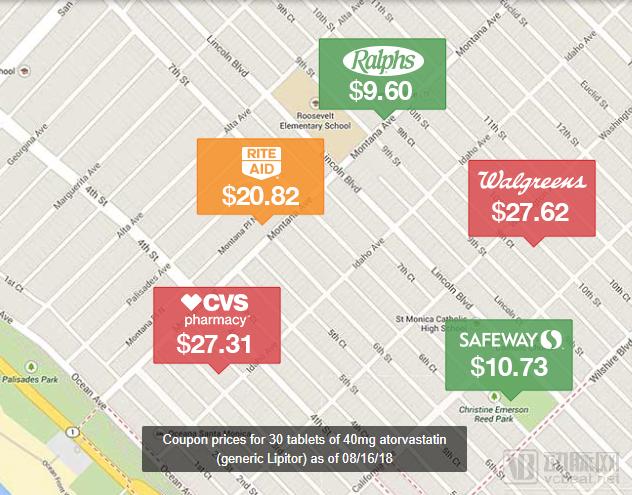
The United States is famously known as a nation of heavy medication users, with pharmaceutical sales reaching approximately $450 billion in 2017. However, an increasing number of Americans are opting for high-deductible health insurance plans or going uninsured altogether, making the staggering disparities in drug prices increasingly unaffordable for consumers. Take atorvastatin (brand name Lipitor), a lipid-lowering drug produced by Pfizer, as an example: its wholesale price is $9.04, the insured discounted price is $5.08, while the cash price paid by patients can be as high as $129.98.
There are two reasons for this discrepancy: first, pharmacies offer different prices depending on the payment method used by consumers, including cash, coupons, and insurance copayments; second,Retail prices vary across different pharmacies.
Due to the strict implementation of the "separation of prescribing and dispensing" policy in the United States, pharmaceutical distribution involves a large number of third-party entities. Price negotiations between pharmaceutical manufacturers and Pharmacy Benefit Managers (PBMs) or insurance companies often involve discounts and rebates. For example, CVS, the largest pharmacy chain in the U.S., also owns Caremark, the country’s largest PBM. Consequently, consumers may encounter different drug prices depending on their method of payment.
Regarding the variation in retail prices at pharmacies, GoodRx co-founder Hirsch attributes this to excessive markups during the distribution process. In an interview with Medgadget, he stated, “First, pharmaceutical companies set a drug price list, known as the Wholesale Acquisition Cost (WAC). Manufacturers then sell the drugs to wholesalers at a discount of 2–5%. Subsequently, wholesalers establish the Average Wholesale Price (AWP), which is the list price plus a markup—typically around 20%. Finally, wholesalers sell the drugs to pharmacies at a slight discount. Pharmacies usually set a Usual and Customary (U&C) price, which varies significantly across different pharmacies and represents the amount consumers are required to pay.”
Hirsch stated, “Consumer choices regarding payment methods—such as cash, insurance copayments, or coupons—result in price discrepancies.” This very discrepancy serves as the entry point for GoodRx to penetrate the U.S. prescription drug sales chain.
One might wonder why regulators have not imposed restrictions on this, given that the National Health Insurance is the largest payer—and thus the largest purchaser from pharmaceutical companies—and the law prohibits the government from imposing such restrictions.
GoodRx primarily targets consumers who are uninsured or have high-deductible health plans, offering coupons that enable them to purchase medications at lower prices than those available through direct pharmacy purchases. However, as GoodRx has expanded, even insured individuals now use the platform for price comparisons. In some cases, paying with a GoodRx coupon proves cheaper than using insurance with a copayment.
Currently, the application covers more than 75,000 U.S. pharmacy websites, and the company’s database includes over 6,000 brands and generic drugs valued at more than $1 million. Since its founding in 2011, the company’s website and mobile app have helped Americans save more than $6.5 billion. Each month, over 10 million Americans use GoodRx to reduce their healthcare costs, and more than one-third of U.S. physicians provide patients with information about GoodRx.
GoodRx’s primary revenue model is advertising for prescription drugs. Secondly, GoodRx takes a percentage commission when users utilize its discount cards and coupons. While this may sound similar to the business model of Pharmacy Benefit Managers (PBMs), GoodRx actually earns its commissions through PBMs rather than negotiating prices directly with pharmacies and pharmaceutical companies. In addition to advertising, GoodRx also provides business services such as data analytics, drug price tracking, and alerts.
GoodRx’s industry moat is not particularly wide, and its competitors are expanding rapidly. Blink Health, a rival of GoodRx, has raised $170 million in public funding since 2015 and offers discounts on more than 15,000 medications at its partner pharmacies. Blink enables users to purchase medications online and pick them up offline. While GoodRx provides users with coupons for medication purchases, Blink directly offers discounted drugs.
Blink founder Chaiken stated, “We have redefined the entire industry as the first company to enable patients to purchase medications online and pick them up at retail pharmacies.” Blink reported that its monthly active users have reached 1 million, but declined to disclose the specific number of members.
VCBeat has found that, like GoodRx, Blink Health also operates under the PBM model. Blink Health partners with MedImpact, a PBM company, leveraging its network of 25 million members and affiliated pharmacies. However, Blink Health also collaborates directly with pharmaceutical manufacturers. Currently, Blink has established partnerships with multiple drug companies, including Eli Lilly’s insulin discount program. By negotiating directly with pharmaceutical manufacturers, Blink Health appears to hold greater promise in reshaping the U.S. pharmaceutical supply chain.
High drug prices are also a significant challenge in China. Is it possible to reduce drug prices through prescription drug search platforms? Currently, there are substantial differences between the medical environments in China and the United States. In China, a report from China Renaissance Capital indicates that markups at the pharmaceutical distributor level generally reach 60%, gross margins in the logistics segment average around 7%, and gross profit margins in downstream terminal marketing are approximately 30%. Drugs undergo multiple layers of price markups. To date, the out-of-hospital prescription drug market accounts for 70% of the total in the United States, reflecting a high degree of market concentration, whereas in China, the out-of-hospital prescription drug market represents only 23%.(Data from Beijing Baolaitong Data Research Institute)。
Currently, DTP pharmacies and prescription outflow in China are still in the early stages of development, and the prospect of compressing prescription drug prices through search remains unclear.
In addition, GoodRx’s primary monetization model is through prescription drug marketing, as direct-to-consumer advertising of prescription drugs is permitted in the United States. According to Nielsen data, U.S. pharmaceutical companies spent as much as $5.17 billion on direct-to-patient (DTP) marketing in 2015. However, in China, prescription drugs are not allowed to be promoted or marketed directly to the general public, making this approach difficult to replicate domestically.
In the over-the-counter (OTC) drug sector, platforms such as JD Daojia, Dingdang Kuaiyao, and Kuaifang Songyao have already enabled home delivery services. The Chinese government also encourages the “online order, in-store pickup” and “online order, store delivery” models. Consequently, Blink Health, a competitor of GoodRx, may find opportunities with its “coupon + O2O” model.