

Adicon Holdings Secures $22 Million Investment from Meinian Onehealth, Valued at RMB 3.03 Billion
health 100
Medical Examination Service Provider
VCBeat (WeChat: vcbeat)It is reported that on September 28, Meinian Onehealth Healthcare Holdings Co., Ltd., the leading listed company in China’s health checkup industry, announced that it had approved its wholly-owned subsidiary, Shanghai Mei’ai Investment Management, or a wholly-owned subsidiary established overseas upon approval, to subscribe for a 5% stake in Ikang Healthcare Group (Holdings) Limited for US$22 million, and to sign the Share Purchase Agreement. Ikang Healthcare’s overall valuation stands at US$440 million, equivalent to approximately RMB 3.03 billion.
Health 100 stated that its investment in Adicon reflects confidence in the long-term development prospects of China’s third-party medical laboratory industry and Adicon’s strong comprehensive capabilities. The investment is also of significant importance for enhancing the quality standards of the company’s health examination testing services and integrating resources across the upstream and downstream segments of the industrial chain.
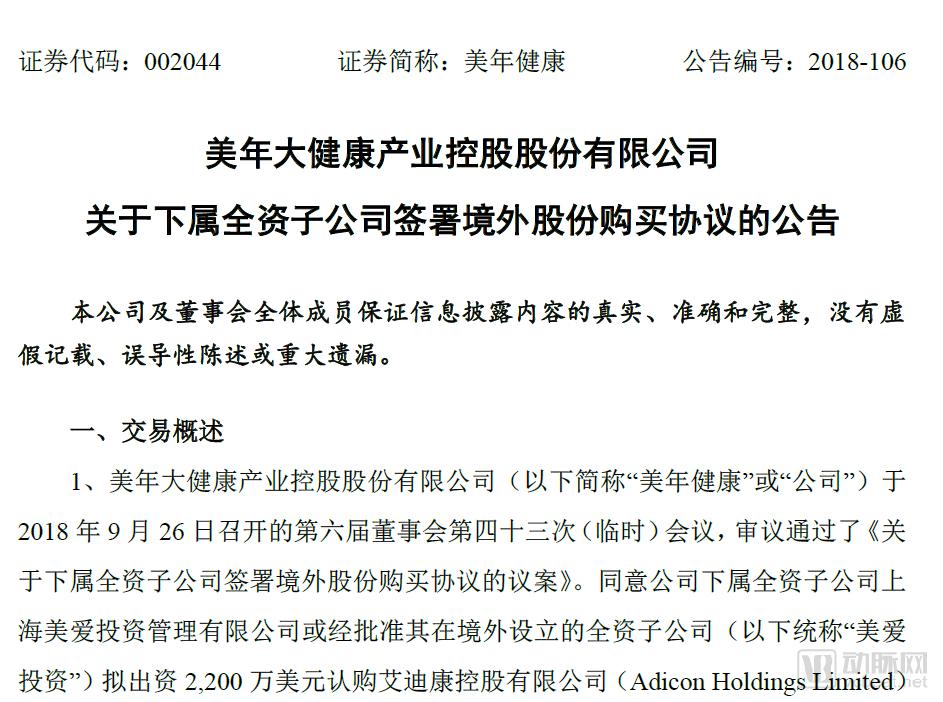
Original Announcement (Source: Choice)
According to the announcement, Adicon is a limited liability company incorporated in the Cayman Islands in 2008, which indirectly holds 100% of the equity interest in Adiken (Hangzhou) Biotechnology Co., Ltd. (“Hangzhou Adiken”), headquartered in Hangzhou. Hangzhou Adiken controls Hangzhou Adicon Medical Laboratory Center Co., Ltd. (“Hangzhou Adicon”), also headquartered in Hangzhou, through a variable interest entity (VIE) structure.
Hangzhou Adicon is a nationwide, cross-regional chain of third-party independent medical laboratories. Its primary business model involves providing medical testing services within China, covering pathology, genetics, biochemistry, immunology, molecular diagnostics, microbiology, trace element analysis, and laboratory testing for drug clinical trials. Its client base primarily consists of public hospitals, private hospitals, health examination centers, pharmaceutical companies, and research institutions.
As of December 31, 2017, Hangzhou Adicon had established medical laboratories in 19 provinces, autonomous regions, and municipalities across China, offering more than 2,000 testing items and collaborating with over 10,000 medical institutions nationwide.
Hangzhou Adicon adopts the advanced management systems of independent laboratories in Europe and the United States, introduces international high-end quality standards, and operates five major central laboratories and an R&D center covering clinical testing, pathology, reproductive genetics, genetic testing, and clinical trials. It provides customers across China with exceptional medical laboratory testing, clinical trial, scientific research, health management, and pathological consultation services.
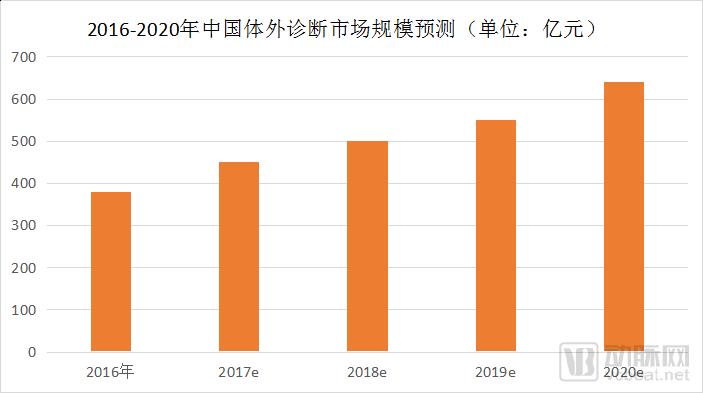
Data Source: CICC Industrial Research Center
According to forecasts by the Industry Research Center of China Investment Advisors, the in vitro diagnostics (IVD) sector is expected to maintain a compound annual growth rate (CAGR) of 15% starting from 2017, with the market size in China projected to reach approximately RMB 64 billion by 2020. Given that diagnostic reagents account for 80% of the Chinese IVD market share, while diagnostic instruments comprise the remaining 20%, the market size for IVD instruments in China may reach RMB 13 billion by 2020.
Within the IVD industry landscape that had already taken shape by 2011, Adicon had firmly secured its position as “China’s third-largest third-party chain laboratory,” and as the first laboratory to operate on a cross-regional chain basis, its value was immeasurable.
As early as March 2018, news emerged that Adicon was considering a sale for $500 million. Reportedly, potential buyers at the time included BGI Genomics, Guangzhou Kingmed Diagnostics Group Co., Ltd., several private equity firms, and a healthcare institution under Fosun International Ltd.
Leading domestic third-party laboratory companies such as KingMed Diagnostics, Dian Diagnostics, and Adicon were all established in 2004–2005, a period that saw rapid market expansion from 2004 to 2012. In 2004, Adicon pioneered the industry’s first chain model, followed by Dian Diagnostics, which began expanding its chain operations in Nanjing and Shanghai. Over these eight years, the in vitro diagnostics (IVD) industry experienced leapfrog development. By 2012, there were approximately 100 independent clinical laboratories across China, predominantly operating under the chain business models of KingMed, Adicon, and Dian. Meanwhile, the sales scale of third-party diagnostic services grew from RMB 170 million in 2006 to RMB 1.2 billion in 2010.
For Meinian Onehealth, the acquisition of a controlling stake in ICDI should be a “tiger-with-wings” deal. At the “Top 100 Future Healthcare Companies” event held at the end of last year, VCBeat had the honor of inviting Mr. Yu Rong, Chairman of Meinian Onehealth Healthcare Holdings Co., Ltd. and Chairman of Tianyi Investment (Group) Co., Ltd., as a keynote speaker. During the conference, Mr. Yu outlined Meinian Onehealth’s future strategic focus. The following are his exact words:
“In the upcoming year of 2018, these industries remain my primary focus. First, significant breakthroughs in health big data, telemedicine, and intelligent diagnostics; second, a surge in the development of healthcare services, particularly specialized and value-added medical care; third, major reshuffling and substantial opportunities within the traditional Chinese medicine industry; fourth, continued strong momentum in precision prevention, genetic testing, early diagnosis, and cell therapy.”
"Technology is transforming traditional health checkups," a conviction that Yu Rong has long held. Consequently, Meinian Onehealth (Health 100) has continuously expanded its personalized health screening and value-added services in recent years, advocating for an enrichment of product offerings, an upgrade in quality and service, and an optimization of its product structure driven by new high-end screening products such as genetic testing, early cancer screening, coronary MRI, and liver ultrasound.
In the business model of Health 100, two key concepts stand out: patient volume and platform integration. As health management becomes a significant source of business for third-party clinical laboratories, whether Health 100, which also operates on a chain-store model, can achieve effective synergy with Adicon should be considered as part of the evaluation of this transaction.
Yu Rong has long excelled in investment and mergers and acquisitions (M&A). The acquisition of Ciming Health Checkup propelled Health 100 to the leading position in the health examination industry. Within Health 100’s ecosystem, which encompasses diverse sectors—including specialized medical services (Meiwei Dental, Minsheng ENT), genetic testing (Meiyin Health), medical data (Haozhuo Data), and mobile healthcare (Daxiang Medical)—the “Health 100 Group” has also expanded into traditional Chinese medicine (Zhang Zhongyi). This controlling stake in a leading third-party clinical laboratory enterprise represents another successful capital operation for Health 100.