

Mature Medical AI Must Transcend Disease Boundaries and Integrate into the Entire Healthcare Workflow, Says Dr. Lü Fajin, Director of Radiology at the First Affiliated Hospital of Chongqing Medical University

YITU
Provider of Full-Stack Intelligent Healthcare Product Solutions
“If the task of interpreting medical images is entirely delegated to machines, doctors can devote more than 70% of their time to effective communication with patients, thereby significantly optimizing the patient healthcare experience.” This was the response given by Lü Fajin, Director of the Department of Radiology at the First Affiliated Hospital of Chongqing Medical University (hereinafter referred to as “the First Affiliated Hospital of CQMU”), when asked by a reporter from VCBeat (WeChat ID: vcbeat) whether physicians are concerned about being replaced by machines.
In reality, it is no surprise that patients endure hours of queuing for only five minutes of consultation when an ever-growing patient population must share severely limited medical resources. For common ailments, individuals can often recover gradually through everyday health knowledge supplemented by brief advice from physicians. In contrast, when facing serious illnesses, people often feel helpless and must strictly follow medical advice in every detail. Taking lung cancer as an example,Lung cancer is the disease with the highest incidence and mortality rates among all cancers in China. Under current diagnostic models, more than 70% of patients are already at an advanced stage when diagnosed with lung cancer, and the five-year survival rate is only 15.6%. At this point, ifFailure to meet physicians’ orders can have fatal consequences. With its ability to rapidly process massive amounts of data, medical AI can free doctors from repetitive tasks in a timely manner and is gradually gaining recognition among healthcare institutions.
How capable is medical AI in meeting clinical needs? What is the attitude of physicians toward medical AI? With these questions in mind, VCBeat once again conducted an exclusive interview with Director Lv Fajin.
The First Affiliated Hospital of Chongqing Medical University seized the opportunity to integrate medical AI driven by a sharp rise in demand for lung cancer screening among its staff. In 2016, the hospital initiated a hospital-wide lung cancer screening program for its employees. In the first year, over 2,000 individuals were screened, identifying 22 cases of early-stage lung cancer. The detection rate, exceeding 1%, heightened awareness and underscored the importance of lung cancer screening.
By 2017, the number of employees participating in lung cancer screening had surged to over 6,000. For each lung cancer screening case, radiologists need to rapidly review more than 600 medical images; thus, the workload for screening over 6,000 individuals is imaginable. However, there were only 40 radiologists, including 18 specialists who were unable to interpret images around the clock. Relying solely on manual image interpretation would be tantamount to pushing human limits to the extreme.
In early 2017, the First Affiliated Hospital of Chongqing Medical University introduced a batch of medical AI products with high accuracy and strong operability through rigorous screening and validation. YITU Medical’s care.aiTMIntelligent Imaging Diagnostic System for Lung Cancer (hereinafter referred to as “care.ai”TM”) were also included. Since then, the hospital’s lung cancer screening program has entered a fast track.
Currently, multiple medical AI products that have been validated in laboratory settings are being successively implemented into clinical workflows, with some radiology departments at Grade A tertiary hospitals even experiencing a surge in AI adoption. Director Lv Fajin believes this situation should be viewed from two perspectives.
On the one hand, the role of medical AI in meeting the daily work needs of physicians should be acknowledged. Director Lu pointed out that some medical AI products have addressed usability issues and can, to a certain extent, assume the repetitive tasks of radiologists. Taking care.aiTMas an example, care.ai is the first medical AI product in China to be directly embedded into clinical workflowsTMIt can integrate with the hospital's RIS and PACS, enabling physicians to perform intelligent image interpretation on their own computers without altering their established workflows, thereby demonstrating a high degree of user-friendliness.
On the other hand, there is still room for improvement in the extent to which medical AI covers clinical healthcare needs. Currently, the application of medical AI is mainly focused on single-disease diagnosis, such as the detection of pulmonary nodules, and remains in its early stages regarding broader single-department task solutions. Taking pulmonary diseases as an example, Director Lv believes that medical AI should, in the future, be capable of facilitating the detection of various lung diseases and generating structured reports.
Director Lv Fajin told VCBeat that the four medical AI products deployed at the First Affiliated Hospital of Chongqing Medical University have all achieved their expected goals in serving clinical workflows. Among them, care.aiTMIt is highly popular among frontline physicians due to its high accuracy and excellent user experience.
care.aiTMOfficially launched in 2016, it has released its third-generation product to date. From the first generation, care.aiTMTo the Third Generation of care.aiTM, Yitu Medical's R&D team continuously optimizes its products by applying clinical thinking and has invested over a million data points to train the system. To date, care.aiTMofSensitivity exceeds 95%, with a report adoption rate of over 92%.
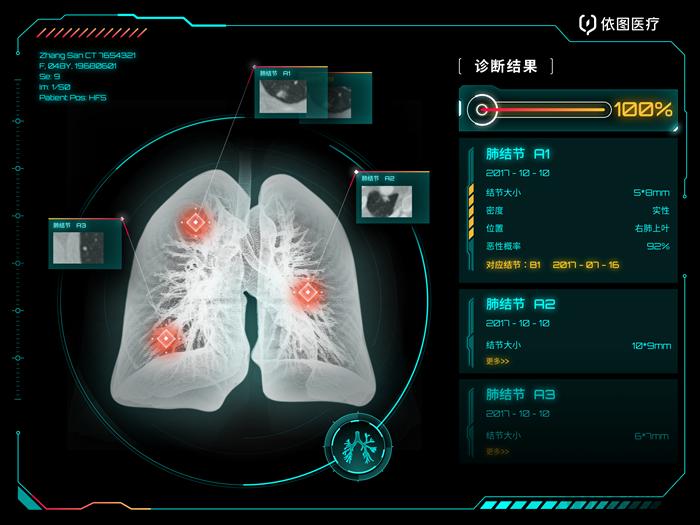
In fact, after extensive practical implementation, medical AI has gradually gained recognition from physicians for its performance, achieved through learning from massive amounts of clinical data. Director Lu Fajin cited an example, “Initially, lung nodule screening relied solely on metrics such as sensitivity and specificity; later, functionalities like nodule volume measurement and historical image comparison were added. ”
Yitu Medical stated that it rapidly iterates its products to align with clinical needs, with the third-generation Care.ai.TMIts high accuracy is underpinned by three key technical features: a low false-positive rate, a high detection rate for non-solid nodules, and a high detection rate for nodules in complex anatomical structures.
Low False Positive Rate
care.aiTMBy leveraging 3D classification algorithms and an enhanced ResNet architecture, the system significantly mitigates false positives in vascular and other lesions. Furthermore, by strengthening feature extraction capabilities, it addresses issues of false positives and false negatives for nodules of specific sizes, thereby reducing the overall false positive rate by 75%.
Detection Rate of High Non-Solid Nodules
care.aiTMBy leveraging the CycleGAN algorithm to transform solid nodules into non-solid nodules, we addressed the scarcity of non-solid nodule data, enabling comprehensive and systematic training for non-solid nodule lesions and increasing the detection rate by 50%. In real-world clinical studies, care.aiTMThe miss rate for ground-glass nodules was only 0.7%, whereas the miss rate among associate chief physicians exceeded 4%.
Detection Rate of Highly Complex Structural Nodules
care.aiTMBy leveraging the Pix2pix-GAN algorithm, we creatively combine limited datasets with manual 3D painting to generate complex nodule structures, thereby addressing the scarcity of data for nodules with intricate anatomical features. This approach enables robust training for lesions adjacent to complex structures, such as hilar nodules and perivascular nodules.
Furthermore, the third-generation care.aiTMEquipped with unique nodule navigation technology, it enables rapid and accurate localization of nodules, multi-angle observation, and provides assessments of tumor malignancy probability, recommendations for similar cases, and quantitative follow-up analysis based on data such as nodule volume, density, characteristics, location, and doubling time.
Director Lu Fajin pointed out that although it is still premature for machines to replace doctors, medical AIThis enables future multidisciplinary intelligent diagnosis of lung cancer, further validating the robust learning capabilities and broad application prospects of medical AI.
Currently, due to certain objective constraints, the clinical implementation of medical AI remains limited to auxiliary diagnosis in medical imaging, particularly for pulmonary nodules. To achieve mature medical AI, AI products must be applied across the entire healthcare workflow and break down disease-specific boundaries, thereby enabling truly intelligent reengineering of medical processes.
According to Director Lv, after the introduction of medical AI, pulmonary nodule screening at the First Affiliated Hospital of Chongqing Medical University is divided into two stages: initial machine screening and subsequent physician review. This reflects that the level of intelligence in medical AI is still insufficient, requiring additional labor from physicians to compensate for technological shortcomings, thereby reducing medical efficiency.
However, Director Lv believes that medical AI will play a significant role in frontline clinical settings and primary healthcare institutions in the future. As public awareness of health management grows, an increasing number of people will undergo regular health checkups, allowing medical AI to assume physicians’ roles in disease screening.
Taking the First Affiliated Hospital of Chongqing Medical University as an example, its health examination center receives nearly 100 examinees daily, generating tens of thousands of requests for medical image interpretation in the backend. If AI could handle this substantial workload, physicians would be able to dedicate significantly more time to addressing patient inquiries and discussing treatment plans.
Note: care.ai mentioned in the articleTMThe relevant data are provided and verified by Yitu Medical.