

Amivantamab Subcutaneous Injection Approved in China for EGFR-Mutated NSCLC with 5-Minute Administration

Johnson & Johnson
Medical Device R&D and Manufacturer
EGFR Lung Cancer Patient Communication Group(Click)
Summary Table of the Latest Targeted and Immunotherapy Drugs for Lung Cancer [With Prices]
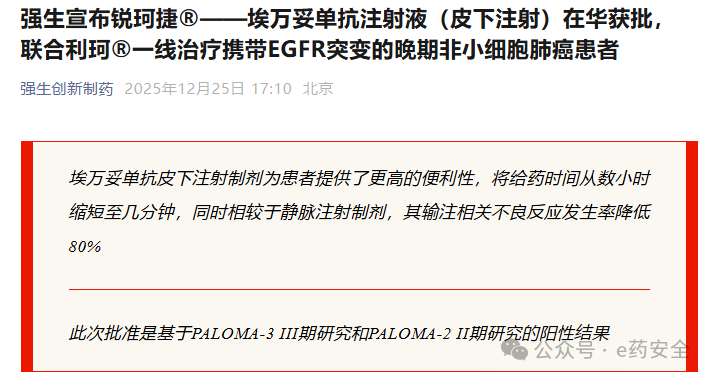
Source: Johnson & Johnson Innovation WeChat Official Account

Amivantamab is under Johnson & Johnson.Johnson & Johnson Innovative MedicineDevelopedA bispecific antibody under research that targets EGFR and MET. In addition to blocking EGFR and MET-mediated signal transduction, it can also guide immune cells to target activating and resistant cells.EGFR/METTumors with Mutations and Amplifications。Evanmab subcutaneous injection takes only about 5 minutes to administer, with an 80% reduction in infusion-related adverse reactions compared to intravenous formulations.
This approval is mainly based onPositive results from the PALOMA-3 Phase III study and the PALOMA-2 Phase II study.
PALOMA-3 is a randomized, open-label Phase III study. It evaluates the non-inferiority in pharmacokinetics of subcutaneous amivantamab combined with lazertinib versus intravenous amivantamab combined with lazertinib in patients with EGFR-mutated locally advanced or metastatic NSCLC whose disease progressed during or after treatment with osimertinib and platinum-based chemotherapy. The study results showed that the subcutaneous formulation of amivantamab achieved blood drug concentration levels meeting the two co-primary pharmacokinetic endpoints, demonstrating its non-inferiority to the intravenous formulation.
PALOMA-2 is an open-label, parallel-cohort study designed to evaluate the efficacy, safety, and pharmacokinetic profile of subcutaneous amivantamab in patients with locally advanced or metastatic NSCLC carrying EGFR mutations. The study results show that the subcutaneous formulation of amivantamab is as effective as the previously approved intravenous formulation, while offering advantages in tolerability and ease of administration.
Patients receiving subcutaneous evolocumab combined with lenvatinib had an infusion-related adverse reaction rate only one-fifth of that in the intravenous formulation group (13% vs 66%). The incidence rates of venous thromboembolism (VTE) in the subcutaneous injection group were 7% and 17% for patients with and without prophylactic anticoagulation, respectively. Apart from the rates of IRR and VTE, the overall safety profile of the subcutaneous formulation of evolocumab was consistent with that of the intravenous formulation.
Disclaimer:The information in this article is for general reference only and should not be directly used as decision-making content by doctors, patients, or any other entities. "e药安全" (eDrug Safety) assumes no responsibility for any losses incurred by any party due to the use of the content in this article.
JoinTumor (Lung Cancer) Knowledge Base, to obtain more tumor-related information