

Boshi Health Cloud Files IPO Prospectus: Powering Specialized Structured EHR and Research Platforms for 500 Tier-3 Hospitals and 5,000 Departments
Boshi Medical Cloud, established in 2014, is an industry-leading platform for disease-specific structured electronic medical records (EMR) and clinical research. The company’s team has independently developed a foundational data architecture and core technologies. Guided by physicians’ needs, it customizes EMRs for specific diseases, enabling the complete deployment of all structured data fields within 6–8 hours. Building on structured electronic forms tailored to clinicians for disease-specific information, the system supports real-time updates. When new clinical guidelines or research directions emerge, the team can implement updates at the physician’s request within minutes.
In June 2017, Boshi Medical Cloud completed a Series A financing round worth tens of millions of RMB, with Matrix Partners China as the investor.
After more than four years of development, Boshi Medical Cloud products have now entered 500 Grade-A tertiary hospitals across China, covering 50 specialized disease categories and 5,000 departments. The services are primarily focused on major disease areas such as oncology, hematology, orthopedics, and neurology, while also supporting nearly 100 multicenter clinical research projects led by top-tier domestic hospitals.
Recently, at the “2018 World Forum on Medical Technology” co-hosted by VCBeat and Eggshell Research Institute, Fan Xiaolei, Co-founder and China Sales Director of Boshi Medical Cloud, shared the company’s development journey over the past few years and offered insights into the value that high-quality disease-specific data platforms bring to clinical research and pharmaceutical companies.

Fan Xiaolei, Co-founder of Boshi Medical Cloud and National Sales Director. Photo by VCBeat.
The following content is compiled and edited based on the shorthand notes shared by Fan Xiaolei.
Introduction to Boshi Medical Cloud: We are a startup whose technical team hails from Tsinghua University and medical team from Peking University—our team is composed of alumni from China’s “two universities most known for their rivalry.”
We aim to serve China’s top-tier expert researchers and become their preferred partner. Thanks to the growing recognition of our data management system, research management system, and patient management platform among leading experts, we have expanded our reach over the past four years to cover more than 500 Grade-A tertiary hospitals across China, collaborating with 5,000 clinical departments in over 50 specialized disease areas.
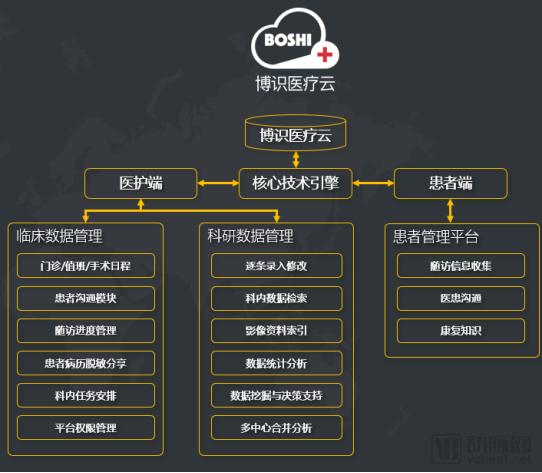
Bosch Medical Cloud: Main Products and Services, Sourced from the Guest Speaker’s PPT
These disease areas include oncology, hematology, and neurology—conditions with very high mortality rates. A single patient’s illness can have a profound impact on their family and impose a significant societal burden. We are committed to striving in these fields to make greater contributions.
We hold numerous patents and software copyrights, and have achieved Level 3 Classified Protection filing with the Ministry of Public Security as well as Level 1 Certification for National Information System Security Assurance. In 2017, we established a joint laboratory focused on healthcare big data with the Data Science Center of the Chinese Academy of Sciences, paving the way for in-depth collaboration in artificial intelligence, data analysis, and modeling.
Over the past few years, we have undertaken multiple national key engineering projects across various disease areas, including the National Dialysis Registry System of the National Health Commission, the cohort study on neurological disorders under the 13th Five-Year National Key R&D Program, and the project titled “Research on Screening for High-Risk Populations with Chronic Obstructive Pulmonary Disease (COPD) and Appropriate Technologies for Comprehensive Community Prevention and Control.” Meanwhile, we have also supported clinical experts in establishing specialized disease collaborative groups covering tertiary hospitals nationwide in fields such as oncology, hematology, and orthopedics.
The past decade in healthcare has been characterized by innovation and differentiation in products such as pharmaceuticals and medical devices. From a data perspective, we have predominantly seen retrospective studies, where research is conducted based on historical data and evidence-driven approaches.
In the current decade, driven by advancements in computing devices and the explosion of data, enterprises have typically been results-oriented, delivering real-time, data-driven solutions such as assisted diagnostic decision-making, intelligent image interpretation, and real-world studies to provide differentiated services for patients. In contrast, the coming decade will be an era where intelligent solutions focused on disease prevention win the market.
Consumers are also becoming more open to big data and artificial intelligence. Our research shows that over half of consumers are willing to embrace diagnostic and treatment improvements driven by data and AI technologies. Younger demographics demonstrate higher acceptance of new technologies and approaches. This trend is further reflected in the acceptance of treatment processes, where patients are increasingly comfortable with AI playing a deeper role in clinical decision-making, rather than limiting its application to basic laboratory tests and examinations as in the past.
Whether it is big data or artificial intelligence, high-quality data is clearly the most important starting point.
It is well known that the highest-quality medical data has always been research-grade data recorded through pre-structured methods. We have consistently remained committed to providing the best research-grade data services to leading clinical experts in China.
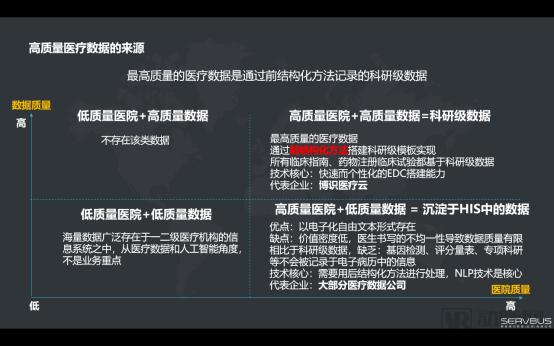
Dimensions of Medical Data, Sourced from the Guest’s Presentation Slides
Currently, the majority of high-quality hospitals in China are key Grade 3A hospitals located in core cities. A prevalent issue is the lack of standardized guidelines for medical record documentation, resulting in significant variability and inconsistency due to the considerable discretion afforded to physicians. Furthermore, these records often lack critical information such as biomarker testing results, assessment scales, and follow-up data. The high cost associated with structuring such data means that even the data accumulated by high-quality hospitals exhibits a relatively low value density.
We have consistently focused on serving clinical experts by custom-developing disease-specific data platforms in a structured manner. This approach not only standardizes data recording but also highly accommodates the personalized needs of different hospitals in research and patient management, thereby better aligning with the characteristics of high-quality data generation in the upper-right quadrant. Let us now examine a real-world case:
We partnered with a top-tier tertiary hospital in Beijing to provide data solutions. Prior to our collaboration, the hospital had very limited descriptive data dimensions for a specific category of diseases. Implementing such data would have required extensive data governance efforts, including natural language text recognition and manual review. As the department director stated, the data recorded and retained by the hospital’s systems served primarily as evidence for determining liability and handling litigation in doctor-patient disputes, offering minimal support for scientific research.
Following our collaboration with Boshi Medical Cloud, we developed customized, pre-structured forms tailored to the single-disease requirements of each department. This approach resolved issues related to non-standardized and inconsistent data, as well as the need for post-generation data governance. Data is now immediately usable upon generation. Currently, clinical ward rounds and data quality control are conducted entirely on this disease-specific platform, significantly enhancing physicians' research efficiency.
In summary, compared with traditional electronic medical records (EMRs) or conventional departmental databases, high-quality pre-structured disease-specific data platforms offer flexible and rich information dimensions, customizable configurations, and high data quality, with over 90% of content being structured. These platforms can be applied to clinical trials, real-world studies, adverse event tracking, and patient management and follow-up, significantly improving the efficiency of clinical data management and reducing the implementation costs of research.
We have also explored specific applications. First, we provide services for pharmaceutical companies’ clinical research, assisting them in conducting feasibility analyses for clinical trials. By integrating assessment results across various dimensions—such as patient potential, site influence, clinical trial recruitment cycles, and the number of required patients—we deliver comprehensive evaluation outcomes. Leveraging our channels, we can also help companies rapidly select Principal Investigators (PIs) and participating sites.
Secondly, expand the reach of patient recruitment information through dual online and offline channels. This approach enables both initial screening of existing patient resources and targeting of new patients, thereby facilitating rapid patient enrollment and accelerating the completion of clinical studies.
and to serve national clinical KOLs in specialized diseases, helping them establish collaborative alliances, generate academic outputs through real-world studies, and partner with enterprises to achieve shared academic and commercial value.
For marketed drugs, real-world studies can be used to track and remind patients to complete their treatment regimens on time, with adequate dosage and full course duration, thereby improving patient prognosis and driving rational sales growth for pharmaceutical companies.
Here, we also have a case concerning hemophagocytic syndrome. The Hemophagocytic Syndrome Alliance was initiated by Director Wang Zhao from the Department of Hematology at Beijing Friendship Hospital. Initially established as the Beijing Hemophagocytic Syndrome Collaborative Group, it covered key departments in 22 major tertiary hospitals in Beijing. In 2016, it expanded nationwide to nearly 200 tertiary hospitals and established the Chinese Hemophagocytic Syndrome Alliance. Boshi Medical Cloud created the Chinese Hemophagocytic Syndrome Registry Platform for the alliance, which is now the world’s largest patient database for hemophagocytic syndrome.
Guided by the principles of mutual assistance, sharing, collaboration, and win-win outcomes, the platform allows all departments that have contributed case records and passed quality control to apply for access to platform-wide data for research purposes. Director Wang Zhao has also leveraged the platform to develop an innovative chemotherapy regimen tailored for hemophagocytic lymphohistiocytosis (HLH) in Chinese patients, achieving remarkable therapeutic efficacy. The corresponding article has been published in Blood, a top-tier journal in the field of hematology.
During the trial, numerous pharmaceutical companies actively participated, confirming the excellent efficacy of the relevant drugs in the Chinese population. The platform continues to be in use.
In summary, big data and artificial intelligence (AI) technologies are reshaping the landscape of the healthcare industry, profoundly impacting every link in the industrial chain. In recent years, products such as Boshi Medical Cloud have built a “data intelligence infrastructure” by initially serving top-tier physicians in China. Only on this foundation have big data and AI applications based on high-quality medical data begun to be implemented in areas such as medical services, clinical research, and drug development. High-quality data and commercial applications reinforce each other, holding immense potential for future growth.