

Miao Health: Leveraging AI and IoT to Transform Health Management for 44 Million Users
Health management is an ecosystem, where every link—from the data entry point of wearable devices to personalized health management plans based on data feedback, and ultimately to user adherence—is still under continuous exploration.
Founded in 2015, Miao Health has now become a leading health management platform in China, boasting 44 million users and accumulating extensive health data. Miao Health is dedicated to exploring the integration of big data with offline health management centers. In March this year, it established a joint venture, Canada Wellness Inc. (China), with Canada Wellness Inc. (hereinafter referred to as “CWI”), to pioneer a new Health Management 2.0 model that combines emerging technologies such as the Internet of Things (IoT), health big data, and artificial intelligence.
Recently, at the “2018 World Forum on Medical Technology” hosted by VCBeat and VBInsight, Kong Fei, CEO of Miao Health, shared new trends in the development model of health management, as well as some recent initiatives undertaken by Miao Health.
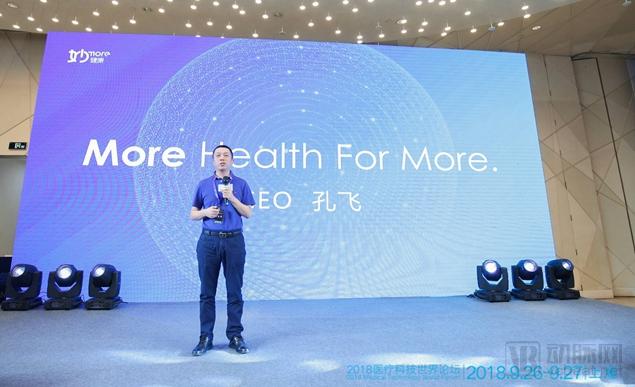
Kong Fei, CEO of More Health
The following content is compiled and edited based on the shorthand notes shared by Kong Fei:
I. The Core of Health Management Lies in “Management” and “Regulation”
When I first started this project in 2014, many people asked me: “Health management is not an essential need, whereas healthcare is. Why did you choose to start your business in a non-essential sector?” My response was that before entering the health management industry, I had spent many years in the gaming industry. I reflected on the fact that gaming is also not an essential need, yet it has thrived, with its profitability ranking among the highest in the mobile internet industry to date.
In fact, upon re-examining the health management industry, we have identified another critical issue: past so-called “health management” was confined merely to the stage of health education. In Chinese, the characters “管” (guan, meaning to control or manage) and “理” (li, meaning to organize or regulate) carry profound and multifaceted connotations. If we were to evaluate previous health management practices, I would argue that they fell far short of both “control” and “regulation,” amounting to little more than basic health education.
When a family member is diagnosed with diabetes and visits the hospital, in addition to the treatment plan prescribed by the doctor, the second most common advice is to “watch your diet and increase physical activity.” In reality, how should patients implement these recommendations after leaving the hospital? Follow-up management is often lacking.
II. Health Management 2.0: Technology Transforms Health
The health management industry is challenging to operate in, but it is gratifying to see genuine growth in the sector over the past two years, with increasing attention from practitioners, investors, and even the government.
Recently, John Hancock Life Insurance Company in the United States announced that it would exclusively sell “interactive” insurance policies that track fitness and health data via smart wearable devices and smartphones. Rather than launching a new line of business, John Hancock has discontinued underwriting traditional policies. This shift represents a significant transformation. Miao Health has already initiated interactive policy programs with several life insurers, including Sunshine Insurance Group, Aeon Life Insurance, and Peking University Founder Life Insurance, dynamically adjusting coverage amounts based on health data.
In the era of Health Management 2.0, we have drawn a distinction between mobile internet-based health management and traditional health management:
1. Possess data tracking capabilities.Only with data tracking capabilities can the pain point of user adherence in the health management industry be addressed. In the past, when doctors or health managers provided a solution, it was impossible to know whether users followed the prescribed plan or whether their condition improved after implementation. In fact, health management without data tracking is untenable and amounts to mere health education, as its effectiveness cannot be evaluated.
2. Health management products have the capability of AI intervention.If each individual were assigned a dedicated health physician for one-on-one management, control would undoubtedly be effective. However, it is impractical to assign a personal physician to every ordinary citizen. Therefore, how can we amplify physicians’ expertise and enhance overall efficiency? In fact, AI-enabled health interventions represent an excellent solution in the 2.0 era.
3. Gamified Operations.This may be related to my personal background. In a non-essential industry, so many people are willing to engage in gaming and even pay for it. The health management industry offers substantial benefits to users, significantly contributing to their future health outcomes. Why, then, are people reluctant to participate? We can apply the operational strategies and tactics of gaming to health management—not by turning health management into a game, but by incorporating the insights into human nature that the gaming industry has developed. When designing a game, one must first consider the habits of users with different behaviors and personalities, an approach that is equally applicable to the health management sector.
An individual’s smartphone typically hosts only a few dozen commonly used apps. In today’s landscape, only high-frequency scenarios can give rise to entry-level applications; if a scenario is inherently low-frequency, it cannot produce such an app. The health sector is no exception. To succeed in the health domain, we must aggregate low-frequency scenarios into high-frequency interactions. Our approach is to integrate health management, medical care, pharmaceuticals, and insurance, starting with high-frequency health management activities to link the lower-frequency scenarios of healthcare, medication, and insurance coverage. This reflects our core philosophy: retaining users through gamification.
4. Offline Health Management Centers.For individuals with chronic conditions or those in a sub-health state, mild to moderate online interventions may prove insufficient. By referencing global management solutions, it becomes evident that while China’s surgical capabilities are already among the most advanced worldwide, its approach to chronic disease management and rehabilitation lags significantly behind. In response, Miao Health has begun to strengthen its integrated online-to-offline (O2O) capabilities. This March, Miao Health established a joint venture with the Canadian Health Management Center to launch offline health management centers. Stores in Beijing, Shanghai, and Chengdu will soon be open to the public.
III. Integrating Wearable Devices to Connect Data Silos Outside Hospitals
In terms of data tracking capabilities, over the past three years, Miao Health has refined this capability to its utmost potential. The Miao+ platform by Miao Health has integrated more than 30 different categories and over 300 models of smart wearable devices. Today, we are likely the leader in data connectivity within the Chinese market, and this capability enables data tracking for our health management services.
In early 2017, Miao Health began to offer this capability externally, and our presence can be seen in a series of applications including Huawei, Samsung, China Unicom, Penguin Doctor, Ali Health, and Taobao Health.
Data connectivity poses significant challenges. The lack of interfaces for software and hardware data sharing among various medical institutions has hindered the smooth collection of big health and medical data, creating a disconnect between data acquisition and application. Information silos have become the most pressing issue in the current application of medical big data. Furthermore, compared to in-hospital medical big data stored in Hospital Information Systems (HIS), acquiring out-of-hospital health and health behavior big data has always been more difficult. If hospitals are considered isolated islands, out-of-hospital health behavior data exists in an even more fragmented and isolated state.
Regarding data silos outside hospitals, the challenges faced by Miao Health are:
First, conducting business negotiations with hundreds of wearable device manufacturers is a challenging process;
Integrating the second set of data also requires time and effort;
After acquiring the third batch of data, it is necessary to consolidate data from the same user into a single data warehouse; the data curation process is highly complex;
Fourth, data is made available for use by third parties. Communication protocols for hundreds of wearable devices vary, and it is impractical for any internet-based mobile app to embed a 400–500 MB communication protocol within the app, as this would result in an excessively large file size.
Therefore, Miao Health has undertaken several initiatives in the process of integrating data:
1. Perform cloud-based processing.Miao+ has currently integrated wearable devices from nearly 90% of global brands. The advantage of Miao+ lies in its lightweight SDK, which is only a few hundred kilobytes in size. When users connect to a wearable device, our system automatically identifies the manufacturer and model. Subsequently, our cloud-based communication protocol rapidly updates to establish the connection.
2. Development of Data Interaction Standards for Health Wearable Devices.In 2017, Miao Health, in collaboration with the Ministry of Industry and Information Technology (MIIT) and the Chinese Center for Disease Control and Prevention (China CDC), launched the “Big Data Platform for Health Management Information Exchange” project, aiming to establish a standard for the interoperability of health wearable devices in China. In April 2018, the “Health Management Information Exchange Platform” was released. We welcome partners in the wearable device sector to join our platform and rapidly achieve standardized data interfaces.
3. AI-Powered Health Interventions.Our health interventions focus primarily on assigning distinct health labels to users based on their data. Generic advice such as “eat less and exercise more” is impractical due to its vagueness. Currently, Miao Health’s AI functions mainly as an intelligent recommendation engine, tailoring healthy lifestyle solutions to individual users. These solutions cover exercise, dietary management, sleep, stress management, and chronic risk factors. On the platform, each user may receive different daily health tasks. After these tasks are assigned, wearable devices connected via Miao+ track whether users complete them. At present, we cannot yet monitor adherence to specific completion standards; however, future capabilities will include tracking compliance with predefined criteria, quantifying health scores, and generating an “M-Score.” A higher M-Score indicates a healthier lifestyle and a lower probability of insurance claims. We can assist insurance companies in implementing differential pricing, where individuals with higher M-Scores may be rewarded with higher coverage amounts.
Supported by mobile apps and mini-programs, our health intervention platform is now capable of delivering external solutions. This solution has already been adopted by certain insurers’ mobile apps and WeChat official accounts, and it is expected that all life insurance policies will soon incorporate this approach. The system includes breaking down complex tasks into M-values, serving as a lifestyle navigation tool that enables users to directly follow the health plan for self-management.
Additionally, the collaboration between Miao Health and China CITIC Bank will soon be unveiled. Users can earn M-Points on our platform and redeem them for vouchers from Starbucks, McDonald’s, supermarkets, and other merchants. The key to quantified health lies in effectively delivering health interventions while digitally quantifying these intervention solutions, thereby imbuing data with tangible value.
The health management industry is challenging to operate. I believe that the current state of the sector, particularly the transformation undertaken by Hengkang Life Insurance, may signal the eve of rapid growth or significant change in the health management industry. Today, no insurance company provides health management services solely through telephone-based physicians. Platform capabilities now outweigh the products themselves. The value of Miao Health lies in helping insurers acquire customers and control costs, upgrading their digital capabilities, and enhancing user stickiness.