

Health Youyi Files IPO Prospectus: AI-Powered Health Management Platform Driving Full-Scenario Digital Transformation in Healthcare

Health Hope
Health Management Service Provider
Within the specialized segments of artificial intelligence, how to achieve practical implementation remains a contentious issue widely debated across the industry, and it is the core determinant of whether this disruptive technology can deliver its intended benefits. While AI products focused on assisted diagnosis are still seeking viable pathways within hospital settings, the “AI + Health Management” model—encompassing functions such as risk assessment, virtual assistants, health evaluations, and health interventions—appears to have identified a broader and more promising path forward.
Health Hope focuses on technological innovation in artificial intelligence within the healthcare sector. By leveraging AI technologies such as computer vision, natural language processing, and knowledge graphs, and integrating its professional healthcare expertise, the company has built the “ego-Healthcare Smart Brain” to provide diversified products and services for the industry.
At the “AI + Health Management” sub-forum of the 2018 World Medical Technology Forum, Li Yuxin, founder of Health Hope, shared with us the company’s experiences over the past four years in technological exploration and commercialization models.

Li Yuxin, Founder of Health Hope
The following content is compiled and edited from Li Yuxin’s shared shorthand notes:
Technological Evolution Creates Multidimensional Modes of Interaction
From the perspective of technological innovation and evolution, technology serves as the engine driving the development of this era. From the early days of 2G and 3G to the current 5G, encompassing the internet, mobile internet, and now artificial intelligence, this overall progress has ushered in tremendous prosperity for the internet age. In fact, this flourishing internet era has laid a solid foundation for the future era of artificial intelligence and the intelligent ecosystem.
The overall progress in biotechnology—spanning from health management to medical care, from genomics to cell fusion, and extending to holistic prediction of life-related diseases and the decoding of human genetic issues—has laid a solid foundation for the digitalization of biotechnology into life digitization and the digital tracking of life trajectories.
AI modules are increasingly replacing humans in tedious tasks, such as using intelligent AI technology for medical image recognition, performing large-scale data computations, and widely applying facial recognition in security systems. These are areas where artificial intelligence has the potential to make significant contributions to humanity in the future, including substituting for certain types of manual labor.
With the continuous advancement of technology, the touchpoints for human–scenario interaction are becoming increasingly numerous. In the past, many product strategies were primarily focused on mobile devices and the mobile internet era; however, driven by developments in artificial intelligence, our application scenarios are now penetrating more deeply into various fields.
As illustrated by the examples I have listed—such as homes, smart terminals, nursing homes, hospitals, automobiles, communities, and MR (Mixed Reality)—it is evident that the application of artificial intelligence in healthcare is no longer confined to wearables, hospital settings, or medical devices. Healthcare has now fully extended into our daily lives, with health management integrating into prevention and everyday activities, encompassing areas such as precision health and precision medicine.
Commercial transformation has facilitated the integration of data infrastructure, shifting from one-to-one output focused on individual users to multi-dimensional services. As scenarios become interconnected and technology links all stages, it is no longer a case of single technologies serving consumers through sales on a specific platform; rather, all technologies now communicate directly with multiple users through various scenario-based touchpoints.
In terms of efficiency and cost, the openness of technology directly reduces the expenses for enterprises to independently develop artificial intelligence solutions. From the perspective of user experience, the transition from a conventional household setting to an intelligent ecosystem-enabled home environment will be rapid. We aim to make all our technologies accessible to our partners and users, enabling them to enjoy a diverse range of smart products and services as quickly as possible.
Platform Strategy, Open AI Technology
For both consumer-facing (B2C) users and business-to-business (B2B) clients, technology serves as a foundational layer, providing the underlying technical support for existing traditional industries and various currently available devices. A company may not manufacture automobiles, but it might produce car engines, wheels, and voice communication systems.
Since its establishment, Health Hope has secured more than ten patented technologies centered on AI. It has partnered with major enterprises such as Tencent, Baidu, iFlytek, Xiaomi, OPPO, and COFCO to provide technical services.
We hope that by joining forces, we can collectively advance the establishment of a future intelligent ecosystem. This is why, since the development of all our technologies, we have applied them across various sectors, transforming the market from an early-stage competitive landscape into a platform-driven model focused on shared success and mutual benefit.
Ego Healthy Brain: A Smart Healthcare Brain Powered by AI Technology and Professional Expertise
There are approximately 2,000 to 3,000 artificial intelligence companies in China, with only 26 operating as open technology platforms—including BAT and iFlytek—that provide underlying open-source technologies.Health Hope is the only enterprise operating an open platform on the health management side, accounting for 1/26 of AI open platforms.We have integrated a suite of AI technologies into the health management platform. Covering everything from system architecture and module configuration to application development and requirement analysis, our solution spans the digitalization of physical health assessments, daily behavioral tracking, and user reporting, while also monitoring users’ health management goals and records. The resulting data feedback loop enhances the entire system, enabling its application across various subpopulations within health management.
In July this year, Health Hope released the ego2.0 system, which is our healthcare smart brain built based on AI technology and professional healthcare capabilities. This brain integrates AI expertise with professional healthcare theories, simulating aspects of the human brains of medical experts and health management specialists.
Leveraging Ego’s core capabilities, we have developed and launched the first AI technology open platform in the healthcare and medical sector. Currently, smart devices and hardware used in China’s traditional medical and health management industries, as well as service models such as community elderly care centers, can directly download relevant technologies from our platform for technical upgrades to their health management products and services. Developers can readily utilize these technologies to facilitate product upgrades.
Three Models of AI Technology Research Methods
Let us first share our technical research methodology. In building the open health and medical platform, Health Hope primarily conducts research across three dimensions: vital signs, health and medical models, and machine learning.
First, vital signs.Through multi-omics testing, the first step involves analyzing physiological data from a life-science perspective. The second step captures users’ daily behavioral patterns by leveraging all terminals within an empowered product ecosystem to monitor every aspect of their everyday lives—including clothing, diet, housing, transportation, and daily routines such as sleeping and sitting—and then provides personalized solutions. Therefore, life signatures, which are intrinsically linked to individuals, serve as the foundational data elements.
Second is the health and medical model.Currently, approximately one hundred diverse models have been developed around health management and healthcare, facilitating their integration into various products.
The last one is machine learning.This is a popular narrative representing artificial intelligence technology. In reality, what distinguishes us from other health management companies or those leveraging AI to empower the health management sector is that all current AI technology companies are already developing next-generation artificial intelligence technologies. Previously, it was widely believed that training an algorithm to recognize a single medical image required thousands of sample images. However, advances in brain science now enable learning with just three images, relying on high-precision recognition techniques rather than large datasets. For a technology company, the most critical strategy is to consistently target cutting-edge technologies and then apply them to relevant industries.
Covers 80% of AI technical capabilities, enabling technology empowerment
Health Hope’s AI technology currently covers 80% of the technical capabilities within its professional scope, including image recognition, pose estimation, 3D reconstruction, emotion recognition, text classification, relation extraction, single-turn question answering, multi-turn dialogue, text generation, named entity recognition, data disambiguation, and data fusion.
Taking NLP as an example, there are currently many companies in China engaged in speech recognition and semantic understanding. However, applying these technologies to the health management industry requires extensive technical training, including the provision of knowledge systems and knowledge graphs for health management and disease management. In the artificial intelligence industry, “knowledge graph” is a highly specialized term and constitutes a product in its own right.
The construction process of an NLP-based health knowledge graph primarily involves information extraction techniques such as data collection, data cleaning, entity extraction, relation extraction, and attribute extraction; knowledge fusion techniques including entity linking and knowledge merging; and knowledge processing techniques encompassing ontology construction and knowledge reasoning. Additionally, it incorporates automatic knowledge expansion based on deep learning models and semi-automated knowledge update technologies.
Product forms extended from Health Hope’s platform, such as intelligent hardware like robots or smart speakers, are capable of understanding health management needs—including generating tailored health management plans after analyzing those needs. This service is made possible by our extensive use of NLP technology in semantic recognition training.
We have now built a healthcare knowledge system comprising over 6 million entries. The portion that all robots learn daily is aimed at constructing a comprehensive dimensional framework akin to the human brain. In this industry, why can robots, through extensive training, replace humans in performing many tasks? This is because their architectural capabilities within single-domain knowledge systems have already surpassed those of humans; however, establishing complex interconnections still requires substantial theoretical support.
This is precisely why we have focused on building knowledge graphs within this industry. In the field of health management, enabling robots to think and solve problems like humans is an extremely challenging task. While we do not claim to resolve all issues, we have already achieved certain results in targeted training scenarios.
The AI technology open platform primarily performs analytical decision-making, which involves thinking like the human brain as previously described. It can identify an issue and work toward a specific objective. For instance, if a user says, “I have a headache” while in a car, an AI-enabled product will inquire about the user’s condition and then decide whether to recommend resting at home or seeking treatment at a hospital.
From a technological perspective, all products have already achieved technology empowerment. Our next focus will be on backend partnerships and frontend user engagement. In home scenarios, once smart hardware devices are fully interconnected, imagine how convenient our lives could become. Health Hope will share all its technologies openly.
Multiple Platform-Level Products and Applications: Providing Comprehensive AI + Health Management Services
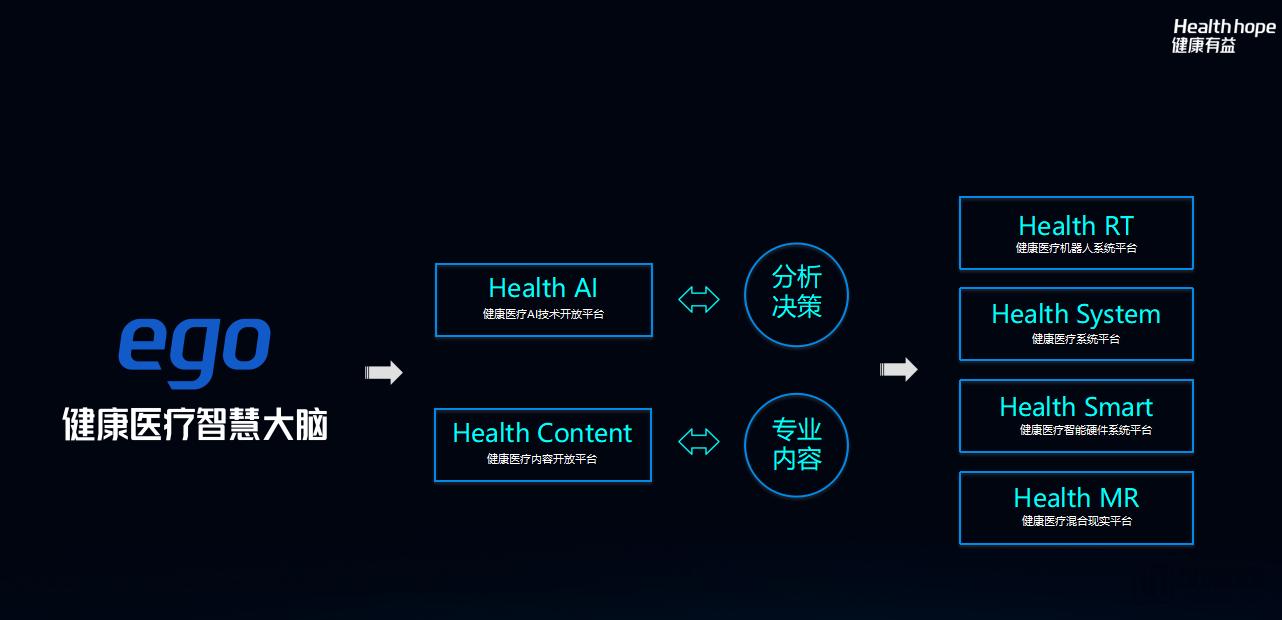
What Exactly Will the Open Platform Offer? Health Hope’s Open Platform Comprises Two Major Aspects:
Health AI,Health AI is our open AI technology platform dedicated to the healthcare vertical. Currently, Health AI encompasses AI applications across both health and medical domains, integrating over one hundred specialized research achievements and related capabilities in healthcare. It provides one-stop comprehensive solutions and services to meet the healthcare needs of various industries.
Health Content,Health Content is a professional open content platform developed based on the needs of health management and the medical sector. Health management involves not only identifying users’ issues but also providing solutions after addressing their health management needs. As an open content platform, Health Content covers nutrition, exercise, mental health, and diseases, delivering content in various formats including video, audio, and illustrated articles.
Built upon the foundational support of two major platforms, we have extended our offerings to include four application-level platforms and systems. Our current capabilities cover nearly all open-platform enterprises and smartphone manufacturers; notably, the AI-powered health management modules embedded in the latest Vivo, OPPO, and Huawei smartphones are provided by us.
Health Hope’s Four Major Application-Level Platforms and Systems Include:
Health RT,Namely, the Health and Medical Robot System Platform, which primarily empowers service robots by equipping them with health management capabilities, as well as partial medical assistance and rehabilitation functions;
Health SystemIt is primarily an auxiliary system for healthcare, targeting system providers by embedding the Health System module into their products;
Health SmartRepresenting a variety of smart hardware, Health Hope will independently or in collaboration with partners develop new and innovative smart products, such as "listening and speaking" water cups, to enable consumers to quickly understand and experience artificial intelligence;
Health MR, leveraging AR, VR, and MR technologies, Health MR provides technology-driven products and services such as medical assisted teaching, surgical assistance, visualization of medical data, and visualization of pharmacological responses, significantly enhancing the quality and efficacy of healthcare diagnosis and treatment.
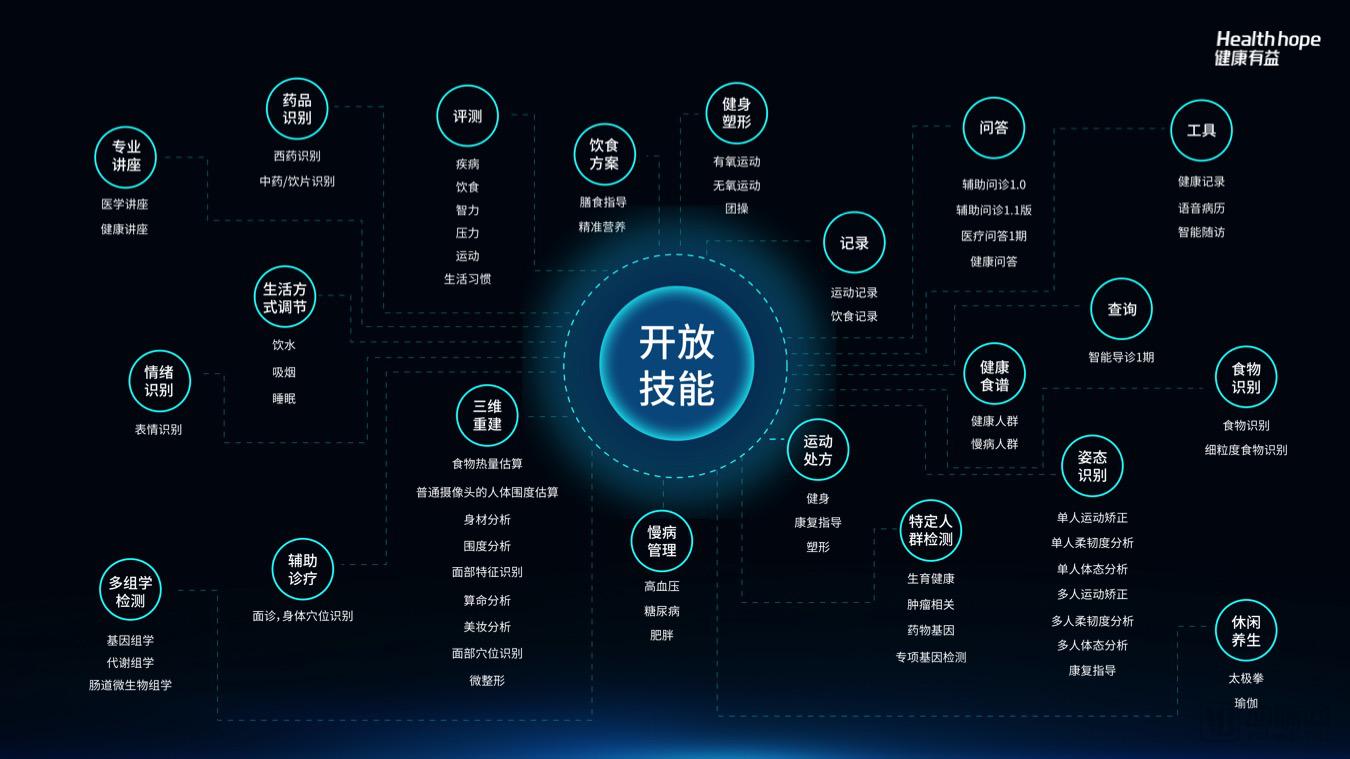
In the Open Skills and Content Module, Health Hope’s platform content has already been applied across various industries. The following is a representative selection, encompassing AI skills and professional content such as medication identification, evaluation, dietary planning, fitness and body shaping, health tracking, Q&A, tools, queries, food recognition, healthy recipes, posture recognition, exercise prescriptions, screening for specific populations, chronic disease management, multi-omics testing, assisted diagnosis and treatment, 3D reconstruction, and professional lectures. Numerous specialized sub-applications are also included within these broad categories.
Empowering Multiple Scenarios to Fully Implement AI + Health Management
Health Hope’s key empowerment focus areas include the following scenarios: open platforms, smart terminals, robotics, smart homes, smart elderly care, smart communities, traditional chain stores, healthcare institutions, and insurance organizations.
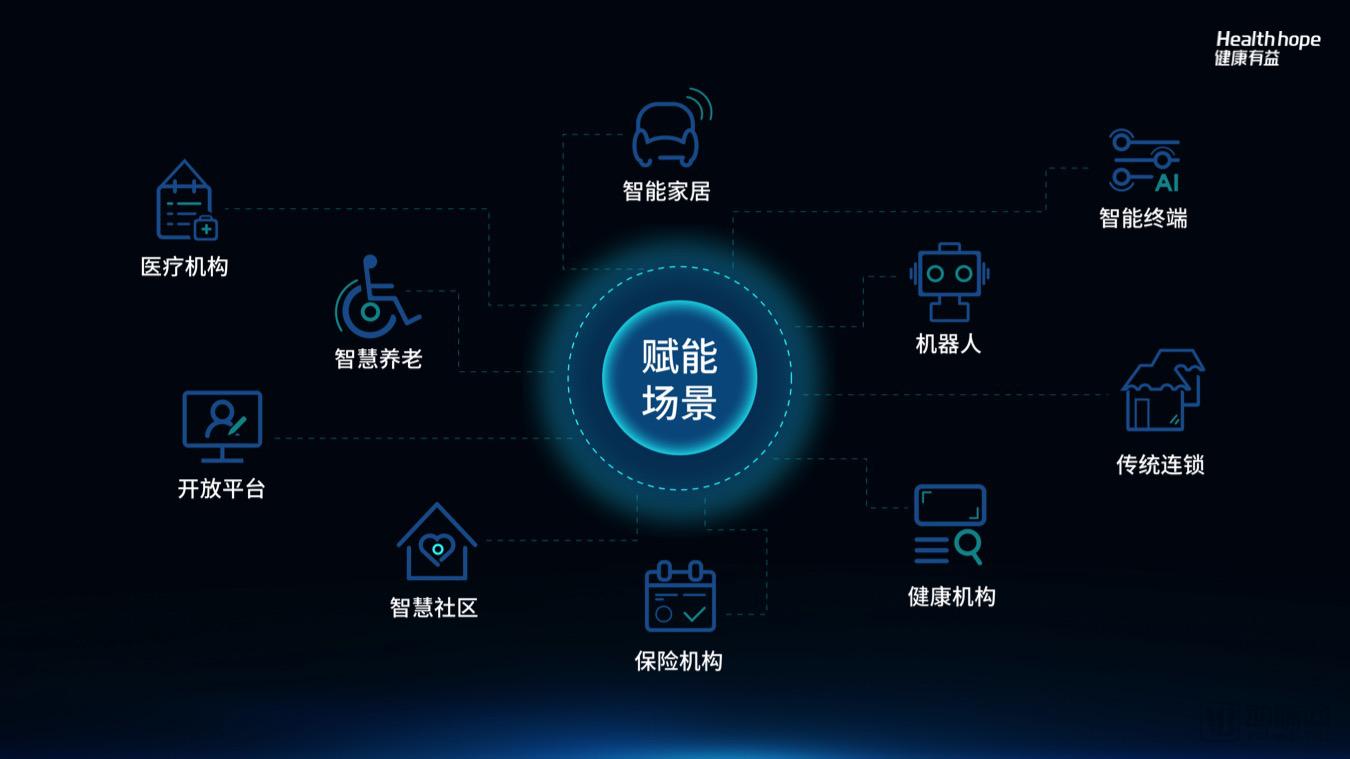
AI Companies in Various Vertical Sectors Are Basically B2B. Currently, most smart devices are not truly AI-powered; at the very least, they lack companionship features and the ability to engage in conversations with users, failing to address their deeper needs. From this perspective, there remains significant potential to empower the industry.
Health Hope effectively integrates diverse skill-based services to cater to enterprises and developers with varying needs and terminal platforms, covering robots, smart terminals, hardware and software providers, system providers, and health/medical institutions. Required skills can be found via the official website (www.jiankangyouyi.com). Through its open technology platform, Health Hope will make all its AI capabilities accessible, enabling widespread application of artificial intelligence, empowering B-side clients, enhancing efficiency, and accelerating the advent of the AI era.